Month: April 2022

Hayneville Shale: Record Natural Gas Production

Guest “Fracking A, Bubba,” by David Middleton

The Haynesville Shale (technically Haynesville/Bossier) in northeast Texas and northwest Louisiana is the third largest natural gas play, in terms of production rate and proved reserves, in these United States. Haynesville gas production set a record high in 2021 and will likely break that record this month.

APRIL 13, 2022
Haynesville natural gas production reached a record high in late 2021

Dry natural gas production from the Haynesville shale play in northeastern Texas and northwestern Louisiana reached new highs in the second half of 2021, and production has remained relatively strong in early 2022. Haynesville natural gas production accounted for about 13% of all U.S. dry natural gas production in February 2022.

Haynesville is the third-largest shale gas-producing play in the United States. The Marcellus play in the Appalachian Basin (mainly in Pennsylvania, West Virginia, and Ohio) is the highest-producing shale gas play in the United States. During 2021, an average of 31.7 billion cubic feet per day (Bcf/d) of natural gas was produced from the Marcellus play. In the Permian play in Texas and New Mexico, production averaged 12.4 Bcf/d in 2021, making it the second-highest producing play. Altogether, the Marcellus, the Permian, and the Haynesville account for 52% of U.S. dry natural gas production.

Natural gas production in the Haynesville declined steadily from mid-2012 until 2016 due to its relatively higher cost to produce natural gas compared with other producing areas. At depths of 10,500 feet to 13,500 feet, wells in the Haynesville are deeper than in other plays, and drilling costs tend to be higher. By comparison, wells in the Marcellus in the Appalachian Basin are shallower—between 4,000 feet and 8,500 feet. Years of relatively low natural gas prices meant it was less economical to drill deeper wells. However, because natural gas prices have increased since mid-2020, producers have an incentive to increase the number of rigs in operation and use those rigs to drill deeper wells.

Producers tend to increase or decrease the number of drilling rigs in operation as natural gas prices fluctuate. The number of natural gas-directed rigs in the Haynesville has been rising steadily since the second half of 2020 and reached an average of 46 rigs in 2021, according to data from Baker Hughes. Since the beginning of 2022, producers have added 17 rigs in the Haynesville region. For the week ending April 8, there were 64 natural gas-directed rigs operating in the Haynesville, representing 45% of natural gas-directed rigs currently operating in the United States.

Pipeline takeaway capacity out of the Haynesville has also increased in recent years. The additional capacity allows producers to reach industrial demand centers and liquefied natural gas terminals on the U.S. Gulf Coast. The Enterprise Products Partners’ Gillis Lateral pipeline and the associated expansion of the Acadian Haynesville Extension entered into service in December 2021. Prior to that project, Enbridge Midcoast Energy’s CJ Express pipeline entered into service in April 2021. These projects added 1.3 Bcf/d of takeaway capacity in the Haynesville area, which is currently estimated to total 15.9 Bcf/d according to PointLogic.

Principal contributor: Katy Fleury

Tags: production/supply, natural gas, shale, Haynesville

EIA

Haynesville Features

Favorable Regulatory Environment

Haynesville pipeline takeaway expansion has not faced the same sort of political opposition as has plagued the Marcellus Shale. Texas has a very favorable regulatory environment, so favorable that only 33% of Texas Democrats support a ban on frac’ing.

No Flaring Required

Being a nearly pure gas play, flaring is almost nonexistent in the Haynesville play.
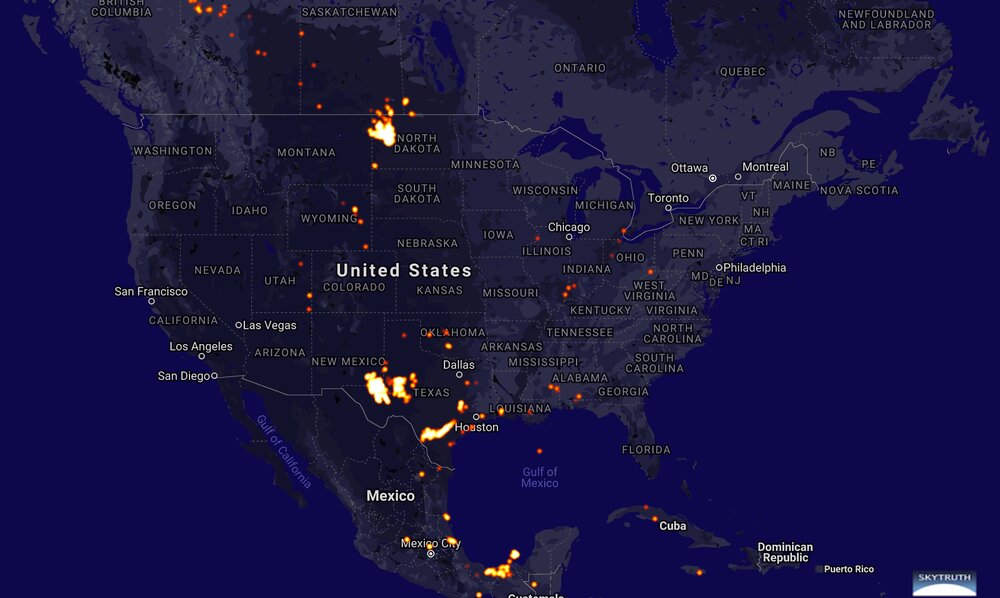
2020 gas flaring map (Phys.org). The most extensive flaring occurs in oil plays where low gas prices and/or lack of pipeline takeaway capacity make it more economical to flare associated natural gas, rather than try to market it. The bright yellow blobs are: Permian Basin in West Texas, Eagle Ford play in Southeast Texas and the Bakken play in North Dakota.

Proved Reserves

At year-end 2020, the estimated proved gas reserves in the Haynesville stood at 44.8 trillion cubic feet (Tcf). If the Haynesville was a nation in Europe, it would rank second only to Norway (50.5 Tcf).

Note: the 1.9 Tcf decline in proved reserves from 2019-2020 is not due to there being less natural gas than previously thought. It’s due to low natural gas prices in 2020 (shamdemic effect). US oil and natural gas proved reserves declined in 2020. The decline was entirely due to price-driven revisions. Extensions and discoveries actually exceeded production by 2.7 Tcf.

U.S. Crude Oil and Natural Gas Proved Reserves, Year-end 2020 (EIA)

Most increases in proved reserves are the result of field extensions, rather than new discoveries.

Discoveries include new fields, new reservoirs in previously discovered fields, and additional reserves that resulted from drilling and exploration in previously discovered reservoirs (extensions). Extensions typically make up the largest share of total discoveries. Beginning with the 2016 report, operators reported to us on Form EIA-23L their discoveries as a single, combined category—extensions and discoveries. Totals for that category are presented in one column on the data tables in this report.

U.S. Crude Oil and Natural Gas Proved Reserves, Year-end 2020 (EIA)

Extensions typically represent the conversion of probable reserves, possible reserves and contingent resources into proved reserves, based on well performance, infield drilling and other asset management efforts. Proved reserves only represent the volume of oil and/or gas with a >90% probability of being recovered.

Undiscovered Resource Potential

The most recent USGS assessment puts the undiscovered resource potential of the Haynesville shale (highlighted) at nearly 300 Tcf (~10 years of total US natural gas consumption).

Assessment of Undiscovered Oil and Gas Resources in the
Haynesville Formation, U.S. Gulf Coast, 2016. (USGS)

The Haynesville shale plays are the hachured and dotted areas on the map below…
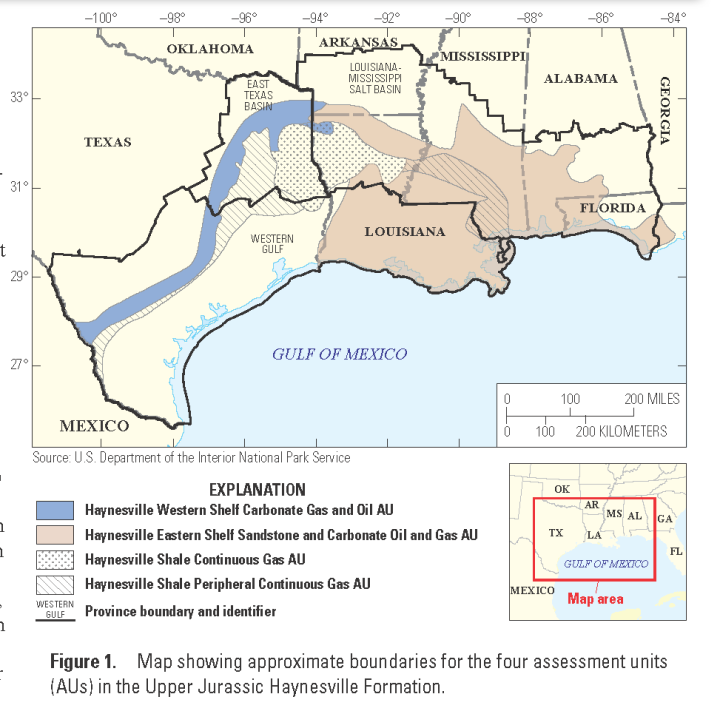
Assessment of Undiscovered Oil and Gas Resources in the
Haynesville Formation, U.S. Gulf Coast, 2016. (USGS)

The Many Benefits of Catastrophic Sea Level Rise

The Haynesville Shale, which has also been referred to as the “lower Bossier,” is the basinal equivalent
of the Cotton Valley Lime and pinnacle reef trend in East Texas that was deposited during the transgressive phase of SS2. These pinnacle reefs formed in response to the rising sea level as they were back-stepping onto Haynesville ramp carbonates; the carbonates were able to keep up with rising sea level until they were “drowned” by the fine-grained-sediment-dominated transgression. The top of the Haynesville Shale marks the maximum flooding surface as evidenced by maximum marine onlap on the shelf (e.g., Goldhammer, 1998). The Bossier shales (so-called “upper Bossier”) are characteristic of the highstand systems tract of SS2 reflecting a turn-around in sea level and increase in siliciclastic influence.

Hammes et al., 2009

A marine transgression (catastrophic sea level rise), approximately 150 million years ago, led to the deposition of the Haynesville Shale, as well as the trapping mechanism for the Haynesville Shale and the stratigraphically equivalent Cotton Valley Lime pinnacle reef plays.

The hydrocarbons in the Haynesville Shale and Cotton Valley Lime were sourced from the Smackover and Haynesville Formations.

Mudstones within the Upper Jurassic Smackover and Haynesville Formations are sources of oil and gas
in both conventional (Montgomery, 1993a, 1993b; Mancini and others, 2006) and continuous reservoirs
(Hammes and others, 2011; Cicero and Steinhoff, 2013) throughout much of the assessment area.

Assessment of Undiscovered Oil and Gas Resources in the Haynesville Formation, U.S. Gulf Coast, 2016. (USGS)

The Smackover Formation is probably the most prolific source rock in the Gulf Coast/Gulf of Mexico region. Depending on depositional environment, the Smackover is also a prolific oil & gas producer and the seal for the Norphlet Formation where it is productive. The Haynesville would be between the Bossier and Smackover Formations on the diagram below.
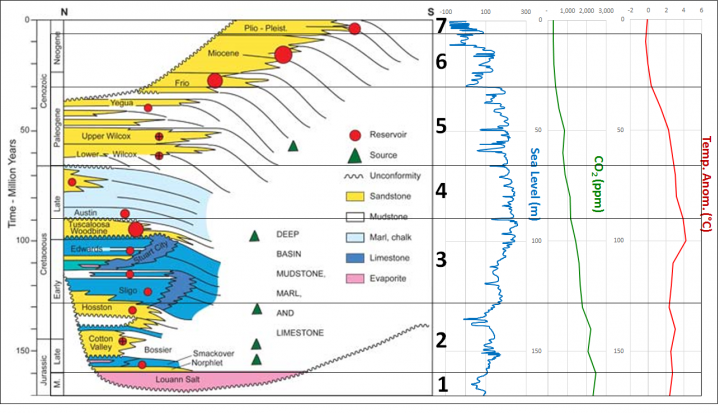
Left to right: Generalized cross section along northern GOM region (Galloway et al., 2009), depositional phases are numbered. Relative sea level (Miller et al., 2005), atmospheric CO2 (Berner & Kothavala, 2001) and temperature anomalies (Royer et al., 2004). Click for image. The Haynesville is between the Bossier and the Smackover to the east of the Cotton Valley.

The next four displays are from Cicero & Steinhoff, 2013, depicting the sequence stratigraphy and depositional environments of the Haynesville and Bossier shales.

Map of wells, seismic surveys and cross-sections used in study.
Cross-section B-B’. West is toward the left. The curve on the right represents sea level, rising sea level is toward the left.

This is interpreted seismic profile A-A’, running from north (left) to south (right), just west of the Texas-Louisiana state line.

Figure 3b. Integrated seismic and sequence stratigraphy of dip-oriented seismic line A-A’. Supersequence boundaries indicated in red (SSB), higher-order (3rd+) sequence boundaries with dashed black lines (SB), maximum flooding surfaces (mfs) in green, and transgressive surfaces (TS) pertaining to supersequences in blue. Onlap and downlap indicated with the use of arrows. Dashed vertical lines indicate approximate basement faulting. Modified from Cicero et al. (2010).

The following is a depositional environment (paleogeography) map of the Bossier Shale (~150 million years ago):

“You see the story yet?”

You see the story yet? It’s all pretty much here.
In a language you can’t yet understand, but it’s here.
A tale of upheaval and battles won and lost.
Gothic tales of sweeping change, peaceful times, and then great trauma again.
And it all connects to our little friend.
That’s what we are, we geologists.
Storytellers.
Interpreters, actually.
That’s what you gentlemen are going to become.
And how does this relate to the moon? From 240,000 miles away you have to give the most complete possible description of what you’re seeing.
Not just which rocks you plan to bring back but their context.
That and knowing which ones to pick up in the first place is what might separate you guys from those little robots.
You know, the ones some jaded souls think should have your job.
You see, you have to become our eyes and ears out there.
And for you to do that, you first have to learn the language of this little rock here.


–David Clennon as Dr. Leon (Lee) Silver, From the Earth to the Moon, Episode 10, Galileo Was Right, 1998

HBO’s 1998 From the Earth to the Moon miniseries was a sort of follow-on to the great movie Apollo 13… It’s a must see for space program fanatics. I particularly like this episode because my childhood interest in the space program led me toward the sciences and ultimately geology. Future Apollo 17 astronaut Harrison “Jack” Schmitt recruited his former field geology professor to train the Apollo 15 lunar module team and their backup crew how to become field geologists.  It reminds me of why I love geology so much.  I’ve also had the great honor of meeting Dr. Schmitt at the 2011 American Association of Petroleum Geologists convention in Houston.  Shaking hands with someone who not only walked on the Moon, but also got to throw a rock hammer farther than any geologist ever has before or since, was pretty fracking cool… And so is geology!

References

Berner, R.A. and Z. Kothavala, 2001. GEOCARB III: A Revised Model of Atmospheric CO2 over Phanerozoic Time, American Journal of Science, v.301, pp.182-204, February 2001.

Cicero, Andrea D. and Ingo Steinhoff, 2013, Sequence stratigraphy and depositional environments of the Haynesville and Bossier Shales, East Texas and North Louisiana, in U. Hammes and J. Gale, eds., Geology of the Haynesville Gas Shale in East Texas and West Louisiana, U.S.A.: AAPG Memoir 105, p. 25–46.

Galloway, William. (2008). “Chapter 15 Depositional Evolution of the Gulf of Mexico Sedimentary Basin”. Volume 5: Ed. Andrew D. Miall, The Sedimentary Basins of the United States and Canada., ISBN: 978-0-444-50425-8, Elsevier B.V., pp. 505-549.

Galloway, William E., et al. “Gulf of Mexico.” GEO ExPro, 2009, https://ift.tt/YwgNqPR.

Hammes, Ursula and Ray Eastwood, Harry Rowe, Robert Reed. (2009). Addressing Conventional Parameters in Unconventional Shale-Gas Systems: Depositional Environment, Petrography, Geochemistry, and Petrophysics of the Haynesville Shale. 10.5724/gcs.09.29.0181.

Miller, Kenneth & Kominz, Michelle & V Browning, James & Wright, James & Mountain, Gregory & E Katz, Miriam & J Sugarman, Peter & Cramer, Benjamin & Christie-Blick, Nicholas & Pekar, S. (2005). “The Phanerozoic Record of Global Sea-Level Change”. Science (New York, N.Y.). 310. 1293-8. 10.1126/science.1116412.

Ramirez, Thaimar, James Klein, Ron Bonnie, James Howard. (2011). Comparative Study of Formation Evaluation Methods for Unconventional Shale Gas Reservoirs: Application to the Haynesville Shale (Texas). Society of Petroleum Engineers – SPE Americas Unconventional Gas Conference 2011, UGC 2011. 10.2118/144062-MS.

via Watts Up With That?

https://ift.tt/p9GQdJe

April 15, 2022 at 04:52PM

Roaring And Screaming

Guest Post by Willis Eschenbach

Among blue-water sailors like myself, the area of the ocean from 40° South to 50° South is called the “Roaring Forties” because of the strength of the winds that blow there so often.

And the next ten degrees south of that? They are called the “Screaming 50’s”. There, the winds can blow unimpeded around the globe.

Figure 1. The cold pole.

Compared to the South Pole, the North Polar weather is far less complex. The North Pole is underlain by the Arctic Ocean, ice-covered most of the time. The South Pole, on the other hand, has a continent in the middle. And it’s mostly a high elevation permanently frozen chunk of rock. It sheds icy winds and glacial chunks into the surrounding ocean. Due to the constant winds and storms, the “mixed layer” around Antarctica is deeper than anywhere in the world.

Figure 2. Mixed layer depth.

And why is this of note? Well, I was asked to take a look at a recent peer-reviewed study called “Simulated Twentieth-Century Ocean Warming in the Amundsen Sea, West Antarctica“.

And where is the Amundsen Sea when it’s at home? It’s off of the coast of Antarctica, down below 60°S.

Figure 3. Oceanic warming trends, showing the Amundsen Sea.

A short digression. Roald Amundsen was one of my heroes when I was a kid. He was a famed polar explorer. He led the first expedition to reach the South Pole. He was also the first man to sail the Northwest Passage from the Pacific to the Atlantic over the top of Asia and Europe. As a boy I remember seeing his ship “Gjøa”, the one that he used for the Northwest Passage, up on blocks in Golden Gate Park in San Francisco. Even as a young inexperienced sailor, I was amazed at how small it is, only 70 feet (21 meters) long. Amundsen definitely had albondigas of pure brass … but I digress

The press release about the study is”Researchers demonstrate new link between greenhouse gases and sea-level rise“. Inter alia, it says (emphasis mine):

A new study provides the first evidence that rising greenhouse gases have a long-term warming effect on the Amundsen Sea in West Antarctica. Scientists from British Antarctic Survey (BAS) say that while others have proposed this link, no one has been able to demonstrate it.

Well … in a word, no. The study doesn’t provide any evidence at all, not one scrap. What it provides instead are the results of computer models using another computer model as input.

Sigh. Look, if computer models were “evidence”, I’d be a very rich man based on my 1980’s evolutionary-based computer model of the stock market … but computer model results are not evidence. They are merely the understandings and more importantly the misunderstandings of the programmers made solid.

The study itself says:

Our simulations are performed using the Massachusetts Institute of Technology general circulation model including components for the ocean, sea ice, and ice shelf thermodynamics. Here we build on the Amundsen Sea configuration, which has been updated and re-tuned to provide best agreement with observations when forced with the latest ERA5 atmospheric reanalysis.

The “ERA5 atmospheric reanalysis” is a computer climate model which is forced with whatever data is available. The model then fills in the blanks where there is no actual data … like say the Amundsen Sea, where people only venture very rarely, and even then only in modern times.

Let me take a heel-turn to the question of the performance of the climate models. This study is about sea levels and ocean temperatures. Folks keep telling me that the climate models have done well for decades. So I looked at the first IPCC Assessment Report. Here are their sea-level projections:

Figure 4. Sea level projections from the IPCC AR1 Report.

And here is a close-up of that figure, with the actual sea level rise overlaid on the graph.

Figure 5. Actual sea level rise, compared to the IPCC projection.

Oops …

Moving to more modern models, here are model estimates of the post-1981 sea surface temperature (SST) rise from a number of CMIP6 models. These are the computer outputs of the sea surface temperature identified in the CMIP6 models as the variable “TOS”, the temperature of the ocean surface. Below I’ve compared them to the Reynolds OI SST observational dataset.

Figure 6. Modeled and observational sea surface temperature (SST) rise, 1981 – 2021

As you can see, the models are … well … let me call them “much less than accurate” and leave it at that.

To return to the Amundsen Sea, here are some of the complexities that affect the weather there.

Figure 7. Amundsen Sea.

As you can see, the sea temperature and the weather are affected by the Circumpolar Current, circumpolar winds, the Antarctic Slope Current, the Amundsen Sea Polyna (open water) in the middle of the Amundsen Bay sea ice, the varying ocean depths, and the ever-changing sea ice. It’s a most intractable and complex area to model.

To return to RealWorld from ModelWorld, here’s a look at just where and how the ocean has warmed and cooled since 1981.

Figure 8. Decadal trends in sea surface temperature (SST), Reynolds OI observational dataset.

As you can see, there’s been a bit of cooling in the SST in Amundsen Sea in this 41-year period.

Moving on, how well do their model results agree with the ERA5 reanalysis? Here’s their graphic:

Figure 9. Original Caption: “Timeseries of conditions in the Pacific Pacemaker Ensemble (PACE) simulations (blue) and the ERA5 simulation (red). Thinner blue lines show the 20 PACE ensemble members, while the thicker blue line is the ensemble mean. (a) Zonal wind (m/s) averaged over the shelf break. (b) Temperature (°C) averaged over the Amundsen Sea continental shelf between 200 and 700 m. (c) Basal melt flux (Gt/y) for ice shelves between Dotson and Cosgrove inclusive.

YIKES! Their own models don’t even begin to approximate the ERA5 reanalysis, which is the information that is used as an input to the models. And like the Reynolds OI SST, the ERA5 reanalysis shows slightly cooling temperatures in the Amundsen Sea, where the models claim warming … bad models, no cookies!

Oh, yeah, almost forgot. I did an analysis looking for what I call “weasel words” in their study. These are words that show their conclusions are weak. They include “could”, “may”, “might”, “possibly”, “plausibly”, “potentially”, “suggests”, and “assumed”. Those words are used a total of 34 times in their study … no bueno.

In closing, the study itself says (emphasis mine);

Rapid ice loss is occurring in the Amundsen Sea sector of the West Antarctic Ice Sheet. This ice loss is assumed to be a long-term response to oceanographic forcing, but ocean conditions in the Amundsen Sea are unknown prior to 1994. Here we present a modeling study of Amundsen Sea conditions from 1920 to 2013, using an ensemble of ice-ocean simulations forced by climate model experiments.

“Simulations forced by climate model experiments” for a location where ocean conditions are “unknown prior to 1994” … it’s models on top of models all the way down, what could possibly go wrong? It’s clearly destined to be a lead article in the “Journal of Irreproducible Results“.

I weep for the death of science.

Finally, let me mention that the Amundsen Sea is only 0.085% of the total ocean area … it appears that what we have here are scientists with models looking for funding. Not saying that’s a bad thing, just that it can easily lead to … well … this kind of study.


Here, I’ve just spent three days (well, part-days, I’m retired) mowing a couple of acres of steep hillside in our opening in the forest … and today, rain, marvelous rain. Life is good, what’s not to like?

My best wishes to you all,

w.

AS USUAL: When you comment, please quote the exact words you are responding to, so we can all be clear on your subject.

4.9
12
votes

Article Rating

via Watts Up With That?

https://ift.tt/DZweSJh

April 15, 2022 at 12:56PM

PIK Researcher Stefan Rahmstorf Plays It Loose With His Sources, Mischaracterizes Wind Energy Drawbacks

Stefan Rahmstorf has problems with his sources

By Die kalte Sonne
Translated by NoTricksZone

Stefan Rahmstorf, is just as we know him. In a new Spiegel column, the climate researcher from the Potsdam Institute for Climate Impact Research attempts a sweeping blow – but apparently without really checking the numerous sources he links to.

Recycling turbine blades

Just two examples from his recent article:

The switchover of the fossil propaganda machine from fake news about climate research to fake news about solutions is a worldwide trend that can also be observed in Germany. Wind turbines allegedly endanger the population of red kites (no), cause dangerous infrasound (wrong) and are not recyclable (indeed they are), electric cars are allegedly more harmful to the climate than combustion engines (no) or cause the power grid to collapse (no).”

If Rahmstorf had followed the link on recycling, for example, he could (should?) have read that the blades of wind turbines, and that’s what we’re talking about, are crushed using various methods, then (please note!) burned in the kilns of cement factories. This is not recycling, but a material thermal utilization, moreover one that releases a lot of CO2. Cement factories do not have the filters that waste incinerators have. These would become gummed up and unusable when the blade fragments are incinerated. The Bremen-based company Neocomp offers to shred the rotor blades. There, the subsequent incineration is described in flowery terms.

With the experience of three decades of recycling and waste management, Neocomp sees itself as part of the recyclable economy. As a professional reprocessor, the company offers a 100 percent recycling guarantee. Thus, your GRP waste is turned into a high-quality substitute for the cement industry in our processing plant, providing both energy and raw materials (SiO2). This recycling process represents an economically and ecologically viable alternative to fossil fuels.”

The Tagesspiegel gives a good overview of where the problems lie in this area. Possibly, Rahmstorf had neither the time nor the inclination to inform himself about the topic. Fundamental problems such as the different regulations from state to state regarding the dismantling of wind turbines are better left out altogether; for Rahmstorf, a link to a lobby site is sufficient.

For example, there is no nationwide uniform clarification of what happens to concrete turbine foundations. In principle, concrete can of course be recycled, but in some states the foundations may remain in the ground, in others only a certain height has to be milled off. The linked lobby article also explicitly refers to burning the crushed blades, again nicely packaged. However, with a remarkable logic:

The plastics separated from the wood and other filler material consist of two components: Fibers and resins. When the blades are burned in conventional incinerators, the glass fibers remain. Therefore, they are shredded by special recycling companies so that they can be used as substitute fuel by the cement industry, whose kilns reach up to 2000°C. The ash produced during incineration consists mainly of silicon and can be added to cement right away as a raw sand substitute.”

According to this, everything that is burned is part of the recyclable economy, because all that is left is ash, which can even be recycled. It would be the canonization of coal.

Hazards to birds

On the subject of bird strikes, again only one aspect is considered. In this case, a study that is only available as an interim result so far. The study was carried out by an engineering office that earns its money with expertise for the wind power and electricity industry. There is criticism of this study, but nothing of the sort can be found in Rahmstorf’s selection.

We recently reported on a study by researchers from the United Kingdom, who pointed out the risk of birds being killed by wind turbines and power lines. According to the logic of the study linked to by Rahmstorf, there has to be two huge poison areas in Europe, one via the West (France, Spain) to North Africa and one via the Balkans and the Middle East to the North of Africa. These are the classical migration areas and it is exactly there the researchers determined the largest danger, equally by wind power plants and power lines and not by poisoned rats and mice as the cause.

Rahmstorf also achieves a real feat. He actually blames Fritz Vahrenholt (who in fact had earlier built up the wind power division for power utility RWE) for the company’s CO2 pollution by casually mentioning it in one sentence. One reads nothing in the Rahmstorf text from the RWE wind power subsidiary Innogy. Rahmstorf rather tries to produce the impression that Vahrenholt personally shoveled the coal into the coal power plants. Currently, RWE is now involved in wind power in a great many countries, including outside Europe. Just recently, RWE announced that it would expand its wind power capacity to 50 GW by 2030, investing 50 billion euros to do so. Without the Vahrenholt’s early efforts beginning in 2008, this would hardly have been possible.

But differentiating was not the aim of the column anyway. Rahmstorf is more interested in attacking as many protagonists as possible. They’re all paid by the fossil mafia is what should stick in the mind of the reader, nothing more.

Donate – choose an amount

via NoTricksZone

https://ift.tt/bTAv3WR

April 15, 2022 at 12:52PM

Deep State Twitter

“BREAKING: As @elonmusk offers to buy the rest of @Twitter a legal source tells @FoxBusiness @SECGov and @TheJusticeDept have launched what he described as a “joint investigation” into a myriad of Musk regulatory issues primarily involving @Tesla” 5:07 AM · … Continue reading

via Real Climate Science

https://ift.tt/21y9WEi

April 15, 2022 at 11:43AM