If Biden climate policies targeting financial institutions’ lending practices to farmers, ranchers, and oil and natural gas producers remain in place, rising prices for food and energy will be the inevitable result.
Every country attempting to run on wind and solar suffers rocketing power prices; no exception. In Britain, power prices jumped 50%, overnight, when a legislated price cap was lifted; and power prices continue to rise at an astonishing rate.
Subsidised wind power is at the heart of Britain’s power pricing and supply calamity.
Pete North explains why.
The Green capture of the Tory party is complete
UKIP-More Net Zero Insanity
Pete North
29 March 2022
The Times reports that the power market is facing its biggest overhaul in decades after National Grid said that wholesale electricity should be traded at local prices that vary from town to town. The company responsible for keeping the lights on said that the radical change was needed because Britain’s national electricity market was “not designed for net zero and if left unchanged will impose excessive costs to consumers”.
At present, power plant owners can sell their electricity on the national market, even if there are not enough cables to take that power to where there is consumer demand. That is forcing National Grid’s control room to pay wind and solar farms in remote locations to switch off at times when the network cannot cope and to pay expensive gas plants closer to consumers to switch on and replace them. These “constraint” costs, which are passed on to consumers via their energy bills, have risen sevenfold since 2010 as more renewables have been built, hitting £1.2 billion in 2021.
The National Grid ESO, or Electricity System Operator, warned industry last week that keeping supply and demand in balance nationwide was “becoming more challenging” and was resulting in “dramatic and rising costs for consumers”, even with plans to build lots of expensive new transmission cables. Constraint costs could hit £2.3 billion a year by 2026 without market reform.
Wind energy has already created massive problems for the grid and expanding capacity only exacerbates those balancing problems. This latest proposal is an attempt to disguise the problems wind energy creates.
There is an inherent conflict between the idea of diffuse, local generation and the national grid as currently constituted. It was set up to take a few, large generators from a limited number of locations, and distribute power nationally. Now it is being asked to take small packages of power distributed over a vast range of sites, and still perform the function of ensuring equal distribution of power throughout the nation.
This is something for which the grid was not designed to do, and to make it fit for purpose would require tens of billions of pounds. This money is simply not available and, if it was factored in, it would be seen as part of the cost of renewables provision, pricing it out of the market.
Therefore, National Grid is trying to find solutions on the cheap, without admitting that the system is fundamentally incapable of handling a diffuse, renewables-based generation system. As always, our entire generation system is being built on the basis of dishonesty, pretending the system can do something which it cannot. Local pricing is just dumping because they’ve built energy generation where it cannot be usefully utilised.
The Times has it that a new system would encourage energy-intensive industries to be located near wind farms around the coast or in Scotland to take advantage of cheap wholesale prices for electricity that might otherwise be wasted. That assumes they can afford the inherent transport costs that go with being in a remote location. But it’s quite telling that the economy is being geared around the needs of the Net Zero ideology rather than building a grid to meet the needs of the economy. Moreover, this is in direct conflict with the government’s free ports programme.
In reality, this will create an energy price postcode lottery, which energy retailers will spin to incentivise residents in more remote locations to consent to more useless windmills the rest of us will have to pay for.
For the last seven days now wind energy has barely mustered 1GW, supplying a mere 2% of demand, with nuclear and gas doing all the heavy lifting. The cold reality is that wind cannot be relied upon, nor can it be economically integrated into the grid, and Net Zero ambitions simply will not come to pass. Quadrupling wind capacity means quadrupling the amount of dispatchable back up (gas) to cover these long wind outages, or battery storage for something in the range of 24 – 30 days of average usage.
Since battery storage is in its infancy, and prices of materials skyrocketing, as technically unfeasible it is, it is not going to come in any cheaper. Far from it. We’re already set to spend billions on batteries, but this capacity will cover only hours, not days.
Green blob energy wonks are insisting that wind energy is the cheapest form of generation, but only by ignoring the fact that the cost of gas generation is increased by a third due to carbon taxes, ignoring the subsidy bill for renewables, and by lying about the cost of grid “upgrades”. They won’t say how much storage is actually needed or what it is likely to cost, and most of the industry figures are deliberately massaged to mislead politicians. When green wonks talk about “grid upgrades” they mean expensive mitigation of problems they created.
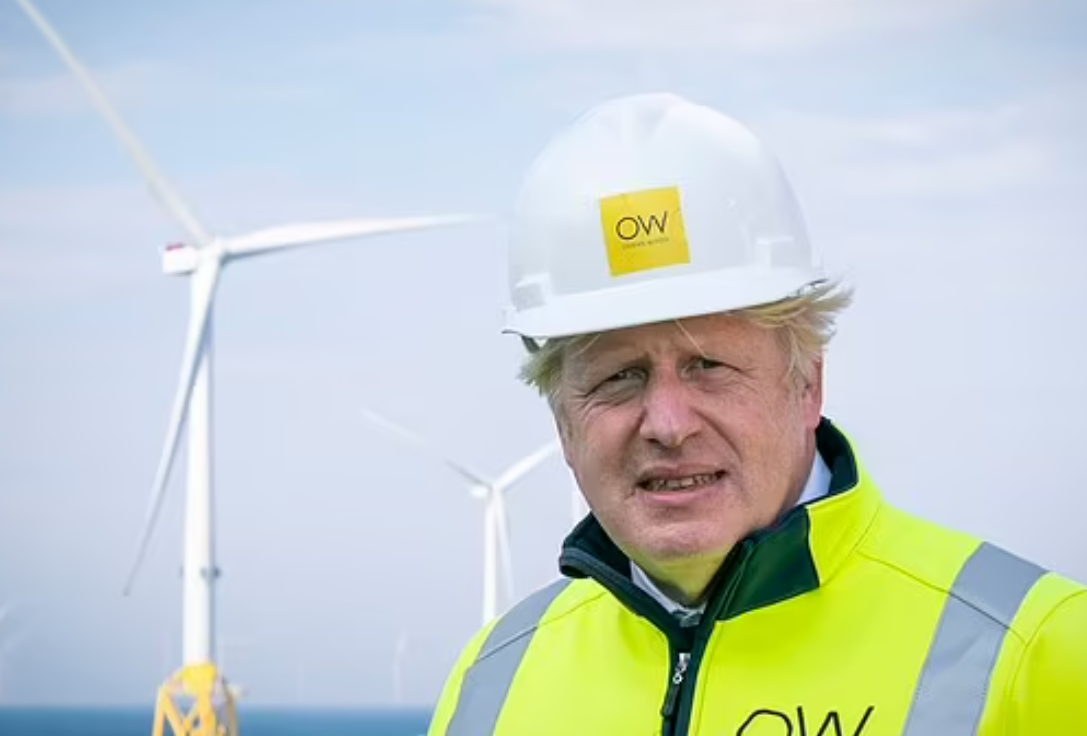
Depressingly, there is no hope of sanity prevailing in the near future. Boris Johnson is pressing ahead with plans to quadruple wind energy, while we learn today from Conservative Environment Network that half of the Conservative Party’s backbenchers support the green agenda. This is very far from the Brexit government elected in 2019. The mask has slipped and the establishment is reverting to business as usual. That can only mean disaster. UKIP-More Net Zero Insanity
“Climate change is no hoax, because the climate always changes. Modest global warming might be beneficial for the globe. But not all climate change is beneficial. Cooling would be disastrous.”
“The American Geophysical Union … displays a diminishing interest in science, that is, in the disinterested pursuit of knowledge. Instead, it revels in an escalating interest in politics, including much talk about nebulous ideas like ‘environmental justice’ and mobilizing scientists to be ‘change agents.’
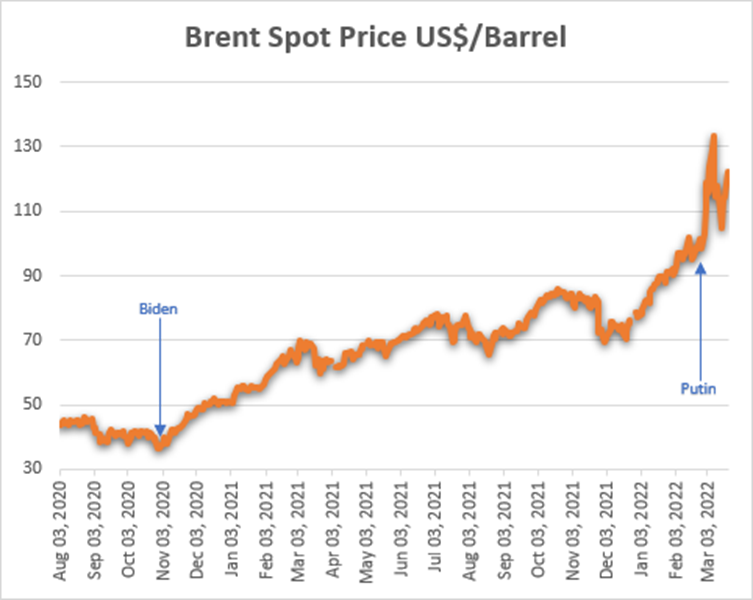
Since November 2020, the price of gasoline has steadily increased like a rising tide. A good portion of the pain at the pump that Americans, and people around the world, have felt, and increasingly feel, is due to enormous monetary expansion coupled with disastrous energy policies. The energy-price emergency began long before Russian President Vladimir Putin invaded Ukraine.
It almost makes one yearn for the halcyon days when nasty tweets were offset by low energy costs, when He-Who-Must-Not-Be-Named adopted policies for American energy progress and directly challenged the myth of energy scarcity, most of which he argued was self-imposed. In 2018 these policies resulted in the United States’ becoming energy independent, exporting for the first time in over 70 years more oil than was imported. Oh, how the times they are a-changin’! American energy independence came and went like the warm scent of summer.
Looking further back, one can barely remember the happy days when the energy secretary of the Obama-Biden administration said that transition to a Green New Deal would only become possible if gasoline neared European prices, $7 at the time he spoke. What was only a politician’s pipe dream now approaches reality. As I write, gasoline in California has just reached $7.00/gal, and the national average is at a 40-year high. Just a little bit more and we can reach the promised Green utopia, at least in terms of prices though not in all the promised unicorns and lollypops.
Green Extremism
In its pursuit of green extremism, ostensibly to save the planet from global warming, the Biden-Harris administration appears to be a retread of the Obama-Biden government, only on steroids. Ratcheting up energy prices, as has happened continuously over the past year, is not a problem to be fixed, but a feature of the administration’s Green policies.
It is intentional. In pre-revolutionary France, Marie Antoinette was infamously said to suggest that if the little people couldn’t afford bread they should simply switch to eating cake. In January 2022 the US Transportation Secretary suggested, with all the self-awareness of European royalty, that if the little people don’t like high energy and gasoline costs they should just switch to buying an electric vehicle. It is the virtuous thing to do. No matter that the average price of an electric vehicle is close to $60,000. Put it on the expense account.
The American public, like the world at large, is now compressed between eco-extremism and the dogs of war, the Scylla and Charybdis of Biden and Putin, both happy to continue to increase energy prices, but for different reasons. Between the demented and dementia it is not inconceivable that energy prices may double again, and again, and thus the cost of all else, since energy is the master resource.
Coming back down to Earth, I recently studied a research paper authored by scientists at the University of Nigeria entitled, “Prediction of Solar Cycles: Implication for the Trend of Global Surface Temperature,” (Communication in Physical Sciences: 2020) by E. A. Ibanga, et al. (The article’s keywords are solar cycle, solar-geomagnetic activity, grand episode, greenhouse emission, general circulation model.)
This article brought to mind my work several years ago on a committee of the American Geophysical Union (AGU). We were tasked to decide on an annual award to an African scientist for completing significant work which had promise of making outstanding contributions to research in Earth and space sciences. It was a pleasure and privilege to acknowledge, support, and advance research from this continent.
The AGU is a not-for-profit, professional, scientific organization which once existed exclusively to advance the Earth and space sciences. Today, however, these formerly ironclad AGU commitments appear increasingly shaky and subservient to fashionable dogmas. This organization displays a diminishing interest in science, that is, in the disinterested pursuit of knowledge. Instead, it revels in an escalating interest in politics, including much talk about nebulous ideas like “environmental justice” and mobilizing scientists to be “change agents.”
In such a milieu, I’m pretty sure that this paper on solar cycles and climate would immediately disqualify the African authors from competing for the above-mentioned award. Why? I think it is because the AGU, like too many Western scientific societies, has been completely overrun by zealots who wish to politicize all pursuit of scientific activity.
A few years ago, a B.A. in English was on the board of directors, tasked with establishing priorities and directives for the organization. How could a B.A. in English be in charge of establishing scientific priorities for thousands of real scientists? It is because science no longer has pre-eminence. His appointment was primarily because of his devotion to “correct” dogma, as demonstrated by his skills to dramatize ostensible crises such as global warming and demonize scientists who wish to consider alternatives to politically correct ideas.
Real scientists are under pressure. Do they ignore this co-opting of their scientific organizations, challenge it, try vainly to keep their heads down, or get on the bandwagon? When activism is a ticket to professional success, it may be too much to hope that we can turn back to the disinterested quest for knowledge that I believe scientists should prefer.
The Nigerian paper argues that the modest warming over the past hundred years or so is largely due to natural phenomena. That is not likely to be welcome at the AGU. It is inconceivable that the work could pass the litmus test of political correctness, because it directly addresses, and contradicts, the idea that the planet is undergoing unprecedented, catastrophic warming and all because of human activity. Rather, it considers that great ball of fire—the Sun—and ascribes to it a large role in the planetary climate.
If the Sun suddenly went out, we’d not notice anything. Well, not for about 8.3 minutes, for that is how long it takes light to cross the distance to Earth. But 8.3 minutes later we’d find ourselves in complete darkness. There is a delay in the cause and effect. Then, within a week, cause and effect would bite deeper: Earth’s average global surface temperature would probably drop below 0°F. A year later it would be closer to –100°F.
Climate cycles have been connected to solar activity in the past. Humans have experience of ice ages, the most recent “Little Ice Age” extending from the mid-16th to mid-19th centuries. It was terrible. During this time England’s River Thames regularly froze over, and harsh winters caused increased death and suffering. The cold weather that plagued the world coincided with an inactive Sun in a period called the Maunder Minimum.
The Sun goes through subtler cycles than just a binary on and off. It follows a solar cycle of brighter and dimmer phases, also called the sunspot cycle. It follows also longer century and millennial scale cycles. The “Prediction of Solar Cycles” paper by Ibanga et al. argues that the Earth’s climate response to solar cycles is delayed. Thus, according to the authors, the present decline in the solar cycle, expected to continue for several decades, implies a coming, delayed, response of global cooling.
In their paper, Ibanga et al. argue that due to the decline in solar geomagnetic activity over the past three or so decades the Earth could be poised to endure a cooling period, with the coldest temperatures arriving by 2039±11 years. These results comport with forecasts by other climate researchers and scientists who have warned we are at the end of a long cyclical warming trend and entering a decadal cooling trend.
Conclusion
Yogi Berra apparently said, “It’s tough to make predictions, especially about the future.” It is notoriously difficult to forecast climate. That hasn’t stopped the Green blob from crying impending doom due to minor global warming. This doom is screeched from the rooftops, in kindergarten classes, movies, you name it. The ubiquity of the one-track messaging makes this scientific paper on solar cycles rather refreshing, if unsettling. It is unsettling because while no one knows the future, what will we do if we are now heading into an ice age?
Climate change is no hoax, because the climate always changes. Modest global warming might be beneficial for the globe. But not all climate change is beneficial. Cooling would be disastrous. This is especially so because, in a staggering display of wishful thinking, politicians continue to drain vast sums of national treasure to fund so-called alternative energy schemes. These not only cost a fortune, and so reduce our ability to become more resilient to untoward natural events, but also attack the lifeblood of modern civilizations, which is our energy infrastructure. Let’s pray that the global cooling forecast by many scientists does not come to pass.


 Iowa Climate Science Education