Month: April 2022

Wind & Solar Subsidies: High Time To End The Never-Ending Story of Wasted $Billions

Death and taxes are certainties, so too the wind and solar industry’s critical dependence on massive and endless subsidies.

Those pushing wind and solar keep telling us that the power they produce is ‘free’ and getting cheaper all the time.

Every so often, rent seekers and their political enablers are faced with the retort that, if wind and solar really are so cheap and, therefore, truly competitive with coal, gas and nuclear, then it’s surely time to do away with the $billions in subsidies directed at the unreliables?

Shortly after the stuttering and spluttering stops, wind and solar scammers then start waffling about subsidies to fossil fuels. For sport, try pressing them on the precise nature those subsidies and their total value, and they’ll flounder some more.

The producers of oil, coal and gas all pay royalties to governments based on the volumes extracted, as well as taxes on the profits they earn; likewise, those in the supply chain – freight companies, refiners and the like, also pay tax on profits; and the users of fossil fuels are generally hit with a variety of sales and/or consumption taxes for power and petrol.

Stripped away, the State Revenue enjoys a whole lot more upside from the constant and steady production and use of fossil fuels than it does from the chaotic delivery of wind and solar.

On the other side of the coin, there are the direct taxpayer-funded subsidies to wind and solar, in addition to the subsidies incorporated in the cost of electricity (paid for by all electricity users) in the form of renewable energy certificates or production tax credits or equivalent.

Alan Moran takes a look at the colossal cost of the subsidies directed to wind and solar in Australia, and tackles the myth that the production and use of fossil fuels can only occur with government subsidies.

Renewables subsidies: $22 billion by 2030
Spectator Australia
Alan Moran
5 April 2022

Energy Minister Angus Taylor noted that the Commonwealth Budget added $1.3 billion to assist uneconomic renewable energy, bringing the total support to $22 billion by 2030. Added to direct budget support are the regulatory subsidies that force consumers to pay for otherwise unviable wind and solar energy as well as the networks that have to be built to bring their energy to market.

Green energy enthusiasts and vested interests fraudulently claim wind and solar are cheaper than coal-generated electricity. Some also concoct data purporting to prove that fossil fuels benefit from enormous subsidies.

One such compilation is published by the Australia Institute which claims $11.6 billion of subsidies go to Australia’s fossil industry. Some $8 billion of this is the Fuel Tax Credits Scheme, the diesel fuel rebate for off-road vehicle use.

By no stretch of the imagination can this be deemed a subsidy to the oil industry. The rebate is simply a recognition that excise on fuels in Australia, and the world over, were introduced as a means of paying for roads by charging the users rather than the general public; farm, mining, and other such vehicles do not use public roads and taxing their fuel would contravene the cardinal taxation rule of avoiding taxing inputs into production.

As the OECD points out, ‘Most OECD countries have excise-tax exemptions for fossil fuels used in the production process in coal mining, oil extraction, refineries, etc.’ This is true of the USJapanIsrael, and others.

Other than the diesel fuel rebate, the Australia Institute includes within its compilation of spurious subsidies, the Grid Reliability Fund to support energy security, the Carbon Capture Use and Storage Development Fund, payments to refineries to increase liquid fuel stocks and up to $2 billion for the Fuel Security Services Payment. It even includes $79 million from the Victorian Government used to support a carbon capture and storage project, and a brown-coal-to-hydrogen project.

The fact is that fossil fuel production and use in Australia face heavy taxes, their production is impeded by punitive regulatory regimes, and massive subsidies on renewable energy wreck their market competitiveness. Government documents nowadays avoid identifying and publicising the full extent of renewables subsidies. But, in an estimate that was not contested, I put them at $7 billion a year for 2019.

Though Australia continues to tax commercial energy sources and subsidise the unreliable renewables, the Ukraine War has ignited a new policy agenda to that which favours renewables supposedly to prevent climate change.

Some politicians, like Germany’s governing Rainbow Coalition, see the dependence on Russian energy that the war has revealed as a justification to intensify subsidies to rid the world of carbon emissions. They have learned nothing from escalating power prices resulting from current policies aiding renewables. Ukraine’s President Zelenskyy shares their views but not to the extent of stipulating that the equipment and energy used to help in his nation’s defence be carbon-free!

The more sober-minded recognise the war’s message as dictating a reversion to cheaper more reliable energy sources. The UK is inching its way to re-embracing domestic oil and gas resources. France has reversed course on its former plans to shift from nuclear to renewables. The EU itself has now pronounced gas as a ‘sustainable’ fuel and has sanctioned temporary increases in coal use. Even the Biden Administration is walking back on its previous hostility to oil and gas drilling.

Hostility to conventional and nuclear fuels on the part of governments, activists, and the investment community has led to a lack of investment and closures of mines and power stations. The upshot is energy shortages. These have been compounded by actions against Russia, one nation that has not shared the dream of a carbonless future. The resulting shortage of usable energy has resulted in soaring prices.

Analysts at Thunder Said Energy estimate that this year world energy costs will compromise 13 per cent of global GDP. That compares to the traditional level of under 4 per cent and surpasses the level it reached in 1980 at the height of the OPEC oil crisis. A new cycle of investment in reliable fuel sources is necessary. But among the barriers to this is the Environmental Social and Governance (ESG) ideology that targets coal, oil, and gas and has infected the commercial finance industry and its regulators. The EU’s bizarre redefinition of gas as ‘sustainable’ is designed to circumvent this.

Australia has been perhaps the most aggressive nation in subsidising renewables and disadvantaging their more efficient alternatives. We need to reverse course.

Some are calling for an ending of the unique embargo Australia has on nuclear power. While the embargo should be removed, realistically, given the morass of regulatory and political impediments, it would be a decade before a plant was in operation. And in any event, for Australia, coal, and gas are almost certainly cheaper sources of reliable power.

As the world’s best-endowed energy resource nation, Australia could reclaim its position as having the world’s cheapest gas and electricity.

But this means navigating the political and bureaucratic impediments, supplemented by the powerful vested interests of those who have invested in renewables on the basis of never-ending subsidies. Those interests have the support of a heavily indoctrinated coterie of activists and have proved willing to marshal considerable financial resources to support political outcomes that, notwithstanding costs to the community in general, continue to provide them benefits.
Spectator Australia

via STOP THESE THINGS

https://ift.tt/tVxi170

April 11, 2022 at 02:31AM

Epicentre of Mass Coral Bleaching – Still So Beautiful (Part 1)

It is all over the news, and the news across the world, the Great Barrier Reef is bleaching – again.   Children can’t sleep at night: it is not only the war in the Ukraine, but also our apparent disregard for nature that is keeping them awake.

Except!

I went to the very epicentre of the claimed latest severe mass coral bleaching on 10th April 2022, and I found a coral wonderland.

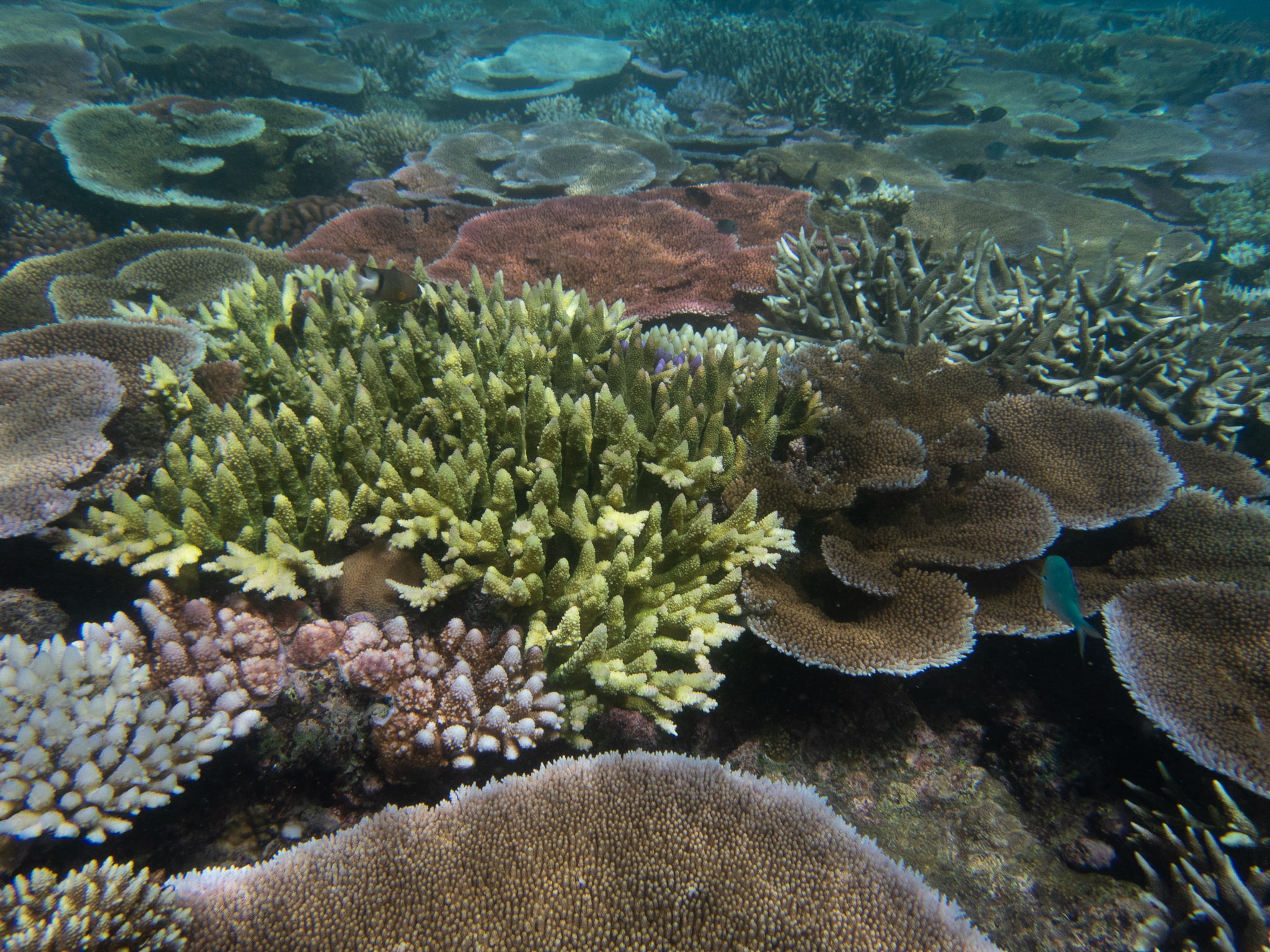
There was some bleaching, especially around the perimeter of John Brewer Reef – on the sandy sea floor where the Australian Institute of Marine Science (AIMS) surveys and concludes coral cover is never more than 30% – but most of John Brewer Reef is still covered in more than 80% colourful corals.    This high percentage is denied by AIMS because they never survey the reef crest.

At John Brewer Reef just yesterday, I swam over the top – over the reef crest – and I also swam along the walls that drop down to the sandy sea floor.

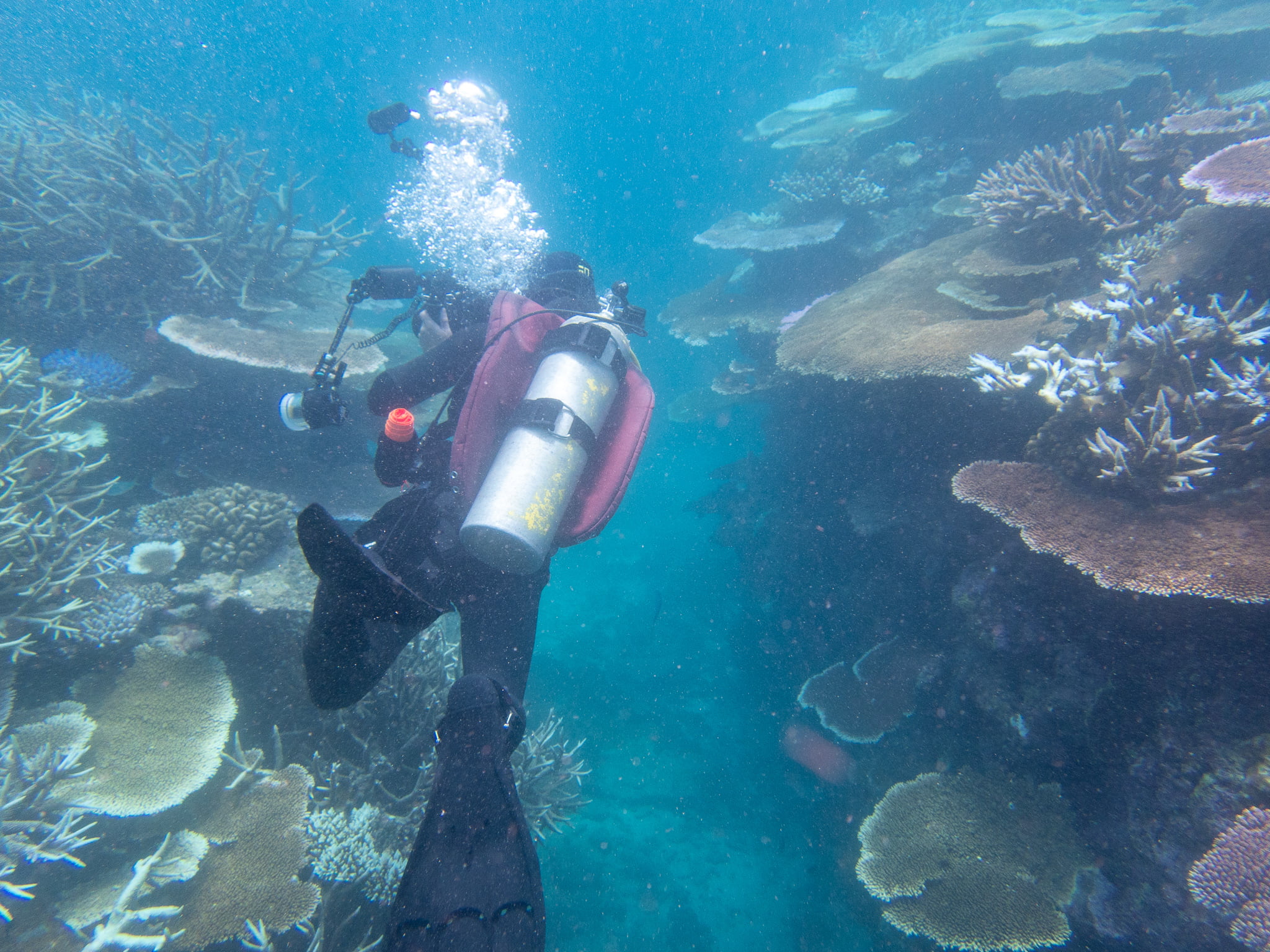
My buddy swam in front of me between the walls of coral at John Brewer Reef on 10th April 2022. Photographed by Jennifer Marohasy.

I will show you some of the snap shots that I took with my Olympus TG6, no lights.  I also swam around the sandy perimeter, and I will show you these photographs in my next blog post – that will be Part 2 of this series.   In Part 3 and 4 I plan to show you video of transects that will be swam later in the week when I return to John Brewer Reef with one of Australia’s best underwater cinematographers.

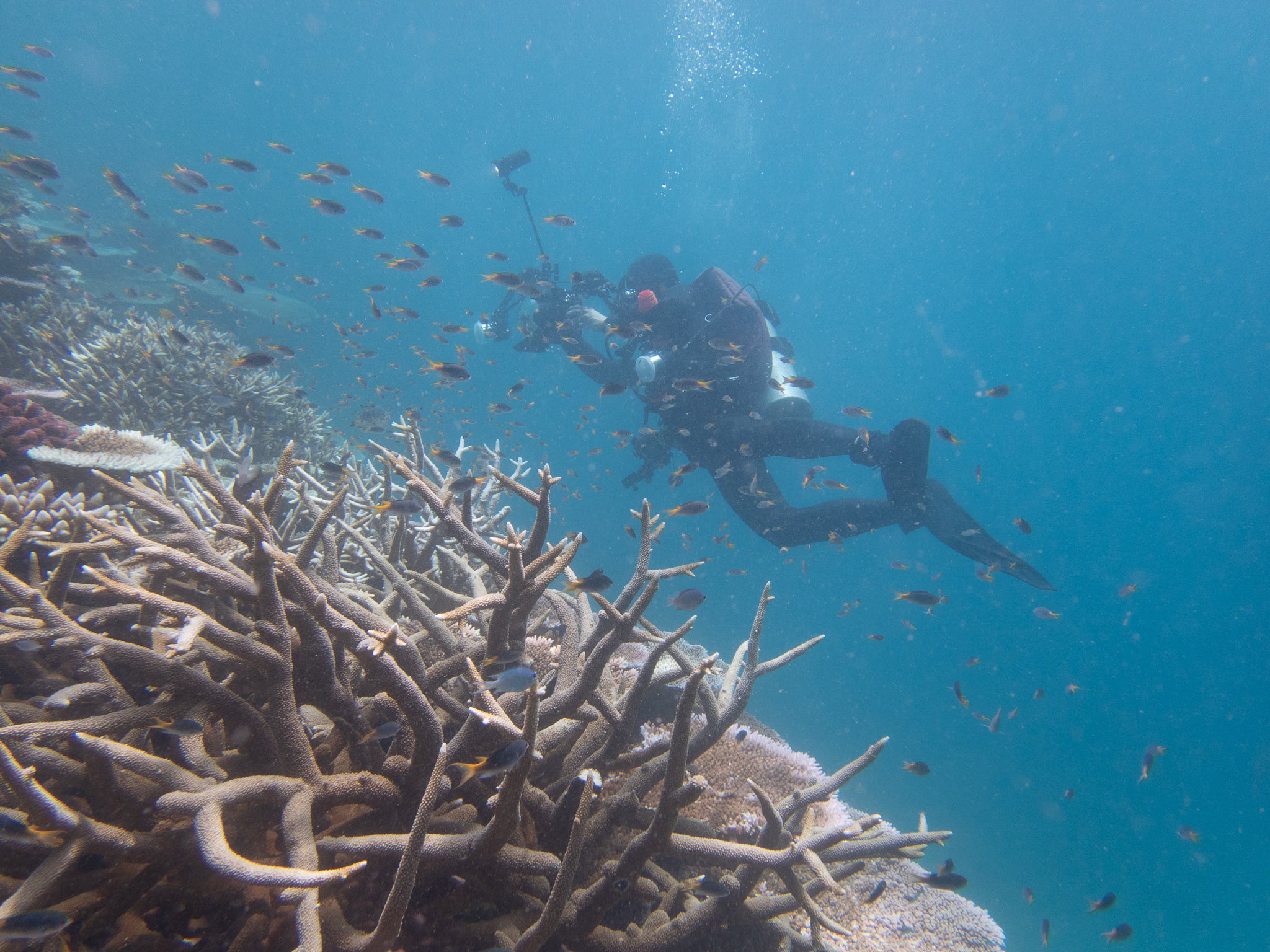
My buddy swimming along the front wall of John Brewer Reef on 10th April 2022. Photographed by Jennifer Marohasy.

John Brewer Reef is 70 kms (38 nautical miles) east of Townsville, part of the central region of the Great Barrier Reef.   Rising from the sandy sea floor are two huge flat-topped blocks of consolidated limestone that represent layer upon layer of dead coral (that you can’t see) with a topping (that you can see) of colourful plates and so many tiny fish.  Running between these two reefs is a deep canyon with walls of more coral and more fish.

Most of the corals were very healthy with lots of chocolate brown zooxanthellae, but you can see a bleached coral in the distance that is very white.  Photographed by Jennifer Marohasy at John Brewer Reef on 10th April 2022.

While most of the corals at the reef crest were healthy, there were some corals that were bleaching white and others were bleaching colourful.

The pink to purple coloration in some of the corals at the reef crest is not from zooxanthellae, which are the symbiotic algae, but rather from increased pigment accumulation from the coral itself as the zooxanthellae are expelled.  Zooxanthellae are expelled when the coral becomes stressed from water that is a bit too hot or a bit too cold.  These colourful corals are often described as fluorescing.

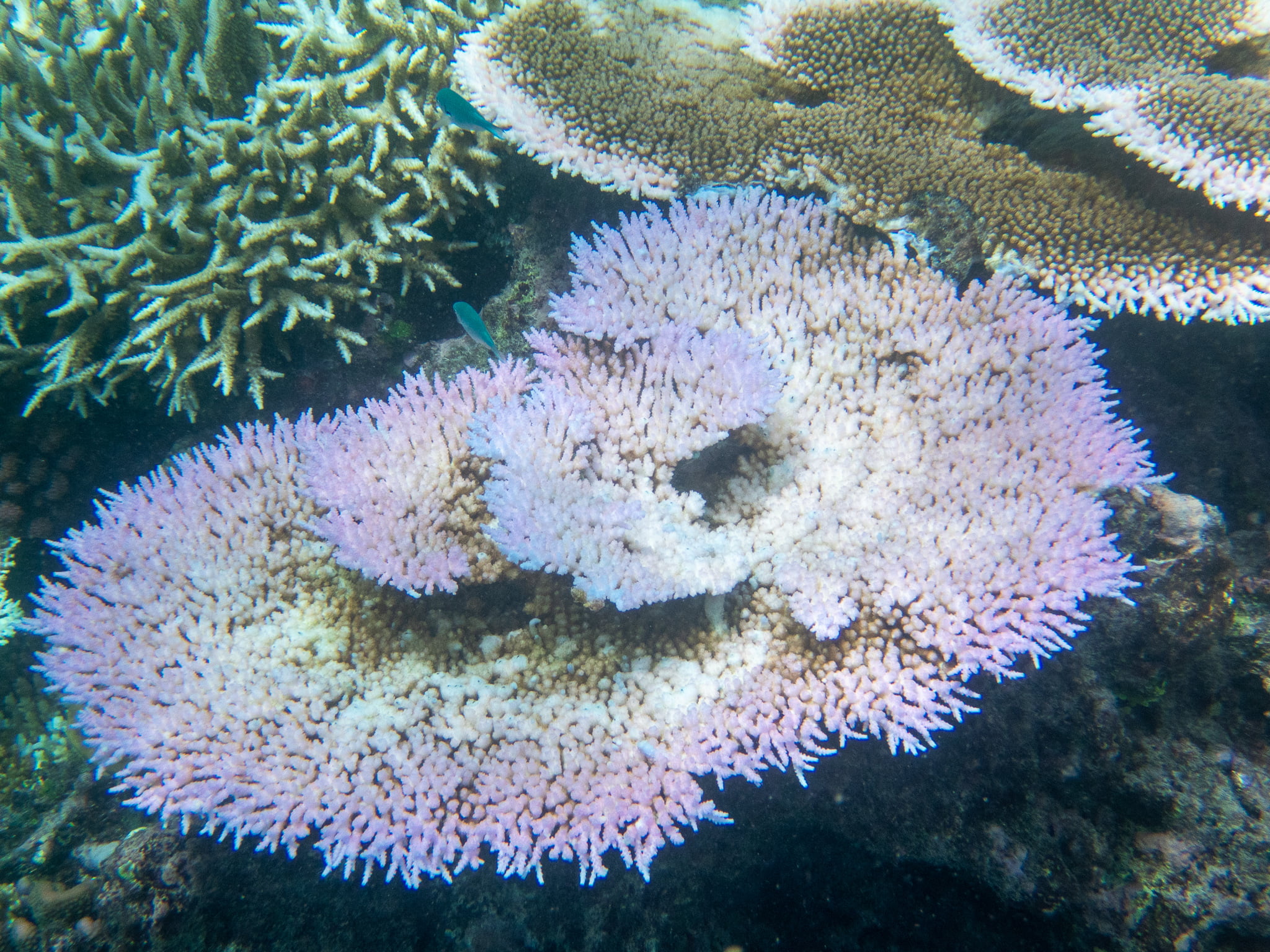
This plate coral has bleached and is fluorescing. Photographed by Jennifer Marohasy at John Brewer Reef on 10th April 2022.
This is a closeup of a plate coral with its pink tips are still alive.  The coral colony will likely recover.  According to the technical literature, some corals florescence/go this pink colour within 2 to 3 weeks of exposure to unusually warm temperatures.  More usually this coral would be a deep chocolate brown. Photographed by Jennifer Marohasy at John Brewer Reef on 10th April 2022.
This is a close-up of a brown plate coral, that has not bleached and is not fluorescing. Photographed by Jennifer Marohasy at John Brewer Reef on 10th April 2022.
This is a closeup showing the coral polyps of a healthy brown coral colony (top) and also a bleached colony (foreground). If you look closely you will see tentacles that enable the coral to feed even when all the zooxanthellae have been expelled. Photographed by Jennifer Marohasy at John Brewer Reef on 10th April 2022.

***

The photograph at the very top of this blog post was taken just yesterday (10th April 2022) while I (Jennifer Marohasy) swam over the top of John Brewer Reef.  The coral in the foreground is not bleached, but rather naturally beige-coloured and with naturally white tips.  The very pink coral in the centre of the photograph is bleaching colourful. The pink to purple coloration in some of the corals at the reef crest is not from zooxanthellae, which are symbiotic algae, but rather from increased pigment accumulation from the host tissue/the coral itself as the zooxanthellae are expelled.

via Jennifer Marohasy

https://ift.tt/eRSxKjg

April 11, 2022 at 01:14AM

The Philippines Sees the (Nuclear) Light

By Joseph Somsel

The Philippines is a tropical country of 113 million, with beautiful beaches, dense rainforests, 11,000 islands, and a smiling, industrious, educated population.  English is an official language, unifying its multitude of native languages and dialects, allowing its “overseas foreign workers” to return billions in remittances and savings annually to the country’s economy.  What it doesn’t have is ample indigenous energy resources; high electricity prices have hurt it competitively against its Southeast Asian neighbors.

What they also have is a roaring democracy – the Filipinos put the “party” back into “political parties.”  With elections coming up on May 9th, high electricity prices and unreliable service have become a campaign issue.  The outgoing Dutarte Administration has been criticized by major presidential candidates for not doing enough about these high prices (presidents serve but a single 6 year term.).  While President Dutarte is most famous internationally for his “extra-judicial treatment” of shabu (methamphetamine) dealers to restore civil order and for his delicate geopolitical balancing act between China and America, his administration has been active behind the scenes preparing for an eventual adaptation of nuclear power into the generation mix. This has included a detailed cost study by the Koreans of restoring and bringing into service the Bataan Nuclear Power Plant (BNPP), placed in caretaker mode in 1986 having never gone critical.   The International Atomic Energy Agency (IAEA) also was invited to lay out a governmental action plan that has already been partially enacted.  The government has further tentatively identified 10 sites for possible new reactors.  The capstone was when Dutarte formally issued Executive Order No. 164 in late February that flatly stated “The National Government commits to the introduction of nuclear power technology into the State’s energy mix for power generation.”

There are two major causes of the long-term rise in electricity prices.  One is the rapid depletion of the country’s major offshore natural gas field, currently fueling 20% of generation.  Further investment in expanded exploration and development in the South China Sea is hampered by the aggressive attitude of the Communist Chinese toward resources ownership in the area, be it fisheries, coral reefs, or oil/gas.  The second was the signing by the prior administration of Benigno “Noynoy” Acquino of the Paris Accords in April 2016.  He pledged that the Philippines would forego permitting of new coal plants not already in the regulatory pipeline.  In exchange, the Philippines was promised developmental financing of alternatives; the moneys have not been forthcoming to date.  Coal currently provides almost 60% of the kWh sold and is mostly fueled by Indonesian bituminous at a fuel cost of about $3 USD per million BTU.

The Dutarte’s Department of Energy’s future energy plan, released in January 2022, expected that path forward (sans nuclear) would be a huge shift to imported liquefied natural gas (LNG) and a massive expansion in photovoltaics (PV).  Spot market LNG deliveries in Tokyo Bay have been running at $8 USD a million BTUs (long-term contracts might be a bit lower) before the Ukrainian War caused massive disruptions in demand and prices.  Some expansion in hydropower was forecast but recent calls for more projects failed to get expected bidders even at attractive “feed-in-tariffs.”

How will the candidates seeking to succeed Dutarte hope to lower electricity prices when the present options under the Paris Accords are replacing $3 coal and $2 natural gas with $8+ LNG and Chinese-made PV?  An aggressive nuclear power program might not immediately reduce current bills but will at least provide some stability of price and supply while still reducing CO2 emissions. The Germans and the Filipinos might today be sharing the same regrets about their prior decisions to shutter nuclear.

Joseph Somsel is a nuclear engineer (with an MBA) and long-time public analyst of energy policy.  Further elaboration of the Philippines energy situation can be found in the April 2022 issue of Nuclear Engineering International Magazine.

via Watts Up With That?

https://ift.tt/0us2rBl

April 11, 2022 at 12:06AM

New UN IPCC report claims ‘Now or Never’ to flight climate – That’s an easy choice – NEVER! – More tipping points – Point-by-point rebuttal

From Climate Depot

By: Marc Morano – Climate Depot

IPCC climate change report headline via AFP: Scientists warn it’s now or never to limit global warming – The boss of the United Nations has erupted at world leaders as scientists warn the planet is in peril unless urgent action is taken.

UN Claim: “Humans have less than three years to halt the rise of planet-warming carbon emissions and less than a decade to slash them by nearly half, UN climate experts said. … It’s a last-gasp race to ensure the world has a “liveable future”.

“It’s now or never, if we want to limit global warming to 1.5C,” said Jim Skea, a professor at Imperial College London and co-chair of the working group behind the report.

Climate Depot Response: “‘Now or Never’ again?! Easy choice, NEVER!” See: Earth ‘serially doomed’: The official history of climate ‘Tipping Points’ began in 1864

AFP: UN Claim: UN Secretary-General Antonio Guterres said: “Some government and business leaders are saying one thing, but doing another. Simply put: They are lying. And the results will be catastrophic.”

Greenpeace co-founder Dr. Patrick Moore: “Absolutely nothing in this IPCC report is true. It is all fake and threatens the existence of civilization, especially the West because the East and the South don’t buy it. We must reject it or face the consequences. Celebrate CO2!!” 

UN Claim: “The IPCC made clear that individuals can also make a big difference…Cutting back on long-haul flights, switching to plant-based diets, climate-proofing buildings and other ways of cutting the consumption”

Climate Depot Response: “Ignore the UN’s promotion of energy lockdowns to ‘fight’ climate change. More restrictions on plentiful energy to turn peoples’ lives into micromanaged deprivation all in the service of some cultish climate goals. See:Intl Energy Agency report urges ENERGY LOCKDOWNS: ‘Banning use of private cars on Sundays…Reducing highway speed limits…more working from home…cutting business air travel’ & SUV ‘tax’UN Claim: Olha Boiko, an activist from the Climate Action Network, based in Ukraine, said: “The money, that we begged not to invest in dirty energy, is now flying over our heads in the form of bombs.”

Climate Depot Response: “Let’s rework Boiko’s claim into a true statement: Accurate revision: “The money, that we begged the U.S. & Europe not to invest in unreliable solar and wind that produces very little energy compared to fossil fuels,  is now flying over our heads in the form of bombs because Europe and the U.S. had to rely on Russia’s fossil fuels and thus fund Putin’s war machine.”

#

Full article from AFB below: 

AFP: The UN has blasted “lying” politicians, as it reports the world is rapidly running out of time to avoid the “catastrophic” impacts of climate change.

Humans have less than three years to halt the rise of planet-warming carbon emissions and less than a decade to slash them by nearly half, UN climate experts said.

It’s a last-gasp race to ensure the world has a “liveable future”.

And it’s a daunting task that is – only just – still possible.

But current policies are leading the planet towards “catastrophic” temperature rises, with politicians and business leaders coming under fire for “lying” about the action they are taking to deal with climate change, the UN’s Intergovernmental Panel on Climate Change (IPCC) said.

UN Secretary-General Antonio Guterres said: “Some government and business leaders are saying one thing, but doing another. Simply put: They are lying. And the results will be catastrophic.”

Future of the world in the balance

The 2800-page report is by far the most comprehensive assessment of how to halt global heating ever produced.

But it also documents “a litany of broken climate promises”, Mr Guterres said in a blistering rebuke of governments and industry.

The world’s nations, the report said, are taking our future right to the wire.

In recent months, the IPCC published the first two instalments in a trilogy of mammoth scientific assessments covering how greenhouse gas emissions are heating the planet and what that means for life on Earth.

This third report outlines what we can do about it.

“We are at a crossroads,” IPCC chief Hoesung Lee said.

“The decisions we make now can secure a liveable future. We have the tools and know-how required to limit warming.”

US Secretary of State Antony Blinken said these tools “are firmly within our grasp”.

“Nations of the world must be brave enough to use them,” he said.

The solutions touch on virtually all aspects of modern life, require significant investment and need “immediate action”, the IPCC said.

The very first item on the global to-do list is to stop greenhouse gas emissions from rising any further.

“It’s now or never, if we want to limit global warming to 1.5C,” said Jim Skea, a professor at Imperial College London and co-chair of the working group behind the report.

“Without immediate and deep emissions reductions across all sectors, it will be impossible.”

Slashing coal, oil, gas

To do that, the world must radically reduce the fossil fuels which are responsible for the lion’s share of emissions.

Nations should stop burning coal completely and cut oil and gas use by 60 and 70 per cent respectively to keep within the Paris goals, the IPCC said, noting that both solar and wind were now cheaper than fossil fuels in many places.

But just cutting emissions is no longer enough, the IPCC said.

Technologies to suck CO2 out of the atmosphere – not yet operating to scale – will need to be ramped up enormously.

While government policies, investments and regulations will propel emissions cuts, the IPCC made clear that individuals can also make a big difference.

Cutting back on long-haul flights, switching to plant-based diets, climate-proofing buildings and other ways of cutting the consumption that drives energy demand could reduce greenhouse gas emissions 40 to 70 per cent by 2050.

Those with the most, also pollute the most, the report said. Households whose income is in the top 10 per cent globally – two-thirds of whom are in developed countries – emit up to 45 per cent of carbon pollution.

“Individuals with high socio-economic status contribute disproportionately to emissions and have the highest potential for emissions reductions – as citizens, investors, consumers, role models and professionals,” the IPCC said.

With war in Ukraine spurring efforts to transition away from Russian oil and gas in the West, observers said the report should sharpen nations’ focus on climate commitments.

More Coverage

Eye-watering cost of fossil fuels revealed
Grim sign as ‘point of no return’ approaches
“It is heartbreaking for me, as a Ukrainian climate activist, to be living through a war which has fossil fuel money at its core,” Olha Boiko, an activist from the Climate Action Network, based in Ukraine, said.

“The money, that we begged not to invest in dirty energy, is now flying over our heads in the form of bombs.”

via Watts Up With That?

https://ift.tt/VayzbPe

April 10, 2022 at 08:15PM