Month: April 2022

Claim: Model Pinpoints Glaciers at Risk of Collapse Due to Climate Change

Meltwater seeping beneath Arctic glaciers puts thickest and fastest at risk of sudden collapse

Peer-Reviewed Publication

UNIVERSITY OF CALIFORNIA – BERKELEY

Meltwater on Alaskan glacier
IMAGE: A POOL OF MELTWATER IN A CREVASSE IN AN ALASKAN GLACIER. THOUGH ICE-COLD, THESE POOLS OF WATER CAN MELT THE UNDERLYING ICE AND PUNCH ALL THE WAY THROUGH THE GLACIER, DRAINING TO BEDROCK AND LUBRICATING A GLACIER’S DOWNHILL FLOW, FACILITATING RAPID COLLAPSE AND SUDDEN SEA LEVEL RISE. view more 
CREDIT: WHYJAY ZHENG, UC BERKELEY

As climate change warms the planet, glaciers are melting faster, and scientists fear that many will collapse by the end of the century, drastically raising sea level and inundating coastal cities and island nations.

A University of California, Berkeley, scientist has now created an improved model of glacial movement that could help pinpoint those glaciers in the Arctic and Antarctic most likely to rapidly slide downhill and fall into the ocean.

The new model, published last week in the journal The Cryosphere, incorporates the effects of meltwater that percolates to the base of a glacier and lubricates its downhill flow. The new physical model predicts that the most vulnerable glaciers are the thickest ones that have a history of faster flow, even when that rapid flow is periodic.

“The model suggests that thick and fast-flowing glaciers are more sensitive to lubrication than thin and slow glaciers,” said Whyjay Zheng, a postdoctoral fellow in the UC Berkeley Department of Statistics. “The data from Greenland glaciers support this new finding, indicating that those fast and thick glacier beasts might be more unstable than we thought under global warming.”

Zheng built the new model to incorporate a mechanism that has taken on more importance with global warming: meltwater penetrating to the bottom of glaciers and lubricating their downhill movement over bedrock. The Arctic and Antarctic have warmed more than the rest of the world — in March, the Antarctic saw record high temperatures of 70 degrees Fahrenheit above normal, while some parts of the Arctic were more than 60 degrees warmer than average. The warmer weather causes meltwater lakes to form on many glaciers, in particular those in Greenland. The lakes can punch through to the bottom of glaciers by a process called hydrofracture or drain to the bottom through crevasses nearby.

Glaciologists have already seen that the speedup and slowdown of glaciers are related to what’s happening at the front of the glaciers, where the ice merges into the ocean and meets warmer water. Observations show that for many such marine-terminating glaciers, when the fronts melt, or calve, into the ocean, the remaining glaciers tend to speed up. When the fronts advance into the ocean, the glaciers slow. As a result, the focus has been primarily on what’s happening at the glacial terminus.

But basal lubrication by meltwater appears to be creating a feedback loop that accelerates glaciers that have already sped up for other reasons, such as changes at the terminus.

“In Greenland, the glacier’s speed seems to be mostly controlled by the terminus position: If the terminus is retreating, then the glacier will speed up; if the terminus is advancing, the glacier will slow down,” Zheng said. “People think this is probably the primary reason why the Greenland glaciers can speed up or slow down. But now, we are starting to think there’s another and maybe quicker way to make glaciers slow down or speed up — basal lubrication.”

So Zheng set out to modify the common perturbation model of glacier flow to take meltwater lubrication into account, using standard equations of fluid flow.

He tested the predictions of the model against glaciers in Greenland, which is part of Denmark, and in Svalbard, a Norwegian archipelago. The prediction that thicker, faster-moving glaciers are more prone to thinning and discharge into the ocean fit with observations of glacier flow over a 20-year period, from 1998 to 2018.

“Basal lubrication creates a positive feedback loop,” Zheng said. “The faster glaciers are more likely to respond faster to basal lubrication, and the following speedup makes them more prone to future lubrications. For example, if a glacier is flowing 3 kilometers per year, and basal lubrication suddenly happens, it will react so fast that you can see the fluctuation of the speed, probably just a few days later, compared to another glacier that would be flowing at 100 meters per year.”

The implication is that thick, fast-moving glaciers around the Arctic and Antarctic should be monitored frequently, just as glaciers are now monitored for changes at the terminus, to anticipate discharges of large icebergs into the ocean that could impact sea level. Better ways of measuring basal lubrication are also needed, Zheng said.

“If the glacier has a potential to be disrupted in a short time and drain a lot of the ice into the ocean, perhaps within a year or two, that could be something we have to worry about,” he said.

Zheng, whose background is in geophysics, planetary science and remote sensing, first got interested in the basal lubrication of glaciers after studying an ice cap in the Siberian Arctic — the Vavilov Ice Cap on the Russian island of Severnaya Zemlya — that suddenly collapsed over a period a few years, at one point in 2015 speeding up to 9 kilometers per year. After analyzing the event, he determined that the stationary ice cap transitioned to an ice stream — a rapidly flowing glacier — in such a short amount of time because of basal lubrication and the advance of the terminus into the ocean, which reduced friction at the front of the glacier that was holding the glacier back. About 11% of the ice cap flowed into the ocean between 2013 and 2019.

“This is the first time we saw such a gigantic collapse of an ice cap,” he said. “Once it started to speed up, it maintained its speed for a long time. We think one of the most likely reasons is that it created a lot of crevasses on the surface, and those crevasses are pipelines for the surface meltwater to go down into the bottom of the glacier. Now, water comes down more easily and effectively reduces the friction, so the glacier can keep sliding fast, and even faster if the climate gets further warmed up.”

Zheng plans to test the new model on some of the marine-terminating glaciers in Antarctica. Meanwhile, through a new online platform called Jupyter Book, anyone can run Zheng’s data through the model equations and Python code to reproduce his results — a publishing standard he hopes will become commonplace for big data research in the future.

The work was partially supported by the Jupyter meets the Earth project, which is funded by the National Science Foundation’s EarthCube program (1928406, 1928374).


JOURNAL

The Cryosphere

DOI

10.5194/tc-16-1431-2022 

METHOD OF RESEARCH

Computational simulation/modeling

SUBJECT OF RESEARCH

Not applicable

ARTICLE TITLE

Glacier geometry and flow speed determine how Arctic marine-terminating glaciers respond to lubricated beds

ARTICLE PUBLICATION DATE

21-Apr-2022

via Watts Up With That?

https://ift.tt/gNyVW3Z

April 29, 2022 at 12:36AM

Military Industrial Complex Moves Their Permanent War To Europe

NATO Says It’s Ready to Back Kyiv for Years in War Against Russia | World News | US News

via Real Climate Science

https://ift.tt/TPJGc20

April 28, 2022 at 10:29PM

Political Shift

11:47 AM · Apr 28, 2022

via Real Climate Science

https://ift.tt/SxjhnDR

April 28, 2022 at 09:36PM

Claim: Unchecked Global Emissions on Track to Initiate Mass Extinction of Marine Life


Peer-Reviewed Publication

PRINCETON UNIVERSITY

Ocean ecosystem
IMAGE: PRINCETON UNIVERSITY RESEARCHERS REPORTED THAT UNLESS GREENHOUSE GAS EMISSIONS ARE CURBED, MARINE BIODIVERSITY COULD BE ON TRACK TO PLUMMET TO LEVELS NOT SEEN SINCE THE EXTINCTION OF THE DINOSAURS. THE STUDY AUTHORS MODELED FUTURE MARINE BIODIVERSITY UNDER PROJECTED CLIMATE SCENARIOS AND FOUND THAT SPECIES SUCH AS DOLPHINFISH (SHOWN) WOULD BE IMPERILED AS WARMING OCEANS DECREASE THE OCEAN’S OXYGEN SUPPLY WHILE INCREASING MARINE LIFE’S METABOLIC DEMAND FOR IT. view more 
CREDIT: PHOTO BY EVAN DAVIS

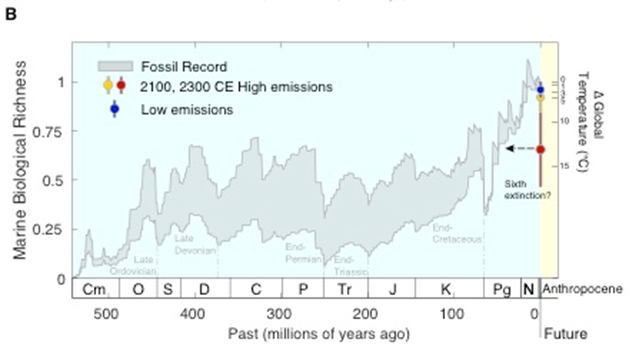
As greenhouse gas emissions continue to warm the world’s oceans, marine biodiversity could be on track to plummet within the next few centuries to levels not seen since the extinction of the dinosaurs, according to a recent study in the journal Science by Princeton University researchers.

The paper’s authors modeled future marine biodiversity under different projected climate scenarios. They found that if emissions are not curbed, species losses from warming and oxygen depletion alone could come to mirror the substantial impact humans already have on marine biodiversity by around 2100. Tropical waters would experience the greatest loss of biodiversity, while polar species are at the highest risk of extinction, the authors reported.

“Aggressive and rapid reductions in greenhouse gas emissions are critical for avoiding a major mass extinction of ocean species,” said senior author Curtis Deutsch, professor of geosciences and the High Meadows Environmental Institute at Princeton.

The study found, however, that reversing greenhouse gas emissions could reduce the risk of extinction by more than 70%. “The silver lining is that the future isn’t written in stone,” said first author Justin Penn, a postdoctoral research associate in the Department of Geosciences. “The extinction magnitude that we found depends strongly on how much carbon dioxide [CO2] we emit moving forward. There’s still enough time to change the trajectory of CO2 emissions and prevent the magnitude of warming that would cause this mass extinction.”

Deutsch and Penn, who initiated the study when both were at the University of Washington, combined existing physiological data on marine species with models of climate change to predict how changes in habitat conditions will affect the survival of sea animals around the globe over the next few centuries. The researchers compared their model to the magnitude of past mass extinctions captured in the fossil record, building on their earlier work that linked the geographic pattern of the End-Permian Extinction more than 250 million years ago — Earth’s deadliest extinction event — to underlying drivers, namely climate warming and oxygen loss from the oceans.

The researchers found that their model projecting future marine biodiversity, the fossil record of the End-Permian Extinction, and indeed the distribution of species that we see now follow a similar pattern — as ocean temperature increases and oxygen availability drops, there is a pronounced decrease in the abundance of marine life.

Water temperature and oxygen availability are two key factors that will change as the climate warms due to human activity. Warmer water is itself a risk factor for species that are adapted for cooler climates. Warm water also holds less oxygen than cooler water, which leads to more sluggish ocean circulation that reduces the oxygen supply at depth. Paradoxically, species’ metabolic rates increase with water temperature, so the demand for oxygen rises as the supply decreases. “Once oxygen supply falls short of what species need, we expect to see substantial species losses,” Penn said.

Marine animals have physiological mechanisms that allow them to cope with environmental changes, but only up to a point. The researchers found that polar species are more likely to go globally extinct if climate warming occurs because they will have no suitable habitats to move to. Tropical marine species will likely fare better because they have traits that allow them to cope with the warm, low-oxygen waters of the tropics. As waters north and south of the tropics warm, these species may be able to migrate to newly suitable habitats. The equatorial ocean, however, is already so warm and low in oxygen that further increases in temperature — and an accompanying decrease in oxygen — might make it locally uninhabitable for many species.

The researchers report that the pattern of extinction their model projected — with a greater global extinction of species at the poles compared to the tropics — mirrors the pattern of past mass extinctions. A study Deutsch and Penn published in Science in 2018 showed that temperature-dependent increases in metabolic oxygen demand — paired with decreases in oxygen availability caused by volcanic eruptions — can explain the geographic patterns of species loss during the End-Permian Extinction ago, which killed off 81% of marine species.

The new paper used a similar model to show that anthropogenic warming could drive extinctions from the same physiological mechanism at a comparable scale if warming becomes great enough, Penn said. “The latitude pattern in the fossil record reveals the fingerprints of the predicted extinction driven by changes in temperature and oxygen,” he said.

The model also helps resolve an ongoing puzzle in the geographic pattern of marine biodiversity. Marine biodiversity increases steadily from the poles towards the tropics, but drops off at the equator. This equatorial dip has long been a mystery — researchers have been unsure about what causes it and some have even wondered whether it is real. Deutsch and Penn’s model provides a plausible explanation for the drop in equatorial marine biodiversity — the oxygen supply is too low in these warm waters for some species to tolerate.

The big concern is that climate change will make large swathes of the ocean similarly uninhabitable, Penn said. To quantify the relative importance of climate in driving extinctions, he and Deutsch compared future extinction risks from climate warming to data from the International Union for Conservation of Nature (IUCN) on current threats to various marine animals. They found that climate change currently affects 45% of the marine species at risk of extinction, but is only the fifth-most important stressor after overfishing, transportation, urban development and pollution.

However, Penn said, climate change could soon eclipse all of these stressors in importance: “Extreme warming would lead to climate-driven extinctions that, near the end of the century, will rival all current human stressors combined.”

The paper, “Avoiding ocean mass extinction from climate warming,” was published April 29 in Science. The work was supported by grants from the National Science Foundation (OCE-1737282), the National Oceanic and Atmospheric Administration (NA18NOS4780167), California SeaGrant and Ocean Protection Council, and the UW Program on Climate Change.


JOURNAL

Science

DOI

10.1126/science.abe9039 

METHOD OF RESEARCH

Computational simulation/modeling

SUBJECT OF RESEARCH

Animals

ARTICLE TITLE

Avoiding ocean mass extinction from climate warming

ARTICLE PUBLICATION DATE

29-Apr-2022

From EurekAlert!

###

And this is Rud’s take.

Ridiculous New Alarm—Climate Caused Mass Ocean Extinction!!

Rud Istvan

I was reading the electronic news today and spotted a Google News synopsis of a WaPo piece wailing about a new paper today (April 28, 2022) in Science, “Avoiding Ocean Mass Extinction from Climate Warming” by two Princeton ‘researchers’. This post is in three parts: what the WaPo reported, what the  paper abstract said (the rest is paywalled), and what the SI shows is going on.

WaPo

“One third of all marine animals will be extinct in 300 years, new research shows.” (The horror…)

“The new biological and climate models were tested by simulating the Permian extinction.” (So they must be right.)

“The climate models predict species behavior (like extinction) based on simulated organism types.” (Climate models of simulated organisms, sure.)

Paper Abstract

“Global warming threatens marine biota with losses of unknown severity. Here we quantify global and local extinction risks in the ocean across a range of climate futures on the basis of the ecophysiological limits of diverse animal species and calibration against the fossil record. With accelerating greenhouse gas emissions, species losses from warming and oxygen depletion alone (poster comment—the thesis is warmer water holds less dissolved oxygen (true) so hypoxia is an extinction mode) become comparable to current direct human impacts (IUCN red list, 89% of marine species NOT threatened at all) within a century AND culminate in a mass extinction rivaling those in Earth’s past.”

Associated Science editor comment: “A stark future for ocean life.”

OK, so the WaPo was actually reasonably reporting on Science hyperventilation. They may even have got the ‘1/3 in 300 years’ from the body of the paper I chose not to read after reviewing the SI. Just shows the alarmist echo chamber.

SI

This is always a good skeptic cheapskate trick, since it is never paywalled and often reveals ‘dirty secrets’ not in the paper itself. As here, excerpted after downloading it.

The climate models used were 16 from CMIP5 and CMIP6. The global warming scenario in both was of course the physically impossible RCP8.5.

The ‘ecophysiotypes’ were based on warm water and hypoxia tolerance across several different orders of marine organisms including bony fishes, cephalopods, bivalves… They were estimated in figure S3, with the following R^2: 0.08, 0.08, 0.21, 0.03, 0.08, 0.05. In other words, just statistical junk ‘ecophysiotypes’.

The SI has the RCP8.5 models warming the ocean upper 500 meters by 2300 a stunning 5C on average (!!, SI figure S8), resulting in an O2 loss of about 30%. The problem is, 30% oxygen depletion isn’t close to marine hypoxia.

The best of all (sarcasm) was how they validated all this by showing they could simulate the Permian extinction (when almost 90 percent of marine organisms went extinct). I have done considerable research on the Permian extinction. It was almost certainly caused by the vast Siberian Traps flood basalt eruptions lasting almost 1 million years. This released vast amounts of SO2, which cooled the atmosphere but grossly acidified the oceans on washout. The eruptions were also through vast Siberian coal deposits, causing them to burn and release enormous quantities of CO2 to warm the atmosphere. We know this from coal ash deposits from the period in Chinese lakebeds. Now, the SO2 and CO2 would have offset some in the atmosphere, but NOT in the oceans. Which is why the Permian extinction was most severe on marine life, not terrestrial plant and animal life.

So these Princeton folks claimed to be able to simulate that and match the Permian fossil record using their CMIP5 and CMIP6 climate models, using their statistically dodgy ‘ ecophysiotypes’. But their SI graphical evidence in support of this claim simply does not do so. Nor could it ever have. As SI figure 1a and 1B amply demonstrate.

via Watts Up With That?

https://ift.tt/pAGWgsl

April 28, 2022 at 08:36PM