Month: April 2022

European Parliament Votes To Return To The Dark Ages

“The European Parliament passed a resolution on Thursday demanding “an immediate full embargo on Russian imports of oil, coal, nuclear fuel and gas.” EU Parliament approves total Russian energy ban — RT World News

via Real Climate Science

https://ift.tt/d7M0Ekv

April 7, 2022 at 04:58PM

Sorry, WQAD, Data Shows Climate Change Is Not Making Storms Worse

From ClimateREALISM

By H. Sterling Burnett

WQAD ran a story reporting climate models predict climate change will make various types of weather events worse, titled “Climate change is spiking frequency, intensity of severe weather.” The story is misleading in couple of ways. First, although the title suggests climate change is already acting to make extreme weather worse, the story itself focuses on predictions for the future based on climate models, not current trends. Indeed, data does not support the claim that climate change has increased the frequency or intensity of tornadoes, thunderstorms, derechos, or snowstorms. Secondly, the climate models predicting that weather will become more extreme, are seriously flawed. They don’t reflect past or present temperatures accurately so their predictions of future climate should not be trusted.

“Severe weather in the Midwest can bring dangerous systems that develop quickly,” says the WQAD report. “A changing climate means better potential for tornadoes, thunderstorms, Derechos, and snowstorms to be even more powerful than before.”

While the first statement is absolutely accurate. The second claim is pure speculation. History and data indicate climate change could equally mean fewer, less intense storms across the region.

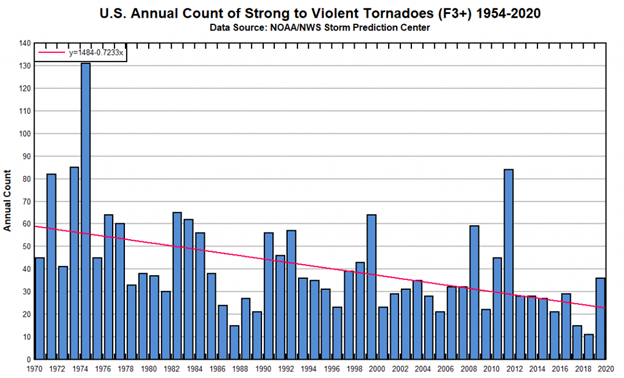
WQAD’s statements regarding tornadoes are cautious, and rightly so. In its most recent science report, Assessment Report 6 (AR6) released in July, the Intergovernmental Panel on Climate Change (IPCC) reports it has found no worsening of tornadoes during the period of modest warming and cannot attribute any changes in tornado frequency or strength to human caused climate change. Indeed, even as the number of reported tornadoes has increased due to better reporting over the past 50 years, data from the National Oceanic and Atmospheric Administration indicates the number of strong tornadoes has declined during the period of warming. (See the figure below)

Graph by Anthony Watts using official NOAA/Storm Prediction Center data.

Concerning thunderstorms, the facts are just as unalarming. As with tornadoes, IPCC AR6 reports no evidence thunderstorms are becoming more extreme, nor any evidence that any changes in thunderstorm frequency are attributable to human causes. One concern arising from extreme thunderstorms is the threat of flooding. Concerning that, the IPCC reports climate change is as likely to have reduced flooding as it is to have made flooding events more common. Also, on page 99 of the 2018 National Climate Assessment published by the National Oceanic and Atmospheric Administrations, its states, “Human-induced warming has not been formally identified as a factor in increased riverine flooding and the timing of any emergence of a future detectable human caused change is unclear.”

Concerning Derechos, as explained on Watts Up With That, these infrequent events are caused by a relatively rare confluence of weather conditions, and there is no evidence climate change is likely to make those conditions arise and coincide more often in the future.

The IPCC also reports there is no evidence winter storms are becoming more intense, delivering more powerful wind or greater amounts of snowfall. The IPCC’s report is confirmed by satellite data recorded by NASA. As discussed in Climate at a Glance: Snowpack,  the extent of average North American snowpack has been virtually unchanged in recent years compared to the late 1960s, when satellite measurements began. Following a short-term decline in snowpack in the mid-1980s, average North American snowpack has increased. As shown in the figure below, what’s true of snowfall in the United States is true for most of the Northern Hemisphere as well.

Twelve-month running anomalies of monthly snow extent, from November 1966 to October
Note that North America, represented by the blue dots, remains virtually unchanged in recent
years compared to the late 1960s, when satellite measurements first began. Source: Global Snow
Lab, “12-month Running Anomalies of Monthly Snow Extent from November 1966 to October 2021,”
Rutgers University Climate Lab, accessed February 2022, https://ift.tt/CrwktzL

One last thing WQAD should have considered before publishing its story hyping climate induced increases in extreme weather is the fact that the projections it references of worsening weather were produced using climate model simulations. Yet, as explored in Climate Realism, herehere, and here, for example, and in Climate Change Weekly, here and here, the general circulation models referenced by the IPCC are flawed and produce results that are woefully inaccurate. Models overstate warming and for more than 30 years have consistently predicted increases in extreme weather that have failed to materialize.

In the end, climate models are not scientific evidence, just like theories are not facts, and the evidence that exists indicates extreme weather events are not increasing. WQAD would do a great service to its audience, if it informed them of that. It might decrease any climate alarm inflamed anxieties those watching their reporting over the years have developed after years of seeing unverified climate change scare stories on the channel.

H. Sterling Burnett

H. Sterling Burnett, Ph.D. is managing editor of Environment & Climate News and a research fellow for environment and energy policy at The Heartland Institute. Burnett worked at the National Center for Policy Analysis for 18 years, most recently as a senior fellow in charge of NCPA’s environmental policy program. He has held various positions in professional and public policy organizations, including serving as a member of the Environment and Natural Resources Task Force in the Texas Comptroller’s e-Texas commission.

via Watts Up With That?

https://ift.tt/T16VaL0

April 7, 2022 at 04:38PM

How the UK Combats Activism in the Classroom

This essay, the first of two, looks at the UK education system and its praiseworthy laws under the Education Act 1996 against teachers pushing partisan views. The ban prohibits not just touting for political parties but promoting contentious ideas in a one-sided way – trashing Winston Churchill as an imperialist, for example (let alone “Critical Race Theory”). The law would require teachers to also discuss Churchill’s positive achievements. The Ministry issued 9000 words of further and comprehensive “guidance notes” for teachers on February 17 on interpreting these laws.

Indoctrination by schools is also a boiling political issue in the US. School board elections are now political battlegrounds across states. In Virginia, anti-indoctrination candidate Glenn Youngkin became the first Republican to serve as governor since 2009.[1] Florida Republican governor Ron DeSantis is a likely presidential nominee, on a platform that includes condemning Critical Race Theory, explicit sex materials and other “woke” indoctrination by Democrat brainwashers in schools.

Do the Australian states’ education systems have similar laws? My second essay will spell out these policies plus examples of how they are violated continuously and with impunity.

The UK ban on classroom indoctrination

Under the heading “Political Indoctrination’, Section 406 of the UK Education Act forbids

(a) the pursuit of partisan political activities by any of those registered pupils … who are junior pupils [under 12],[2] and

(b) the promotion of partisan political views in the teaching of any subject in the school.

 Section 407 is headed, “Duty to secure balanced treatment of political issues” and comes with sub-sections that enable teachers to advocate fundamentals such as rule of law and religious tolerance. But the key clauses ban partisan political teaching of any subject or distribution of partisan material, and require that teachers give kids a “balanced presentation of opposing views.”

February’s guidance notes provide teachers with about 20 illustrations of contentious situations in class. Clarification was needed because many schools have been convulsed by angry parental protests about teaching and withdrawals of kids from state education.[3] At the sharp end is the teaching of issues like Black Lives Matter and “white privilege”, LGBTQI+ affairs in Muslim-heavy schools, #metoo, statue-trashing, “Critical Race Theory” and of course, the supposed climate apocalypse. Even if a topic like net-zero is bi-partisan in Parliament, UK schools must give it balanced treatment if it remains contentious in the UK community.

The Guidance was precipitated by an adverse Commons education committee report last June and a dossier to Parliament from the Free Speech Union last November, citing partisan teaching in 15 schools, described as ‘the tip of the iceberg’:

“They [teachers] are so far down the woke rabbit hole, they think these claims are incontestable facts rather than contentious political positions and regard anyone who challenges them as completely beyond the pale,” the Free Speech secretary said. Examples included a history teacher comparing Donald Trump to Adolf Hitler and diatribes against the police, racism and colonialism. The earlier Commons report said teachers preached against “white privilege” even though their working-class white students were low-achieving and disadvantaged. Tory MP Jonathon Gullis, an ex-teacher, said teachers pushing “white privilege” racism should be disciplined and reported to counter-terrorism programs as extremists. The Ministry agreed any such teaching was contrary to the Education Act’s impartiality clauses.

UK teachers hit back at the government’s ‘awful’ Guidance, calling it a “war on woke” while dismissing it as patronising and gratuitous advice to schools. Some teachers argued the guidance is “non-statutory” and could be ignored.

The Minister for School Standards, Robin Walker, explained in the Commons, “Pupils must form their own political views, and schools should not indoctrinate or encourage children to pin their colours to any particular political mast.” Similarly, the Secretary of State for Education, Nadhim Zahawi, says in the foreword to the Guidance,

Parents and carers want to be sure that their children can learn about political issues and begin to form their own independent opinions, without being influenced by the personal views of those teaching them.

The Guidance says, “Given the changing nature of political issues and how they are taught, schools may wish to consider reviewing their approach to political impartiality even where issues have not already emerged.” The department clearly expects schools rife with parental complaints will rigorously review and reform any illegally-biased teaching.

“Teachers are role models and authority figures, and hence should seldom share their personal political views,” the Guidance says. If they do, they should alert pupils to equivalent contrary views. Schools should consider whether or not to ban teachers altogether from expressing personal political opinions.

Third parties, including charities and campaigners are welcome to supplement teaching, but schools should ensure in advance that speakers or materials do not undermine schools’ legal impartiality, and visitors should represent a fair cross-section of views. The guidance instances an external agency invited to speak on economic challenges of the Global South, but the agency wrongly promotes partisan free-market economic reforms like privatisation and deregulation.

On climate, the guidelines cite the 2007 legal challenge by citizen Stuart Dimmock[4]against schools airing Al Gore’s 2007 Inconvenient Truth disaster movie. The UK High Court, ruling against the Education Department, defined “partisan” as “one-sided” and defined “political views” as “those expressed with a political purpose, such as to further the interests of a particular partisan group, change the law or change government policy. This could be on a wide range of matters such as economic and social issues at a local, national, or international level.”[5]

The High Court ruling was that Gore’s movie was politically partisan and the court required teachers to alert kids about this and provide balancing material, as well as obliging them to point out nine major errors in the film (which Gore has never corrected).[6] [7]

The UK guidance notes define climate change as “scientific fact” (whatever that’s supposed to mean) and not political, but says correctly that discussion of causes and policy responses to it might well be politically influenced. Teachers and pupils should distinguish between climate facts, solutions and opinions. Teachers need not reference misinformation that “anthropogenic climate change is not occurring,” it says. [A straw-man as the controversy is over how much is occurring and why].

An inquiry by the skeptic-minded Global Warming Policy Foundation in 2014 picked up these examples of UK teachers’ partisan preaching on climate:

♦ A mind-map (schematic) suggests global warming will be worse than famine, plague or nuclear war. The mind-map was sourced to a pamphlet from a “passionate” green activist.

♦ “Scientists believe that a 1◦C increase in world temperature is all that the world can tolerate before climatic chaos sets in.”

♦ “Explain why developed rich countries should provide money to poorer, developing countries so that they can reduce their CO2 emissions.”

♦ Academics and renewables executives invited to a Norfolk school did a futuristic presentation:

As the day begins, the students are informed that the Earth’s remaining reserves of fossil fuels have finally been exhausted and, as a result, the fabric of what we consider normal life has immediately started to crumble. No more light, no more heat, no more iPods. No more anything, in fact, meaning something needs to be done – and soon – before the world falls into total chaos.

Only when the last tree has died, and the last river has been poisoned, and the last fish has been caught, will we realise that we cannot eat money. Is it all about money?

UK teachers’ comments to a draft survey suggested that even half a decade ago UK schools were overdoing the climate scare:

♦ “It’s done to death in UK schools across a range of subjects and in nearly all year groups. We risk turning them off it.”

♦ “Blimey, it is virtually impossible to do any science topic without some reference to greenhouse effect/global warming/climate change having to be included.”

♦ “It has become a bit of a joke in my higher groups that on the long exam questions the words carbon dioxide and global warming will always get a mark regardless of the question!

GWPF said the “sustainability” teaching isn’t improving kids’ scientific and economic knowledge.

Our research for this report suggests, perhaps unsurprisingly, that having unqualified primary school teachers explain complex physical phenomena to primary school children has not been a successful strategy…

The slant is on scares, on raising fears, followed by the promotion of detailed guidance on how pupils should live, as well as on what they should think. In some instances, we find encouragement to create ‘little political activists’ in schools by creating a burden of responsibility for action on their part to ‘save the planet’, not least by putting pressure on their parents… Children are being treated as political targets by activists who wish to change society in fundamental ways…

The fact that children’s ability to pass their exams – and hence their future life prospects – appears to depend on being able to demonstrate their climate change orthodoxy, is painfully reminiscent of life in communist-era Eastern Europe or Mao’s China. Politicians seem to have given the nod to this process, effectively handing much of the curriculum to green activists.

Many — possibly most — kids had become upset and frightened for their future, GWPF added.

The UK Ministry now urges teachers to thoroughly review third party material on all controversial topics. It instances fact-sheets about the Israeli-Palestinian conflict, which might seem balanced and helpful but omits historical and other contexts. It welcomes anti-racist views but warns that organisations such as Black Lives Matter can have partisan policies — ‘defund the police’ for starters — that teachers should not promote.

To continue reading this delightful piece click HERE

via Climate Scepticism

https://ift.tt/2JjBFfR

April 7, 2022 at 04:25PM

Greta’s “Girls’ Big Bumper Book of Misery”

Greta has a new book coming out, published by Penguin in the autumn, as both Mark Hodgson and Vinny Burgoo spotted. Her last book was slim in content, so Penguin printed it in large letters, a few lines per page. (Nothing to do with Greta’s diminutive size or literary output, since Penguin Science did the same thing with other books on the climate crisis by Professor Chris Rapley and Visiting Professor and Microsoft Blue Sky Thinker Stephen Emmott, the reason presumably being that Penguin’s Science climate publications are aimed at people whose last extended reading material was a Noddy book.)

Greta’s new book should be longer, given that it has a hundred authors. The Guardian, in it’s puff, lists them. They are:

Abrahm Lustgarten, Adriana de Palma, Alexander Popp, Alexandra Urisman Otto, Alice Garvey, Alice Larkin, Amitav Ghosh, Ana M. Vicedo-Cabrera, Andy Purvis, Annie Lowrey, Ayana Elizabeth Johnson, Ayisha Siddiqa, Beth Shapiro, Beverly Law, Bill McKibben, Bjørn H. Samset, Carlos Nobre, Christian Brand, Dave Goulson, David Wallace-Wells, Derek Macfadden, Disha A. Ravi, Drew Shindell, Elin Anna Labba, Elizabeth Kolbert, Erica Chenoweth, Eugene Linden, Felipe J. Colón-González, Friederike Otto, George Monbiot, Gidon Eshel, Glen Peters, Hans-Otto Pörtner, Hilda Flavia Nakabuye, Hindou Oumarou Ibrahim, Ina Maria Shikongo, Isak Stoddard, Jacqueline Patterson, Jason Hickel, Jennie C. Stephens , Jennifer A. Francis, Jennifer Soong, Jillian Anable, Joëlle Gergis, Johan Rockström, John Barrett, John Brownstein, Julia Arieira, Karin Kvale, Karl-Heinz Erb, Kate Marvel, Kate Raworth, Katharine Hayhoe, Keith W. Larson, Ketan Joshi, Kevin Anderson, Laura Verónica Muñoz, Lorraine Whitmarsh, Lucas Chancel, Margaret Atwood, Marshall Burke, Mauricio Santillana, Michael Clark, Michael Mann, Michael Oppenheimer, Michael Taylor, Mike Berners-Lee, Mitzi Jonelle Tan, Naomi Klein, Naomi Oreskes, Nathália Nascimento, Nicholas Stern, Nicki Becker, Niclas Hällström, Nina Schrank, Olúfémi O. Táíwò, Örjan Gustafsson, Paulo Ceppi, Per Espen Stoknes, Peter Brannen, Peter H. Gleick, Rebecca Wrigley, Ricarda Winkelmann, Rob Jackson, Robin Wall Kimmerer, Saleemul Huq, Samuel S. Myers, Sarah McGough, Seth Klein, Silpa Kaza, Simone Gingrich,Solomon Hsiang, Sonia Guajajara, Sonja Vermeulen, Stefan Rahmstorf, Stuart Capstick, Sunita Narain, Taikan Oki, Tamsin Edwards, Tedros Adhanom Ghebreyesus, Thomas Piketty, Wanjira Mathai, Zeke Hausfather.

Three quarters of the names were unfamiliar to me, so I started researching the first ten names on the list.

Abrahm Lustgarten is an environmental reporter, with a focus at the intersection of business, climate and energy. His early investigation into the environmental and economic consequences of fracking received the George Polk award for environmental reporting, the National Press Foundation award for best energy writing, a Sigma Delta Chi award and was honored as finalist for the Goldsmith Prize. Before joining ProPublica in 2008, Lustgarten was a staff writer at Fortune. His work has appeared in Fortune,The New York Times, The Washington Post, The Atlantic, Scientific American, Wired, Salon, and Esquire, among other publications. He has a master’s in journalism from Columbia University and a bachelor’s degree in anthropology from Cornell.

Adriana de Palma is a Postdoctoral Research Assistant at the Natural History Museum and a data scientist with a focus on understanding biodiversity responses to anthropogenic drivers of change, including both land-use change and extreme weather events. She is interested in synthesising extensive carefully-collated databases to identify, and test the efficacy of, potential management practices and policy decisions at different scales to mitigate the impacts of global change on biodiversity and ecosystem services.

Alexander Popp is a Senior Scientist at the Potsdam Institute for Climate Impact Research and coordinates the development of the global land-use model ‘Model of Agricultural Production and its Impacts on the Environment’ (MAgPIE), which over the last years has evolved into one of the world’s leading integrated global land and water use modelling systems. He is ranked by Web of Science among the 1% most influential scientists in the world [and] was listed among the World’s forty most influential climate scientists on the Reuters Climate Hot-List.

Alexandra Urisman Otto is a Swedish journalist She was born in 1986. After completing a degree in Master of Laws at Lund University, she realized that practicing law would be too square, and that she needed a more creative career. Today she combines a life with young children and working as a journalist at Dagens Nyheter, where one of her tasks is to write about climate activist Greta Thunberg.

Alice Garvey is a PhD candidate based in the Sustainability Research Institute who previously worked at the Centre for Research into Energy Demand Solutions (CREDS), modelling industrial emissions mitigation scenarios and carrying out a review of industrial decarbonisation policies to help inform the 6th Carbon Budget recommendations of the Climate Change Committee (CCC).

Alice Larkin is Head of the School of Engineering and a Professor in Climate Science & Energy Policy. Alice trained as an astrophysicist at the University of Leeds, did her PhD in climate modelling at Imperial College, joining the interdisciplinary Tyndall Centre to research conflicts between climate change and aviation.She was the lead Manchester investigator on a large consortium project funded by the EPSRC entitled ‘Shipping in Changing Climates’. She was also PI on a large EPSRC consortium project on the Water-Food-Energy Nexus and a Co-I on the UKERC project RACER.

Amitav Ghosh is an Indian writer, best known for his English language historical fiction. He has also written non-fiction works discussing topics such as colonialism and climate change. Ghosh famously withdrew his novel The Glass Palace from consideration for the Commonwealth Writers’ Prize, where it was awarded the best novel in the Eurasian section, citing his objections to the term “commonwealth” and the unfairness of the English language requirement specified in the rules. He lives in New York.

Ana M. Vicedo-Cabrera is head of a research group investigating epidemiology and climate change at the university of Bern. She has published 106 papers, including five in March, 2022, including “Comparison of weather station and climate reanalysis data for modelling temperature-related mortality” and “Suicides and ambient temperature in Switzerland: A nationwide time-series analysis.”

Andy Purvis leads the PREDICTS project (Projecting Responses of Ecological Diversity In Changing Terrestrial Systems), which aims to model globally how local terrestrial biodiversity responds to human pressures and to use these models to project potential biodiversity futures under alternative scenarios of socioeconomic development. PREDICTS estimates the Biodiversity Intactness Index, the first indicator available on the Natural History Museum’s Biodiversity Trends Explorer. He was a Coordinating Lead Author on the first IPBES Global Assessment of biodiversity and ecosystem services, and scientific advisor on Sir David Attenborough’s documentary, “Extinction: The Facts”. Other research interests include phylogenetic comparative methods and macroevolution, often using macroperforate planktonic foraminifera as a model system.

Annie Lowrey is an American journalist who writes on politics and economic policy for The Atlantic.[3] Previously, Lowrey covered economic policy for the New York Times and prior to that was the Moneybox columnist for Slate. She graduated from Harvard University with a degree in English and American Literature. She is married to Ezra Klein, the co-founder of Vox and currently a columnist and podcast host at the New York Times.

That’s six scientists, (five of whom are into modelling, and one of whom synthesises carefully-collated data bases) three journalists, none of them with any relevant scientific qualifications, and a writer of historical novels. I know there are proper climate scientists among the other ninety, such as Marvel, Mann, Hayhoe, and Nonny-no. (Sorry, that’s just my spellcheck playing up.) But still, it doesn’t promise to be either a bunch of laughs or much of an insight into complex chaotic systems. Perhaps Ed Hawkins will draw us a nice rainbow on the cover.

(And if anyone would like to continue the research in the comments, we might well succeed in compiling the list of the hundred most boring people in the universe).

via Climate Scepticism

https://ift.tt/ID7oWAy

April 7, 2022 at 04:11PM