
The busiest hurricane year in the US was 1886, when Texas was hit by four hurricanes and Florida was hit by three. Storm Tracks WebGL (By Toto)
via Real Climate Science
April 7, 2022 at 10:15AM
The busiest hurricane year in the US was 1886, when Texas was hit by four hurricanes and Florida was hit by three. Storm Tracks WebGL (By Toto)
via Real Climate Science
April 7, 2022 at 10:15AM
Guest “Is anyone else annoyed every time the Soviet invasion of Ukraine and climate change appear in the same sentence?” by David Middleton
This NPR article isn’t as awful as I thought it would be…
How the war in Ukraine could speed up Europe’s climate plans
April 5, 2022 5:00 AM ET
LAURA BENSHOFFThe war in Ukraine has made getting more fossil fuels to Europe a top priority of the Biden Administration, in order to wean European Union members off Russian energy. But this comes as both Europe and the U.S. are behind on their goals to quickly reduce carbon emissions to avoid the worst consequences of climate change.
The latest report from the Intergovernmental Panel on Climate Change (IPCC) calls for an immediate switch to renewable energy, and says the world will need to capture carbon from the atmosphere to stay within 1.5 degrees Celsius of warming. That tension has prompted concern among climate activists, who warn that more fossil fuel exports will mean more climate warming emissions.
“I think it is more likely than not that we’ll look back on this crisis as actually accelerating a clean energy transition,” said Jason Bordoff, founding director of the Center on Global Energy Policy at Columbia University.
Though, Bordoff notes, it could go either way.
Experts told NPR the climate cost of the war is still up in the air, and depends on how governments balance an immediate need for fossil fuels against long-term shifts in energy production.
[…]
We have four nonexperts in energy who oppose fossil fuels and view the Soviet invasion of Ukraine as an opportunity to speed up the energy transition that isn’t happening because… climate change. And we have one nonexpert in energy, who wants to Warp Speed US energy production and infrastructure to enable us to help Europe deal with their self-inflicted energy crisis… Self-inflicted because… climate change.
While I don’t consider myself to be an “energy expert.” I’m just s petroleum geologist/geophysicist… But I can look things up. Right now, the only way we can really help Europe is to accelerate LNG (liquified natural gas) exports to them. And the LNG exporters are already doing this. From what I can tell, they are operating at full capacity. It’s not unusual for every LNG export facility in the US to be loading tankers at the same time.
February 28, 2022
LNG tanker congestion forms outside U.S. export terminals
By Marcy de LunaHOUSTON, Feb 28 (Reuters) – More than two dozen liquefied natural gas (LNG) tankers were near U.S. Gulf Coast export terminals on Monday, either loading or waiting to load, according to data from Refinitiv Eikon and consultancy Kpler.
European demand for U.S. LNG climbed last year due to local production declines, lack of pipeline supply and cold weather. Sanctions on companies and banks in major gas producer Russia following its invasion of Ukraine appear to be spurring fresh demand. read more
There are currently seven (7) US LNG export terminals in operation:
The map above is about a year old. Some of the Gulf Coast LNG facilities have added capacity since this map was made. About 90% of the 11 Bcf/d depicted on the map is concentrated in the four Gulf Coast facilities.
By the end of 2022, the capacity is expected to be about 14 Bcf/d.
The EU plus UK currently consume about 40-45 Bcf/d.
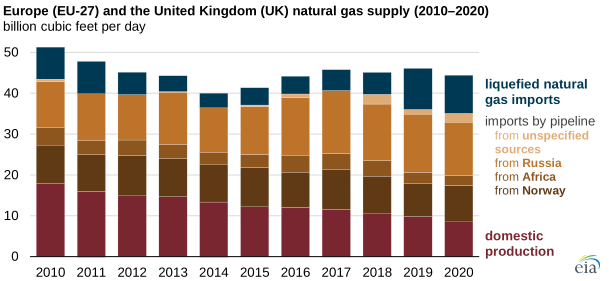
I don’t know how quickly new LNG export facilities can be Warp Speeded online… But we can start with what was under construction last year and what has been approved by FERC (Federal Energy Regulatory Commission) and not yet under construction.
Train 6 at Sabine Pass is already on line and Calcasieu Pass is expected to be online by the end of this year.
The following new LNG export capacity additions will come online by the end of 2022, according to announced project plans:
Train 6 at the Sabine Pass LNG export facility. Train 6 will add up to 0.76 billion cubic feet per day (Bcf/d) of peak export capacity. Train 6 began producing LNG in late November; the first export cargo from this train is expected to be shipped before the end of 2021.
Calcasieu Pass LNG. This new export facility has 18 liquefaction trains with a combined peak capacity of 12 million metric tons per annum (1.6 Bcf/d). Commissioning activities at Calcasieu Pass LNG started in November 2021; the first LNG production is expected before the end of this year. All liquefaction trains are expected to be operational by the end of 2022.
With Calcasieu Pass operating at full capacity, the total would reach 16 Bcf/d. On a side note Venture Global LNG will employ CCS at their Calcasieu Pass facility.
Venture Global Launches Carbon Capture and Sequestration Project
Arlington, VA– Today, Venture Global LNG announced plans to capture and sequester carbon at its Calcasieu Pass and Plaquemines LNG facilities. Having concluded a comprehensive engineering and geotechnical analysis, the company is launching, subject only to regulatory approvals, a shovel-ready carbon capture and sequestration (CCS) project, compressing CO2 at its sites and then transporting the CO2 and injecting it deep into subsurface saline aquifers where it will be permanently stored.
Through this undertaking, Venture Global will capture and sequester an estimated 500,000 tons of carbon per year from its Calcasieu Pass and Plaquemines liquefaction sites. In addition, the Company anticipates using similar infrastructure to capture and sequester 500,000 tons of carbon per year from the CP2 LNG facility once permitted. Altogether, Venture Global plans to sequester 1 million tons of carbon per year, the equivalent of removing nearly 200,000 cars off the road each year for 20 years. The successful deployment of carbon capture and sequestration technology at Calcasieu Pass would be the first of its kind for an existing LNG facility in the United States.
[…]
Being very familiar with the geology of the area and the CCS process, I have no doubt that they can easily do this. In the press release, “carbon” should be CO2. It’s called Carbon Capture and Storage or Sequestration, but it’s actually CO2 that’s captured and stored. At $50/ton, the 45Q tx credit for 1 million tons per year (1 MTPA) would be worth $50 million per year. This is just one of many Gulf Coast CCS projects that are in the early stages of development. LNG facilities are among the most low-hanging CCS fruit. This should please the climatariat, but it just infuriates them even more.
Facilities that have been approved by FERC, but are not yet under construction, would add another 22 Bcf/d, bringing the total to 42 Bcf/d… Enough to keep the lights on in Europe. Unfortunately the current FERC Chairman, appointed by Biden, and Obama judges on the DC Circuit are doing everything they can to short-circuit the construction of these additional LNG export facilities.
FERC Ordered to Revisit South Texas LNG Authorizations as Court Finds Environmental Analyses Lacking
BY CAROLINE EVANS
August 4, 2021A federal court on Tuesday ordered FERC to review its approvals of two planned liquefied natural gas (LNG) export projects in South Texas, saying the agency had not adequately explained its approach in evaluating the potential impacts on climate change and environmental justice (EJ) communities.
The decision handed down from the U.S. Court of Appeals for the District of Columbia (DC) Circuit remands the Federal Energy Regulatory Commission’s authorizations, clearing the facilities for construction and operation, but it does not vacate them. That leaves the authorizations in place, allowing the developers to continue work on the facilities while the review proceeds.
“We find it reasonably likely that on remand, the Commission can redress its failure of explanation with regard to its analyses of the projects’ impacts on climate change and environmental justice communities, and its determinations of public interest and convenience” under the Natural Gas Act (NGA) “while reaching the same result,” Circuit Judge Robert Wilkins wrote in an opinion on behalf of the court.
The facilities in question, NextDecade Corp.’s Rio Grande LNG and an associated pipeline, and the privately owned Texas LNG development, received FERC authorization in 2019. Neither has reached a final investment decision. A coalition of environmentalists and local activists has long opposed the projects and challenged FERC’s authorizations in court.
[…]
Robert Wilkins is an activist Obama judge. FERC Chairman Richard Glick, a Biden appointee, applauded the decision. He opposed these LNG facilities when he was in the FERC minority. Coups have consequences.
So, there you have it. Theoretically, an energy infrastructure Warp Speed program might be able to save Europe from dependence on Soviet natural gas and rescue them from their own failed policies… However, PBS energy experts, Obama judges, Biden bureaucrats and environmental terrorist organizations are hell-bent on replacing fossil fuels with Unicorns and rainbows.
MARCH 2, 2018
Putin, before vote, says he’d reverse Soviet collapse if he could: agenciesMOSCOW (Reuters) – Russian President Vladimir Putin said on Friday he would reverse the collapse of the Soviet Union if he had a chance to alter modern Russian history, news agencies reported.
[…]
Liquefied natural gas (LNG), is natural gas that is super-cooled to minus 260 degrees Fahrenheit (minus 162 degrees Celsius). At that temperature, natural gas transforms from a gaseous state into a liquid. When in liquid form, natural gas takes up to 600 times less space than in its gaseous state, making it feasible and more economical for transport over long distances.
Is it safe?
LNG is very safe to transport, and the industry’s safety record is exemplary. For over 50 years, tankers have safely transported LNG around the world.
LNG is an odorless, non-toxic, non-corrosive liquid and leaves no residue after it evaporates. LNG will not ignite until it becomes a vapor, and even then, the vapor will not ignite until it mixes with air and becomes extremely diluted (5-15% vaporized gas-to-air ratio). Below 5%, there is too little gas in the air to burn; above 15%, there is not enough oxygen.
What if there is a release?
LNG is safely transported by sea because every precaution is taken to mitigate the possibility of a release. If there were a release, vaporizing LNG is not soluble in water and any liquid released on land or in the ocean, would quickly evaporate. There is no possibility for land or water contamination. LNG is non-toxic and it does not chemically react unless ignited.
How is natural gas liquefied?
Natural gas is converted to a liquid in a liquefaction plant, or “Train”. An LNG Train performs four main processes:
1) Pretreatment
Remove dust and slug (water and condensate) along with hydrogen sulfide (H2S) and mercury (Hg). These pollutants can cause corrosion and freezing problems, especially in aluminum heat exchangers.
2) Acid Gas Removal and Dehydration
Carbon dioxide (CO2) is absorbed and removed from natural gas with an amine absorber (acid gas removal or AGR) and remove water using an adsorbent. The removal of these impure substances prevents ice from forming during the subsequent liquefaction process.
3) Remove Heavy Hydrocarbons
Heavy hydrocarbons (C5+) are removed by fractionation before liquefaction. Natural gas is pre-cooled to about -31°F (-35°C) by propane.
4) Separation and Liquefaction
1. Pre-cooled mixed refrigerant (MR) moving through a high-pressure separator separates into a vapor and liquid. Each stream is cooled further, fully liquefied, and sub-cooled in separate tube circuits in the main cryogenic heat exchanger (MCHE).
2. The two sub-cooled MR streams are let down in pressure, further reducing their temperatures. As the mixed refrigerant vaporizes and flows downward on the shell side of the MCHE, it provides refrigeration for liquefying and sub-cooling the natural gas.
3. The pre-cooled natural gas moves through a separate tube circuit in the MCHE, causing it to liquefy and sub-cool to between -238°F (-150°C) to -260°F (-162°C).
4. The LNG end flash at the outlet of the MCHE and in the receiving LNG storage tank, generates flash gas and boil-off gas to make up the fuel gas needed mainly by the propane and MR gas turbine driven compression cycles.
Cameron LNG is located just north of Hackberry LA, about halfway from Houston TX to Baton Rouge LA.
Here’s a Google Earth image of the facility:
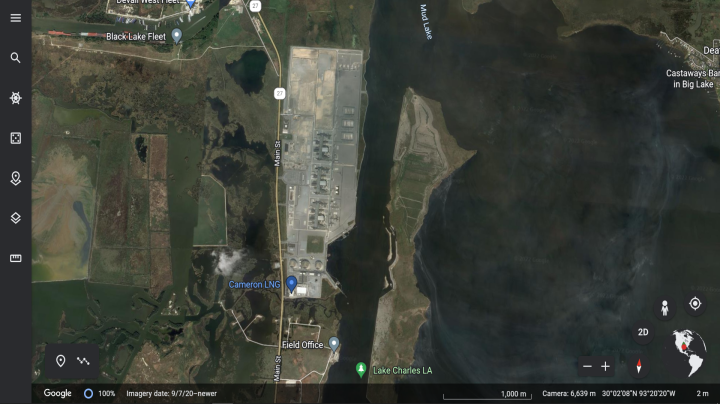
The facility is about 1.7 miles long from north to south, up to about 0.6 miles wide and covers just over 500 acres.
These are the trains (north is towards the top of the photo):
Each train is about 265 meters (~290 yards) long.
Here’s an oblique shot of the entire facility:
via Watts Up With That?
April 7, 2022 at 08:23AM
By Paul Homewood

Up to eight more nuclear reactors could be delivered on existing sites as part of the UK’s new energy strategy.
The plan, which aims to boost UK energy independence and tackle rising prices, also includes plans to increase wind, hydrogen and solar production.
But experts have called for a bigger focus on energy efficiency and improving home insulation.
Consumers are facing soaring energy bills after the Russian invasion of Ukraine pushed gas prices even higher.
Under the government’s new plans, up to 95% of the UK’s electricity could come from low-carbon sources by 2030.
It outlines, for example, the hope of producing up to 50 gigawatts (GW) of energy through offshore wind farms, which the Department for Business, Energy and Industrial Strategy (Beis) said would be more than enough to power every home in the UK.
The government’s energy strategy has been much-delayed, with one of the big points of contention reported to have been the construction of onshore wind turbines.


Environmentalists and many energy experts have reacted with disbelief and anger at some of the measures in the strategy.
They cannot believe the government has offered no new policies on saving energy by insulating buildings.
They say energy efficiency would immediately lower bills and emissions, and is the cheapest way to improve energy security.
A Downing Street source said the strategy was now being seen as an energy supply strategy.
Campaigners are also furious that ministers have committed to seeking more oil and gas in the North Sea, even though humans have already found enough fossil fuels to wreck the climate.
There is a strong welcome, though, for the promise of more energy from wind offshore with speedier planning consent.
The same boost has not been offered to onshore wind.
The decision to boost nuclear has drawn a mixed reaction. Some environmentalists say it’s too dear and too dangerous. They ridicule the idea from some politicians that every city could have its own mini reactor.
But other climate campaigners believe nuclear must be part of the energy mix.
‘Opportunity missed’
Green Party co-leader Adrian Ramsay said the new strategy "did not serve the needs of people or the climate".
Mr Ramsay suggested that if the government was "concerned about energy bills and taking real climate action, it would be going even further on onshore wind."
Former Ofgem boss Dermot Nolan said: "Most of these decisions will take a long time to have an impact and in the short run we will continue to be dependent on fossil fuels.
He said the lack of focus on energy efficiency, on insulation, on improving the quality of people’s homes "is an opportunity missed".
Ed Miliband, Labour’s shadow climate change and net-zero secretary, said: "The government’s energy relaunch is in disarray. This relaunch will do nothing for the millions of families now facing an energy bills crisis."
Liberal Democrat leader Sir Ed Davey also described the plans as "utterly hopeless", while the SNP’s Stephen Flynn called it a "missed opportunity".
Dr Simon Cran-McGreehin, head of analysis at the Energy & Climate Intelligence Unit said: "This is an immediate problem that needs solutions now, and this doesn’t do anything on prices.
"It tries to do some things on energy supply, but they’re all medium to long-term measures. So it does seem to fail the exam question," he said.
https://www.bbc.co.uk/news/business-61010605
Once again Harrabin irresponsibly pushes the insulation nonsense, without telling us how much this will all cost, never mind who will pay. [Reminder to Harrabin – It is not your job to promote the opinions of you and your “Environmentalists and many energy experts” chums]
As for the idiot Miliband or the guy from the ECIU, do they think we can magic energy out of thin air overnight?
The one thing missing from this action list is fracking. A restart of fracking is the single most important thing we could have done, which would have yielded results relatively quickly.
And it is a lie that UK shale gas would not bring down retail prices. Cuadrilla and others would need a licence to extract gas and pump it into the gas grid. There is no reason why such a licence should not be conditional on a CfD type agreement, which would guarantee a price, much lower than current levels, both to Cuadrilla and the grid.
Let’s take a closer look at some of the key points:

Nuclear
The suggestion is that one new reactor is approved each year. That will mean that it will be the mid 2030s before any new capacity is added to Hinkley Point. begging the question of what we do in the meantime.
There seems to be some confusion between “reactors” and “plants”. They talk of 24G of nuclear by 2050, which would suggest eight plants, and probably sixteen reactors of the size of Hinkley’s.
The current strike price for Hinkley Point C is £113.83/MWh. If prices could be reduced to below £100/MWh, it would make economic sense given current power prices of double that.
There are two issues raised by this strategy:
1) Who will build and fund them?
2) A nuclear strategy rather undermines the case for wind and solar power. With the baseload provided by nuclear, wind and solar power will be redundant much of the time.
And, of course, you cannot simply ramp nuclear up and down to match the vagaries of renewables. Quite apart from the technical issues, the economic case for nuclear depends on 24/7 operation.
Wind
Plans are now for 50 GW of offshore wind by 2030, rather than the previous target 40 GW. The extra 10 GW may supply an extra 35 TWh a year, which is only about 3% of total energy consumption. In contrast, the 24 GW planned for nuclear will generate 200 TWh.
It will therefore make little difference to overall consumption of oil and gas.
Hydrogen
A dead end! Doubling what the BBC ludicrously calls “cleaner energy” will simply increase demand for natural gas, not reduce it.
There is no way that any significant portion of this hydrogen can be produced by electrolysis from renewable energy, as there will simply not be enough renewable capacity built in this timescale.
Solar
I’m not quite sure what difference “reforming rules” will make. If people and businesses want solar panels on their roofs, they will have them anyway.
I suspect what we have here is a reflection of the deadlock between proponents and opponents in the Cabinet and party as a whole. Ditto with onshore wind.
Oil and Gas
It’s good to see a bit of common sense.
Heat Pumps
A “£30m heat pump investment accelerator competition" is worthless, purely window dressing.
As even the government must realise now, virtually nobody wants to splash out up to £20000 and more on technology which costs more to run and is not as effective than traditional gas boilers.
This is despite all of the subsidies thrown at buyers down the years.
via NOT A LOT OF PEOPLE KNOW THAT
April 7, 2022 at 05:39AM
The year 1871 is well known for being the deadliest fire in US history, but it was also a remarkable year for tornadoes and hurricanes, with Florida being hit by four. 09 Mar 1871, 4 – Quad-City Times at Newspapers.com … Continue reading →
via Real Climate Science
April 7, 2022 at 05:09AM
 Iowa Climate Science Education