
Covid and Climate and a whole bunch of other things share a common link of distraction and fear.
The post Carpet bombing hope appeared first on CFACT.
via CFACT
April 4, 2022 at 11:09AM
Covid and Climate and a whole bunch of other things share a common link of distraction and fear.
The post Carpet bombing hope appeared first on CFACT.
via CFACT
April 4, 2022 at 11:09AM
Personal health – and foreign policy – prescriptions don’t have to be complex or expensive
The post Candy Bomber lessons for Ukraine – and daily life appeared first on CFACT.
via CFACT
April 4, 2022 at 11:09AM

Summertime [image credit: BBC]
What evidence is there that such powers do exist? An air of unreality is palpable here, with talk of extreme dangers and use of decimal point temperature statements while brushing aside all uncertainties. Endless alarmism creates fatigue, not the fear they crave.
– – –
UN scientists have unveiled a plan that they believe can limit the root causes of dangerous climate change, says BBC News.
A key UN body says in a report that there must be “rapid, deep and immediate” cuts in carbon dioxide (CO2) emissions.
Global emissions of CO2 would need to peak within three years to stave off the worst impacts.
Even then, the world would also need technology to suck CO2 from the skies by mid-century.
After a contentious approval session where scientists and government officials went through the report line by line, the UN’s Intergovernmental Panel on Climate Change (IPCC) has now published its guidance on what the world can do to avoid an extremely dangerous future.
First, the bad news – even if all the policies to cut carbon that governments had put in place by the end of 2020 were fully implemented, the world will still warm by 3.2C this century.
This finding has drawn the ire of the UN Secretary General Antonio Guterres.
“Some government and business leaders are saying one thing – but doing another. Simply put, they are lying. And the results will be catastrophic.”
That sort of temperature rise would see our planet hit by “unprecedented heatwaves, terrifying storms, and widespread water shortages.”
To avoid that fate, the world must keep the rise in temperatures at or under 1.5C this century, say researchers.
The good news is that this latest IPCC summary shows that it can be done, in what Mr Guterres calls a “viable and financially sound manner.”
But keeping temperatures down will require massive changes to energy production, industry, transport, our consumption patterns and the way we treat nature.
To stay under 1.5C according to the IPCC means that carbon emissions from everything that we do, buy, use or eat must peak by 2025, and tumble rapidly after that, reaching net-zero by the middle of this century.
Full article here.
via Tallbloke’s Talkshop
April 4, 2022 at 10:57AM
We routinely see screaming headlines such as CO2 in the Atmosphere Climbs to Highest Level in 4.5 Million Years or Carbon Dioxide Levels Reach Highest Point in Human History.
However, these claims that modern CO2 levels are unusual or unprecedented are highly presumptive, resting on assumptions that we can accurately discern the atmospheric CO2 levels from alkenone, stomata, boron isotope…and other proxies.
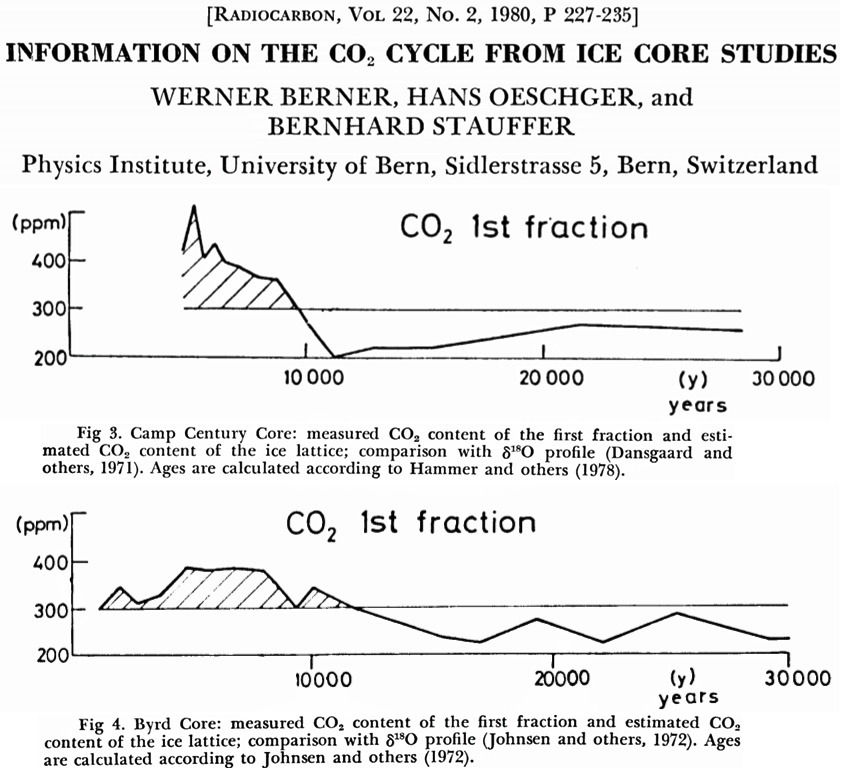
It is presumed that air bubbles in Antarctic ice cores accurately record the “global” atmospheric CO2 levels for the last 400,000 years even though air bubbles from Greenland ice cores record entirely different CO2 values for the most recent millennia.
A recent study (Rae et al., 2021) published in Annual Reviews suggests CO2 varied between about 150 ppm and up to 600 (to 750 ppm) throughout the last 4 million years. Presuming the atmospheric CO2 level is the only variable in the determination of the global ocean pH, the authors also claim seawater pH has varied between 7.9 and 8.3 for since the early Pliocene.
These data are graphically shown to be so imprecise that discernment of the timing or accuracy of these records is inconclusive at best. It’s more suggestive of guesswork.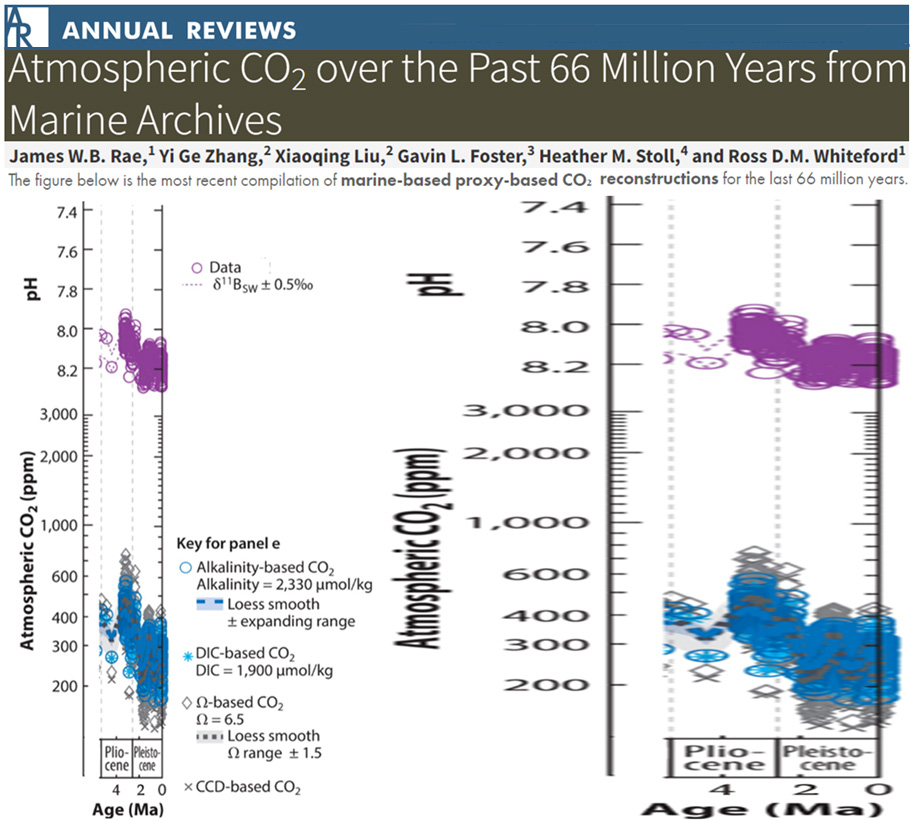
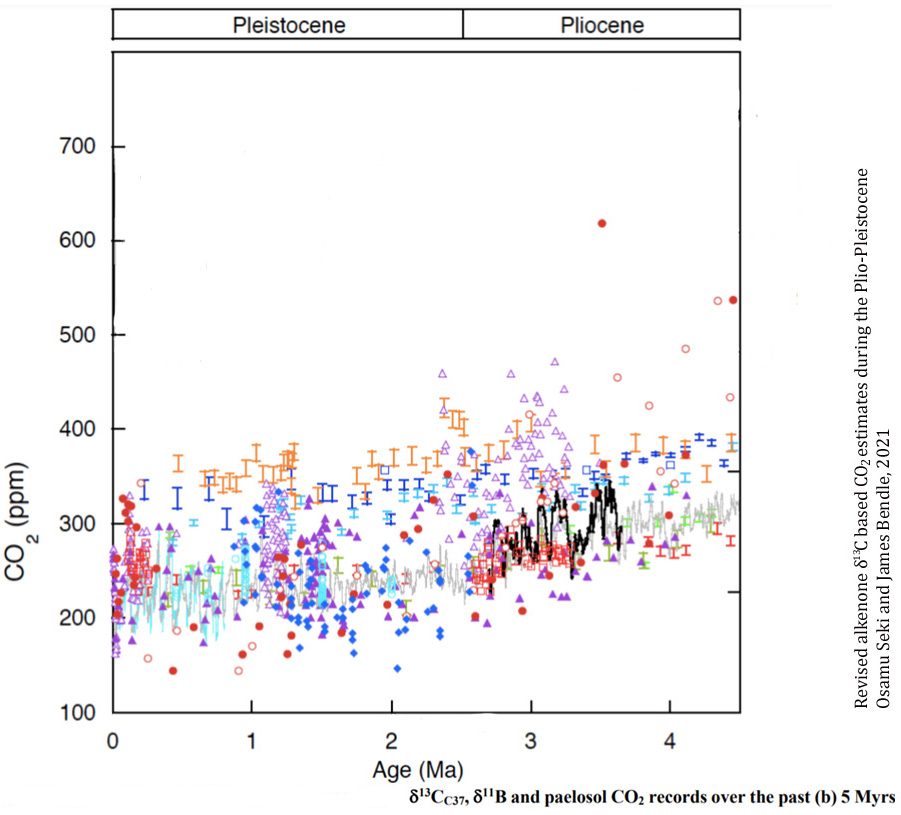
Another recent study (Seki and Bendle, 2021) also demonstrates just how futile it may be to discern the accuracy of CO2 estimates ranging from 150 to 600 ppm for the last 4.5 million years.
We are asked to just believe it when we’re told the modern CO2 levels are the “highest ever” in millions of years. Given the data presented, a healthy dose of skepticism is in order.
via NoTricksZone
April 4, 2022 at 10:29AM
 Iowa Climate Science Education