Month: April 2022

If That Tesla Battery Could Talk

Let’s imagine what an EV battery could tell us about its reality. A short story.  H/T Graeme Weber

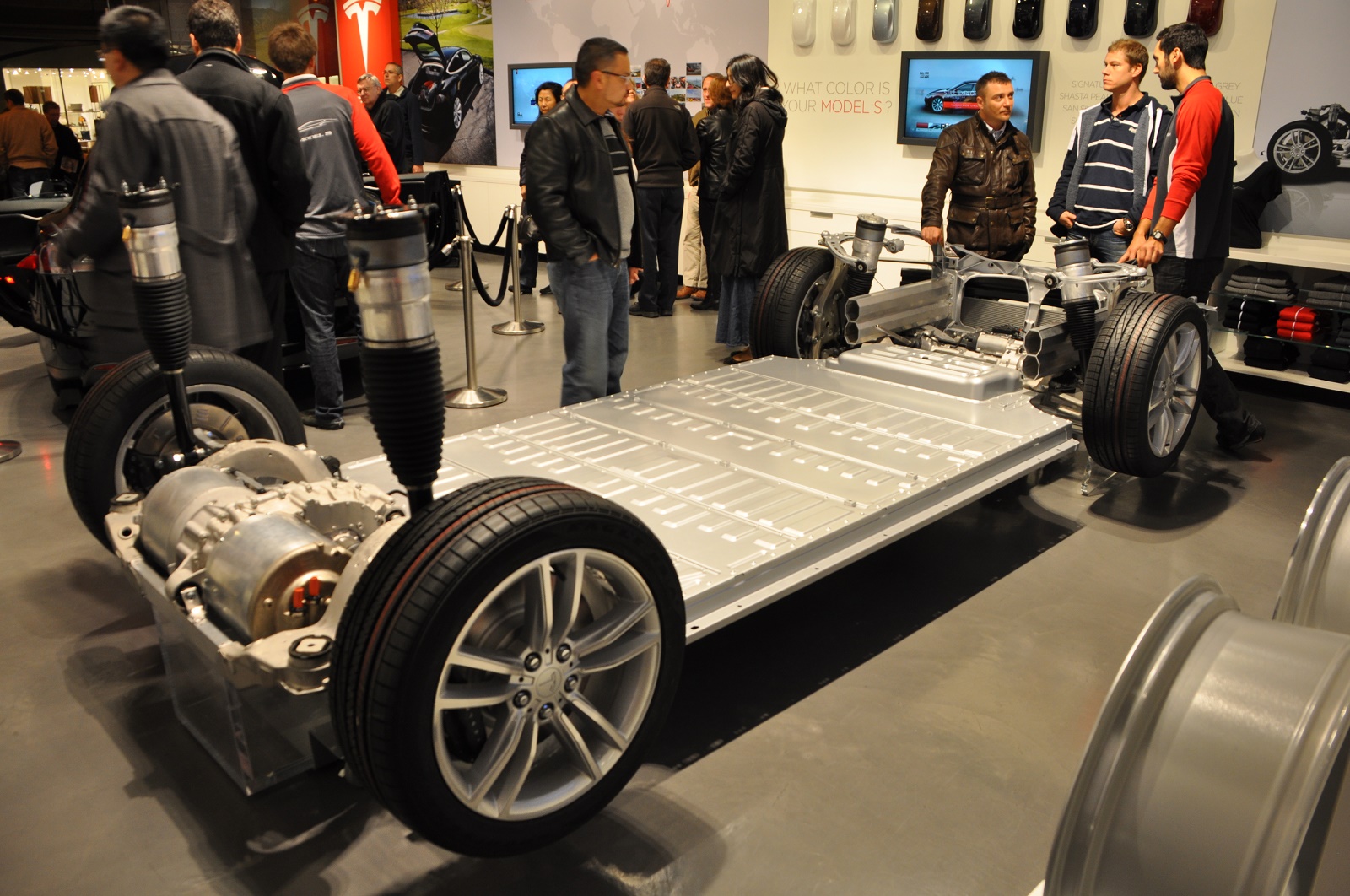
The packed auditorium was abuzz; nobody seemed to know what to expect. The only hint was a large aluminum block sitting on a sturdy table on the stage.

When the crowd settled down, a scholarly-looking man walked out and put his hand on the shiny block, “Good evening,” he said, “I am here to introduce NMC532-X,” and he patted the block, “we call him NM for short,” and the man smiled proudly. “NM is a typical electric vehicle (EV) car battery in every way except one; we programmed him to send signals of the internal movements of his electrons when charging, discharging, and in several other conditions. We wanted to know what it feels like to be a battery. We don’t know how it happened, but NM began to talk after we downloaded the program.

“Despite this ability, we put him in a car for a year and then asked him if he’d like to do presentations about batteries. He readily agreed on the condition he could say whatever he wanted. We thought that was fine, and so, without further ado, I’ll turn the floor over to NM;” the man turned and walked off the stage.

“Good evening,” NM said. He had a slightly affected accent, and when he spoke, he lit up in different colors.

“A few days ago, at the start of my last lecture, three people walked out. But here is what I noticed about them. One was wearing a battery-powered hearing aid, one tapped on his battery-powered cell phone as he left, and a third got into his car — which would not start without a battery. So, I’d like you to think about your day for a moment; how many batteries do you rely on?”

He paused for a full minute which gave people time to count their batteries. Then he went on, “Now, it is not elementary to ask, ‘what is a battery?’ I think Mr. Tesla said it best when they called us Energy Storage Systems. That’s important. We do not make electricity — we store electricity produced elsewhere, primarily by coal, uranium, natural gas-powered plants, or diesel-fueled generators. So, to say an EV is a zero-emission vehicle is not at all valid. Also, since 40% of the electricity generated in the U.S. is from coal-fired plants, it follows that 40% of the EVs on the road are coal-powered, n’est-ce pas?”

He flashed blue again. “Einstein’s formula, E=MC2, tells us it takes the same amount of energy to move a 5,000 lb. gasoline-driven automobile a mile as it does an electric one. The only question again is, what produces the power? To reiterate, it does not come from the battery; the battery is only the storage device, like a gas tank in a car.”

He lit up red when he said that, and then he continued in blue and orange. “Mr. Elkay introduced me as NMC532. If I were the battery from your computer mouse, Elkay would introduce me as AA, if from your cell phone as CR2032, and so on. We batteries all have the same name depending on our design. By the way, the ‘X’ in my name stands for ‘experimental.’

“There are two orders of batteries: rechargeable and single use. The most common single-use batteries are A, AA, AAA, C, D, 9V, and lantern types. Those dry-cell species use zinc, manganese, lithium, silver oxide, or zinc and carbon to store electricity chemically. Please note they all contain toxic, heavy metals.

“Rechargeable batteries only differ in their internal materials, usually lithium-ion, nickel-metal oxide, and nickel-cadmium.

“The United States uses three billion of these two battery types a year, and most are not recycled; they end up in landfills. If you throw your small, used batteries in the trash, here is what happens to them.

“All batteries are self-discharging. That means even when not in use, they leak tiny amounts of energy. You have likely ruined a flashlight or two from an old, ruptured battery. When a battery runs down and can no longer power a toy or light, you think of it as dead; well, it is not. It continues to leak small amounts of electricity. As the chemicals inside it run out, pressure builds inside the battery’s metal casing, and eventually, it cracks. The metals left inside then ooze out. The ooze in your ruined flashlight is toxic, and so is the ooze that will inevitably leak from every battery in a landfill. All batteries eventually rupture; it just takes rechargeable batteries longer to end up in the landfill.

“In addition to dry-cell batteries, there are also wet-cell ones used in automobiles, boats, and motorcycles. The good thing about those is, 90% of them are recycled. Unfortunately, the cost of recycling EV batteries is more expensive than the cost of mining and creating a new battery. EV batteries that don’t have enough potency to power a vehicle can sometimes be used to power home appliances, street lights or solar panel backup until they finally lose all their energy.

“But that is not half of it. For those of you excited about electric cars and a green revolution, I want you to take a closer look at batteries and windmills and solar panels. These three technologies share what we call environmentally destructive embedded costs.”

NM got redder as he spoke. “Everything manufactured has two costs associated with it: embedded costs and operating costs. I will explain embedded costs using a can of baked beans as my subject.

“In this scenario, baked beans are on sale for $1.75 a can. As you head to the checkout, you begin to think about the embedded costs in the can of beans.

“The first cost is the diesel fuel the farmer used to plow the field, till the ground, harvest the beans, and transport them to the food processor. Not only is his diesel fuel an embedded cost, so are the costs to build the tractors, combines, and trucks. In addition, the farmer might use a nitrogen fertilizer made from natural gas.

“Next is the energy costs of cooking the beans, heating the building, transporting the workers, and paying for the vast amounts of electricity used to run the plant. The steel can holding the beans is also an embedded cost. Making the steel can requires mining taconite, shipping it by boat, extracting the iron, placing it in a coal-fired blast furnace, and adding carbon. Then it’s back on another truck to take the beans to the grocery store. Finally, add in the cost of the gasoline for your car.

“But wait — can you guess one of the highest but rarely acknowledged embedded costs? It’s the depreciation on the 5000-lb. car you used to transport one pound of canned beans!”

“But that can of beans is nothing compared to me! I am hundreds of times more complicated. My embedded costs not only come in the form of energy use; they come as environmental destruction, pollution, disease, child labor, and the cost to be recycled.”

He paused, “I weigh 1,000 pounds, and as you see, I am about the size of a travel trunk. I contain 25 pounds of lithium, 60 pounds of nickel, 44 pounds of manganese, 30 pounds cobalt, 200 pounds of copper, and 400 pounds of aluminum, steel, and plastic. Inside me are 6,831 individual lithium-ion cells.

“It should concern you that all those toxic components come from mining. For instance, to manufacture EACH auto battery like me, you must process 25,000 pounds of brine for the lithium, 30,000 pounds of ore for the cobalt, 5,000 pounds of ore for the nickel, and 25,000 pounds of ore for copper. All told, you dig up 500,000 pounds of the earth’s crust for just. one. battery.

“I mentioned disease and child labor a moment ago. Here’s why. Sixty-eight percent of the world’s cobalt, a significant part of a battery, comes from the Congo. Their mines have no pollution controls, and they employ children who die from handling this toxic material. Should we factor in these diseased kids as part of the cost of driving an electric car?”

400MW/1600MWh Moss Landing Energy Storage Facility in California Image: LG Energy Solution

“Finally, “I’d like to leave you with these thoughts. California is building the largest battery in the world near San Francisco, and they intend to power it from solar panels and windmills. They claim this is the ultimate in being ‘green,’ but it is not! This construction project is creating an environmental disaster. Let me tell you why.

“The main problem with solar arrays is the chemicals needed to process silicate into the silicon used in the panels. To make pure enough silicon requires processing it with hydrochloric acid, sulfuric acid, nitric acid, hydrogen fluoride, trichloroethane, and acetone. In addition, they also need gallium, arsenide, copper-indium-gallium-diselenide, and cadmium-telluride, which also are highly toxic. Silicon dust is a hazard to the workers, and the panels cannot be recycled.

“Windmills are the ultimate in embedded costs and environmental destruction. Each weighs 1688 tons (the equivalent of 23 houses) and contains 1300 tons of concrete, 295 tons of steel, 48 tons of iron, 24 tons of fiberglass, and the hard to extract rare earths neodymium, praseodymium, and dysprosium. Each blade weighs 81,000 pounds and will last 15 to 20 years, at which time it must be replaced. We cannot recycle used blades. Sadly, both solar arrays and windmills kill birds, bats, sea life, and migratory insects.

“There may be a place for these technologies, but you must look beyond the myth of zero emissions. I predict EVs and windmills will be abandoned once the embedded environmental costs of making and replacing them become apparent. I’m trying to do my part with these lectures.”


via Science Matters

https://ift.tt/P5rA47U

April 27, 2022 at 06:54PM

The Annual Disaster Fake News Story

From NOT A LOT OF PEOPLE KNOW THAT

By Paul Homewood

It’s Whack-A-Mole time!

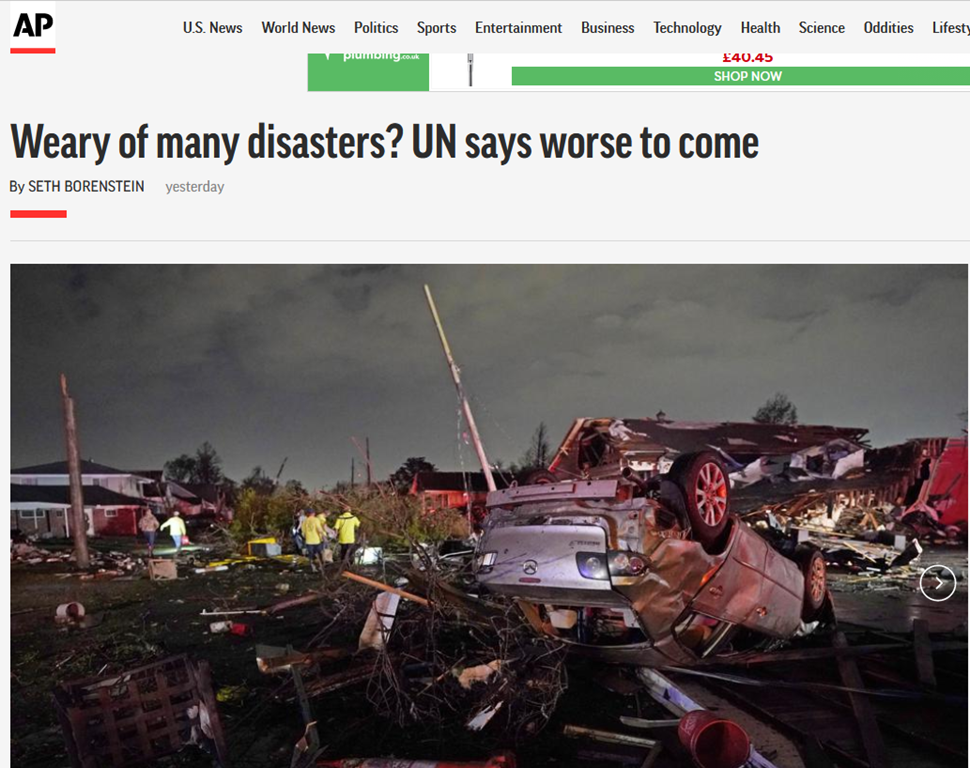
A disaster-weary globe will be hit harder in the coming years by even more catastrophes colliding in an interconnected world, a United Nations report issued Monday says.

If current trends continue the world will go from around 400 disasters per year in 2015 to an onslaught of about 560 catastrophes a year by 2030, the scientific report by the United Nations Office for Disaster Risk Reduction said. By comparison from 1970 to 2000, the world suffered just 90 to 100 medium to large scale disasters a year, the report said.

The number of extreme heat waves in 2030 will be three times what it was in 2001 and there will be 30% more droughts, the report predicted. It’s not just natural disasters amplified by climate change, it’s COVID-19, economic meltdowns and food shortages. Climate change has a huge footprint in the number of disasters, report authors said.

https://apnews.com/article/climate-science-united-nations-natural-disasters-fa1d16ad7d59c7629bb1a9a955a494b0

The UN report referred to is utterly fraudulent. Below is the key chart from the UN Press Release:

https://www.undrr.org/gar2022-our-world-risk#container-downloads

They claim an increasing trend since the 1970s, when miraculously it seems there were hardly any disasters at all!

In fact, the table from the actual report makes it clear that the number of disasters has in reality been declining since 2000, a fact which makes a nonsense of the projected rise of 40% by 2030:

https://www.undrr.org/media/79595/download

But why the rapid increase since 1970?

We have been down this road before. The data comes from EM-DAT the International Disaster Database. They only began publishing data in 1998, and in 2004 warned that earlier data was incomplete:

http://web.archive.org/web/20210906114530/https://notalotofpeopleknowthat.wordpress.com/2018/09/07/the-international-disaster-database/

In other words, most disasters were simply never officially recorded prior to 2000. To put it into some sort of perspective, EM-DAT define a disaster below:

https://www.emdat.be/sites/default/files/whats%20new/wn_disastersinnumbers_2021.png

How many disasters would have been officially logged by the UN or any international body fifty years ago, when the threshold was so low? Indeed many much bigger disasters don’t appear in EM-DAT in those early years, such as the Red River Delta flood in Vietnam, which killed an estimate 100,000 people in 1971:

https://worldhistoryproject.org/1971/8/1/red-river-delta-flood-of-1971

Yet EM-DAT ignore this flood entirely:

By Paul Homewood

It’s Whack-A-Mole time!

imageimage

A disaster-weary globe will be hit harder in the coming years by even more catastrophes colliding in an interconnected world, a United Nations report issued Monday says.

If current trends continue the world will go from around 400 disasters per year in 2015 to an onslaught of about 560 catastrophes a year by 2030, the scientific report by the United Nations Office for Disaster Risk Reduction said. By comparison from 1970 to 2000, the world suffered just 90 to 100 medium to large scale disasters a year, the report said.

The number of extreme heat waves in 2030 will be three times what it was in 2001 and there will be 30% more droughts, the report predicted. It’s not just natural disasters amplified by climate change, it’s COVID-19, economic meltdowns and food shortages. Climate change has a huge footprint in the number of disasters, report authors said.

https://ift.tt/uLnlfWk

The UN report referred to is utterly fraudulent. Below is the key chart from the UN Press Release:

imageimage

https://ift.tt/y2hFpWV

They claim an increasing trend since the 1970s, when miraculously it seems there were hardly any disasters at all!

In fact, the table from the actual report makes it clear that the number of disasters has in reality been declining since 2000, a fact which makes a nonsense of the projected rise of 40% by 2030:

imageimage

https://ift.tt/yrDbOtm

But why the rapid increase since 1970?

We have been down this road before. The data comes from EM-DAT the International Disaster Database. They only began publishing data in 1998, and in 2004 warned that earlier data was incomplete:

imageimage
imageimage
imageimage

https://ift.tt/3joi0Is

In other words, most disasters were simply never officially recorded prior to 2000. To put it into some sort of perspective, EM-DAT define a disaster below:

imageimage

https://ift.tt/n5dlXse

How many disasters would have been officially logged by the UN or any international body fifty years ago, when the threshold was so low? Indeed many much bigger disasters don’t appear in EM-DAT in those early years, such as the Red River Delta flood in Vietnam, which killed an estimate 100,000 people in 1971:

imageimage

https://worldhistoryproject.org/1971/8/1/red-river-delta-flood-of-1971

Yet EM-DAT ignore this flood entirely:

imageimage

Every year the UN publish a fraudulent report like this one. And each year it is faithfully reported by the media, who have no interest in telling the public the real facts.

via Watts Up With That?

https://ift.tt/VajTdeg

April 27, 2022 at 04:34PM

China boosts coal again: set for record in 2022: Official says energy security trumps carbon neutrality

A week ago our newspapers were full of dire warnings that the Australian coal mining industry was going to be left in the lurch by declining orders from China. “The End of Australia’s coal export boom is Imminent” said the AFR — parroting a report by a group that includes Alex Turnbull, someone known to profit from renewables.

What none of the headlines mentioned was that China is set to hit a new all time record of coal use this year.

China already burns 32 times as much coal each year as Australia does. Soon that will be 34 times as much. But who’s counting?

By Joe McMoncald, AP Business Writer, 25th April 2022

Official plans call for boosting coal production capacity by 300 million tons this year, according to news reports. That is equal to 7% of last year’s output of 4.1 billion tons, which was an increase of 5.7% over 2020.

Chinese officials are blunt about why they need more coal:

Coal is important for “energy security,” Cabinet officials said at an April 20 meeting that approved plans to expand production capacity, according to Caixin, a business news magazine.

“This mentality of ensuring energy security has become dominant, trumping carbon neutrality,” said Li Shuo, a senior global policy adviser for Greenpeace. “We are moving into a relatively unfavorable time period for climate action in China.”

Clearly these new levels of 4.4 million tons are going to set a record high for coal production, with or without Australian imports: 

The ABC worked to mislead Australians during an election campaign, right in the headline. It’s if the Australian coal industry has no future and “needs to transition” at a time when the largest user of coal in the world is set to use even more coal.

A new report warns Australian thermal coal exports to China could fall by 20 per cent by 2025 as China invests in domestic mines and a major coking coal mine in Mongolia.

The report also predicts coking coal exports to China could fall by more than 20 per cent.

The modelling by ANU energy economists Jorrit Gosens and Frank Jotzo suggests that if China commits to its current climate policy, coking and thermal coal imports will drop by a quarter within three years, from 210 megatonnes (Mt) in 2019 to 155Mt by 2025.

Like all election advertising ABC fake news stories should be legally required to name the Green or Labor party official that approved them.

The real stories and the trends that matter to Australians lie unnoticed:

December 2021: After falling in 2019 and 2020, global power generation from coal is expected to jump by 9% in 2021 to an all-time high of 10,350 terawatt-hours, according to the IEA’s Coal 2021 report, which was released today.

 However, global coal trends will be shaped largely by China and India, who account for two-thirds of global coal consumption, despite their efforts to increase renewables and other low-carbon energy sources.

Australia exports about 400m tons of coal a year and only consumes about 50m tons itself. We’re the first or second largest exporter of coal in the world, but we’re only digging up about a tenth as much coal as China does.

We have a 300 year supply of coal, even at this rate of production, so there’s no reason to transition out of it.

0 out of 10 based on 0 rating

via JoNova

https://ift.tt/DQrYxjz

April 27, 2022 at 02:41PM

Denmark suspends Covid vaccination campaign

Victoria Australia and the Northern Territory are sacking thousands of teachers for not getting their third injection. And in Western Australia, from tomorrow, the unvaccinated will be allowed to dance in packed nightclubs, but they still can’t go to work and earn money to support their families, for “health reasons” (the health of Pfizer?).

Meanwhile, Denmark is going to pause vaccinations entirely:

Denmark has said it is suspending its widespread Covid-19 vaccination campaign. All remaining Covid restrictions were lifted in the country in February. Noting that the epidemic was under control and that vaccination levels were high, the Danish Health Authority said the country was in a “good position”. “Therefore we are winding down the mass vaccination programme against Covid-19,” said Bolette Soborg, director of the authority’s department of infectious diseases.

Around 81% of Denmark’s 5.8 million inhabitants have received two doses of the vaccine and 61.6% have also received a booster. Denmark noted a drop in the number of new infections and stable hospitalisation rates.

They says they may bring it back some vaccinations in autumn.

Current infections are running at about 1,000 new cases a day. … Worldometer


[…]

via JoNova

https://ift.tt/3FKtu5C

April 27, 2022 at 02:41PM