As Australia approaches a tight May 21 federal election, the countryside based junior ruling coalition partners, the Nationals, appear on the verge of walking away from their net zero 2050 commitment.
Coalition climate split emerges as Nationals Senator labels net-zero goal ‘dead’
The Coalition appears to be splitting on climate change, with Nationals Senator Matt Canavan describing 2050 net-zero targets as “all sort of dead” just hours after Prime Minister Scott Morrison was forced to defend his government’s “absolute” commitment to it.
Labor seized on the former minister and outspoken fossil fuel champion’s comments on Tuesday as a “huge development”, coming the day after Queensland Nationals candidate Colin Boyce described the target as a “flexible plan” that “leaves us wiggle room”.
Both Mr Boyce and Senator Canavan pointed to the world’s reaction to Russia’s invasion of Ukraine, and particularly the dramatic impacts on oil and gas supply to Europe, as evidence of a lack of commitment to the target.
“The net zero thing is all sort of dead anyway,” he told the ABC’s Afternoon Briefing on Tuesday.
“I mean, (United Kingdom Prime Minister) Boris Johnson’s said he’s pausing the net-zero commitment, Germany’s building coal and gas infrastructure, Italy’s reopening coal-fired power plants, it’s all over.
Senator Canavan is right when he describes Net Zero as dead in Europe, at least until the Ukraine crisis is resolved.
But Australia has largely been shielded from the energy crisis in Europe, and the gasoline price and inflation crisis in the USA – our white hot commodities boom has kept our currency strong enough so voters in Australia haven’t felt gasoline and electricity price pain to the same extent as other countries. So Australian voters haven’t caught up with the new reality in Europe and the USA.
The ruling federal incumbents, the Australian Coalition, are composed of the Liberal Party and the National Party. To add to the fun, in the state of Queensland the Liberals and Nationals merged into one party, the LNP. Senator Canavan is LNP, but he sits with the federal National Party as a senator.
Despite the name, the Liberals in Australia claim to be a centre right party – “Liberal” has a slightly different meaning in Australia.
National Party supporters are mostly Christian conservative rural voters, who are deeply concerned about mining jobs, coal jobs and fuel prices. The Liberal Party’s support base is more urban.
Like greens in the USA, green voters in Australia tend to cluster in big cities, as far from actual contact with nature as they can manage. Support for the ruling coalition has stagnated in recent years, so senior Liberals, like Federal Treasurer Josh Frydenberg, have been sucking up to inner city green voters in a desperate attempt to cling on to their parliamentary seats.
But this pandering to greens doesn’t sit well with National Party rural voters, who are deeply concerned about rising energy costs and mining jobs. Polling suggests a lot of voters might be on the verge of defecting to minor parties with a strong climate skeptic agenda, such as One Nation. On the other side of the coin, the Green Party might be on the verge of making strong gains in inner city electorates.
If the Coalition had stuck to their principles and made a solid case for fossil fuel, energy exports, and affordable energy, they would have stood a chance of replicating climate skeptic Prime Minister Tony Abbott’s landslide election success in 2013. The Liberals might have lost some of their more useless inner city politicians, but voters generally like evidence that their politicians have principles, even if they don’t fully agree with them.
Instead the coalition went all in trying to please everyone, backflipping on climate policy to follow the latest opinion polls, and are now being torn apart by opposing demands from different groups of supporters.
The only reason the Coalition has any chance is the opposition Labor leader blundered badly in an interview, and inadvertently revealed he has a weak understanding of economics – a big issue for an electorate worried about a possible imminent economic downturn.
So it is anyone’s guess who will run Australia, after the May 21st election.
9 U.S. cities now produce more solar power than the entire U.S. did 10 years ago Ben Adler · Senior Editor Thu, April 21, 2022
American rooftop solar power is growing at a stunning rate, a new study finds, with solar capacity increasing 19% in 2021.
The United States now has 121.4 gigawatts of solar photovoltaic capacity, enough to power 23 million homes, up from just 0.34 gigawatts in 2008, according to the Department of Energy.
[…]
“The amount of solar power installed in just nine U.S. cities exceeds the amount installed in the entire United States 10 years ago,” the report, titled “Shining Cities 2022,” found. In fact, 15 of the 56 cities included in the study increased their solar capacity tenfold since 2014.
Ben Adler is the Senior Climate Editor for Yahoo! News. He has a BA in government. Apart from not actually being able to edit the climate, Mr. Adler also doesn’t seem to grasp a few simple concepts:
Cities don’t produce solar power, the Sun does. Solar panels convert it to electricity.
Installed capacity isn’t generation.
The cited EIA link puts the capacity at 97.2 GW, not 121.4 GW.
The most recent Electric Power Annual 2020, published last moth puts solar PV at 73.9 GW (75.6 if you count solar thermal), including small-scale installations.
Rooftop solar accounts for only about 1/3 of the 121.497.2 75.6 GW of solar photovoltaic capacity.
121.4 GW of solar photovoltaic capacity would be “enough to power 23 million homes” for 6-8 hours per day, when the Sun is shining.
If it looks like a duck curve, swims like a duck curve, and quacks like a duck curve, then it probably is a duck curve.
“On a clear day you can” generate 8-9 hours’ worth of solar PV electricity.
Let’s assume that the aforementioned 9 US cities now have more solar PV capacity than the entire US did 10 years ago… So what? As of 2019, three states (TX+FL+CA) had more natural gas generation capacity than the current total US solar PV capacity.
Based on the U.S. Energy Information Administration’s (EIA) annual survey of electric generators, natural gas-fired generators accounted for 43% of operating U.S. electricity generating capacity in 2019. These natural gas-fired generators provided 39% of electricity generation in 2019, more than any other source. Most of the natural gas-fired capacity added in recent decades uses combined-cycle technology, which surpassed coal-fired generators in 2018 to become the technology with the most electricity generating capacity in the United States.
Generator capacity: The maximum output, commonly expressed in megawatts (MW), that generating equipment can supply to system load, adjusted for ambient conditions.
Generator nameplate capacity (installed): The maximum rated output of a generator, prime mover, or other electric power production equipment under specific conditions designated by the manufacturer. Installed generator nameplate capacity is commonly expressed in megawatts (MW) and is usually indicated on a nameplate physically attached to the generator.
Actual generation, commonly expressed in megawatt-hours (MWh) is the actual electricity output that the generating equipment delivers to the grid. This varies widely by generation source. Nuclear power plants require very little downtime and routinely deliver 95% of their rated capacity. Natural gas combined cycle and coal-fired power plants can theoretically deliver 80-90% of their rated capacities, but usually only realize 40-50% because they react to demand and economics. They ramp up and down in response to demand. They also react to natural gas prices. Higher natural gas prices reduce natural gas utilization and increase coal utilization. Wind and solar power only deliver electricity to the grid when the winds and Sun cooperate. Wind generally ranges from 20-40% of rated capacity. Solar is generally in the 20-30% range.
I didn’t include wind, because it isn’t relevant to this post. I did include petroleum, because it is relevant to the next section of this post.
“Solar Superstars”
In his Yahoo! News article, Mr. Adler referenced this report: Shining Cities 2022, The Top U.S. Cities for Solar Energy. Oddly enough, the report doesn’t seem to mention actual electricity generation and focuses exclusively on capacity. The report highlights a group of cities that they call “Solar Superstars”.
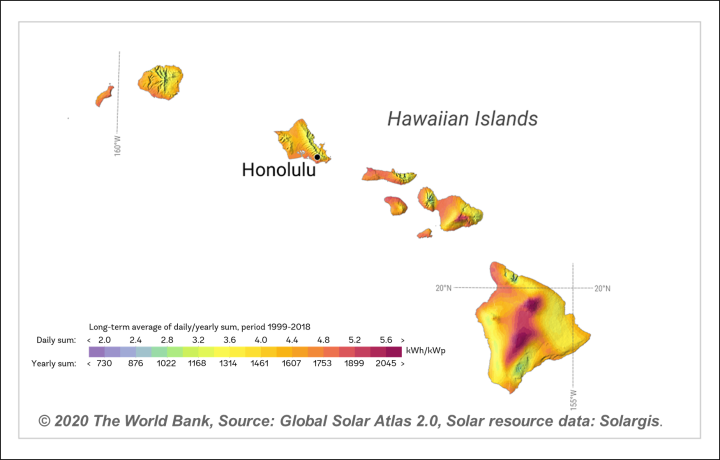
Some of these cities make a lot of sense: Las Vegas, San Diego, Phoenix, etc. It’s not unusual for solar PV installations in these sorts of places to realize 40% capacity factors during summers. However, the superstar of superstars, Honolulu HI, struck me as “funny.”
Hawaii State Energy Profile
Hawaii Quick Facts
Hawaii was the first state to set a deadline for having 100% of its electricity sales come from renewable energy, which is required to be achieved by 2045. In 2020, the state’s power suppliers met the interim requirement that 30% of electricity sales come from renewables.
Despite being among the five states with the lowest total energy consumption, Hawaii uses about 12 times more energy than it produces. More than four-fifths of Hawaii’s energy consumption is petroleum, making it the most petroleum-dependent state.
In 2020, solar power provided almost 17% of Hawaii’s total electricity, primarily from the increase in generation from small-scale, customer-sited solar panel systems that nearly doubled since 2015.
In 2020, the amount of Hawaii’s coal-fired generation was the lowest since 1992, and coal fueled 11% of the state’s electricity generation. The state’s single coal-fired power plant is scheduled to close in 2022.
Hawaii has the highest electricity retail price of any state and it is nearly triple the U.S. average rate, in part because the state relies on imported petroleum for 60% of its electricity generation.
Solar power might actually make sense for Hawaii… But…
“In 2020, the state’s power suppliers met the interim requirement that 30% of electricity sales come from renewables…”
January 2022
Generation Source
Thousand MW
% of Total
Petroleum-fired
540
77%
Coal-fired
61
9%
Nonhydroelectric Renewables
103
15%
Total
704
100%
In 2020, the state’s power suppliers met the interim requirement that 30% of electricity sales come from renewables.
What happened since 2020? Or was January just a bad month for solar? There are no accessible data for rooftop solar performance in the Honolulu area, but the data for utility scale solar are easily accessible. Let’s look at one of the larger facilities in the area:
Plant Name: Waipio Solar Plant Code: 60024 Utility Name: Waipio PV, LLC Utility ID: 59764 City: Waipio County: Honolulu State: Hawaii Sector: IPP Non-CHP Technology: Solar Photovoltaic Data Period: 202108 Primary Fuel: solar Total Nameplate Capacity: 45.9 MW Total Net Summer Capacity: 45.9 MW Net Summer Capacity by Energy Source: Solar = 45.9 MW
Yet, Waipio’s average annual capacity factor is only 20%, with winter being the worst wind season.
That said, Hawaii has very few choices when it comes to electricity. Petroleum, natural gas and coal all have to be imported. While they have significant geothermal resources, the only active geothermal power plant is on the Big Island and provides about 30% of Hawaii island’s electricity:
Hawaii Island purchases 38 MW of power from the Puna Geothermal Venture plant. PGV has permits allowing it to expand another 22 MW in the future at its current location. Learn more about Puna Geothermal Venture.
Possible geothermal energy resources may exist in West Hawaii and on the island of Maui.
No geothermal resources have been identified on Oahu that could be tapped for electricity.
Hawaii has an abundant wind resource and actually pioneered wind power back in the 1980’s…
Hawaiian Electric Pioneered Wind Energy Development
A primary reason for the formation of Hawaiian Electric’s parent company, HEI, in the early 1980s was to develop wind energy. HEI invested more than $25 million through a non-regulated subsidiary to develop a 9-MW wind farm at Kahuku. HEI invested another $7 million in a 3.2 MW wind turbine at the same location — the 360-ft. MOD-5-B – which was then the world’s largest horizontal axis wind turbine. The Kahuku wind farm experienced winds that were more turbulent than expected and mechanical problems with the first-generation turbines, resulting in low energy production. In addition, a dramatic drop in the price of oil made the wind farm too costly to operate. It was later sold to New World Power and has since been closed and the turbines dismantled, but the operations provided useful research information.
In the mid-1980s, Maui Electric hosted a 340-kW wind turbine demonstration unit for several years at its Maalaea facility. Maui Electric later purchased this wind turbine and operated it until the end of its useful life.
However onshore wind projects have faced considerable opposition and significant offshore wind power projects are many years down the road… So it looks Hawaii will be mostly stuck with imported petroleum and intermittent solar for the foreseeable future.
Conclusions
Irrespective of how many US cities become “solar superstars,” petroleum and natural gas will continue to kick solar’s @$$ well into the future.
Is there any other way to close out a post on Hawaii other than with Steve McGarrett’s classic line from Hawaii Five-O?
Alan Moran published an account of the carbon taxes that both the Coalition and the ALP support. In The Spectator he spelled out the cost of two forms of carbon taxation that we have at present and on top of that the ALP is determined to impose a great deal more.
The existing taxes arise from the RE mandates that increase the amount of wind and solar power in the mix and associated costs that arise from the additional transmission infrastructure required to service dispersed sources of power. Secondly there are taxes to support grants and soft loans dispensed by agencies like the Clean Energy Finance Corporation.
The ALP spelled out their vision for increased power costs in a document called Powering Australia which represents a triumph of aspiration over reality. To quote, it will close the yawning gap between our current Federal Government and our business community, agricultural sector and state governments when it comes to investing in the renewables that will power our future.
Our plan will create 604,000 jobs, with 5 out of 6 new jobs to be created in the regions.
It will spur $76 billion of investment.
It will cut power bills for families and businesses by $275 a year for homes by 2025, compared to today.
Moran pointed out that the $78 billion to “rewire Autralia” is nearly four times the asset value of the existing NEM system in SE Australia and the cost of that “investment” will be a charge on taxpayers.
As to the reality of plans to increase the RE capacity and replace the poor old clapped out coal burners, have a look at the situation in South Australia just before sunrise this morning.
While the wind across the NEM was running at 20% of capacity (2/3 of the average) and delivering 10% of demand, in the wind leading state there was a wind drought (3% of capacity), with 60% of demand provided from Victoria while 80% of local generation was gas and (unusually) they were burning oil as well!
Wind was low in Victoria as well, running at 15% of capacity (half the average) while the much maligned coal burners kept the lights on, running at 75% of capacity (they can manage 100% when necessary.)


 Iowa Climate Science Education