Month: April 2022

NEW STUDY: “Part Of North Atlantic Is Cooling”…”Natural Fluctuations Have Been Primary Reason”

From the NoTricksZone

By P Gosselin on 30. April 2022

New studies on the Atlantic current system assess the threshold between natural fluctuations and a climate change-driven evolution

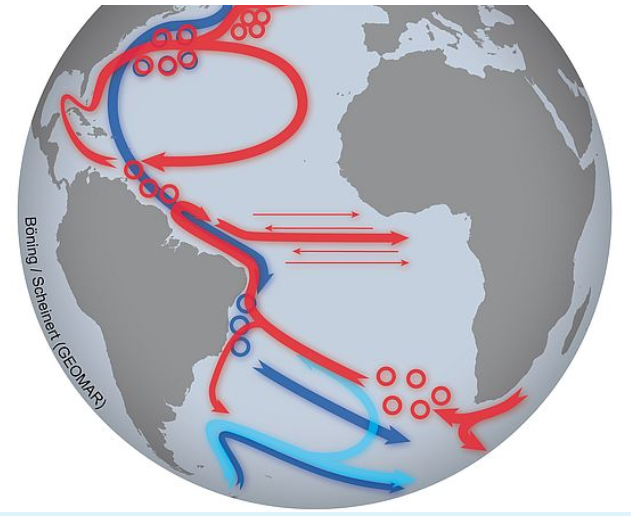
25 April, 2022/Kiel, Germany. With a new publication in the scientific journal Nature Climate Change, researchers from Kiel once again contribute to the understanding of changes in the Atlantic Meridional Overturning Circulation (AMOC) – also known as the “Gulf Stream System”. It is important both for the global climate as well as for climate events in Europe. The authors focus on the question whether human-induced climate change is already slowing down this oceanic circulation. According to the new study, natural variations are still dominant. Improved observation systems could help detect human influences on the current system at an early stage.

Is the Atlantic Meridional Overturning Circulation (AMOC) slowing down? Is this system of ocean currents, which is so important for our climate, likely to come to a halt in the future? Are the observed variations a natural phenomenon or are they already caused by human-induced climate change? Researchers from various scientific disciplines use a wide range of methods to better understand the gigantic oceanic circulation.

“The AMOC provides Europe with a mild climate and determines seasonal rainfall patterns in many countries around the Atlantic. If it weakens over the long term, this will also affect our weather and climate. Other consequences could be a faster rise in sea levels at some coasts or a reduction in the ocean’s ability to take up carbon dioxide and mitigate climate change”, Professor Dr. Mojib Latif, Head of the Research Unit: Marine Meteorology at GEOMAR Helmholtz Centre for Ocean Research Kiel, explains. “We depend on the AMOC in many ways – but so far, we can only guess how it will develop, and whether and how strongly we humans ourselves will push it towards a tipping point where an unstoppable collapse will take its course.”

Using observational data, statistical analyses and model calculations, a team led by Professor Latif has therefore examined changes in the current system over the past one hundred years in greater detail. The results have now been published in the scientific journal Nature Climate Change. According to the researchers, part of the North Atlantic is cooling – a striking contrast to the majority of ocean regions. All evaluations indicate that since the beginning of the 20th century, natural fluctuations have been the primary reason for this cooling. Nonetheless, the studies indicate that the AMOC has started to slow down in recent decades.

Climate models consistently predict a significant slowing of the current system in the future as carbon dioxide emissions continue to rise, the ocean continues to warm, and the melting of the Greenland ice sheet accelerates. “Our results confirm earlier scientific findings. But the question remains how long we will remain in the realm of natural variability and when climate change will take control of the AMOC. Then the trend would only be in the direction of weakening and risks could increase significantly”, co-author and GEOMAR meteorologist Dr. Jing Sun points out.

Better observational data are needed to determine the critical limit, the authors conclude. “Systematic and sustained measurements of the changes already taking place across the Atlantic also allows us to say with greater certainty what influence climate change has on the AMOC current system today and in the future”, says Professor Dr. Martin Visbeck. The head of the Research Unit Physical Oceanography at GEOMAR is also co-author of the new publication. “At the moment, we do not see any clear signs that the system is slowing down dramatically – rather, it is fluctuating. But since the latest climate models agree that a significant reduction will occur, we should know how much longer we are on the relatively safe side of natural change.”

Original publication:

Latif, M., Sun, J., Visbeck, M., Bordbar M.H. (2022): Natural variability dominates Atlantic meridional overturning since 1900. Nature Climate Change, doi 10.1038/s41558-022-01342-4.

via Watts Up With That?

https://ift.tt/XzBn23g

April 30, 2022 at 12:05PM

Claim: Global warming accelerates the water cycle, with relevant climatic consequences

According to a new study led by the ICM-CSIC, this could lead to a destabilisation of the global climate system, an intensification of storms in specific areas, and an acceleration of ice melting at the poles.

Peer-Reviewed Publication

INSTITUT DE CIÈNCIES DEL MAR (ICM-CSIC)

Figure showing the average sea surface salinity of the world' s seas and oceans during the period 2011-2018 / ICM-CSIC.
IMAGE: FIGURE SHOWING THE AVERAGE SEA SURFACE SALINITY OF THE WORLD’ S SEAS AND OCEANS DURING THE PERIOD 2011-2018 / ICM-CSIC. view more 
CREDIT: FIGURE SHOWING THE AVERAGE SEA SURFACE SALINITY OF THE WORLD’ S SEAS AND OCEANS DURING THE PERIOD 2011-2018 / ICM-CSIC.

Researchers at the Institut de Ciències del Mar (ICM-CSIC) in Barcelona have found that global warming is accelerating the water cycle, which could have significant consequences on the global climate system, according to an article published recently in the journal Scientific Reports.

This acceleration of the water cycle is caused by an increase in the evaporation of water from the seas and oceans resulting from the rise in temperature. As a result, more water is circulating in the atmosphere in its vapour form, 90 per cent of which will eventually precipitate back into the sea, while the remaining 10 per cent will precipitate over the continent.

“The acceleration of the water cycle has implications both at the ocean and on the continent, where storms could become increasingly intense. This higher amount of water circulating in the atmosphere could also explain the increase in rainfall that is being detected in some polar areas, where the fact that it is raining instead of snowing is speeding up the melting”, explains Estrella Olmedo, the leading author of the study.

The work also shows that the decrease in the wind in some areas of the ocean, which favours stratification of the water column, i.e. water not mixing in the vertical direction, could also be contributing to the acceleration of the water cycle.

“Where the wind is no longer so strong, the surface water warms up, but does not exchange heat with the water below, allowing the surface to become more saline than the lower layers and enabling the effect of evaporation to be observed with satellite measurements”, points out Antonio Turiel, also an author of the study. In this sense, Turiel adds that “this tells us that the atmosphere and the ocean interact in a stronger way than we imagined, with important consequences for the continental and polar areas”.

Satellites are key for oceanographic studies

To carry out the study, researchers analysed ocean surface salinity data –which is measured by satellites-. Unlike subsurface salinity data -obtained with in situ instruments- the satellite data allowed them to detect this acceleration of the water cycle and, for the first time, the effect of stratification over very large regions in the ocean. According to them, this is due to the ability of satellites to measure data continuously, regardless of environmental conditions and the accessibility of different areas of the ocean.

“We have been able to see that surface salinity is showing an intensification of the water cycle that subsurface salinity does not. Specifically, in the Pacific we have seen that surface salinity decreases more slowly than subsurface salinity and, in this same region, we have observed an increase in sea surface temperature and a decrease in the intensity of winds and the depth of the mixing layer”, details Olmedo.

These findings are the result of the use of algorithms and other data analysis products that the Barcelona Expert Center (BEC), attached to the ICM-CSIC, has been generating in the recent years from the SMOS space mission of the European Space Agency (ESA), designed to acquire observations of ocean salinity, which is essential for understanding ocean circulation, one of the key factors in understanding global climate.

This circulation basically depends on the water density, which is determined by its temperature and salinity. Therefore, changes in these two parameters, however small they may be, can end up having important consequences on the global climate, which makes it key to monitor them closely.

For this, Turiel concludes that “ocean models must standardise the assimilation of satellite salinity data, since the information they provide complements in situ data, and this is crucial, especially at the current time of climate crisis, where changes are occurring much faster than before”.


JOURNAL

Scientific Reports

DOI

10.1038/s41598-022-10265-1 

METHOD OF RESEARCH

Computational simulation/modeling

SUBJECT OF RESEARCH

Not applicable

ARTICLE TITLE

Increasing stratification as observed by satellite sea surface salinity measurements

From EurekAlert!

via Watts Up With That?

https://ift.tt/AqdmI7h

April 30, 2022 at 11:04AM

NEW STUDY: “Part Of North Atlantic Is Cooling”…”Natural Fluctuations Have Been Primary Reason”

How close is the tipping point?

New studies on the Atlantic current system assess the threshold between natural fluctuations and a climate change-driven evolution

25 April, 2022/Kiel, Germany. With a new publication in the scientific journal Nature Climate Change, researchers from Kiel once again contribute to the understanding of changes in the Atlantic Meridional Overturning Circulation (AMOC) – also known as the “Gulf Stream System”. It is important both for the global climate as well as for climate events in Europe. The authors focus on the question whether human-induced climate change is already slowing down this oceanic circulation. According to the new study, natural variations are still dominant. Improved observation systems could help detect human influences on the current system at an early stage.

Is the Atlantic Meridional Overturning Circulation (AMOC) slowing down? Is this system of ocean currents, which is so important for our climate, likely to come to a halt in the future? Are the observed variations a natural phenomenon or are they already caused by human-induced climate change? Researchers from various scientific disciplines use a wide range of methods to better understand the gigantic oceanic circulation.

“The AMOC provides Europe with a mild climate and determines seasonal rainfall patterns in many countries around the Atlantic. If it weakens over the long term, this will also affect our weather and climate. Other consequences could be a faster rise in sea levels at some coasts or a reduction in the ocean’s ability to take up carbon dioxide and mitigate climate change”, Professor Dr. Mojib Latif, Head of the Research Unit: Marine Meteorology at GEOMAR Helmholtz Centre for Ocean Research Kiel, explains. “We depend on the AMOC in many ways – but so far, we can only guess how it will develop, and whether and how strongly we humans ourselves will push it towards a tipping point where an unstoppable collapse will take its course.”

Using observational data, statistical analyses and model calculations, a team led by Professor Latif has therefore examined changes in the current system over the past one hundred years in greater detail. The results have now been published in the scientific journal Nature Climate Change. According to the researchers, part of the North Atlantic is cooling – a striking contrast to the majority of ocean regions. All evaluations indicate that since the beginning of the 20th century, natural fluctuations have been the primary reason for this cooling. Nonetheless, the studies indicate that the AMOC has started to slow down in recent decades.

Climate models consistently predict a significant slowing of the current system in the future as carbon dioxide emissions continue to rise, the ocean continues to warm, and the melting of the Greenland ice sheet accelerates. “Our results confirm earlier scientific findings. But the question remains how long we will remain in the realm of natural variability and when climate change will take control of the AMOC. Then the trend would only be in the direction of weakening and risks could increase significantly”, co-author and GEOMAR meteorologist Dr. Jing Sun points out.

Better observational data are needed to determine the critical limit, the authors conclude. “Systematic and sustained measurements of the changes already taking place across the Atlantic also allows us to say with greater certainty what influence climate change has on the AMOC current system today and in the future”, says Professor Dr. Martin Visbeck. The head of the Research Unit Physical Oceanography at GEOMAR is also co-author of the new publication. “At the moment, we do not see any clear signs that the system is slowing down dramatically – rather, it is fluctuating. But since the latest climate models agree that a significant reduction will occur, we should know how much longer we are on the relatively safe side of natural change.”

Original publication:

Latif, M., Sun, J., Visbeck, M., Bordbar M.H. (2022): Natural variability dominates Atlantic meridional overturning since 1900. Nature Climate Change, doi 10.1038/s41558-022-01342-4.

Donate – choose an amount

via NoTricksZone

https://ift.tt/e1A3rVo

April 30, 2022 at 09:59AM

Society Damaged by Surge of Narcissists

Ross Pomeroy writes at Real Clear Science What Are the Effects of America’s Narcissism Epidemic? Excerpts in italics with my bolds and added images.

There’s a strong case to be made that since the end of World War II, Americans have grown increasingly narcissistic on average – more entitled, with an inflated sense of self-importance.

Psychologists Jean Twenge and W. Keith Campbell are most responsible for collecting data and creating a narrative to support this claim. According to the duo, the rise began with the Baby Boomers, who grew up in an era of relative ease and plenty after their grandparents endured a Great Depression and their parents soldiered and sacrificed through World War II. By the time they were college-aged, Boomers eschewed the collectivist mindset of their elders in favor of individualism.

The trend continued with Boomers’ kids. As Dennis Shen wrote for the London School of Economics’ Phelan United States Centre, “One study comparing teenagers found that while only 12% of those aged 14-16 in the early 1950s agreed with the statement “I am an important person”, 77% of boys and more than 80% of girls of the same cohort by 1989 agreed with it.”

And, of course, the rise in narcissism has persisted since. In 2008, Twenge published a study comparing college students’ scores on the Narcissistic Personality Inventory scale to scores from students in 1979, finding that levels of narcissism had risen roughly 30 percent.

Additional research has evinced this increase. “59% of American college freshmen rated themselves above average in intellectual self-confidence in 2014, compared with 39% in 1966,” Shen wrote.

Owing to the elevated prevalence of social media services over the past decade, it’s highly likely that the rise in narcissism has only accelerated of late.

We see it on Twitter, where users flock to share their ‘brilliant’ opinions. We see it on Instagram and TikTok, where people carefully curate their online personas. We also see it in traditional media sources, where elite-educated journalists often make themselves the story and focus on tending their Twitter profiles. Narcissism also reigns on television news. Gone are the days of humble correspondents and “just the facts” anchors, replaced by talking heads and opinionated hosts more interested in their ratings than the truth.

Of course, while narcissism has risen, that doesn’t mean we are all narcissists. It exists both as a trait, which is on a spectrum, and a personality disorder, which is much more extreme and debilitating. Narcissistic personality disorder has actually remained fairly stable in the U.S. over the past decades. This means that the average American is more self-centered than they used to be, but decidedly not stuck in their own head.

What are the wider effects of this psychological transition?

As Shen speculated, partisanship has exploded as people have grown more enamored with their own beliefs and less open to others’. Debt-financed conspicuous consumption “to elevate one’s status in front of others, rather than out of necessity” has risen. And an increasing disdain for government could partly be attributed to a focus on somewhat arrogant self-sufficiency.

There is also another way to look at the rise in narcissism – as a defense mechanism. Narcissism is often driven by low self-esteem and insecurity. Since the 1950s, wealth inequality has risen, cost of living has exploded, especially for housing, and puchasing power has stagnated. Combine these economic pressures with the competitive, pressure-filled media environment since the turn of the century and you have a recipe for a rise in narcissism. And sadly, narcissism is linked to elevated hostility and aggression towards others. One hopes that Americans can find a way to cool their collective narcissism before it boils over.

Narcissism Linked to America’s Political and Economic Crises

Denis Shen adds discussion at LSE (London School of Economics) A rise in narcissism could be one of the main causes of America’s political and economic crises.  Excerpts in italics with my bolds.

Dennis Shen tracks narcissism’s rise, the potential link to economic conditions and discusses consequences. Moreover, he notes the striking phenomena now comparably evolving in China and abroad.

At extremes, narcissism undermines institutions that underpin a strong society, with links to shallow values, less intellectual interest and value on hard work, aggression and relationship complications, and lack of empathy and concern for others. When we consider political or economic dilemmas, we should not avoid discussion of the role that cultural factors and social psychology might have.

A multi-generational change

In the aftermath of the Second World War, a rare consensus within America emerged, the result of existential crises in the form of the World War and looming Cold War. In an era when the United States’ hegemony was unchallenged in the West, a type of groupthink existed within the nation’s borders—the ‘Greatest Generation’ emphasized conformity and discouraged individuality. This was supported by earlier shared struggles and the decline of class differences during the Great Depression and war era. This post-war era of togetherness saw unprecedented economic stability and trust in the state as the steward of the people. The nation backed global reciprocity, exemplified during the founding of the United Nations, Bretton Woods institutions and Marshall Plan.

As the Baby Boomers came of age in the 1960s and 70s, the grey society of the post-war consensus had begun to vanish in favor of a more individualistic focus on self-expression and self-identity.

The problem is that this change in the narrative furthered henceforth. It became pronounced enough by the 1970s that Tom Wolfe in 1976 titled this “The ‘Me’ Decade”. The cohorts that were raised in the 70s and 80s—Generations X and Y—continued this trend: to the extent that one study comparing teenagers found that while only 12% of those aged 14-16 in the early 1950s agreed with the statement “I am an important person”, 77% of boys and more than 80% of girls of the same cohort by 1989 agreed with it. This evolution has accelerated since the 1990s and 2000s, with the rise of the internet and social media influencing the social milieu of the Millennials and Generation Z.

Cultural roots of the modern crisis

Many of the extant crises in the United States can be traced to some extent to such cultural factors and entitled behavior. The racial and ideological tensions, and consequential partisanship in Washington—which supported the election of Donald J. Trump, have been exacerbated by the self-focused and competitive behavior of separate interest groups in society and politics, with not enough of the requisite empathy to reassess the world from one another’s vantage points. The financial crisis can be explained in part by the narcissistic behaviors of bankers and consumers alike—creating a “time-delay trap” of near-term greed over long-term logic. America’s trade deficit has been exacerbated by debt-financed “conspicuous consumption”—goods purchased to elevate one’s status in front of others, rather than out of necessity. And the crisis of confidence in government can be ascribed in part to the philosophical “hunkering down” and focus on self-sufficiency, rather than on mutual dependence.

Methods to address narcissism are not simple, however, even if society is malleable. During times of economic growth and stability, narcissism tends to grow. This is due to how success and prosperity impacts people, how that then filters to more accommodating parenting norms, and how we’re affected by urbanization and changes to smaller family sizes. Conversely, economic hardship and economic down-cycles tend to support group-minded, non-self-centered people, by enforcing modesty and hard work. In that, there may be both an inherent cyclical dynamic between business cycles and narcissism, and a structural dynamic between economic development and narcissism—with too much societal hubris only correctable in the end through a form of economic or national crisis.

A crisis around the world

The issue has not been isolated to the United States. Rather, the evolution of narcissism has advanced around corners of the world.

In China, there’s been an economic revolution experienced within the span of half a lifetime—with hundreds of millions lifted out of poverty since 1980 and living standards transformed and modernized. But, with the economic miracle has come the sudden upheaval in former collectivistic norms. The rise of the ‘Little Emperors’ and ‘Precious Snowflakes’ is now evident in younger generations that have grown up in only-child households amongst growing economic abundance. Research notes the role of sociodemographic factors in this increase in narcissism. In the decades ahead, societal, political and economic dilemmas could manifest, if such trends in China advance absent pushback.

A recognition of the problematic associations with narcissism is critical to solving domestic and international issues impacted by it. In addition, greater attention needs to be placed in policy circles on how economic and political development can be furthered whilst preserving or inducing characteristics of a cohesive, self-critical community.



via Science Matters

https://ift.tt/iy173SX

April 30, 2022 at 09:39AM