Month: April 2022

Hype-Dream: World’s Renewable Energy Storage Capacity Destined to Remain Totally Trivial

When they’re not bursting into toxic fireballs, the contribution made by giant lithium-ion batteries remains utterly trivial. They are, after all, electricity storage devices and don’t add a lick to electricity generation capacity, anywhere.

The cost of battery storage, at scale, is out of all proportion to the benefits returned and we wouldn’t be having this discussion were it not for the hopeless intermittency of wind and solar. No one talked about electricity storage when we allowed nuclear, coal-fired and gas-fired plants to deliver power, 24 x 7, whatever the weather.

At best, battery storage provides additional frequency control at the margins, but it’s the chaotic delivery of wind and solar that increased demand for that as a “service” which grid managers pay a premium for.

But that’s not the pitch put forward by the wind and solar acolytes, who tell us that by adding more and larger lithium-ion batteries, we will soon be powered by nothing more than sunshine and breezes.

Consistent with their model of hype fuelled nonsense, it is, of course, complete rubbish.

One of their persistent antagonists is Francis Menton, who has dedicated his efforts to exposing another whopping lie associated with the great Green Reset.

The People Promising Us “Net Zero” Have No Clue About The Energy Storage Problem
Manhattan Contrarian
Francis Menton
27 March 2022

If you are even a semi-regular reader of this blog, you know about the energy storage problem that is inherent in the effort to eliminate dispatchable fossil fuels from the electricity generation system and replace them with wind and solar. As discussed here many times, other than with nuclear power, the storage problem is the critical issue that must be addressed if there is ever going to be “net zero” electricity generation, let alone a “net zero” economy based on all energy usage having been electrified. For a sample of my prior posts on this subject just in the last few months, go here, here and here.

The problems of trying to provide enough storage to back up a fully wind and solar system without fossil fuels are so huge and so costly that you would think that everyone pushing the “net zero” agenda would be completely focused on these issues. And given that the issues are quite obvious, you would think that such people would be well down the curve with feasibility studies, cost studies, and demonstration projects to make their case on how their plans could be accomplished. Remarkably, that is not the case at all. Instead, if you read about the plans and proposals in various quarters for “net zero” in some short period of years, you quickly realize that the people pushing this agenda have no clue. No clue whatsoever.

Today, I am going to look at discussions of the storage situation coming out of three jurisdictions with ambitious “net zero” plans: California, Australia and New York. First a very brief summary of the problem. It is (or certainly should be) obvious that wind and solar generators have substantial periods when they generate nothing (e.g., calm nights), and other times when they generate far less than users demand. Get out a spreadsheet to do some calculations based on actual historical patterns of usage and generation from wind and solar sources, and you will find that to have a fully wind/solar generation system and make it through a year without a catastrophic failure, you will need approximately a three-times overbuild (based on rated capacity) of the wind/solar system, plus storage for something in the range of 24 – 30 days of average usage. For these purposes “usage” at any given moment is measured in gigawatts, but usage for some period of time is measured in gigawatt hours, not gigawatts. California’s average electricity usage for 2020 was about 31 GW; Australia’s was about 26 GW ; and New York’s was about 18 GW.

To calculate how much storage you need in gigawatt hours, multiply average usage in GW by 30 days and 24 hours per day. So California will need about 22,302 GWH of storage, Australia about 18,720 GWH, and New York about 12,960 GWH. That is to supply current levels of demand. For the “everything electrified” case, triple all of these numbers: 66,906 GWH for California, 56,160 GWH for Australia, and 38,880 GWH for New York. Price that out at current costs of Tesla-type lithium-ion batters (~$150/KWH) and you will get around $10 trillion for California, $8.4 trillion for Australia, and $5.8 trillion for New York. These figures are in the range of triple total annual GDP for each of these jurisdictions, before you even get to the cost of the three-times overbuild of the generations system to account for charging of the batteries when the sun is shining and wind blowing. Nor can Tesla-style batteries hold charge for months on end as would be necessary for this system, but at this point, that seems like a minor quibble.

With that, let’s consider some recent discussion of the march toward “net zero” in each of these jurisdictions:

California. On March 14, PV Magazine (I think that stands for “Photo Voltaic”) had a piece by Christian Roselund with the title “California’s solar market is now a battery market.” The gist is that California’s solar developers have now caught on to the need to pair batteries with their projects, and that therefore new projects going forward are as much battery projects as solar panel projects. Here’s a sample of the cheerleading:

No US state has led the energy transition like California has. . . . As a result California has been a pioneer for a range of clean energy technologies. . . . California is on the cusp of no longer being a solar market where batteries are being added – instead, it is becoming a battery market that (sometimes) includes solar.

So how much battery capacity is being added by the new projects?:

According to the American Clean Power Association, California had only 256MW of utility-scale batteries before 2020, but had reached 2.1GW by the end of 2021 – an eightfold increase. . . . The 256 solar-plus-storage projects representing 72GW of solar and 64GW of batteries make up the vast majority of hybrid projects in the CAISO queue. . . . California will need all the energy storage it can get its hands on; a recent analysis suggests that the state needs 37GW of batteries over the next 20 years, as well as 53.2GW of utility-scale solar.

It’s all GW, GW, GW. But guys, how about the amount of GWH that California will need? You will not find any mention of that unit in this piece. Sorry, but if those 64 GW of batteries you are planning to buy only store energy for one hour, then you will need to multiply your purchase by about a factor of a thousand. If they store energy for about four hours (typical of what you might be able to buy today), then multiply your purchase by a factor of 250.

Could they really be so far off from the actual problem? I’m afraid that the answer is yes.

Australia. Over in Australia, it appears that they have people who have figured out that they need to measure the storage requirements for wind/solar backup in GWH rather than GW. Here is a piece from March 25 from Energy Storage News, headline “Australia surpassed 1GWh of annual battery storage deployments during 2021.” That’s huge progress. But one GWH?

Read the article, and again it’s all cheerleading for the great progress being made:

[F]or Victoria it was a record-breaking year, while NSW has already recorded strong installation volumes and its tally of 7,377 installations was in line with figures in recent years. . . . Victoria hosts a 48% share of the commercial and grid-scale operating capacity today, with South Australia the next biggest at 24%, Queensland on 14% and NSW on 9%. Last year, the Victorian Big Battery came online, which at 300MW/450MWh made a big contribution to the state’s total.

And how much is in the pipeline?:

There is around 1,000MWh of grid-scale energy storage currently under construction, but the development pipeline of projects is a massive 57GWh.

“A massive” 57 GWH. Really? Has anyone told them that they are going to need more like 56,160 GWH to fulfill their “net zero” fantasies? Like California, they are off by about a factor of 1000. Here is a picture from the article of what a Tesla-type battery installation for a mere 150 MWH looks like. That’s well less than 1/6 of one GWH.

Looks like they’re going to need 400,000 +/- of these installations. And by the way, these Tesla-style batteries have no ability to store energy without loss for months on end. Good luck trying to find anyone addressing these issues.

New York. In crazy New York, we have a statute passed in 2019 that requires state-wide greenhouse gas emissions to be cut to 60% of 1990 levels by 2030. Since electricity is less than 1/3 of final energy consumption, this would necessarily mean that all fossil fuel electricity generation will be gone in 8 years.

How to do that? A collection of panels and advisory bodies have been putting out reams of reports, thousands of pages in the aggregate. Nobody could possibly keep up. On the other hand, it is obvious that essentially no batteries are yet under construction.

A lone guy named Roger Caiazza, who blogs as the Pragmatic Environmentalist of New York, is the only critical thinker I am aware of who tries to read most of this stuff. On March 25 Caiazza had a post titled “What the Experts Are Saying Now.” That post was also picked up at Watts Up With That here.

Here’s Caiazza’s big discovery. Rather than proposing a massive build of batteries, New York’s “experts” think they have a better idea: the “DEFR”. That stands for “Dispatchable Emissions Free Resource.” And what exactly is that? As far as Caiazza can determine, it’s something that hasn’t been invented yet. Caiazza links to this March 24 Report from New York’s Independent System Operator, title “System and Resource Outlook Update.” Plow your way through through 17 pages of incomprehensible gibberish and you will come to this on page 18:

DEFR Builds Allowed Starting in 2030

Input Assumption Adjusted:
First allowable year for DEFR builds advanced to 2030

Caveats:

    • Significant uncertainty related to cost / availability of DEFR technologies, as well as regulatory definition of “zero-emissions” compliant technologies
    • Assumption is not based on estimate of realistic timeline for first potential DEFR additions

Observations:

    • DEFR capacity build earlier on in model horizon,although comparable capacity builds by 2040
    • Decreased fossil capacity (i.e., primarily earlier retirements and less new builds) offset by earlier DEFR capacity additions

Yes, we are to be completely dependent on so-called “DEFR” technologies, which have not been invented yet and as to which “significant uncertainties” exist. Could this get any more ridiculous?

I guess if you work at the ISO and open your mouth and say “this can’t possibly work,” you will be immediately fired. And so we plow forward with religious zeal, until one day we hit the wall.
Manhattan Contrarian

They want us to do what?

via STOP THESE THINGS

https://ift.tt/0F1AHcp

April 20, 2022 at 02:30AM

Nothing Here? AWEA/ACPA on Altamont Pass’s Golden Eagle Carnage in 2011

The recent action of the U.S. Department of Justice against a major wind developer for ‘takings’ of golden eagles (see Monday’s post), as well as the tip-of-the-iceberg problem of such wind carnage, is major news. The post today revisits a decade-old dodge of the problem by the American Wind Energy Association (AWEA), now part of the American Clean Power Association. So where were the real environmentalists then–and where are they today?

—————

The double-standard and hypocrisy of the AWEA can be documented from their August 19, 2011, release: Fact Check: Fox News Off Base on Bird Collisions, concerning Altamont Pass’s impact on golden eagles. The op-ed follows with comment:

FoxNews.Com carried a story on bird collisions a few days ago with a number of misleading statements.  We covered much of the same ground with a response to the Los Angeles Times in early June (see “News story draws questionable conclusions from eagle collisions with old turbines,” June 6, 2011), and won’t repeat that material at length.

Corrections of some specific items in the Fox piece:

1) The problem of golden eagle collisions with older, smaller, high-RPM wind turbines in Altamont Pass is nothing new, and has been known (and been in the media periodically) since the early 1990s.

COMMENT: Yes, the problem is old news, but why does this make it okay? And now that it is a decade older, does it make it any less important or forgivable? No, it is just the opposite.

2) Even in Altamont Pass, which has a far higher rate of golden eagle losses than any other U.S. wind farm, exhaustive studies have failed to show any impact on the local breeding population (one of the largest in the world).

COMMENT: Untrue. So what did AWEA do to discourage the studies that were deserved? What was happening behind the scenes with the wind lobby and involved government agencies? Jim Wiegand knows.

3) The most probable reason why wildlife agencies have not prosecuted wind farm operators for bird collisions is that, unlike other individuals and companies prosecuted for bird deaths, the wind power industry has proactively worked with the agencies to study the problem and try to find ways to reduce fatalities.  Many proposed solutions have been tried in Altamont Pass, from installing anti-perching devices to keep birds from perching on turbines to paint schemes aimed at making the turbine rotor blades more visible.  Most recently, the preferred approach has been “repowering”–replacing the old 1980s-vintage turbines with new, larger, lower-RPM machines.  In a landmark legal agreement with then-California Attorney General (now Governor) Jerry Brown last December, the largest operator of turbines in Altamont agreed to change out its entire fleet by 2015, and to pay $2.5 million in mitigation fees (something that is oddly omitted from the Fox article).

COMMENT: Proactive? Trying to solve a problem begs the question: why is there a problem. And why has the problem remain unsolved–then and now?

[Rest of AWEA’s Press Release: I will not comment–read it and weep]

Stepping back for a moment to look at the larger picture of wind and wildlife, here are some additional important facts to keep in mind:

– Wind power is far less harmful to birds than the fossil fuels it displaces. Incidental losses of individual birds at turbine sites will never be more than an extremely small fraction of bird deaths caused by human activities.

Wind is the only source of energy that does not present population-level risks to birds, unlike coal, oil, natural gas, nuclear, and hydroelectric power. Non-renewable energy sources “pose higher risks to wildlife” than renewable sources.  Coal–which wind directly replaces–“is by far the largest contributor” to wildlife risks.

Wind power causes far fewer bird fatalities (under 150,000 a year) than buildings (550 million), power lines (130 million), cars (80 million), poisoning by pesticides (67 million), domestic cats (at least 10 million if not much higher), and radio and cell towers (4.5 million).  The largest documented multiple bird mortality event related to wind energy in the U.S. has been 27 birds. Only 4 events involving more than 3 birds at a single turbine have been reported. See “Wind turbine bird threat modest,” January 18, 2011, for a summary of an article from a peer-reviewed journal. By contrast, thousands of birds have died in a single night at a single communication tower. Thousands of birds have even died in a single night due to collisions with the chimneys of a single coal-fired power plant.

Related articles:

News story draws questionable conclusions from eagle collisions with old turbines, June 6, 2011
WINDPOWER report: Whooping cranes may avoid wind farms, more research ahead, May 25, 2011
Wind developer launches intensive avian monitoring program, May 23, 2011
AWEA files comments on “unworkable” U.S. Fish & Wildlife Service guidelines, May 19, 2011
U.S. Fish & Wildlife Service, AWEA, wind developers sign agreement to promote endangered species conservation, April 20, 2011
Wind industry backs research on bat concerns including White-Nose Syndrome, April 1, 2011
Wind turbine bird threat modest, January 18, 2011
Editorial: How serious is threat to birds?, January 5, 2011
Wind energy and birds: No double standard, September 9, 2009
Wind-wildlife group names first president, February 24, 2009

The post Nothing Here? AWEA/ACPA on Altamont Pass’s Golden Eagle Carnage in 2011 appeared first on Master Resource.

via Master Resource

https://ift.tt/bZREYN1

April 20, 2022 at 01:10AM

Wrong, WDSU, Climate Change Is Not Causing an Increase in ‘Dixie Alley’ Tornadoes

A Tornado forming in the evening from a supercell.

From ClimateREALISM

By Linnea Lueken

A recent article by a meteorologist writing for WDSU New Orleans, “Rising tornado numbers linked to climate change, study says,” makes the erroneous claim that climate change is causing more tornadoes in the southeastern United States. In reality, data show overall tornado occurrences nationwide are likely trending downwards as the planet modestly warms. The writer of the article appears to have misrepresented or misunderstood tornado research.

Meteorologist Adam McWilliams says climate change is shifting more tornadoes into “Dixie Alley,” a region of the Southeastern United States that has a high tornado outbreak frequency.

McWilliams writes in the WDSU article, “The National Oceanic and Atmospheric Administration [NOAA] says since January 2019, 99 of the nation’s 120 tornado-related deaths – 83% — have occurred in the Southeast. In the 2010s, NOAA says 54% of tornado deaths occurred in the Southeast, up from 25% in the 1980s.”

This is a poor argument. As a matter of logic, if the number of tornadoes in Tornado Alley decrease, as some research suggests, then the percentage of deaths by region would be expected to shift, as well.

After misrepresenting NOAA’s findings McWilliams referenced another report, writing, “A 2016 study from Purdue University says that climate change is linked to this increase in tornado activity,” and describes the results of the study, which found an eastward bias for tornado occurrence over time.

In the Purdue news release linked in the article, the study’s authors make far more modest, scientifically circumspect claims. The researchers forthrightly state more research is needed before they could definitively point to climate change as the culprit.

Their research divided the last sixty years into two thirty-year sections, and analyzed tornado occurrences, with the earlier thirty year block representing a cooler period.

From the release:

Data showed a notable decrease in both annual counts and tornado days in the traditional “tornado alley” of the central plains, aided by declines in summer and autumn. However, annual values were sustained in the southeast with some increase in “Dixie alley” due in part to substantial autumn seasons increases from Mississippi to Indiana, Agee said.

Severe tornadoes are decreasing nationally, contrary to alarmist claims, a fact NOAA has recently tried to hide. Climate Realism has covered this several times, including herehere, and here, for example.

As the NOAA Tornado Climatology and Data page explains:

“The increase in tornado numbers is almost entirely in weak (EF0-EF1) events that are being reported far more often today due to a combination of better detection, greater media coverage, aggressive warning verification efforts, storm spotting, storm chasing, more developmental sprawl (damage targets), more people, and better documentation with cameras (including cell phones) than ever.”

Got that! Better detection of tracking of weak tornadoes, not more tornadoes, are responsible for the seeming increase in tornadoes overall.

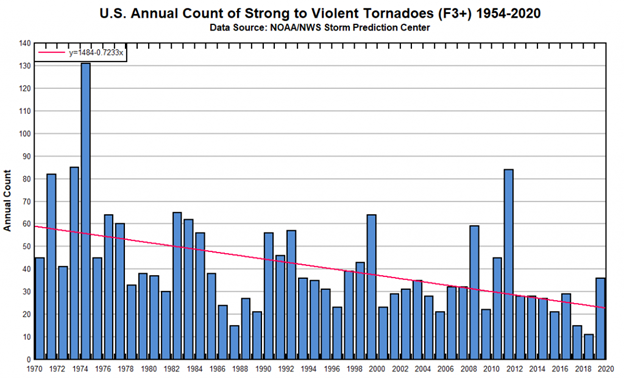
When Climate at a Glance: Tornadoes analyzed extreme tornadoes (EF3+), shown in the Figure below, which would have been harder to miss in the past, it found a notable decline.

This figure shows the frequency of strong to violent tornadoes (tornadoes registering EF3 or stronger) has been declining since the early 1970s. Sources: Graph by Anthony Watts using official NOAA/Storm Prediction Center data, accessed August 16, 2021, https://ift.tt/72yZ5O1

Tornadoes are weather events, and cannot be conclusively linked to a changing climate. When presented the question “Does climate change cause tornadoes,” NOAA’s tornado research FAQ compiled by Roger Edwards responds with a solid “No,” and goes on to explain that “Climate models cannot resolve tornadoes or individual thunderstorms.”

Even the VORTEX Southeast page linked by McWilliams rejects his premise, and goes into detail about the reasons why tornado outbreaks in the Southeast seem to be worse than in other regions.

From their home page:

For example, tornadoes in the Southeast occur in a region often characterized by hills and trees which reduce visibility of the horizon. They are also more likely to occur at night, in fast-moving storms, and earlier in the year compared to other parts of the country. Furthermore, vulnerability is increased by unique socioeconomic factors, which VORTEX-Southeast research has shown include inadequate shelter, housing type, and larger population density relative to other tornado-prone areas in the U.S.

The real problem for the southeast, especially Mississippi, which in fairness McWilliams did devote the second half of his article to, is poor infrastructure and a larger, more dense population with a lot of people living in mobile homes. This combination of dense population and fragile infrastructure offers more, more vulnerable, targets for tornado damage.

As a meteorologist, McWilliams should have recognized this, and been more honest in his reporting on tornado occurrences in the southeast. It seems before sitting down to write, McWilliams failed to do the research necessary to provide a balanced, fully informed article on tornado trends in the Southeastern United States. Perhaps that was intentional, since only a misrepresentation of the evidence can generate alarming claims that climate change is causing more tornadoes.

Linnea Lueken

https://www.heartland.org/about-us/who-we-are/linnea-lueken

Linnea Lueken is a Research Fellow with the Arthur B. Robinson Center on Climate and Environmental Policy. While she was an intern with The Heartland Institute in 2018, she co-authored a Heartland Institute Policy Brief “Debunking Four Persistent Myths About Hydraulic Fracturing.”

via Watts Up With That?

https://ift.tt/TlKLM0n

April 20, 2022 at 12:55AM

Upper Midwest Counties Attempt to Block CCS Pipeline

Guest “NIMBY’ism?” by David Middleton

  • CCS: Carbon (technically CO2) Capture and Sequestration (or Storage)
  • CCUS: CCS+ Utilization
  • NIMBY: Not In My Back Yard
  • NIMBY’ism: Actively opposing something because it’s too close to home.

Technically the counties are attempting to block the use of eminent domain in the construction of this pipeline project.

Counties taking action against eminent domain for carbon capture pipeline
Some North Dakota counties have passed resolutions against using eminent domain for right-of-way for a carbon capture pipeline. Iowa-based Summit Carbon Solutions is behind a $4.5 billion project that covers five states.

By Jeff Beach April 18, 2022

KINDRED, N.D. — Todd McMichael looks out over pasture land that his family owns along the Sheyenne River expecting to see prairie chickens, deer and pheasants.

When it greens up, there will be cattle grazing on the land near Kindred, North Dakota, that has never been tilled.

What he doesn’t want to see is workers sinking a pipeline into the ground.

McMichael describes himself as becoming a “mouthpiece” for landowners in the path of the Summit Carbon Solutions pipeline in North Dakota who object to the threat of eminent domain to gain right-of-way for the pipeline.

He made a presentation in front of his county board in March, which unanimously adopted a resolution: “That the Richland County Commission officially opposes eminent domain for the Summit Carbon Solutions Pipeline within Richland County, North Dakota.”

Neighboring Sargent County has passed a similar resolution. McMichael says there are presentations soon to be made in Dickey and Emmons counties and conversations taking place with landowners in Burleigh and Morton counties.

[…]

In northern South Dakota, McPherson County has issued a moratorium on pipeline construction, but Bruce Mack, an organizer of opponents there, said that is part of county effort to upgrade its zoning and there are moratoriums against large hog barns and wind turbines also. But he added that there is “very stiff opposition” in the county.

[…]

A letter of opposition filed April 5 by commissioners of Brown County, which includes Aberdeen, reads, in part: “The farmers who will be affected by this pipeline are refusing to sign easements that are being offered to them by SCS Carbon Transport. This company is using strong-arm tactics in response to the refusal to sign these easements. The affected farmers fear the inevitable use of eminent domain and the loss of private property rights.

“There is great concern about the safety of the SCS Carbon Transport pipeline. With the pipe being placed only four feet underground and at 2100 PSI, if this pipeline should happen to rupture, there could be serious human and animal consequences.”

[…]

Liquid carbon dioxide is a hazardous material, and a rupture of a carbon dioxide pipeline in Mississippi sickened dozens of people. Opponents add that carbon dioxide can render emergency vehicles useless by robbing the air of the oxygen needed for gas engines to run.

[…]

AGWEEK

North Dakota Gov. Doug Burgum, a supporter of the project, has stated that eminent domain would not be employed. Although, since the pipeline system would be a “common carrier,” eminent domain is certainly applicable.

It’s not clear whether the opponents simply oppose pipelines, CO2 pipelines in particular, or just want to be left alone. Whatever, the case, this project will almost certainly move forward.

Safety

All industrial activities are hazardous at some level. In terms of transporting oil, petroleum products, natural gas and hazardous gases and liquids, pipelines are the safest form of transportation.

Pipelines are the safest, most reliable way to transport energy

US Department of Transportation data shows pipelines are the safest mode of energy transportation. Accidents are rare. According to the most recent numbers available, 99.999997% of gas and crude oil is moved safely through interstate transmission pipelines. Statistics from the National Transportation Safety Board show pipelines make up less than one one-hundredth of one percent (0.01%) of all transportation accidents in the U.S.

American Fuel & Petrochemical Manufacturers

I was going to post the graphs from the U.S. Department of Transportation, Pipeline and Hazardous Materials Safety Administration (PHMSA), but their website (or my browser) isn’t cooperating at the moment.

As of 2015, there were over 4,500 miles of CO2 pipelines in operation in the US and Saskatchewan.

Spanning across more than a dozen U.S. states and into Saskatchewan, Canada, a safe and
regionally extensive network of carbon dioxide (CO2) pipelines has been constructed over the
past four decades. Consisting of 50 individual CO2 pipelines and with a combined length over
4,500 miles, these CO2 transportation pipelines represent an essential building block for linking the capture of CO2 from electric power plants and other industrial sources with its productive use in oilfields and its safe storage in saline formations. Expanding this system could help to enable fossil-fired power generation in a carbon constrained environment and increase energy security by enhancing domestic oil production.

The vast majority of the CO2 pipeline system is dedicated to enhanced oil recovery (CO2-EOR),
connecting natural and industrial sources of CO2 with EOR projects in oil fields. Roughly 80
percent of CO2 traveling through U.S. pipelines is from natural (geologic) sources; however, if
currently planned industrial CO2 capture facilities and new pipelines are built, by 2020 the
portion of CO2 from industrial-sources could be nearly equal to that from natural sources. In
terms of future potential, it is estimated that up to 4 million barrels per day of oil could
potentially be produced in the U.S. with CO2-EOR and that 85% of this would be reliant on
industrial CO2; contributing to significantly fewer oil imports and annual emissions reductions of 400 MMTCO2, by 2030.

A Review of the CO2 Pipeline Infrastructure in the U.S., 2015, US Department of Energy

The February 2020 Mississippi incident involved Denbury’s Delta Pipeline, which transports CO2 and H2S from Jackson Dome to Delhi oil field, where the CO2 is used for enhanced oil recovery (EOR).

Denbury has had a couple of well control incidents, leading to no human fatalities. One of the incidents, a 2011 blow out in Delhi Field, resulted in the company being hit with one of the largest environmental fines in Mississippi state history (there’s some hidden sarcasm here).

Industrial accidents happen. Everyone I know of in the oil & gas industry does everything possible to avoid accidents, mostly be avoiding the conditions that lead to accidents. This effort was seriously magnified after Macondo (Deepwater Horizon).

The rupture of the Delta Pipeline was “the first known instance of an outdoor mass exposure to piped CO2 gas anywhere in the world“… (No, Lake Nyos isn’t an example.)

Right now, the only articles about this incident are hair-raising tales resembling a zombie apocalypse. This is not meant to diminish the seriousness of this pipeline breach. It’s imperative that the cause(s) be identified. The PHMSA hasn’t issued a report on this yet. We won’t know the causes and/or possible preventive measures until they issue a report.

What are these counties trying to block?

Summit Carbon Solutions is partnering with more than 30 ethanol plants across a five-state region. Located in Iowa, Minnesota, North Dakota, South Dakota, and Nebraska, this meaningful investment in the future of agriculture will capture carbon dioxide from the fermentation process of biorefineries such as ethanol plants, compress the captured CO2, and channel it to North Dakota where it will be permanently and safely stored underground in deep geologic storage locations. Doing so will drastically reduce the carbon footprint of ethanol production and enhance the long-term economic viability of the ethanol and agriculture industries. As one of the largest private investments in the region, Summit Carbon Solutions’ project will generate thousands of jobs during construction and hundreds of full-time jobs once operational.

Summit Carbon Solutions

The largest oil producer in North Dakota, Continental Resources, recently joined the project.

Continental Resources ventures into carbon capture with 5-state ethanol project
Oil developer Continental Resources says it can lend its expertise on the geology of North Dakota, where greenhouse gases from 31 ethanol plants will be stored underground. Summit Carbon Solutions is behind the $4.5 billion project.

By Jeff Beach March 02, 2022

CASSELTON, N.D. — Continental Resources, which helped drive a resurgence in North Dakota’s oil industry, is investing in what is being billed as the largest carbon capture project in the world — taking greenhouse gas emissions from ethanol plants and storing it underground in North Dakota.

Iowa-based Summit Carbon Solutions on Wednesday, March 2, announced a $250 million investment from Continental Resources, which also will contribute it’s expertise in North Dakota’s geology.

In an interview, Harold Hamm, the founder of Continental Resources said the storage area in Mercer and Oliver counties west of Bismarck, is an “ideal place” for carbon storage, a key component of North Dakota’s goal to be carbon neutral by 2030.

“We believe that this is the right thing to do for the right reasons, for the environment, for ag, for industry, for the country, and that’s why we’re here,” Hamm said.

[…]

Tharaldson Ethanol is one of 31 ethanol producers in five states to sign on to the Summit Carbon Solutions pipeline. The $4.5 billion project called the Midwest Carbon Express would benefit ethanol plants by allowing them to sell fuel on the low-carbon market for a premium price.

Gary Tharaldson, the owner of Tharaldson Ethanol, said the buy-in of Hamm and Continental Resources, “is going to make this better for us than we had already expected.”

[…]

Summit says it isn’t asking for any of the ethanol plants to help pay for the pipeline project, instead, it would take a percentage of the premium price that ethanol plants would get in the low-carbon markets, such as California.

Summit also is banking on a federal tax credit of $50 for every ton of carbon dioxide that is permanently stored.

[…]

AGWEEK

In terms of CO2 capture, ethanol plants are “low hanging fruit”.

Why CCUS for Ethanol Producers? Why Now? 

Ethanol producers are uniquely positioned to take advantage of financial incentives for CCUS right now. Here’s why: 

*CO2 released during the fermentation stage of ethanol production is highly purified, with just a bit of water to remove. 

*Most ethanol producers in the U.S. are located in areas with favorable geology (particularly through the Midwest and heartland) and near oil producers in need of purified CO2 for EOR. 

*Changes to the 45Q tax credit have made monetization of CCUS more viable for smaller CO2 emitters, including ethanol producers. 

Battelle

The geology of the Williston Basin is well-suited for CCS. The area being considered for the injection site has been extensively investigated. In terms of understanding the geology and drilling operations in the Williston Basin, no one is better than Continental Resources.

Why do it?

For starters, North Dakota’s Republican governor supports it:

Burgum touts goal to make North Dakota carbon neutral by 2030
AMY R. SISK May 12, 2021

Gov. Doug Burgum announced a goal Wednesday to make North Dakota carbon neutral by the end of the decade.

He challenged the state’s energy and agriculture industries to work toward the goal through innovation, a theme he has repeated frequently throughout his four years in office. Increasingly, states and businesses are pledging to go “carbon neutral” in an effort to address climate change.

Burgum envisions reaching the goal while maintaining robust oil and coal industries in North Dakota.

“This may seem like a moonshot, but it’s actually not,” Burgum said to a room full of oil industry workers and executives at the Williston Basin Petroleum Conference being held this week at the Bismarck Event Center. “This is actually completely doable.”

[…]

Burgum cited several carbon capture and storage projects underway as means to achieve the 2030 deadline…

[…]

The governor mentioned enhanced oil recovery efforts in the state as well. The process involves injecting carbon dioxide into depleted oil fields to boost oil production. Denbury Resources is involved in a sizable operation using the technique in the southwestern part of the state.

“We have hit the geologic jackpot in North Dakota,” Burgum said.

North Dakota has the capacity to store over 250 billion tons of carbon emissions, Burgum said. The governor based his goal around an estimate of 30 million tons per year of carbon dioxide released by energy production in the state, a figure from the University of North Dakota’s Energy & Environmental Research Center.

[…]

Bismarck Tribune

There’s no doubt that this can be done from a geological and engineering perspective. The 45Q tax credit and other “low carbon” incentives certainly appear to make it economically viable.

Why does North Dakota care if its oil & gas production is “carbon neutral”?

Two friends were walking through the woods when they attracted the attention of a vicious-looking bear. The bear noticed them and started to walk toward them.

The first man immediately opened his backpack, pulled out a pair of sneakers and started putting them on. The second man looked at him and said: “You’re crazy! You’ll never be able to outrun that bear!”

“Oh, I know that. Bears are much faster than humans. I have no hope of ever being able to outrun a bear.”

“If you know that, why are you changing shoes?” his friend asked.

“Well, the way I figure it,” the first man replied. “I don’t have to outrun the bear. I only have to outrun you.”

Daily Joke: Two friends were hiking in the woods

You don’t have to outrun the bear (government), you just have to outrun your soon-to-be-former friend (competitor).

IHS Markit says that 71 CCS and CCUS projects are operating, in some stage of development, or have been announced in the US. Existing projects can capture up to 25 million metric tons (mt)/year of CO2-equivalent, and nearly 85 million mt/year of additional capacity is in development, IHS Markit said in a report published on 30 November.

IHS Markit

The assumption is that government, investors and financial institutions will continue to incentivize and/or coerce increased investment in CCS and that the “value” of these incentives and coercions will also continue to increase. There is currently strong bipartisan support for CCS/CCUS at the Federal level and in many states, particularly fossil fuel producing states.

While this makes sense from an oil company perspective, something recently occurred to me: Will persistently high oil & gas prices, coupled with the supply chain disruptions and commodities inflation being driven by the Quixotic quest for “green energy” kill support for efforts to reduce the carbon intensity of energy production? Could hyper-inflated food prices kill support for ethanol produced from corn and other food stuffs?

Could the electorate suddenly decide to say, “Eighty-six the climate change BS! We want affordable, reliable energy now! We’ll deal with the whatever the weather does in the future!” If the CCS incentives continue to grow, we will continue to produce oil & gas and do CCS. If the CCS incentives go away, we go back to just producing oil & gas. Either way, it’s a “win” for the oil & gas industry.

So…

via Watts Up With That?

https://ift.tt/UQXw0VC

April 19, 2022 at 08:59PM