Month: April 2022

ROC Windfall Profits Hit £923 Million In UK, December 2021

From NOT A LOT OF PEOPLE KNOW THAT

By Paul Homewood

I have updated the ROC windfall profit figures, using the most recent available data for December 2021:

I have written before of how renewable generators are profiteering from the Renewable Obligation scheme. I now have the generation data from December 2021 to quantify just how much.

To recap, as we know power prices began to rocket last autumn. Day ahead prices rose to well over £200.MWh in December, up from the historic level of under £50.

https://www.ofgem.gov.uk/energy-data-and-research/data-portal/wholesale-market-indicators

Under the Renewable Obligation scheme, renewable generators are subsidised by ROC’s. Last year , the total subsidy was worth over £6 billion, all of which is added to our energy bills.

On top of this subsidy, of course, generators also receive an income from electricity sales.

Virtually all of our onshore wind generation, about 95%, is subsidised via Renewable Obligation Certificates, ROCs. Something like two thirds of offshore wind and half of solar output is also covered.

BEIS have now published the generation data for all ROC schemes for last December, as per the table below.

We also have the daily market price data for the month, as provided by the Low Carbon Contracts Company, which they use for calculating subsidy payments under the CfD scheme. Obviously these are average prices, rather than the actuals received by each individual generator. However, they calculate what they call the Intermittent Market Reference Price for each category of intermittent generators, so they are clearly robust and an accurate reflection of revenue.

Biomass prices are lower, as much of baseload generation would have been sold on Forward Contracts at lower prices. These can be expected to rise after a time lag.

Dec 2021 GWh ROC£/MWh ElectricitySales£/MWh TotalIncome£/MWh
Onshore 2652 55.00 213.58 268.58
Offshore 2341 103.95 213.58 317.53
Solar 92 78.65 244.81 323.46
Biomass 1680 63.80 102.45 166.25

So, for instance, we are now paying £317.53/MWh for offshore wind, an obscene amount given that a third of this is subsidy.

When the ROC scheme was set up in 2002, it was never considered that market prices could rise so high. The implicit understanding was that renewable generators could make a healthy profit with market prices at around £50/MWh.

Now they are not only benefitting from sky high electricity prices, they are also still receiving their handsome subsidies.

Clearly the ROC scheme was poorly designed from the outset, but Blair was so keen to push ahead with renewable energy that he was blind to its obvious flaws. Now we are all paying the price.

For December 2021 alone, the windfall profit for wind, solar and biomass was £923 million. This is the profit over and above a market price of £50/MWh. In addition to that of course, the ROC subsidies amounted to £502 million.

As I commented a few weeks ago, there is clearly now an unanswerable case for a drastic revision of the ROC scheme. There will doubtless be legal challenges. However, if these prove to be insuperable, the government should instead institute a windfall tax. There are of course precedents for this.

via Watts Up With That?

https://ift.tt/vbhfsO5

April 19, 2022 at 04:55AM

1939 – Glaciers Retreated Back To Pre-16th Century Position

Gold mines in Germany were operated for 1,600 years before they were buried by glaciers in the 16th century. “The abandoned workings revealed by the receding glaciers are over 9000 feet above sea level. It will be some time before … Continue reading

via Real Climate Science

https://ift.tt/HaL7qCX

April 19, 2022 at 04:21AM

Utter Madness: Trivial Energy Return For $Billions Squandered On Unreliable Wind Power

Despite the countless $billions in subsidies thrown at wind power, its contribution to world energy demand remains an accounting rounding error. Talk about wind power making a meaningful contribution to electricity supplies is pure delusion.

And yet, those that pretend to govern us openly conspire with the rent-seekers stealing from us in their joint efforts to maintain the greatest economic and environmental fraud, of all time. As brazen as the public are gullible.

Built on myth and fuelled by subsidies, the wind industry is the beneficiary of an endless stream of deceitful propaganda peddled by their buddies in the mainstream press.

Over the last decade, Matt Ridley has been one of the few ready to openly attack the great renewable energy scam. Here he is, on the warpath, once again.

Madness of our worship of wind
Daily Mail
Matt Ridley
28 March 2022

Take a wild guess at how much of the UK’s total primary demand for energy was supplied by wind power in 2020.

Half? 30 per cent? No, in fact, it was less than 4 per cent.

That’s right, all those vast wind farms in the North Sea, or disfiguring the hills of Wales and Scotland, give us little more than one-thirtieth of the energy we need to light and heat our homes, power our businesses or move our cars and trains.

Just think what this country and its seas would look like if we relied on wind for one-third or half of our energy needs.

Last week, Government ministers were considering lowering people’s energy bills if they live close to onshore wind turbines.

They’re also considering relaxing the rules so that onshore wind farms no longer need the backing of local communities and councils in order to get planning permission.

This will give wind farms an easier ride through the planning process than new housing — or shale gas drilling sites.

More importantly, it means further privileging an industry that has cost a fortune, wrecked green and pleasant landscapes and made us dependent on the weather for our energy needs — and thus more wedded to natural gas as a back-up.

The wind industry has already been fattened on subsidies of more than £6billion a year (paid for out of green levies on your electricity bills), it has privileged access to the grid and is paid extra compensation when the wind blows too strongly and the grid cannot cope with the energy output.

Indeed, the way wind power has managed to get politicians and others to think it is uniquely virtuous will deserve close study by future theologians.

Its symbols, akin to a post-modern Easter crucifix, now adorn almost any document that purports to be about British energy needs, signalling ‘goodness’.

Tousle-headed eco-protesters go weak at the knees when they see an industrial wind farm on wild land, while angry anti-capitalists won’t hear a word against the financial firms that back wind companies, somehow convincing themselves that this is all about re-empowering the common man.

When faced with a looming energy crisis, it’s obvious that the Government needs to act fast to secure energy selfsufficiency.

But what is so special about wind?

Why, to the exclusion of all else — in particular, fracking and nuclear energy — has arguably the most inefficient solution been privileged?

I was once a fan of wind power, because it seemed to be free. But it’s not.

It takes a lot of expensive machinery to extract useful power from the wind.

And once turbines are up and running, they’re not reliable.

Because you cannot store electricity for any length of time without huge cost, wind farms need backing up by fossil-fuel power stations.

This makes wind even more expensive.

As I write this article in still, fine spring weather, millions of tonnes of turbines stand largely idle, generating just 3 per cent of our electricity.

Coal contributes 5 per cent.

As a source of energy, wind is so weak that to generate any meaningful electricity output you need three 20-tonne carbon-fibre blades — each nearly the length of a football pitch — turning a 300-tonne generator atop a gigantic steel tower set in reinforced concrete.

Hundreds of these monsters are required to produce as much electricity as one small gas-powered plant. In terms of land covered, wind takes 700 times as much space to generate the same energy that one low-rise shale gas pad can.

It is not as if wind turbines are good for the environment. They kill thousands of birds and bats every year, often rare eagles on land and soaring gannets at sea.

If you were even to disturb a bat when adding a conservatory, you could end up in jail.

The wind turbines are also near impossible to recycle, with the rare earth metals such as neodymium that are vital for the magnets inside most of their generators coming from polluted mines in China.

Wind turbines are often built on hills to catch the breeze, meaning they inevitably intrude into natural beauty.

My favourite Northumbrian view, of Bamburgh Castle and Cheviot from the Farne Islands, is now visually polluted by a giant wind farm.

But for those who live closer to them, life can be intolerable.

The unresolved problem of wind turbine noise can make sleep difficult.

On sunny days, the shadows of the blades create an unnerving flicker as they pass your windows.

Being next to a wind farm won’t enhance your house’s value — and I doubt any reduction in your energy bill would help.

Nor is it clear that wind farms reduce emissions significantly.

If the meagre 4 per cent of our energy that came from wind in 2020 had entirely displaced coal, we would have seen at least a modest cut in our emissions.

But there are three reasons why that is not what happens.

First, we need other power stations to back up the wind farms when the wind does not blow, and these plants — mostly burning gas — are inevitably less efficient when being ramped up and down to support wind’s erratic output.

The wind industry promises that the more wind farms we build, the more likely we are to find there will always be a breeze somewhere.

But experience shows the opposite. Last week, for instance, was virtually still everywhere; the week before was windy everywhere.

A recent study published in the International Journal for Nuclear Power, looking at Germany and 17 neighbouring countries, confirmed this erratic output.

Its author, physicist Thomas Linnemann, wrote: ‘Wind power from a European perspective always will require practically 100 per cent back-up systems.’

Second, wind turbines themselves are built and maintained using fossil fuels.

Analysis of audited accounts suggests that many wind farms will not work for much more than 15 years before the cost of maintaining the machine eats into income and it has to be scrapped and replaced.

The capital refreshment cycle for these machines is very short.

A gas turbine on the other hand can easily last 30 or 40 years.

Third, the one source of energy whose economic rationale has been most damaged by wind power is zero-carbon nuclear.

Nuclear plants all over the world are closing down early, or being cancelled, because they cannot pay their way in a world where bursts of almost valueless wind energy keep being dumped into the grid.

Nuclear plants cannot ‘fill a gap’ when the wind drops — they’re efficient only when generating constantly.

A wind-powered grid can be backed up with gas, or a nuclear grid topped up with gas, but a grid powered by wind and nuclear will not work.

Wind’s champions insist its costs are coming down and that its electricity is now cheaper than from gas or even coal.

But there is a great deal of data, all pointing to industry costs (per megawatthour) not falling but rising, as economics Professor Gordon Hughes of Edinburgh University has found.

Building and maintaining wind farms is about to get even more costly because of the rocketing costs of fuel and raw materials.

As for the competition, gas is currently very expensive in Britain, but it used to be cheap and it could be once more — particularly if we open up the North Sea and get fracking.

Then there’s the cost of ‘constraint payments’, which means extra compensation paid (by you, the electricity consumer) to wind farms when the grid cannot cope with their output.

Some wind farms in Scotland have been paid to throw away large fractions of their energy.

Since the introduction of the payments in 2010, the cost to consumers has topped a staggering £1.1bn.

That’s before you consider the subsidies, which data shows have been rising for offshore wind for two decades.

When the wind industry boasts of being cheap and you challenge them to forgo subsidies, they mutter and look down at their feet.

This happened at a parliamentary select committee this month: boasts of cheapness followed by protestations that subsidies must be maintained.

Something doesn’t add up.

Even these costs understate the problem because they do not include the huge ‘system costs’ in reconfiguring and operating the national grid to cope with more unreliable energy if we continue our mad dash to wind power. T

hese costs would be shared by all power sources, so wind’s competitors would pay for wind’s privileges.

Here is what Professor Hughes and Dr John Constable of the Renewable Energy Foundation said recently: ‘The assumptions which underpin the BEIS [Department for Business, Energy and Industrial Strategy] estimates of the cost of generation for wind and solar power are fanciful, and do not withstand even cursory scrutiny; under close analysis they disintegrate and are a disgrace to the civil service and an embarrassment to ministers.

‘They are so far from the actual costs incurred … and recorded in audited accounts that they are not worth further consideration, except as evidence for fundamental civil service reform.’

Why is this so important? Professor Hughes explains: ‘The Government is creating a situation in which it will have no option other than to bail out failed and failing projects to ensure continuity of electricity supply.

‘Ultimately [the losses] will fall largely on taxpayers and customers.’

For too long, wind power has been championed to the exclusion of virtually all other energy alternatives. That must end.

Thousands of words, mine included, have been written, demonstrating the deluded obsession with wind — and the huge benefits of untapped alternatives, particularly shale gas (accessed through fracking) and nuclear power.

These arguments are based on reason and data.

Yet the Government dismisses them with bluster and deflection, standing up instead for the wind industry.

Someone needs to start standing up for the rest of us.
Daily Mail

via STOP THESE THINGS

https://ift.tt/MvnkSTt

April 19, 2022 at 02:30AM

Green Energy’s Hidden Eagle Slaughter

“It’s hard to imagine and even harder to stomach, but more than 60,000 eagle carcasses have secretly shipped to this repository, with no cause of death or origin given…. Since 1997, nobody involved with wind energy and its eagle carcasses, has been allowed to disclose the truth.”

“America’s silenced USFWS agents know exactly what’s taking place because they process and arrange FedEx overnight shipping for nearly all the eagle carcasses shipped to the Denver Eagle Repository.”

Recently an American wind energy company pleaded guilty to federal criminal charges after at least 150 eagles were killed since 2012.  The company has agreed to spend as much as $27 million on efforts to prevent more deaths.

What good are these millions? Except for shutting down turbines, there is no way to prevent eagle deaths from wind blades. This industry and the U.S. Fish and Wildlife Service (USFWS) are very aware of this because wind turbines have been annihilating eagles for decades.  It’s an open secret that the American Wind Industry Association now has danced around for a decade or more, the subject of tomorrow’s post.

Tip of the Iceberg

Truth is, these 150 dead eagles are only the tip of the iceberg–and very likely represent less than one percent of this ongoing carnage.

Back in 1997, when California was the only state with wind turbines in eagle habitat, the Denver Eagle Repository reported wind turbines being one of their primary sources for their yearly 800 eagle carcasses.  When compared to 1997, America now has 80 times more installed wind energy than it did back then 1997. Today, based upon Repository records released up to 2014, the Denver Repository now receives over 3000 eagle carcasses a year. 

But with this “green energy” expansion came a new era of wind turbines. These new turbines invading eagle habitats were far more deadly.  Early turbines had blade tips speeds that were 110–120 mph while tip speeds for new turbines have speeds twice as fast.  

Public Is In the Dark

How has the wind industry gotten away with decades of carnage? Back in 1997, the information was out regarding Altamont Pass, as evidenced in five pages of Robert Bradley’s Cato study, Renewable Energy: Not Cheap, Not ‘Green’.” Several reasons are prominent:

1) Wind energy mortality disclosures are not required, scientific research is not required, and all wind industry mortality research being conducted is being staged. 

2) In 1997, the Clinton Administration created new laws so this ongoing slaughter could be conveniently considered a business trade secret.  

3) In 1997, The Freedom of information Act was changed to protect this industry.

4) In 1997, Interior Department personnel were silenced and their employment required non-disclosure agreements with very strict penalties.

5) In 1997, the Denver Eagle Repository was silenced and no longer allowed to discuss the origin of their eagle carcasses. 

6) Leaseholders in partnership with wind energy developers are also required to sign very strict non-disclosure agreements.  These leaseholders are never allowed to discuss species mortality taking place from the wind turbines on their property. They’re also required to immediately dispose of carcasses.  Even with post-construction mortality research, access by leaseholders and wind energy employees has never been restricted during studies. 

Since 1997, nobody involved with wind energy and its eagle carcasses has been allowed to disclose the truth.  

Dead Eagle Numbers

The Interior Department and USFWS claim that they keep no records for the origin of these eagle carcasses. This email from USFWS agent Jill Birchell in 2016 confirmed a government protocol of secrecy.

Hi Jim,

I checked with our repository and learned that they don’t keep detailed records of where the eagles they receive come from.”

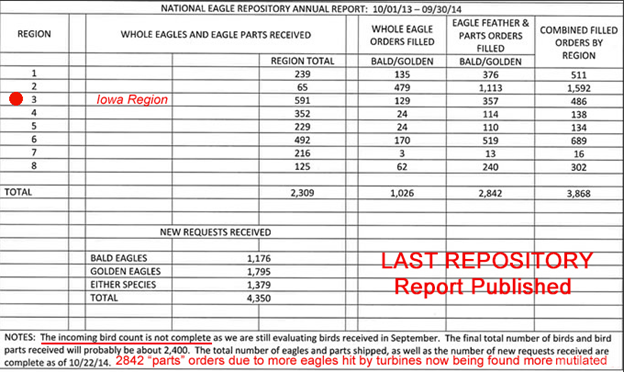
Up to the year 2014, the Repository did report eagle carcasses being received and processed. For 2014 they reported receiving 2309 eagle carcasses for dispersal to American Indians and noted others that had not been counted, which would likely bring totals to about 2400.  Since 2014 the numbers of eagle carcasses being processed for the Native Americans is no longer being given out.

But this eagle carcass story doesn’t end with Repository Eagles being processed for American Indians. There are many other carcasses because “clean” eagles are required for ceremonies; eagles that have died as a result of electrocution, vehicle collision, unlawful shooting or trapping, poisoning or from natural causes are unacceptable for ceremonial sacrifice.

In 2014 NBC did a story on the Denver Repository 2014.  In this story about recycling eagles to American Indians, the repository reported that they had processed about  42,000  eagle carcasses. This Interior Department facility was opened in 1995.

Discussing Wildlife Repository Specialist Dennis Wiist: “But at last count, almost 42,000, he’s touched nearly every eagle that’s come through this facility.” 

Add another eight years of receiving 2,500–3,000 eagles and about anyone past the eighth grade can come up with an estimate of over 60,000 eagle carcasses since 1995. It’s hard to imagine and even harder to stomach, but more than 60,000 eagle carcasses have been secretly shipped to this repository, with no cause of death or origin given.

Real Prosecution for Eagle Kills?

The prosecution of 150 eagles killed since 2012 is nothing to get excited about when nothing has been done about tens of thousands of other eagles ‘taken’ by wind energy. America’s silenced USFWS agents know exactly what’s taking place because they process and arrange FedEx overnight shipping for nearly all the eagle carcasses shipped to the Denver Eagle Repository.

If federal prosecutors wanted the truth, a look into FedEx records would give investigators a very good idea what’s taken place. They would know the origin of shipments, see the proof of millions paid out by the U.S. government for overnight shipping and the weight of crates would indicate eagle numbers per shipment. Surveillance on the Repository site in Denver would also clue investigators in on the number of FedEx shipments coming in per week. 

Another way for prosecutors to get to the truth about green energy’s eagle carnage: They could start interviewing leaseholders.  I know of one case where a dead bald eagle was found near a turbine, and it was reported by someone that hadn’t signed a lease. When agents arrived at the property, the eagle was nowhere to be seen because the leaseholder had already disposed of it.  

So, until any real investigations take place and it remains legal for everyone involved to lie by omission, any reported wind turbine mortality in the media will be nothing but an exercise “green’ collusion.

The post Green Energy’s Hidden Eagle Slaughter appeared first on Master Resource.

via Master Resource

https://ift.tt/nv2x89m

April 19, 2022 at 01:09AM