
Biden wants to turn Ukraine into something like Syria, in order to keep it from becoming like Syria. Biden ally floats idea of US troops in Ukraine — RT World News
via Real Climate Science
April 17, 2022 at 06:28PM
Biden wants to turn Ukraine into something like Syria, in order to keep it from becoming like Syria. Biden ally floats idea of US troops in Ukraine — RT World News
via Real Climate Science
April 17, 2022 at 06:28PM
The real cost of backing up the intermittent provision of wind and solar power has been spelled out in a comprehensive model that has achieved virtually no coverage in the public discussion of energy issues. This is a scandalous situation that reflects the ignorance and virtually criminal negligence of the journalists and commentators of the nation. This is a short version of the report.
According to all the people who are supposed to know about these things the road to net zero is clear and the days of the coal power are numbered because wind and solar power are so much cheaper. How much cheaper? Well the inputs of wind and sunbeams come free of charge, so how much cheaper can you get!
The CSIRO GenCost study is regarded as the last word on the matter and who can challenge the authority of the CSIRO? It is disappointing to find that the study is full of holes and dubious assumptions. The biggest hole of all is the failure to account for the full cost of firming the intermittent inputs. This is currently provided by the much maligned coalers and it comes free of charge to the wind and solar industries. See here for the frog and centipede relationship between conventional power and the predatory parasites of the RE industry.
In November 2020 a group of consultants tabled a report in the NSW Parliament with the results of some elaborate modelling work to generate the total System Levelised Cost of Energy (SLCOE) which is defined as — “…the average cost of producing electric energy from the combination of generation technologies chosen for the system over its entire lifetime”
The models include additional transmission costs for various options including replacing brown coal with nuclear energy, replacing coal with gas and 100% RE with hydro and storage.
SUMMARY OF RESULTS
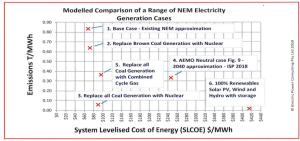
The best policy option to control costs and minimise emissions would appear to be to replace coal generation with nuclear power.
Case 1. This is the current situation, with over 70% of power generated by coal the estimated cost is $68.87/MWh.
Case 2 shows the effect of introducing 3,000 MW of nuclear power capacity into the Case 1 mix to replace brown coal. This raises the cost to $72.48/MWh while reducing emissions by around 23%.
Case 3 shows the effect of replacing all coal in Case 1 with nuclear power. Emissions fall by some 93%, with the cost increasing to $90.23/MWh.
Case 4 shows the effect of the combination of generation technologies projected by the Australian Energy Market Operator (AEMO) to 2040, as shown in its Integrated System Plan (ISP) of July 2018. The cost is in the order of $250/MWh.
Case 5 shows the effect of replacing all coal in Case 1 with CCGT. This shows an increase in cost to approach $100/MWh.
Case 6 shows a 100% renewable mix comprising solar PV, wind and hydro with support from pumped storage and some battery storage. Because of low capacity factors, solar PV and wind require a combined total of 110,000 MW of capacity.T here is also a need for 30,000 MW of pumped storage capacity for 3 days. To this must be added high-cost additional transmission to get the power to points of high consumption where it is needed, making a total SLCOE of $415.50 I MWh.
Supporting information. All key technology performance data, costs, and other relevant information are listed at the Power System Generation Mix Model website.
SUPPLEMENTARY INFORMATION & COMMENTS FROM THE AUTHORS
1. Wind-up subsidies for intermittent power generation
2. Add a capacity market component to the National Electricity Market
The current NEM is an energy-only market, which does not give clear signals when more or replacement dispatchable generation investment is needed. This weakness has been a key factor in the current absence of new dispatchable investment, i.e. power which can be delivered at the time it is needed by customers.
3. Remove the ban on nuclear power
This ban is the result of a political deal done 20 years ago. It has no scientific merit and is now an obstacle to much-needed decisions for the longer-term future. It prohibits by law the development of emissions-free, reliable, affordable nuclear power for Australia. The removal of the ban would allow more competition between various technologies to supply our future electricity needs.
0 out of 10 based on 0 rating
via JoNova
April 17, 2022 at 05:21PM
From NOT A LOT OF PEOPLE KNOW THAT
By Paul Homewood
h/t Philip Bratby
From the Telegraph:
Engineers will rarely tell you something is impossible, even when your proposal is a very bad idea. Computer scientists at Stanford and MIT in the 1970s came up with a wonderful expression for this, an assignment that was technically feasible, but highly undesirable. They called it “kicking a dead whale down a beach”. The folklore compendium The Hacker’s Dictionary defines this as a “slow, difficult, and disgusting process”. Yes, you can do it like that. But you really don’t want to.
In its efforts to show the world how keenly it is embracing CO2 emission targets, our Government has left a lot of dead whales on the beach for us, and as consumers, we’ll be the ones doing the kicking.
For example, it’s not impossible to heat a home with a heat pump, but it is a very noisy, ineffective and expensive way of doing it. An electric car might be fun to drive, but it is also expensive, and because of the inferior energy density of batteries, a petrol equivalent will always be lighter and go further. Nor at the end of the day will an EV be able to boast any CO2 emissions savings, we now know, thanks to Volvo. But perhaps the greatest whale to land on our beach is hydrogen.
Every day, manufacturers announce that they’re working on some kind of hydrogen initiative.
These include our best and brightest companies, such as Rolls-Royce and JCB. The Government has a Hydrogen Strategy. The Climate Change Committee thinks hydrogen is wonderful. You may think these are all signs that it’s a good idea. But things are not what they seem.
To replace gas boilers with hydrogen boilers requires thousands of miles of new, much thicker, high-pressure pipes. Last year, Lord Martin Callanan, the energy minister, candidly described the plans to replace our gas boilers with hydrogen boilers “as pretty much impossible”.
Hydrogen has two big problems which turn any project into a dead whale exercise.
The first is that pure hydrogen doesn’t exist – it’s both everywhere and nowhere. We must generate all the hydrogen we can then use, and this requires a lot of energy. This is fine when the output of the process is something very valuable to us, such as fertiliser. But less so when the output of the process must compete with much cheaper commodities, as it must in an energy market.
Secondly, hydrogen’s intrinsic physical properties create a whole range of unique problems. It’s a tiny atom that easily escapes confinement. Keeping it captive for storage is expensive, and moving it around safely even more so, because in liquid form it must be very cold.
Hydrogen advocates tend to shrug off these issues – solving them will be someone else’s problem, they reckon. Individually, none of these factors make hydrogen as an energy carrier or storer impossible, but the whale-like properties are becoming harder to ignore.
To replace gas boilers with hydrogen boilers requires thousands of miles of new, much thicker, high-pressure pipes. Last year, Lord Martin Callanan, the energy minister, candidly described the plans to replace our gas boilers with hydrogen boilers “as pretty much impossible”.
Wrong, m’Lud. It’s not impossible – it’s just a supremely bad idea. And when hydrogen explodes, it is quite spectacular. Right on cue, Australia’s first hydrogen carrying ship set sail for Japan this year, and burst into flames on its maiden voyage.
Again, hydrogen powered transport is not impossible, it’s just hampered by reality. Liquified hydrogen may be as light as petrol or kerosene, but keeping it at -257C requires much heavier apparatus. Converting a two engine turboprop from kerosene to hydrogen, I noted here recently, increases the weight of the engine from two tonnes to 13 tonnes.
As for storage, the story is little better. Wind often generates electricity when it is not needed (and doesn’t generate it when it is needed). So when the wind is blowing, the hydrogen lobby argues, we can create “green hydrogen” using electrolysis. These electrolysers are expensive, and sensitive, and switching them on intermittently to produce the mythical green hydrogen isn’t economic.
So green hydrogen is really not one, but two dead whales, engaged in a gruesome act of congress.
In his devastating assessment of the Government’s energy paper, Prof Dieter Helm calls it a “lobbyist’s utopia”. Prof Helm, an energy expert, describes how rent-seekers “[react] to each problem… by inventing another intervention. Each has unintended consequences, and these unintended consequences need more ‘fixes’”. That’s green hydrogen in a nutshell.
Green hydrogen may be generated reliably and cheaply using high-temperature gas-cooled nuclear reactors (HTGRs), a technology the Japanese have been refining for two decades. Japan’s first HTGR opened in 1997, but incredibly, was out of commission for a decade.
The history of nuclear energy is full of such stories, of untapped potential, and of avenues not explored. Our own Government tepidly hopes for a “HTGR demonstration by the early 2030s at the latest.” But even with a fleet of HTGRs generating hydrogen, the nasty stuff still needs to be stored and moved, and those costs haven’t gone away. Using hydrogen remains the worst way of doing almost anything.
Special interest groups however have discovered that the magic words “net zero” have the same incantatory power as “Open Sesame!”. In Arabian Nights, the phrase opened up a cave full of treasure. Here, they open up an unlimited trove of research grants and subsidies, and tap into abundant buckets of ill-directed “green” capital. The dead whale is never removed from the beach – and perhaps that’s the point.
https://www.telegraph.co.uk/business/2022/04/16/great-hydrogen-swindle-green-gas-not-seems/
via Watts Up With That?
April 17, 2022 at 04:54PM
Twenty-six year old athlete dies from multiple heart attacks. Brian Wallace Heart Attack: Brian Wallace reportedly suffered multiple heart attacks – ABTC
via Real Climate Science
April 17, 2022 at 04:30PM
 Iowa Climate Science Education