Month: April 2022

Clean energy’s dirty secret: How push for modern technology has made Chinese pond toxic

Image credit: researchgate.net

The report says ‘Water is still leaching from the tailings pond towards the nearby Yellow River – China’s “mother river”, its basin home to 160 million people’. Are climate obsessives and those in renewables-hungry governments content to look the other way?
– – –
There is an open wound in Baotou, says Sky News.

This city in Inner Mongolia, northern China, is home to more than two million people.

A lake lies on the west of the city, one filled with a black grey sludge of toxic and radioactive material.

This is a tailings pond, a quaint name for what is really a dumping ground.

Baotou is the global capital for rare earth elements – metals that are vital to modern technology and especially renewable energy.

This pond is clean energy’s dirty secret. It is the by-product of rare earth processing. It is open to the air but worse it is seeping into the ground below, poisoning the water.

The Chinese authorities are aware of the problem. That’s why they’re following us: at least eight cars always on our tail for three days.

They question anyone we speak to and eventually prevent us from speaking to them altogether, citing COVID-19 regulations.

But the locals still want to speak, mainly because they are unhappy that government promises to clean the mess up have not been kept.

In the villages surrounding the pond, a woman sitting on a sofa on the side of the street tells us “the water is bad – bad.”

“We asked them to give us something to filter it but they didn’t,” she says before the officials cut her off.

Along the same road, a farmer who has just finished watering his field says: “Our water is not very good. It doesn’t meet the standard of drinking water for humans or animals.”

He says that in another village not far away, people got sick.

“It’s called Dalahai village. The village was polluted – 30 to 40% of the villagers got cancer,” he says.

“After they found the pollution, the government moved all villagers to somewhere else. They banned local villagers from farming on the land.”

Continued here.

via Tallbloke’s Talkshop

https://ift.tt/kPtZ7HL

April 17, 2022 at 01:33PM

Vehicle Electrification

By Rud Istvan,

This possible guest post was inspired by Andy May’s recent post concerning mainly internal engine combustion (ICE) alternatives. Since I am a SME in the general field (including several basic supercapacitor patents), thought I would provide some factual engineering perspectives to WUWT.

First, combustion engines come in two basic forms: internal, and external. External (1819, Sterling) was never proven practical despite Dean Kamen’s fairly recent trying to get me as head of Motorola strategy and innovation at the time to invest. His fundamental engineering problem was simple. In ICE, most of the necessary thermodynamic cooling exhaust heat leaves via the tailpipe. The remainder (about 20%) is in the big car radiator. In a Sterling ECE, ALL the working exhaust heat must leave via a REALLY BIG radiator. NOPE.

Second, ICE engines come in various stroke flavors. For purposes of this simplified discussion, just two fours: Otto cycle and Atkinson cycle. Otto cycle is your ordinary 4 stoke piston car. A compression fuel upstoke, a combustion downstroke, an exhaust upstroke, then an intake fuel downstroke.

An Atkinson cycle uses the same four stokes slightly differently. The compression upstroke air intake varies (via complicated valve timing). So delivers more fuel efficiency (about 15%) but less torque efficiency on the combustion downstroke. (Oversimplified explanation: more uptake air, less fuel, less combustion downstroke torque.)

In what follows, we learn full hybrids can fully compensate for that Atkinson cycle fuel efficient torque deficiency.

Hybrids

There are several flavors:

  1. Mild
  2. Moderate
  3. Full (Prius)
  4. Plug in (New Prius, Chevy Volt)

We will define all, but only consider to any extent full and plug in.

  1. Mild hybrids basically just do engine off at idle. NOT simple with conventional automatic transmissions, which is why FORD went with all DCT by 2018. Now this also (as BMW learned) still kills SLA battery life despite DCT. Turns out the necessary additional AH battery sizing (even at low PbA battery cost) “killed” that simple’s application. Valeo’s system is just one ‘dead’ example.
  2. Moderate hybrids add regen braking. The problem is, unless a really big battery, regen kills PbA even if PbA is oversized for starts) battery life by ‘overcharging’. Kills that application also.
  3. Full hybrids work, as posted here previously. Downsize the ICE (mine is a small I4 Atkinson cycle), make up the torque loss with the electric machine. Idle off at stop is free, and regen braking is free. For comparison, the HP and towing 2007 equivalent 4WD Ford Escape V6 got about 20 MPG average, our full hybrid equivalent gets about 30. Plus, we use regular, the v6 equivalent used hitest. About a dollar a gallon difference in these parts, and about 1/3 less gallons for a HP and towing equivalent small SUV.
  4. Plug ins. (like Chevy Volt and new plug in Prius). These by definition have larger, more expensive, and heavier batteries, yet still have all the heavy range extending backup ICE equipment. At the present (unnecessarily elevated) price of gas, still a very bad economic tradeoff. And, there is a hidden subtly. In full hybrids, the traction battery floats between about 60% and 40% charge. Nevermore, never less. That maximizes its life by design.

In a plug in, you drain the battery until the charging engine cuts in. That guarantees a much shorter battery life. Not a good thing economically.

via Watts Up With That?

https://ift.tt/VvzhH5r

April 17, 2022 at 12:53PM

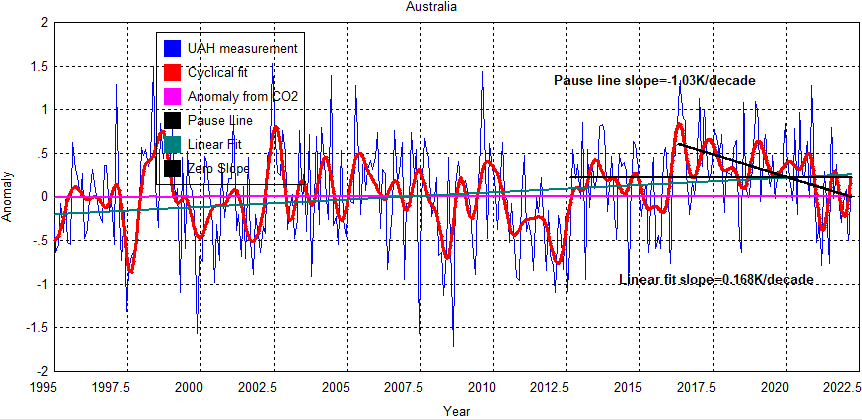
The warming trend in Australia since the end of 2012 is nothing.

The warming trend in Australia since the end of 2012 is nothing.

Across the continent downunder, “the new pause” in temperatures is now 9.6 years long as measured by the most reliable system there is — UAH satellites.

If and when we hit the Ten Year Pause, the National Climate Alarm Centres will all issue press releases, just like the other headline events, right?  Just like the “Worst bleaching since last year”, “Hottest day since records began” in 1993. Six hot days in a row in one city of Australia.

Which model predicted that temperatures in Australia would do “net nothing” for a decade?

Thanks to Charles for the graph!

Australia, UAH Graph. The Pause

The length of the zero slope pause line is now 9.6 years. 

Technically, temperatures have been falling according to the UAH Satellites since May 2016.

Satellites are obviously better for global and continental temperature trends

Assuming we care about trends that is, and not just one-second records. The UAH satellites circle continuously, and cover the entire continent. They don’t just measure 100 small  points with thermometers, next to airports and incinerators, but 7 million square kilometers of area.

Some smarty pants will say UAH is bad, because it doesn’t match the land thermometers like RSS does. But that IS the point, RSS was  adjusted to match the hyper-adjusted junk on land, and now they’re all terrible.

I explained before why UAH really is so much better:

      1. UAH agrees with millions of calibrated weather balloons released around the world. RSS now agrees more with surface data from equipment placed near airports, concrete, air-conditioners and which is itself wildly adjusted.
      2. In the latest adjustments UAH uses empirical comparisons from satellites that aren’t affected by diurnal drift to estimate the errors of those that are. RSS starts with model estimates instead.
      3. Two particular satellites disagree with each other (NOAA-14 and 15). The UAH team remove the one they think is incorrect. RSS keeps both inconsistent measurements.
      4. Diurnal drift probably created artificial warming in the RSS set prior to 2002, but created artificial cooling after that. The new version of RSS keeps the warming error before 2002, but fixes the error after then. The upshot is a warmer overall trend.
      5. UAH uses a more advanced method with three channels. RSS is still using the original method Roy Spencer and JohnChristy developed with only one channel (which is viewed from three angles).

0 out of 10 based on 0 rating

via JoNova

https://ift.tt/ExMVih9

April 17, 2022 at 11:02AM

Protecting Free Speech

If you want to make a local copy of this entire website. From a command prompt on Windows 10 or 11, install Linux wsl –install -d Ubuntu Once you have Linux installed, you can download the entire website from a … Continue reading

via Real Climate Science

https://ift.tt/oWeUi9x

April 17, 2022 at 10:36AM