
By Paul Homewood

September 29, 2022 |
More demand for electricity, fewer fossil-fuel power plants, but (still) too little renewable energy: The energy transition is changing the structure of the power supply in Germany. A new study by the EWI shows the possible consequences for security of supply.
With the expansion of renewable energies, the weather dependency of electricity generation in Germany is increasing. A new analysis shows that the security of electricity supply in this decade is currently not guaranteed in all extreme weather situations. Decisive factors here include the rising demand for electricity due to progressive electrification, the dismantling of fossil power plant capacities and the relatively slow expansion of renewable energies.
This is the result of a new analysis by the Institute of Energy Economics at the University of Cologne (EWI) on behalf of the Society for the Promotion of the Institute of Energy Economics at the University of Cologne. In the publication “Analysis of Supply Security up to 2030”, a team from the EWI examines in which (historical) weather situations the power supply is secure at all times and under which circumstances supply gaps could occur in the course of this decade.
Supply gaps in extreme weather situations
An analysis of weather data from 1982 to 2016 shows that supply gaps could occur in particular during weather situations with strongly below-average wind availability in northern and central Europe and significantly limited solar radiation in southern Europe. These two weather anomalies occurred in combination, for example, in January 1997 and in December 2007 over an extended period of at least seven days.
For such extreme weather situations for power generation, the EWI team analyzed and quantified the possibility of supply gaps for the years 2025 to 2030 in different scenarios of the electricity system development. In doing so, they looked at different paths to coal phase-out, renewable energy expansion, electricity import availability and storage capacity, and the degree of electrification between 2025 and 2030.
Not only controllable capacity can increase power supply resilience
The team of Tom Brinker, Berit Czock, Hendrik Diers, Dr. Philip Schnaars, and Dr. Johannes Wagner cites a variety of factors for the likelihood of supply shortfalls occurring in the extreme weather situations considered. For example, ongoing electrification this decade, particularly of transport and heat, combined with a reduction in controllable power, is one reason for higher peak loads. “Making electricity demand more flexible is therefore of significant importance for the security of electricity supply,” says Schnaars, manager at EWI. However, the individual influencing factors should not be considered in isolation. Additional wind and PV capacity can also help to increase security of supply in extreme weather situations, he adds. This additional benefit is greatest when surplus energy can be stored and then used to cover peak loads, he adds.
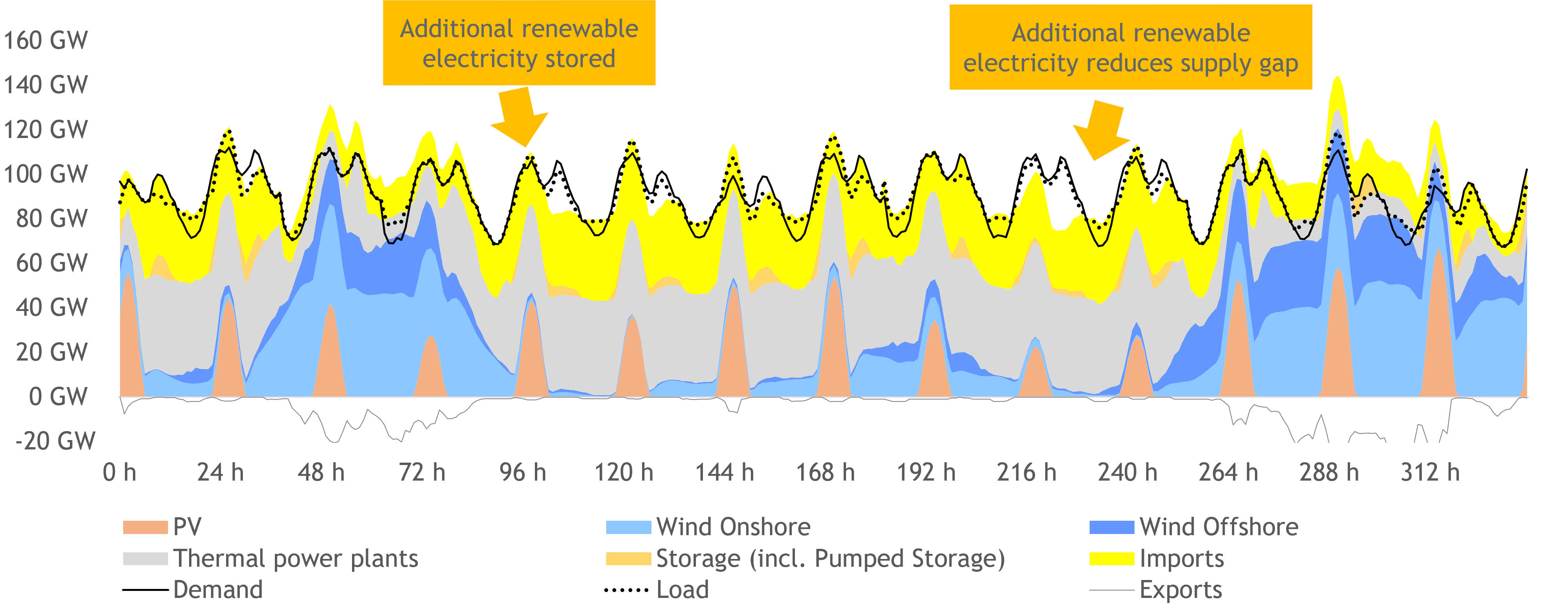
Figure 2: Electricity generation in 2030 in a historical extreme weather situation without coal capacity with an accelerated addition of renewables
In the scenarios considered, an accelerated coal phase-out by 2030 as envisaged in the coalition agreement means that more and larger supply gaps could occur in the period under consideration. These are larger by an average of 5 GW and occur 60 hours more per year than with a coal phase-out by 2038. These potential supply gaps can be countered with additional renewable generation capacity, especially in combination with additional battery storage. What all the scenarios considered have in common is that electricity imports from abroad make a significant contribution to meeting German electricity demand. “A reduced possibility to import electricity from abroad has a major impact on the security of supply in Germany. This highlights the need to look at security of supply at the European level,” Schnaars said.
https://www.ewi.uni-koeln.de/en/news/versorgungssicherheit-bis-2030/
I’m not sure what good extra wind and capacity will do, when the wind has stopped blowing and solar is producing next to nothing in winter! Twice nothing is still nothing!
What is clear from the chart above is that Germany will be dangerously over-reliant on imported electricity, even with a large dollop of gas generation, once the coal and nuclear plants are shut.
And forget about this just being an “extreme weather “ scenario. Pretty much every winter there are periods of days on end when wind power is at extremely low levels.
In January this year, for instance, there was a spell of four days towards the end of the month when wind power ran at around only 5 GW, and shorter periods where there was much less still:

http://energodock.com/germany/electricity-generation
Nuclear and coal contributed about 16 GW during that time, whilst demand peaked at 70 GW.
According to the new study, Germany will need about 50 GW of gas generation, when the wind stops, and even then will need a further 20 GW of imports. But according to S&P, Germany only actually has 30 GW of gas generation now, including what is in the pipeline. It is not clear how EWI have allowed for this?
Whether Germany will actually be able to buy the gas it needs, and whether the rest of Europe will have surplus power to sell is another question.
Meanwhile Germany’s energy future increasingly resembles playing Russian Roulette with a fully loaded gun!
via NOT A LOT OF PEOPLE KNOW THAT
October 5, 2022 at 12:36PM
 Iowa Climate Science Education