Month: January 2023

A DIY Guide To Demystifying “Greenhouse Gas” Claims…The Science That Cuts Corners

By Fred F. Mueller

Do you feel helpless when trying to assess the veracity of “climate doom is looming” claims we are constantly bombarded with?

For ordinary citizens not having acquired at least a Ph.d. degree in atmospheric physics or comparable climate-relevant sciences, it seems nearly impossible to tell right from wrong when it comes to assess such claims. Do so-called greenhouse gases really reflect infrared energy back to earth in such quantities that this affects earth’s temperature?

Don’t give up trying to understand the relevant basics: there are rather simple ways to get an idea about what this is all about. Even without a scientific background, most people have at least a good common sense. And that’s all it takes to get a grasp of how vigorously and chaotically enormous energy fluxes slosh up and down, back and forth between earth’s surface and the skies.

Fig. 1. The setting sun illuminating a fairly thin veil of clouds from below – thus injecting energy into the space between the earths’s surface and cloud cover.

Part 1 – some basics

Let’s first clarify where the heat that allows us to live rather comfortably in our habitats is coming from and where it goes to. Despite the enormous energy content of the molten core of our planet, the bulk of our energy comes from the sun, which sends us energy mainly using three forms of electromagnetic radiation: visible, ultraviolet and infrared light.

At the top of the atmosphere, every square meter oriented towards the sun thus receives a fairly constant power influx of 1361 to 1362 W/m2. Although not being a real constant, this value is often referred to as the solar constant.

The alleged greenhouse effect

The notion of a “greenhouse effect” in our atmosphere has been used and misused incredibly often, resulting in an incredible mess of erroneous perceptions not only among the public, but even in the scientific world. A striking example for an obvious misrepresentation can be seen in the lead-in picture of the Wikipedia chapter on the topic, Fig. 2.
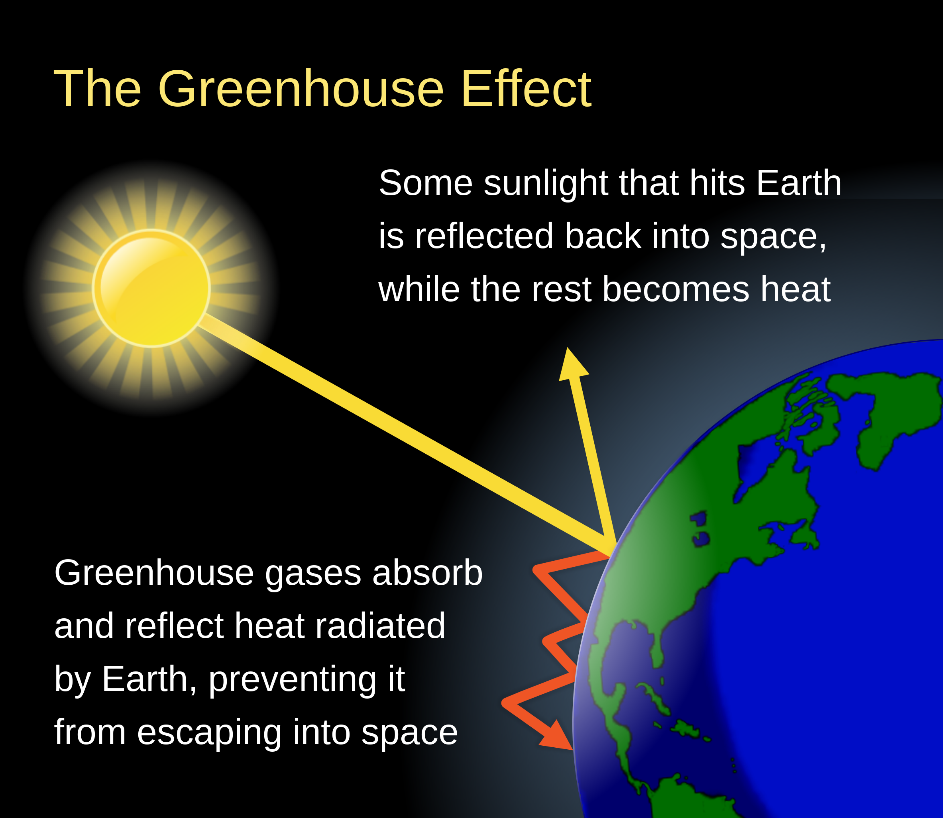
Fig. 2. The lead-in picture of the Wikipedia chapter about the “greenhouse effect” (Author: Efbrazil 2), CC 4.0)

This graphic highlights the extent to which Wikipedia gives the impression of having fallen prey to climate activism. The complex reality of transfers and transformations of energy on our planet involving soils, waters, gases, clouds, aerosols, heat storage, conduction and convection, chemical reactions and phase transformations, as well as a host of additional factors are simply swept under the carpet, attributing all their combined effects solely to the odious “greenhouse gases”.

This Wikipedia chapter is a saddening example for the downfall of an allegedly scientific encyclopedia actually spreading rather crude ideology under the guise of educating the public. The related chapter comprises more than 7,000 words and tries to underscore its claim of being “scientific” by a list of 80 citations including papers about the atmospheric conditions on far-away cosmic bodies such as Titan and Venus. But this cannot excuse the use of such a grossly misleading graphic as the lead-in picture for the abstract. Such tricks commonly used in tabloids or yellow journals. Wikipedia touts itself to be an encyclopedia addressing not only scientists but also laymen and the general public and should therefore care all the more not to disseminate content that may be misunderstood by people lacking a scientific background.
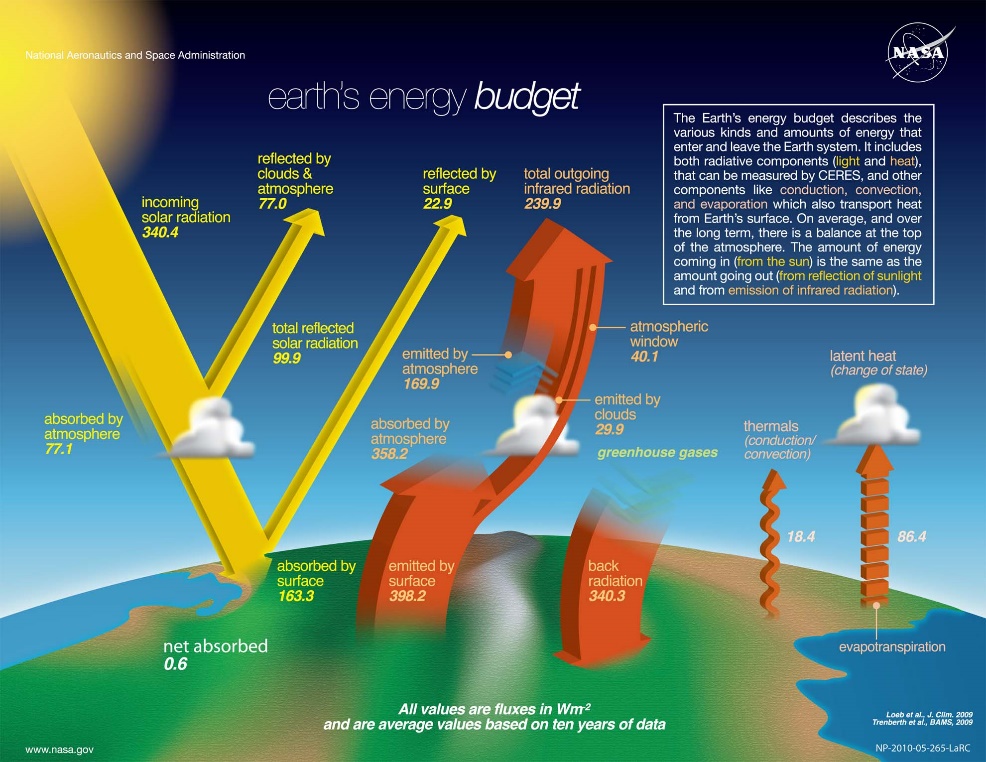
Fig. 3. This more detailed representation of the energy fluxes on earth elaborated by NASA is still misleading with respect to some decisive facts (Picture by NASA 3), public domain) Note: This graphic and the corresponding link have been withdrawn after completion of the article. In a subsequent part, the replacement graphic and its amendments will be treated in detail. Nevertheless, this graphic and its errors have been displayed for a prolonged time, thus warranting a suited discussion.

Although the more detailed Fig. 3 elaborated by NASA gives a better impression of the many different factors influencing energy transfer fluxes between earth’s surface and space, it still misleads in a subtle way that makes it unfit to convey a correct understanding of the vital facts. Let’s look at the main inconsistencies.

Mean values intended to mask natural variations

One of the favourite tricks of climate prophets of doom is to suggest that all major factors influencing our climate are more or less constant, with the sole exception of “greenhouse gases”. They intend to exploit the fact that the CO2-level of the atmosphere is rising while at least for the past some 150 years, meteorologists have also seen a moderate rise of the temperature levels they monitor on their stations. Though both trends are far from being in lockstep, this coincidence of trends has been declared to be the proof for a causality, although no clear mechanism or quantitative deduction could hitherto be established. Despite many striking discrepancies e.g. with respect to the natural cycles of CO2 or the absorption and sequestration of CO2 in our oceans, the perceived rise in temperatures has been almost exclusively attributed to CO2.

Misusing water vapor

Another diversion has been to declare that water vapor is simply reinforcing the leading role of CO2. This might be viewed as a real masterpiece of twisting reality since water vapor has not only a much higher efficiency with respect to absorbing (and re-emitting) infrared radiation (see Fig.4.), but is also exceeds the content of CO2 in the atmosphere by factors between 25 (= median concentration value at sea level) and up to 100!
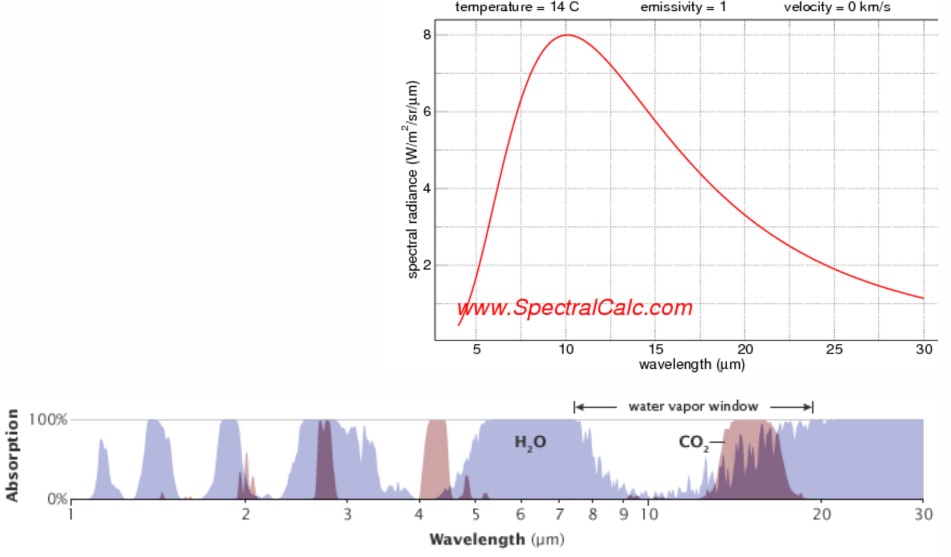
Fig. 4. Comparing the spectral IR radiance of a surface with 14 °C with the overlapped absorption bands of CO2 (brownish) and water vapor (bluish) shows the highly superior absorption capacity of water vapor for the IR emission of soil or water at 14 °C – (which is the “mean” temperature on earth’s surface). Please mind the different scales of the x axes: linear for the spectral radiance, logarithmic for the absorption. (Graphics: SpectralCalc 4) (above), NASA, Robert Rohde 5) Public domain (below)).

 Notwithstanding these inconsistencies, the climate science community has in its vast majority adopted this approach. This might be attributable to the fact that the quantity of water vapor in the atmosphere is subjected to wild temporal and local variations between nearly zero – e.g. at high altitudes and very low temperatures – and sometimes up to 4% at sea level.

Cutting corners

Additionally, especially when transforming to clouds, water vapor tends to condense or freeze out of the atmosphere in ways that have up to now resisted any realistic attempt to describe them mathematically. Trying to establish realistic three-dimensional models of water vapor distribution over a certain location at a given moment and to calculate the resulting effects on absorption and re-emission of IR radiation thus remain a much more arduous task than using a single value for all and every condition, as can conveniently be done when attributing the whole “greenhouse effect” solely to CO2. And voilà, truckloads of complicated research work may simply be skipped. This approach also greatly reduces the scale of expenditures in data acquisition, manpower, computer time – and in waiting time before reaping academic awards. After all, the beacon for all climate science, the IPCC, is doing it too, e.g. by simply omitting water vapor from its account of “greenhouse gases”, see Fig. 5.
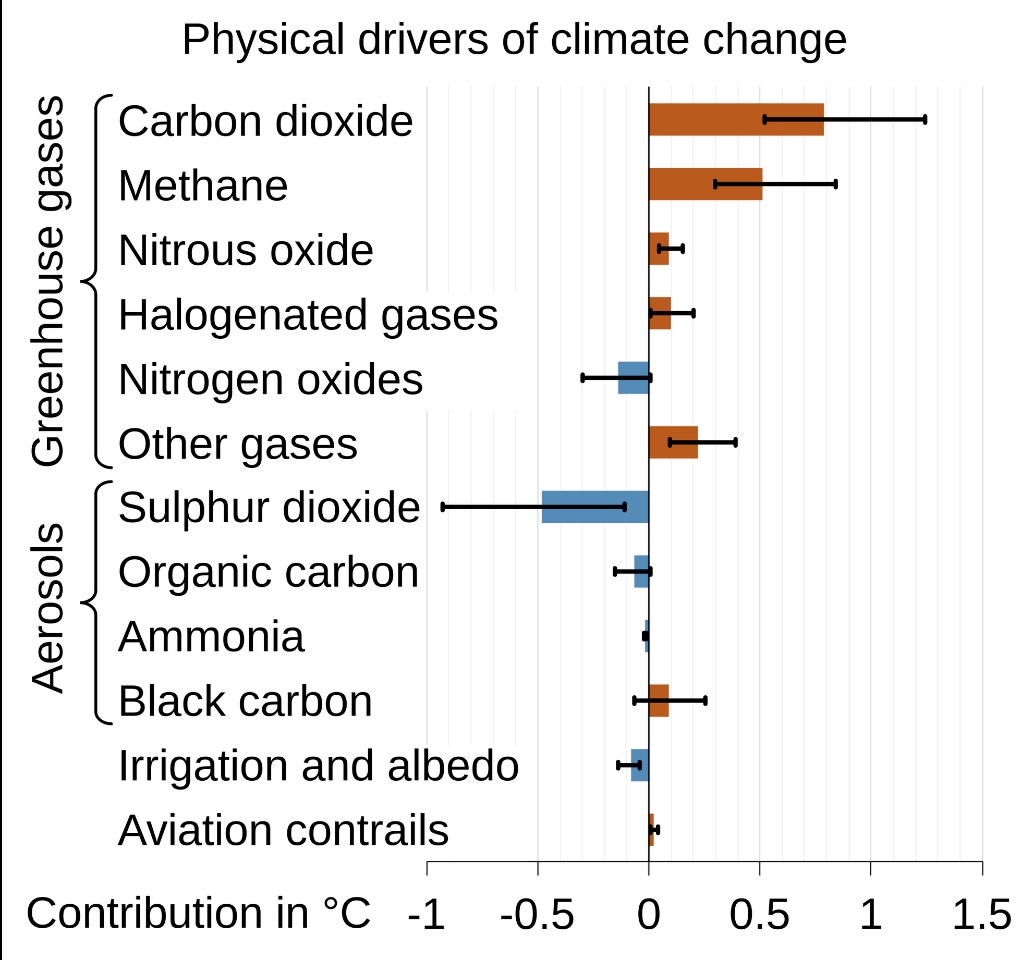
Pic.5. Contribution to observed climate change from 12 different drivers, as taken from the Summary for Policymakers of the sixth IPCC assessment report, adapted from figure SPM.2c (Graphic: Erik Fisk, CC 4.0 6))

The numerous advantages of such a cutting of (scientific) corners might be one of the main driving forces for the deplorable tendency towards the “single number fallacy” explained by Kip Hansen 7) as being “the belief that complex, complicated and even chaotic subjects and their data can be reduced to a significant and truthful single number.”

Unfortunately for us, that’s exactly what the official climate science is doing. Under the headline “One number to track human impact on climate”, NOAA scientists released the first AGGI 8) (aggregated greenhouse gas index) in 2006 as “a way to help policymakers, educators, and the public understand the cumulative impact of greenhouse gases on climate over time”.

The minuscule driving forces of “greenhouse gases”

When trying to assess the real impact of “greenhouse gases” on earths energy balance, the first step should be to assess the driving force they are alleged to exert on the input and output of energy fluxes. Corresponding parameters can be found in a table within the Wikipedia chapter about Greenhouse gases 9). They reveal that in the view of the leading climate scientists, just four gases have a relevant influence on the budget of energy exchange between incoming and outgoing radiation energy since the alleged start of “human- induced climate change” in 1750. These are:

Carbon dioxide with                          + 2.05    W/m2
Methane with                                      + 0.49    W/m2
Nitrous oxide with                             + 0.17    W/m2
Tropospheric ozone                           + 0.4      W/m2
===========
Total GHG contribution             +3.11     W/m2

This figure is extraordinarily small when comparing it with the enormous temporal and local variability of energy fluxes within our planet’s ocean/atmosphere/soil system within short time periods, and amounts to just a low single digit percentage of the daily variations. This will be treated in more detail in the following chapter.

Peculiarly enormous greenhouse effect range 

On a side note, it is interesting to see that the IPCC gives an enormous range for the greenhouse effect (TCR, Transient Climate Response or “climate sensitivity” 10)) of CO2, which is estimated to range “likely” between 1.5 and 4.5°C. The figure represents the alleged rise of earth’s mean temperature in °C for every doubling of the CO2 level of the atmosphere. Given this extraordinarily broad range of ± 50%, one might be surprised that IPCC, NOAA and Wikipedia authors advance temperature rise values for greenhouse gases calculated with up to three “significant” digits. This too might be attributable to the feeling of certainty about climate relevant figures instilled into the public by the “one number fits it all” mentality prevalent in our current climate science community.

References

  1. https://en.wikipedia.org/wiki/Solar_constant
  2. https://en.wikipedia.org/wiki/Greenhouse_effect
  3. https://ift.tt/FUQPvXW (Note: This link seems to have been deactivated very recently.)
  4. https://www.spectralcalc.com/blackbody_calculator/blackbody.php
  5. File:CO2 H2O absorption atmospheric gases unique pattern energy wavelengths of energy transparent to others.png – Wikimedia Commons
  6. https://commons.wikimedia.org/wiki/File:Physical_Drivers_of_climate_change.svg
  7. https://wattsupwiththat.com/2023/01/03/unknown-uncertain-or-both/
  8. https://research.noaa.gov/article/ArtMID/587/ArticleID/2877/Greenhouse-gas-pollution-trapped-49-more-heat-in-2021-than-in-1990-NOAA-finds
  9. https://en.wikipedia.org/wiki/Greenhouse_gas
  10. https://www.metoffice.gov.uk/research/climate/understanding-climate/climate-sensitivity-explained

Donate – choose an amount

via NoTricksZone

https://ift.tt/nWAePYQ

January 14, 2023 at 10:29AM

The Gas Stove Gambit

Remembering that natural gas is a fossil fuel, there must be more than meets the eye in the firestorm over banning gas stoves for safety reasons.  Could it be that the regime along with the media are gaslighting us regarding this maneuver?  Kit Knightly thinks so and explains the gambit in his off-guardian article What is the US “Gas Stove Ban” REALLY about?  Excerpts in italics with my bolds and added images.  H/Y Tyler Durden

What sounds like overreach in itself, is actually a cover for something potentially far, far worse.

The Biden administration is apparently looking to ban gas stoves, calling them a “hidden danger”. But while that sounds bad enough, a deeper dive shows – as usual – it’s not really about what they say it’s about.

Talk of banning gas stoves and “unregulated indoor air quality” could be a Trojan horse designed to get even more “smart” monitoring technology into your home.

Let’s jump in.

Are Gas Stoves Dangerous?

Well, according to Alexandria Ocasio Cortez, the New Scientist and million other outlets and pundits who started talking about it in the last two days, yes.

Earlier this week near-identical articles from the National Review, Bloomberg and CNN detail how the US Consumer Product Safety Commission will be opening “public comment on the dangers of gas stoves sometime this winter”.

The articles claim:

The emissions have been linked to illness, cardiovascular problems, cancer, and other health conditions. More than 12 percent of current childhood asthma cases are linked to gas stove use, according to peer-reviewed research published in the International Journal of Environmental Research and Public Health last month.

Now would be a good time to talk about the phrase “linked to”. It’s always a good one to look out for in any mainstream publication. Journalists love it because it implies causation without stating it.

Consider, one hundred per cent of serial killers have been linked to the ingestion of water and the wearing of shoes.

If this manipulative use of language were not evidence enough of an agenda, the rather premature deployment of the race card proves it:

Senator Cory Booker (D., N.J.) and Representative Don Beyer (D., Va.) wrote a letter to the agency last month urging the commission to address the issue and calling the harmful emissions a “cumulative burden” on black, Latino and low-income households.

So, Will They Ban Them?

Actually, probably not.

Considering that, according to Bloomberg, some 40% of US homes use gas stoves to cook, an outright ban would be impractical to the point of madness. You can’t criminalise 40% of the country. It would be almost unenforceable.

Perhaps they might try a “phasing out”, as they plan for petrol cars in California.

But most likely of all is that this was never really about banning stoves in the first place.

OK, So What’s IT Really About?

What we’re seeing here looks to be your classic bait-and-switch. Having established a “problem”, the powers that be suggest a solution they have no intention of ever carrying out (the more unreasonable the better).

When this measure is inevitably rejected by the public, the government will then proceed to suggest – or pay an NGO to suggest to them – a “compromise” measure.

The compromise is no compromise at all, of course, but actually what they wanted to do from the beginning. Nevertheless, the whole process is sold in the media as a victory for whichever party happens to be in opposition, and cited as evidence that “the system works”.

Tellingly, as I am writing this, Biden has already “ruled out a ban due to backlash”, and Vox were already using the “compromise” a lot in an article they published yesterday.

However, what that “compromise” would be in this case isn’t clear at first, you have to do a little digging.

One clue is present in the National Review article [emphasis added]:

The Association of Home Appliance Manufacturers argues that cooking produces harmful emissions regardless of the kind of stove used. “Ventilation is really where this discussion should be, rather than banning one particular type of technology,” Jill Notini, a vice president at the association, told Bloomberg. “Banning one type of a cooking appliance is not going to address the concerns about overall indoor air quality. We may need some behavior change, we may need [people] to turn on their hoods when cooking.”

And you’ll find another in the abstract of the original report on “Cooking With Gas, Household Air Pollution, and Asthma: Little Recognized Risk for Children”, published in the Journal of Environmental Science in April 2021:

The impact [of gas stove cooking] on children can be substantial because […] indoor air is unregulated.

“Ventilation is where this discussion should be”, after all “cooking produces harmful emissions regardless of the kind of stove” and a ban wouldn’t address “concerns about overall indoor air quality” which is currently “unregulated”.

Do you see where this is going?

It’s not about gas stoves, and it’s not about asthma – it’s about “indoor air pollution”, and more importantly how they plan on “regulating” it.

In one of those startling coincidences we’ve all got so used to witnessing in modern geopolitics, just as the US is talking about indoor air quality because of gas stoves, other countries around the world are doing the same thing for totally different reasons.

Singapore is considering new regulations on indoor air quality too, but because of formaldahyde.

Last month The Conversation was running articles claiming “indoor air pollution kills”, while Sir Chris Whitty, the UK’s chief medical officer, was “demanding action on indoor air pollution”.

On Monday, in a Guardian lifestyle piece purportedly about scented candles, Svetlana Stevanovic calls indoor air quality a “going concern”.

Two days ago The Tyee, an “independent” Canadian magazine which receives some funding from the Canadian government, ran an op-ed headlined:

We Need a Revolution in Clean Indoor Air

Which attempts to link improving indoor air quality to “ending Covid” (whilst making sure to sufficiently fluff the vaccines, of course).

Just yesterday the Irish Times published an article about the dangers of poor indoor air quality.

In a rather interesting piece of timing, the air hygiene technology company AeroClean and Molekule, a market leader for air purifiers, finalised a public stock merger…also just yesterday.

Two days ago it was announced IKEA would be selling their own smart air monitors, the same day Samsung announced their new “smart air purifier”.

Earlier today Chinese tech giant Xiaomi issued a media release about their new smart air monitoring technology.

A recent report expects the global air monitor technology market to swell to nearly 6 billion dollars in the next three years.

But I’m sure this is all just a coincidence.

Where Does This Lead?

Well, if I had to guess I would suggest some new “smart” technology is coming that will monitor air quality and indoor C02 emissions. Like smart electricity and water meters, but for your air.

Interestingly, the World Economic Forum agrees with me, publishing an article on their website last July headlined “Indoor air pollution: What causes it and how to tackle it”, which claims:

indoor air pollutants can now be detected with more precise, efficient, and compact sensors thanks to advances in environmental sensing technology. As a result, intelligent home systems may soon use sensors like these to keep track of indoor air quality and notify the ventilation system before dangerous levels are reached.

As part of “backing down” from the stove ban, they will introduce a new bill which sees “smart air monitors” become mandatory in all new-build houses, hotels and rented accommodation.

Just like smart electricity meters, smart air monitors would almost certainly be used to harvest huge amounts of data and give states or corporations the ability to control your home.

If your “indoor air” isn’t “clean” enough; if you use your stove too much, burn too many scented candles or emit too much co2, expect to get penalized  in some fashion until you learn how to be more responsible.

More smart technology, more monitoring, and ultimately more control.

So, while it’s possible the gas stove ban talk will resolve itself into the cliche new tax or fines or some other petty scheme for bilking the many out of their wages, the signs are certainly there it might be something more sinister.

Meanwhile, expect to keep seeing reports on gas stoves damaging the climate, or stories about poor indoor air quality making covid worse.

The usual bought-and-paid-for columns that support every new normal narrative.

via Science Matters

https://ift.tt/BLaQdVh

January 14, 2023 at 10:04AM

CFACT’s Gabriella Hoffman discusses SEC overreach with ALECTV

Hoffman argues that the SEC has no jurisdiction over reporting requirements for ranchers and farmers and that this move represents a gross overreach of government authority over those who grow our food.

The post CFACT’s Gabriella Hoffman discusses SEC overreach with ALECTV appeared first on CFACT.

via CFACT

https://ift.tt/tm6OoTD

January 14, 2023 at 09:04AM

Guardian: To Solve the Climate Crisis We Need to Change How We Think about Wealth

Essay by Eric Worrall

“… We need to leave the age of fossil fuel behind, swiftly and decisively. But what drives our machines won’t change until we change what drives our ideas. …”

‘If you win the popular imagination, you change the game’: why we need new stories on climate

So much is happening, both wonderful and terrible – and it matters how we tell it. We can’t erase the bad news, but to ignore the good is the route to indifference or despair 

by Rebecca Solnit
Thu 12 Jan 2023 17.00 AEDT

Every crisis is in part a storytelling crisis. This is as true of climate chaos as anything else. We are hemmed in by stories that prevent us from seeing, or believing in, or acting on the possibilities for change. Some are habits of mind, some are industry propaganda. Sometimes, the situation has changed but the stories haven’t, and people follow the old versions, like outdated maps, into dead ends.

We need to leave the age of fossil fuel behind, swiftly and decisively. But what drives our machines won’t change until we change what drives our ideas. The visionary organiser adrienne maree brown wrote not long ago that there is an element of science fiction in climate action: “We are shaping the future we long for and have not yet experienced. I believe that we are in an imagination battle.”

…

To change our relationship to the physical world – to end an era of profligate consumption by the few that has consequences for the many – means changing how we think about pretty much everything: wealth, power, joy, time, space, nature, value, what constitutes a good life, what matters, how change itself happens. …

…

There’s yet another narrative that’s persisted at least since the invention of compact fluorescent lightbulbs and the Toyota Prius: that we must renounce abundance and enter an age of austerity. It’s all in the telling. To consider our age an age of abundance, you have to be counting sheer accumulated stuff and ignoring how it is distributed. That is, we live in an age of extreme wealth for some, and desperation for the many. But there’s another way to count wealth and abundance – as hope for the future, safety and public confidence, emotional wellbeing, love and friendship and strong social networks, meaningful work and purposeful lives, equality and justice and inclusion.

…

Read more: https://www.theguardian.com/news/2023/jan/12/rebecca-solnit-climate-crisis-popular-imagination-why-we-need-new-stories

I think what the author is trying to say is if we embrace climate communism, can we feel better about our stuff being redistributed.

I think I’ll keep my toys. If poor people want their own toys, they should get off their butts and work for them.

via Watts Up With That?

https://ift.tt/o6ucWZT

January 14, 2023 at 08:13AM