
…
The post Dangerous ‘Deep Decarbonization’ (Krebs PowerPoint to Cooler Heads Coalition) appeared first on Master Resource.
via Master Resource
January 13, 2023 at 02:27PM
…
The post Dangerous ‘Deep Decarbonization’ (Krebs PowerPoint to Cooler Heads Coalition) appeared first on Master Resource.
via Master Resource
January 13, 2023 at 02:27PM
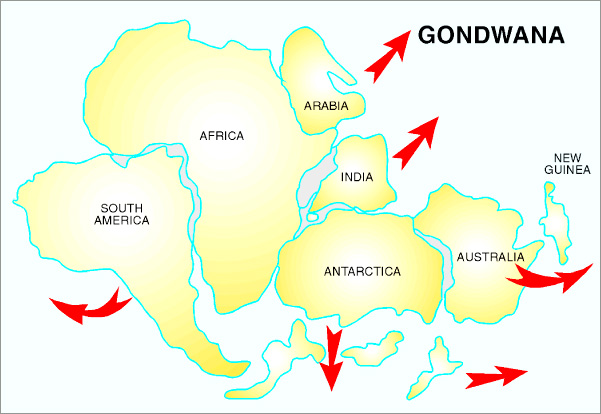
The supercontinent Gondwana hundreds of million years ago at its primary stages, and the directions pieces drifted away
That question is the title of Ian Plimer’s Spectator Australia article What Climate Crisis? Excerpts in italics with my bolds and added images.
For more than 80 per cent of time, Earth has been a warm wet greenhouse planet with no ice. We live in unusual times, when ice occurs on continents. This did not happen overnight. The great southern continent, Gondwanaland, formed about 550 million years ago. It occupied 20 per cent of the area of our planet and included Antarctica, South America, Australia, South Africa and the Indian subcontinent.
Gondwanaland was covered by ice when it drifted across the South Pole 360-255 million years ago. Evidence for this ice age is in the black coal districts of Australia, South Africa and India.
If Antarctica is to lose its ice sheets to end the current ice age, plate tectonics must move the continent northwards or fragment Antarctica into smaller land masses. Parts of Antarctica are currently being fragmented which is why there are more than 150 hot spots and volcanoes in rift valleys beneath Antarctic ice. Plate tectonics must also widen the Bering Strait to allow more warm Pacific Ocean water to enter and warm the Arctic.
Arctic ice formed 2.5 million years ago when plate tectonic-driven volcanoes in central America joined North America to South America and stopped Pacific and Atlantic Ocean waters from mixing. This was exacerbated by a supernova explosion that bombarded Earth with cosmic particles to produce cloudiness and cooling.

Figure 16. The geological history of CO2 level and temperature proxy for the past 400 million years. CO2 levels now are ~ 400ppm. Source: Wallace Manheimer
The Earth has been slowly cooling for the last 50 million years from times when life thrived and rapidly diversified. In these warmer times, there were no mass extinctions due to natural warming and, if the planet is warming today, the past shows us that life will thrive and diversify even more.
Once the Antarctic ice formed, ice sheets waxed and waned depending on whether Earth was closer or more distant from the Sun. Within these cycles there were smaller cycles driven by variations in energy emitted from the Sun producing many short warm spikes during long glaciations and very short cold spikes during short interglacials with average temperature rises and falls of more than 10°C a decade.
If governments, the UN or climate activists want to stop the normal planetary process
of climate change, then they need to stop plate tectonics, stop variations in the Earth’s orbit
and stop variations in solar output.
Even the omnipotent, omnipresent Kevin Rudd couldn’t manage this!
No past warming events have been driven by an increase in carbon dioxide in the atmosphere. No past cooling events were driven by a decrease in atmospheric carbon dioxide.
Six of the six most recent ice ages were initiated when the Earth’s atmospheric carbon dioxide was far higher than at present. Atmospheric temperature rise occurs before the carbon dioxide content of the atmosphere rises. It has never been proven that human emissions of carbon dioxide drive global warming despite numerous requests to climate activist scientists for the published evidence. Trillion-dollar bankrupting decisions on energy policy are being made using invalid science.

The peak of the last orbitally-driven interglacial was 7,000 to 4,000 years ago and for the last 4,000 years the Earth has been cooling as the climate changes from an interglacial into glaciation. There were solar-driven warm spikes such as the Minoan Warming, Roman Warming, Medieval Warming and the Modern Warming and cold spikes (e.g. Dark Ages, Little Ice Age) during this 4,000-year cooling trend.
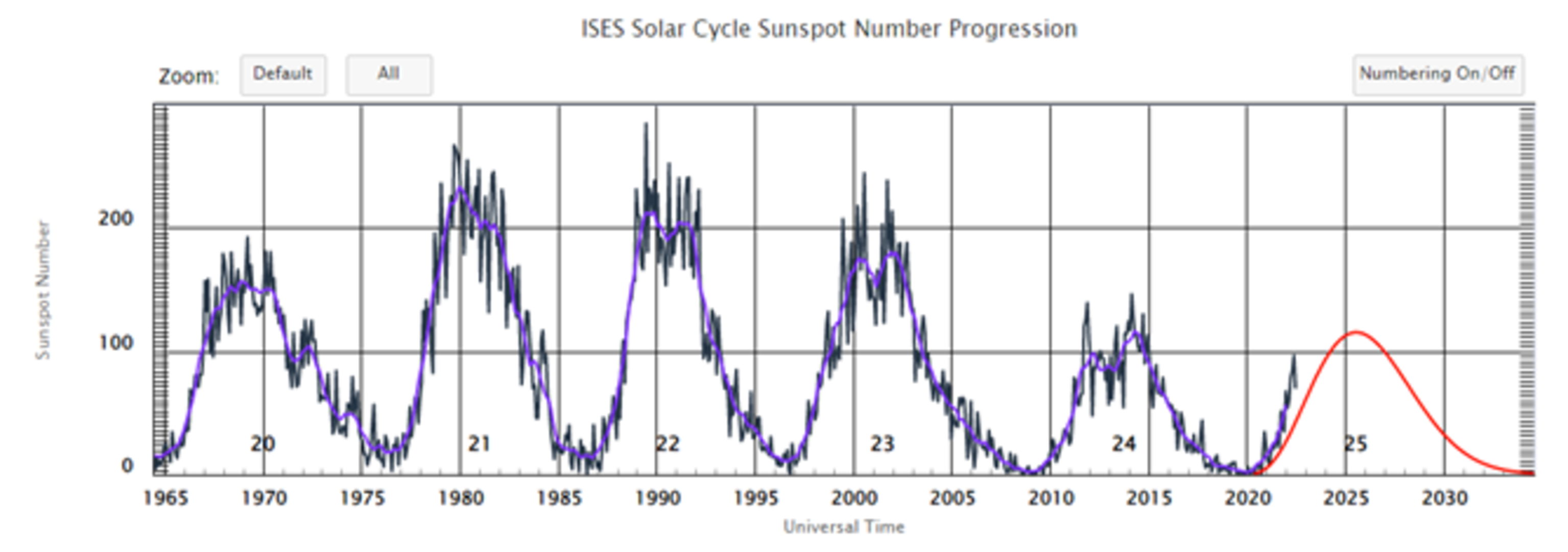
Solar cycle 25 prediction, NOAA, July 2022
In 2020, we entered the Grand Solar Minimum which is calculated to end in 2053. Whether there will be a solar-driven cooling, similar to the Little Ice Age (1300-1850 AD), or a full-blown orbitally-driven glaciation, such as the last glaciation from 116,000-14,400 years ago, is unknown. The former cooling could last for hundreds of years whereas the latter would last for at least 90,000 years. If there was another period of sustained subaerial volcanism, cooling would be accelerated.

During the last glaciation, Europe was covered with ice north of the Alps, as was Russia; Canada and northern and alpine USA were covered by ice; southern South America and the Andes were covered by ice; Himalayan ice expanded to lower altitudes; and alpine Australia, Tasmania and the South Island of NZ were covered by ice as were the southern and elevated portions of Africa.
In the last glaciation, vegetation contracted and tropical areas such as the Amazon Basin only had copses of trees occupying some ten per cent of the area of the current Amazonian rainforests; large areas of inland Australia, China, India, USA and Africa were covered by sand deposited from cold dry cyclonic winds; inland lakes evaporated; sea level was 130 metres lower than at present; there was no Great Barrier Reef; sea ice isolated Greenland, Iceland, northern Russia and northern Canada; Antarctic sea ice extended hundreds of kilometres north and there was a reduction in rainfall and plant and animal species. Areas that now support pastoral and grain-growing activities were sandy wastelands during the last glaciation.
Humans struggled as hunter-gatherers around the edge of ice sheets and at lower latitudes.
We are putting all our efforts and wasting trillions of taxpayers’ dollars into trying to prevent mythical human-induced global warming, yet we still don’t prepare for the inevitable annual floods, droughts and bushfires, let alone longer-term solar – and orbitally – driven global cooling.
We have a crisis of single-minded stupidity exacerbated by a dumbed-down education system supported by incessant propaganda, driven by financial interests and political activist authoritarianism.

via Science Matters
January 13, 2023 at 02:11PM
Oldbrew at Tallbloke’s Talkshop found a study showing that icebergs around Antarctica apparently haven’t changed much in the last few centuries despite an extra 2,000 Gt of CO2, and all that global warming. Remember climate change is going to hit Antarctica twice as hard as anywhere else.
As Oldbrew said: Probably not the result that was expected from this study.
Given the world warmed in the last three hundred years, it seems surprising that icebergs don’t seem to have changed. But if they had declined, this study would be a star of the news tonight. Instead I doubt many stations will report that if Captain James Cook returned today he might not see much difference.
Fascinatingly, Cook had a watch worth £450 so he could estimate longitude. To give some idea of just how fantastically valuable that watch was, ponder that the whole ship he commanded cost £1,800. The Larcum Kendall K1 watch was so prized Cook made sure “the commander, first lieutenant and astronomer were all present when it was used”.
It was modeled on the H4 clock, which only lost 5 seconds on a 81 day journey. Consider — today, we are all richer than kings.
by Todd Hollingshead, Brigham Young University

…
[Phys.Org] A new study comparing observations of large Antarctic icebergs from the 1700s with modern satellite datasets shows the massive icebergs are found in the same areas where they were pinpointed three centuries ago. The study shows that despite their rudimentary tools, the old explorers truly knew their craft, and it confirms that the icebergs have behaved consistently for more than 300 years.
Using primarily the journal records of Captain James Cook’s 1772–1775 Antarctic circumnavigation on the HMS Resolution (where he noted the positions of hundreds of icebergs), a trio of researchers from Brigham Young University, NASA’s Jet Propulsion Laboratory and the University of Washington’s School of Oceanography made comparisons with the two largest modern datasets available today: the BYU/National Ice Center and Alfred Wegener Institute datasets.
They found that Cook’s description of the iceberg plume east of Antarctica’s Amery Ice Shelf, along with iceberg distributions in the Weddell, Ross and Amundsen Seas, agree with modern data. They also found additional iceberg tracking by Edmond Halley in 1700, Lozier Bouvet in 1739 and Edward Riou in 1789 are consistent with modern observations.
“Where they saw icebergs, we see icebergs now; where they didn’t seem them, we don’t see them,” said study coauthor David G. Long, BYU professor of electrical and computer engineering. “The old data from these explorers may not been very good, but it’s all that we’ve got from that time—and it’s good enough.”
Cook’s observations make up 95% of the historical data used for comparison in the study. His crew used the Larcum Kendall K1 watch in combination with a sextant to track longitude on their journey. The K1 watch carried a heavy price tag (£450—the ship Cook sailed for the trip, the HMS Resolution, cost £1,800) so Cook took great care of the device, requiring the commander, first lieutenant and astronomer all present when it was used.
Lead study author Seelye Martin extracted Cook’s iceberg observations from a line-by-line search of Cook’s journal-turned-book about his journey: “A Voyage Towards the South Pole, and Round the World.” It turns out that when possible, Cook recorded his position alongside his iceberg observations, which he referred to as “ice islands,” “ice isles,” and “hills of ice.”
“Cook kept pretty good records, but they’re not perfect,” Long said. “They’re basically journal entries. He took some days off. Sometimes he would just say ‘saw a lot of ice in the ocean.’ Wish it was a little better, but on the other hand it was pretty unique.”
Fortunately, Cook’s onboard astronomer, William Wales, also recorded iceberg observations, which helped fill in a few gaps in Cook’s records.
After creating a spreadsheet of Cook’s data (along with data from Halley, Bouvet and Riou), Martin, Long and coauthor Michael Schodlok plotted the voyagers’ trips and observations on a map of Antarctica that includes the modern iceberg data. BYU’s part of the dataset uses low-resolution satellite scatterometer radars to track icebergs while the National Ice Center data consists of iceberg positions derived from visible, infrared and radar satellite observations. The Alfred Wegener Institute uses satellite transponders to track icebergs from the Weddell Sea.
The diagram provides a visual confirmation of how consistent the early explorers observations are with modern iceberg observations.
Long said since the databases they use track rather large icebergs which are not as sensitive to climate change. Because of that, the study doesn’t necessarily make a connection to global warming issues, but the result of no significant iceberg change from 1700 to 2000s is fascinating to consider.
“It’s the first comparison that I’m aware of, of a satellite iceberg database with pre-modern era data,” Long said. “I have always been proud that my database goes back multiple decades, but here we’re going back multiple centuries…
“I guess it’s a good reminder to keep a journal; you never know how it will be used in the future,” he said.
The research appears in the Journal of Glaciology.
REFERENCE
Comparison of Antarctic iceberg observations by Cook in 1772–75, Halley in 1700, Bouvet in 1739 and Riou in 1789 with modern data, Published online by Cambridge University Press: 12 December 2022
0 out of 10 based on 0 rating
via JoNova
January 13, 2023 at 02:08PM
More fake news from the climate-industrial complex. You can read the NYTimes coverage here. The Science article is here and the supplementary material is here. Below is what you need to know. No Evidence that Exxon ‘Knew’ Anything A new Harvard study claims that its analysis of ExxonMobil internal analyses of emissions and global warming … Continue reading No, Exxon was wrong on warming and didn’t know anything
via JunkScience.com
January 13, 2023 at 12:51PM

