
From Umoja, Kenya to India, climate change has led to domestic violence – The Washington Post
via Real Climate Science
January 5, 2023 at 06:42PM
From Umoja, Kenya to India, climate change has led to domestic violence – The Washington Post
via Real Climate Science
January 5, 2023 at 06:42PM
The Guardian says wind power is free and that most UK electricity comes from wind. So why has electricity become so expensive in the UK?
via Real Climate Science
January 5, 2023 at 05:42PM
Guest Post by Willis Eschenbach
I came across a laudatory article about the Scottish Hywind project, entitled “The world’s first floating offshore wind farm turns 5 — here’s how it’s going“. It’s all full of congratulations about the “capacity factor”, meaning how much of the nameplate capacity it actually generates. And in fact, at a claimed 54% capacity factor, that is impressive.
The wind farm has a nameplate capacity of 30 megawatts (MW). At 54% capacity factor, that’s 263 gigawatt-hours generated per year. As I said, impressive.
There’s just one leetle tiny fly in the ointment … as detailed here, electricity from Hywind is being sold to the grid, not to the consumer but to the grid, for $0.25 per kilowatt-hour. That’s about four times the cost of fossil fuel electricity, and guess who is subsidizing the difference?
Yep. The poor UK taxpayer. At $0.25 per kWh, that electricity subsidy is costing the taxpayers just over $47,000,000 per year, about a quarter of a billion dollars over the five years of its existence … hell of a deal.
This is the ugly reality of wind and solar. They are hugely subsidized by the taxpayers no matter where they are installed. The subsidies are both direct and indirect. They don’t make money, they are not economically competitive anywhere except in the fevered green dreams of the ecolarmists who are forcing them on the poor taxpayer.
Here’s the bottom line:
That’s $0.55 per kilowatt-hour that we’ve thrown down a rat-hole.
(Folks don’t realize how big $5 trillion dollars is … here’s a way to grasp it. If we were to waste a million dollars each and every single hour, setting fire to $24 million dollars a day, 24/7/365, it would take us 570 years to waste $5 trillion. Think about all the good things that money might have done. To pick just one thing, it could have provided clean drinking water to every single village on the planet with lots of money left over … but noooo, the green lobby must have its insanity paid for by the taxpayer.)
And what has the five trillion dollars bought us?
As our UK cousins say, “Sweet Fanny Adams”, a polite way of saying sweet F*** All. In other words …
Nothing.
Grrrr …
The good news, on the other hand, is that drought-prone northern California where I live is getting lots of rain. Here’s the view from my porch, with very wet pumpkins on the patio table.
Of course, according to the media and the oh-so-scientific climastrologers, last year when there was a drought in California it was a sure sign of dreaded climate change. And now when we get rain, guess what?
It’s another sure sign of dreaded climate change …
… and also of course, to go with the so-called “good news” about wind power discussed above, the bad news is that the California electrical grid can’t handle wind. Go figure. We’re out of power at our house, and it’s far, far from just us. Here’s the Pacific Gas and Electric outage map. I live an hour and a half north of San Francisco, which is where the red triangle is on the coast.
As a result, we’re running chez nous on our trusty Honda 2200i gas-powered generator for the indeterminate future, the PG&E site says “ESTIMATED RESTORATION: To Be Announced”, the gorgeous ex-fiancee and our grandson are playing the acoustic piano, the rain is pouring down, and all the woke people around here with their $70,000 sparky cars can’t charge them.
As for me, the grass is green outside my window, and as long as I’m looking down at it and not up, my life is wonderful.
My very best to all of you, whatever your weather may be.
w.
My Usual: Misunderstandings are the bane of the intarwebs. To reduce the number, please quote the exact words you are referring to, so we can know just what and whom you are discussing.
via Watts Up With That?
January 5, 2023 at 04:44PM
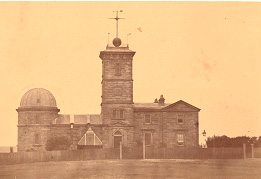
Sydney Observatory in the centre of the city in 1864. (Courtesy of the State Library of NSW.)
For the first time in 163 years of records at Sydney Observatory the temperature didn’t even crack 32 degrees C (or 90F) for the whole year of 2022. Despite CO2 being at higher levels than ever, Sydney has never had temperatures that were so un-extreme.
The hottest day all year at this historic site was just 31.9 C. When BoM auditor Chris Gillham first mentioned this, I assumed he must have meant “for the month of December”. I could not believe Sydney would go a whole year without a single hot day, but here it is. Gillham graphed the hottest day of the year at Sydney Observatory every year since 1859 and it really is unprecedented.
So far the total media attention on this point is one tweet by a weatherzone meteorologist and a paragraph in The Sydney Morning Herald. (h/t b.nice and RealClimateScience). Has the BoM even said a word? If it was the hottest year in 163 years, we’d know all about it. The BoM is an advertising agency for government policies.
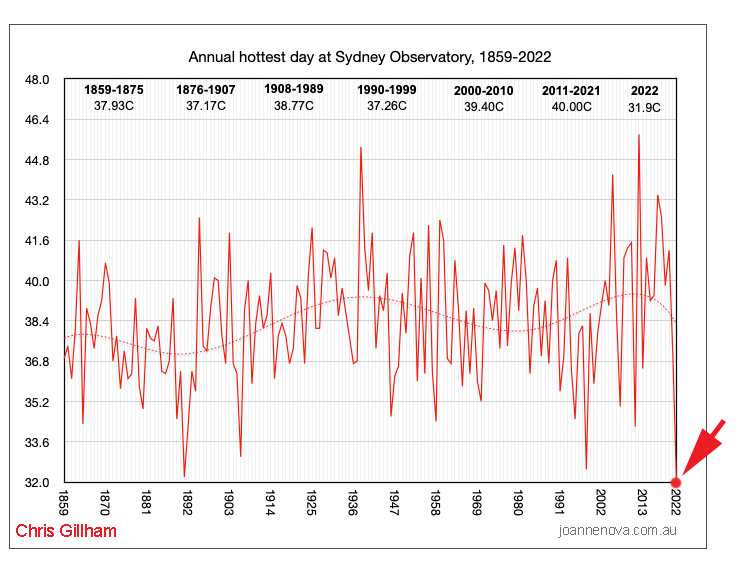 And this is despite many site changes which make the site warmer, including all the concrete, bitumen and 6-lane freeways added in the area. During the time shown in the graph, Sydney grew from 95,000 to 5 million people.
Sydney Observatory is right in the heart of city, surrounded by cars and yet it would have felt hotter there in 1859.

Sydney Observatory is right next to the busiest roads and tallest buildings in Sydney.
Most years in Sydney there are 6 to 20 days of temperatures above 32C. Many thanks to Chris Gillham for doing all the work to make these graphs.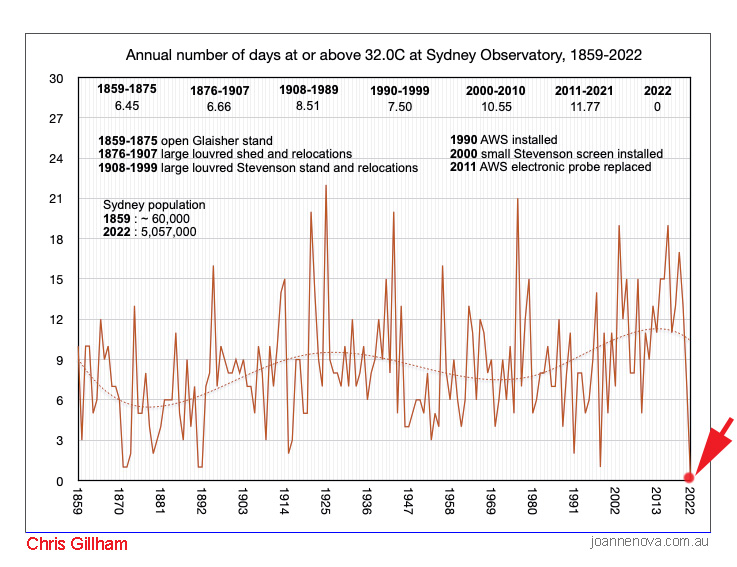 What happened to that extreme heat?
The reason for the lack of hot days is due to the record amount of rain. In 2022 2,530 mm of water fell on Sydney, breaking the previous rainfall record of 2,194mm set in 1950. When soils are wet, sunlight must evaporate the moisture before the soil and air above it, can start to heat up. So more rain means cooler maximums.
To get hotter maximum temperatures takes bone dry sand. If only the Bureau of Meteorology could predict rainfall, droughts and La Nina’s, they might also be able to predict which years would have extreme heat? Wouldn’t that be handy?
Instead, the models are so bad, even the expert climate modelers don’t want to use their own models to help invest their own retirement funds.
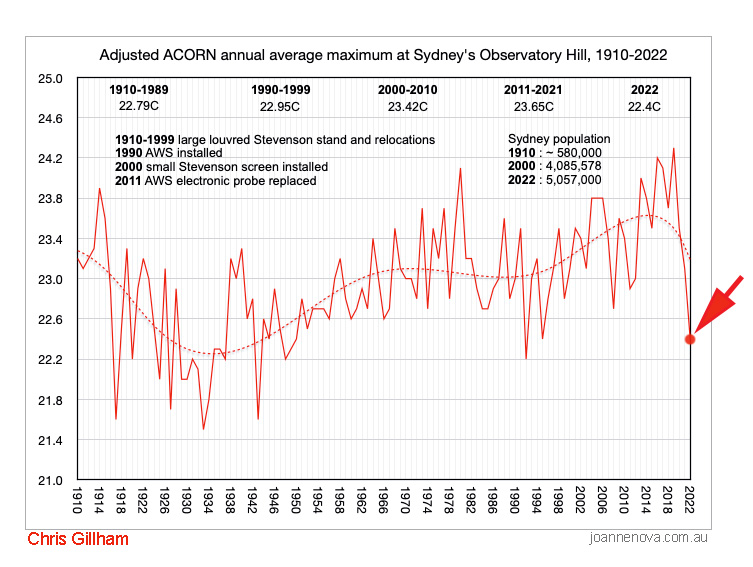
Background information:
BoM Sydney Observatory site (closed) with the new BoM site
In 2017 and 2018 Bill Johnston documented the many site changes and the full history of this iconic site. If only the BoM were as interested in the history as the volunteers are?
..
10 out of 10 based on 2 ratings
via JoNova
January 5, 2023 at 03:12PM

