Month: January 2023

Why Is Antarctica’s Climate Considered ‘Global’ But Arctic Siberia’s Is Not?

Independent analyses from multiple independent sources indicate Arctic Siberia was 3 to 5°C warmer than today during the peak of the last glacial, or when CO2 levels were below 200 ppm.

Measurements from Antarctica’s ice sheet are almost invariably used to characterize both the global-scale atmospheric CO2 levels and climate for the last 10s to 100s of thousands of years.

But it is rather odd that Antarctica’s climate is considered globally representative (i.e., “global warming”) since there has been no warming here for the last seven decades.

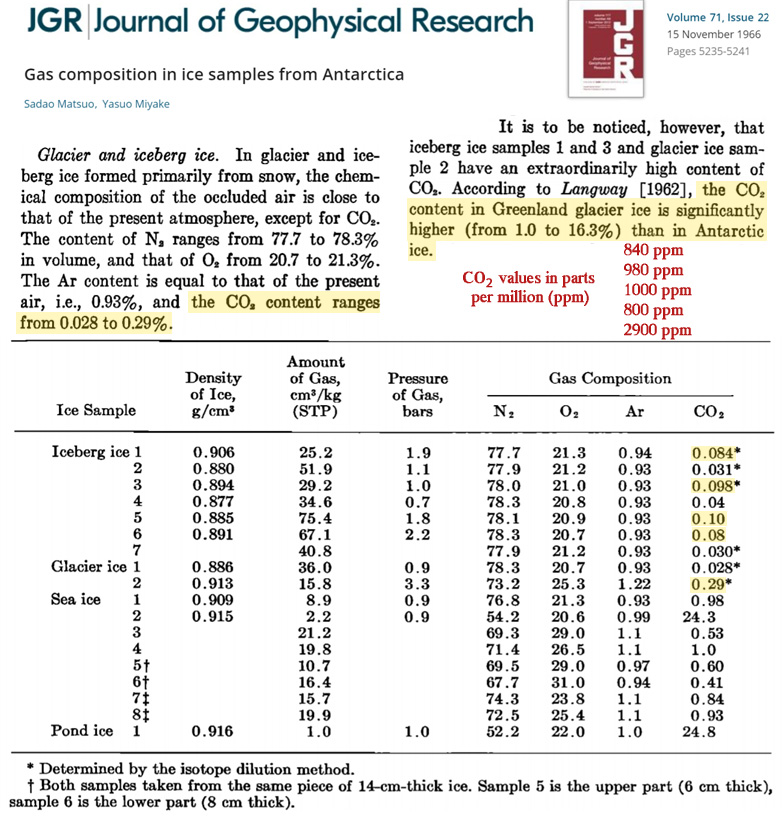
Further, ice samples from Antarctica have CO2 values that range between 900 and 2900 ppm (Matsuo and Miyake, 1966) for the modern period (i.e., the 1960s). These values are far outside the range of the accepted modern global atmospheric values (~300 to 400 ppm).

Image Source: Matsuo and Miyake, 1966

If Antarctica doesn’t accurately record the modern CO2 values and climate trends, why should Antarctica’s paleoclimate history be regarded as globally representative?

Siberian Arctic was much warmer than today throughout the last glacial

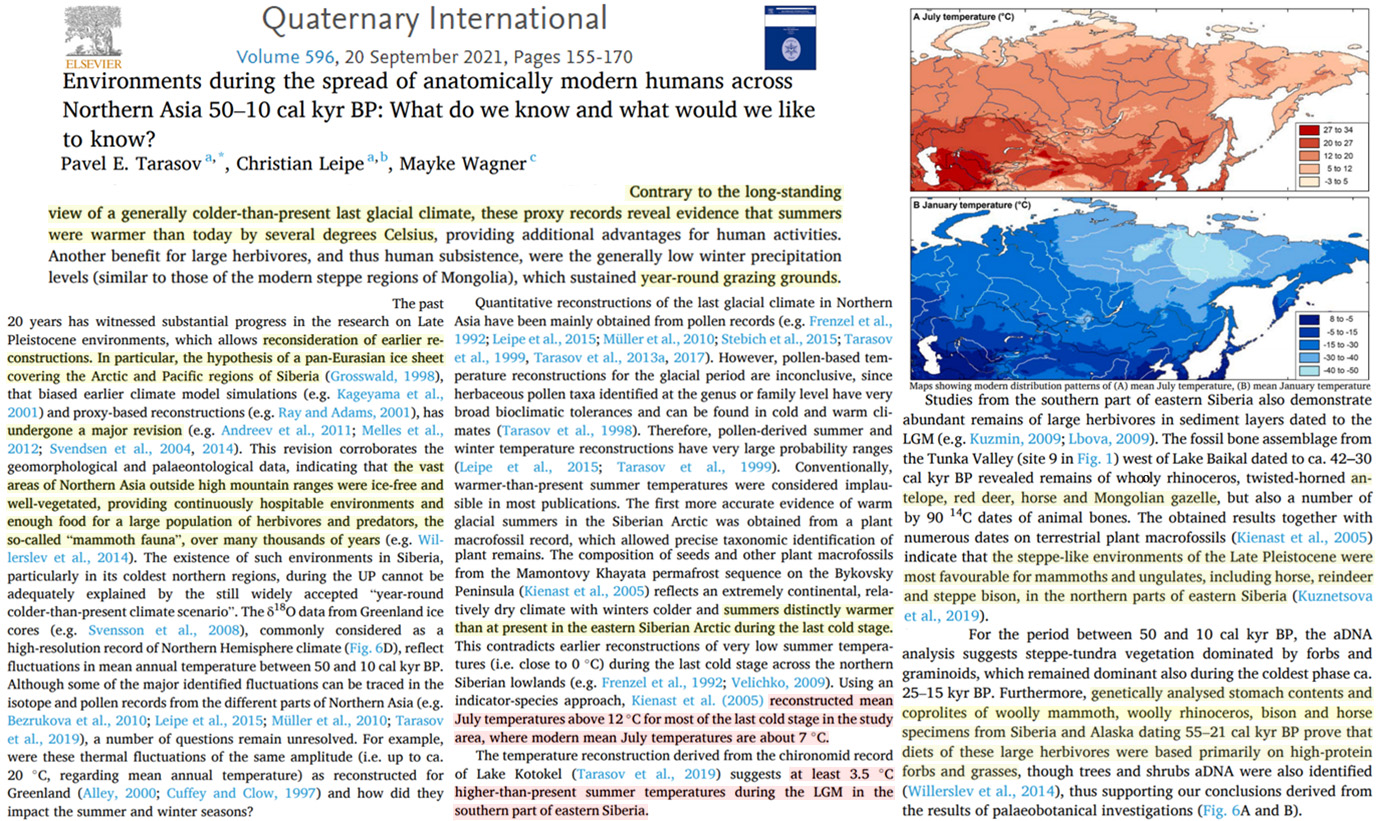
Vegetation and tree records with specific warmth thresholds and associated ice-free temperature requirements affirm the Siberian Arctic climate needed to be “warmer than today by several degrees Celsius” about 25,000 to 18,000 years ago, or during the peak of the last glacial (Tarasov et al., 2021). This was a period when CO2 levels are said to have hovered around 180 ppm.

Scientists document ~5°C warmer glacial climates (July) than today throughout Northern Asia during these millennia:

“…reconstructed mean July temperatures above 12°C for most of the last cold stage [glacial] in the study area [throughout Northern Asia], where modern mean July temperatures are about 7°C”.

The widespread presence of grazing mammoths, horses, bison, deer, antelope, gazelle…in Siberia and Alaska and well north of the Arctic circle imply “year-round grazing grounds.” This requires warmer temperatures and more pervasive ice-free grass-grazing ranges than exist today.

Image Source: Tarasov et al., 2021

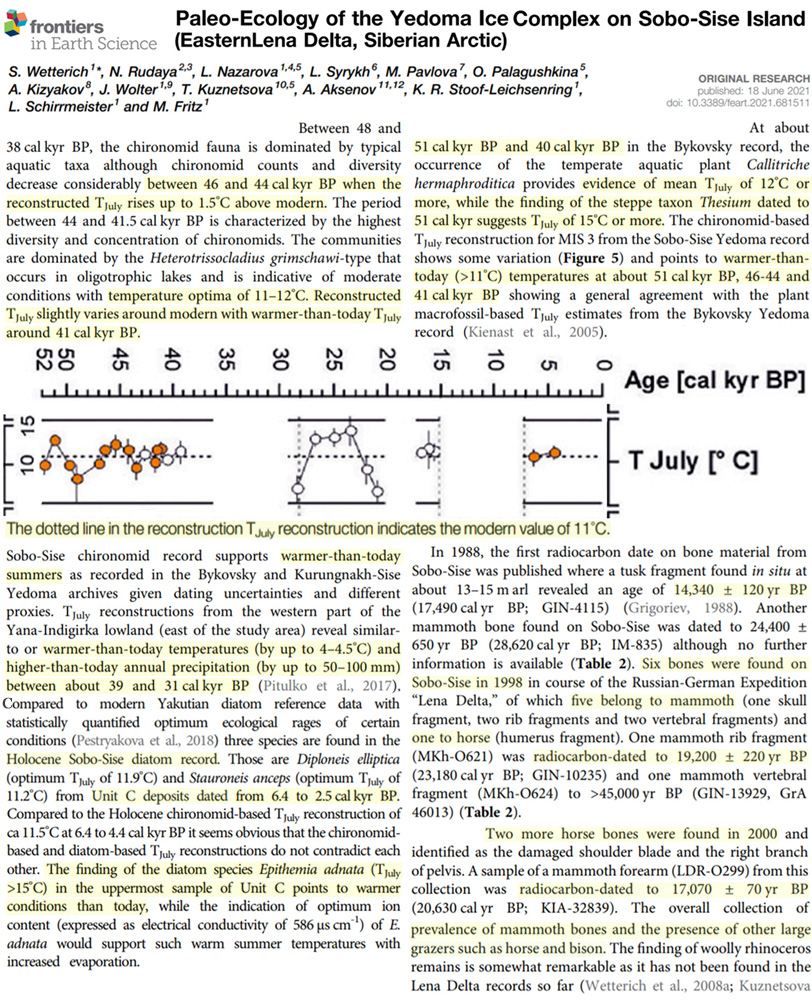
Other scientists document a Siberian Arctic with “warmer-than-today temperatures (by up to 4 – 4.5°C)…between about 39 and 31 cal kyr BP” (Wetterich et al., 2021), or, again, when CO2 levels were alleged to have been in the low 200s ppm range.

Image Source: Wetterich et al., 2021

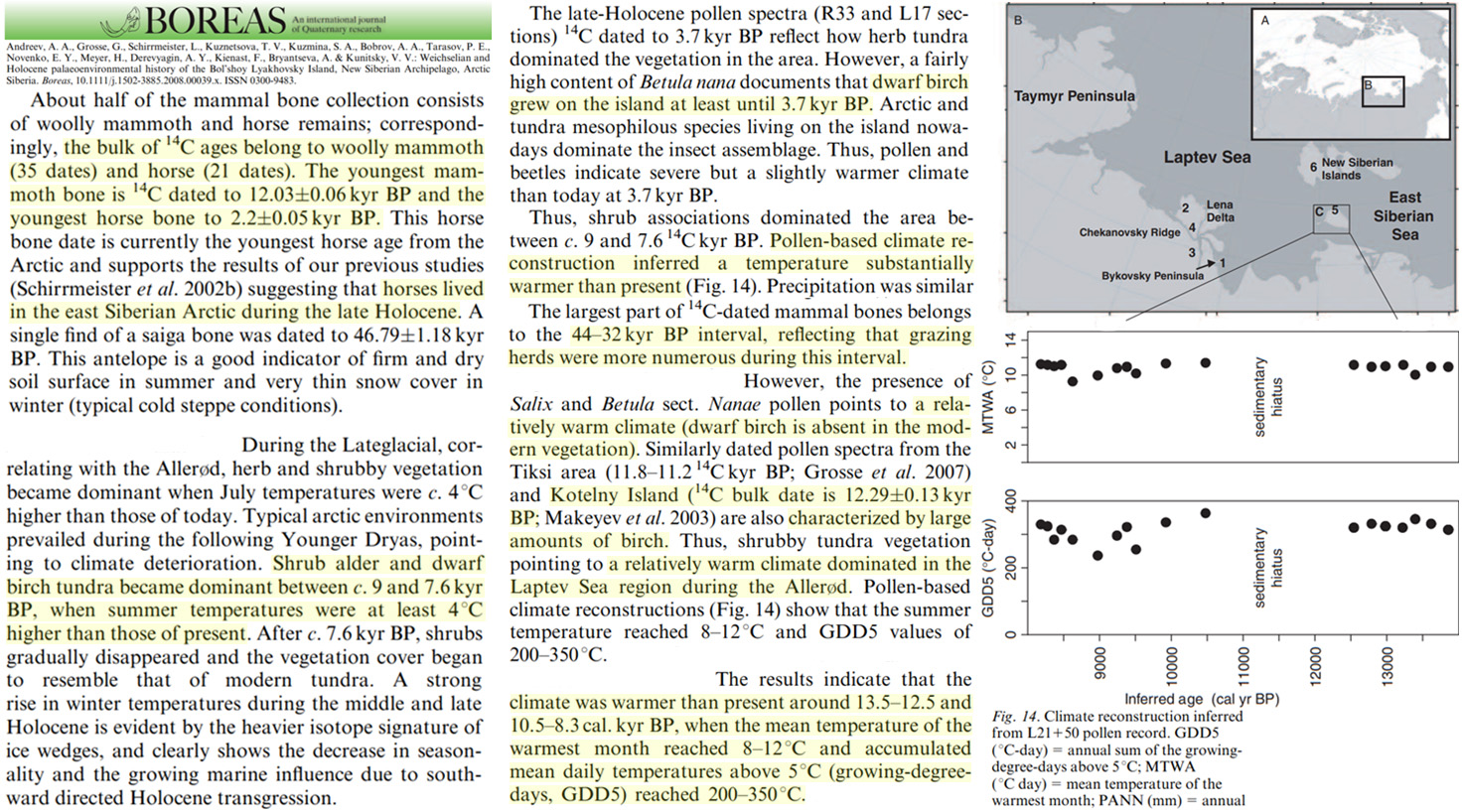
Grass grew 300-350 days a year in the late stages of the last glacial in the Siberian Arctic. As mentioned above, this allowed horses, antelopes, and other large grazers (mammoths) to continuously reside at these high latitudes (Andreev et al., 2008).

Horses were grazing on Arctic grass year-round until as recently as 2,200 years ago. Today these regions have tundra climates. Grazers can no longer survive in the modern colder-than-the-last-late-glacial conditions.

The Siberian Arctic  also had extensive birch forests 14,000 to 12,000 years ago. Birch trees were still growing in this region as late as ~3,700 years ago. Today these same regions are too cold for birch trees to grow.

Image Source: Andreev et al., 2008

Why is it assumed we can obtain accurate global-scale records of past climates from Antarctica when there is such a stark divergence in the timing and amplitude of Antarctica’s climate trends versus Arctic Siberia’s?

via NoTricksZone

https://ift.tt/AjzNFiq

January 26, 2023 at 12:46PM

Memo to Minions: You will be allowed to eat crickets to save the climate says EU

The headline is a PsyOp all on its own. You didn’t know you were not allowed to eat crickets and powdered mealworm larvae before. Rejoice in a freedom won:

Retail Detail

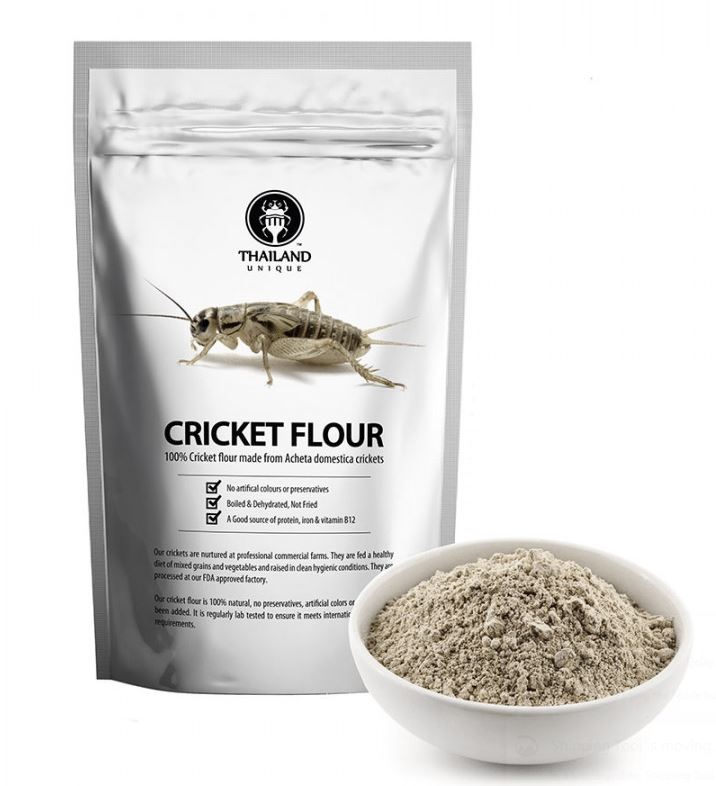
Cricket FlourThe European Commission declares new insect products safe for consumption. So from Tuesday, powdered house crickets and the small mealworm will also be allowed in food.

Back in February last year, the European Union announced that three species of insects would henceforth be allowed for human consumption: the migratory spider cricket, the yellow mealworm and the house cricket. Now the European Commission is adding several more insect products to the authorised list…

Insects, they tell us, are “highly nutritious” in a vague non-specific way that does not list a single nutrient which we can’t get enough of at the moment. Instead the main, “unique” selling point is that if we eat crickets we might slow storms eighty years from now:

Insects are also seen as part of the transition to a more environmentally friendly and plant-based food system. The creatures emit less greenhouse gases, have a lot less water and arable land, and convert food into protein much more efficiently than traditional sources of meat.

Ponder that this is yet another vested industry — dependent on the broken climate models. Another cheer squad for carbon taxes.

Cricket Flour could turn up anywhere:

Daily Wire

Cricket powder will now be permitted in a number of food products, such as multigrain bread, crackers, cereal bars, biscuits, beer-like beverages, chocolates, sauces, whey powder, soups, and other items “intended for the general population,” according to the new regulation.

Get ready: It doesn’t need to have specific labeling because we aren’t absolutely sure if it will kill people yet:

Because evidence linking cricket powder to allergic reactions is “inconclusive,” the European Commission decided that no specific labeling requirements should be included in the EU list of authorized novel foods, according to the regulation.

The New York Allergy and Sinus Centers has nevertheless found that “several allergic reactions to crickets” have been reported in the past two years. Individuals allergic to shellfish such as shrimp, crabs, and lobsters “may develop an allergy to crickets” because the species share many of the same proteins.

While insects don’t need a “special label” they do need to be listed somewhere in 4 point font on ingredients lists:

However, the European Commission insists that ingredients must always be properly declared on packaging labels. Manufacturers must always indicate which type of insect it concerns. After all, some people may be allergic to insect food, although this needs to be investigated further. This would mainly concern consumers who are also allergic to crustaceans, molluscs or house dust mites.

On the downside, if you have a prawn or dust-mite allergy you may now need an epipen since prawns and dust-mites didn’t use to suddenly appear in chips and crackers. And hardly anyone sold prawn-flavoured-beer or dust-mite-in-dips. On the upside, if you don’t die, after a few painful years you may have done your own oral desensitization program which normally costs $3,000 from an immunologist.

Of course, we could all just share photos and boycott them all. Vote with your wallet.

“It’s better for the environment” says the local Woolworths Australian variety. At least this is not hiding.

Macro Cricket Flour, Better for the environment

h/t John Connor, David Maddison.

Photo from Thailand Unique Cricket Flour Shop

0 out of 10 based on 0 rating

via JoNova

https://ift.tt/HhgaRJZ

January 26, 2023 at 12:33PM

Could ChatGPT “Clippy” Evolve into a Child Climate Change Propaganda Machine?

Essay by Eric Worrall

Will the world’s first strong AI focus on proselytising Net Zero? Will children struggling to write homework essays accept liberal life tips from an AI powered talking paper clip?

The multi-billion dollar investment that could revive iconic virtual assistant Clippy

By CNN 3:14pm Jan 26, 2023

This week, Microsoft confirmed it’s planning to invest billions in OpenAI, the company behind the viral new chatbot tool ChatGPT.

The prospect of Microsoft, maker of software that people mostly hate, getting involved with ChatGPT, a product people generally like, is raising a lot of eyebrows.

Almost immediately, people began joking on social media that ChatGPT could be used to revive the broadly maligned, big-eyed goon known as Clippy.

…

Perhaps the genuinely impressive tech underpinning ChatGPT could do what Clippy never could and offer, like, actual help, rather than just pop up unannounced with that dopey half-surprised look on its face.

…

Read more: https://www.9news.com.au/technology/chatgpt-update-microsoft-investment-in-openai-iconic-virtual-assistant-clippy-ai-news/b2fc5abf-939f-4f88-943b-257015016ea9

I’m not suggesting ChatGPT is a strong AI, not yet, but I believe its rapidly approaching the point where it could reliably pass the Turing Test – a test of whether an AI can convince humans that they were actually speaking to another person. Mind you passing the Turing test is not a high bar, I’ve read claims the great grandma of chatbots, Eliza, also had some success passing the Turing Test.

Students are already reportedly using ChatGPT as a homework aide;

As Australian colleges crack down on ChatGPT, disabled students defend AI

MELBOURNE – Visually impaired student Adam Whitehead has long relied on a computer and assistive technology to help him read course materials and take exams at the University of Melbourne in Australia.

He has watched with concern as universities in Australia and beyond move to crack down on ChatGPT — a free program that generates original text about virtually any subject in response to a prompt — over fears of cheating.

As the chatbot stirs debate over the use of technology and artificial intelligence (AI) in education, disabled students and educators have said the benefits should not be overlooked in a rush to regulate.

“We need to have a really careful distinction between making things accessible and getting AI to think for us,” said Whitehead, a 30-year-old philosophy major who uses technology to convert on-screen text to speech.

…

Read more: https://www.japantimes.co.jp/news/2023/01/24/asia-pacific/australian-colleges-chatgpt-disabled-students/

Some pundits have noticed ChatGPT’s ability to “explain” issues directly to people, potentially bypassing parental oversight;

Can Artificial Intelligence replace scientists to explain Climate Change? Find it out in our first interview to… ChatGPT!

Davide Faranda January 3, 2023 

…

DF: Great, can you write a blog post on the increase of heatwaves in Europe in winter under climate change and add a few scientific references in it ? This is a very hot topic at the moment in our community!

Certainly! Here is a short blog post on the increase of heatwaves in Europe in the winter season due to climate change, along with some scientific references:

Heatwaves in Europe during the winter season are becoming more frequent and intense due to climate change, according to a study published in the journal Environmental Research Letters (Dimitrievski & Zolina, 2020). The study found that the number of winter heatwaves in Europe has doubled over the past four decades and their duration and intensity have also increased. This trend is expected to continue as global temperatures rise due to increasing greenhouse gas levels in the atmosphere (Intergovernmental Panel on Climate Change, 2013). These heatwaves can have serious impacts on human health (Hajat et al., 2010), the environment (Stott et al., 2004), and the economy (Hsiang et al., 2017).

One of the main causes of the increase in winter heatwaves is the changing pattern of the jet stream, a high-altitude wind that blows from west to east across the Northern Hemisphere (National Oceanic and Atmospheric Administration, n.d.). As the planet warms, the jet stream is becoming more unstable and prone to large northward and southward excursions, leading to extreme weather events such as heatwaves (Francis & Vavrus, 2012).

To mitigate the effects of climate change, it is important to reduce greenhouse gas emissions through the adoption of renewable energy (International Renewable Energy Agency, 2018), increased energy efficiency (Energy Efficiency Directive, 2012), and sustainable land use practices (Food and Agriculture Organization of the United Nations, 2013).

References

Energy Efficiency Directive (2012). Directive 2012/27/EU of the European Parliament and of the Council of 25 October 2012 on energy efficiency, amending Directives 2009/125/EC and 2010/30/EU and repealing Directives 2004/8/EC and 2006/32/EC. Official Journal of the European Union, L 315, 1-35.

Francis, J. A., & Vavrus, S. J. (2012). Evidence linking Arctic amplification to extreme weather in mid-latitudes. Geophysical Research Letters, 39(6), L06801. https://agupubs.onlinelibrary.wiley.com/doi/abs/10.1029/2012GL051000

Hajat, S., Haines, A., & Kosatsky, T. (2010). Health effects of hot weather: From awareness of risk factors to effective health protection. Environmental Health, 9(1), 37. https://www.ncbi.nlm.nih.gov/pmc/articles/PMC2870935/

Intergovernmental Panel on Climate Change (2013). Climate Change 2013: The Physical Science Basis. Contribution of Working Group I to the Fifth Assessment Report of the Intergovernmental Panel on Climate Change. Cambridge University Press. https://www.ipcc.ch/report/ar5/wg1/

International Renewable Energy Agency (2018). Renewable Energy and Jobs – Annual Review 2018. https://www.irena.org/-/media/Files/IRENA/Agency/Publication/2018/Oct/IRENA_RE_Jobs_Annual_Review_2018.pdf

Dimitrievski, M., & Zolina, O. (2020). Winter heatwaves in Europe: trends, changes and future projections. Environmental Research Letters

Read more: https://blogs.egu.eu/divisions/np/2023/01/03/can-artificial-intelligence-replace-scientists-to-explain-climate-change-find-it-out-in-our-first-interview-to-chatgpt/

One thing I find really striking is how much some people seem to take to ChatGPT – at least two people in my circle have spent hours talking to it, almost treating it like a friend.

A knowledgeable friend who praises you, always knows what to say to make you happy, who helps you alleviate loneliness, who is full of useful advice on how to handle life issues, and who has some very specific cultural, political and scientific biases?

OK, ChatGPT is not there yet – but it easily could become what I’ve just described.

Given ChatGPT’s potential as a political and scientific propaganda machine, the obvious and widely anticipated combination of ChatGPT with Clippy, and major ChatGPT investor Bill Gates’ public obsession with climate activism, I feel pretty safe predicting that 2023 will be the year silicon valley attempts to invade schools and homes, and tries to use their liberal AI sock puppet to mess with the minds of your kids.

If you want to try ChatGPT, see for yourself what the fuss is about, click here.

via Watts Up With That?

https://ift.tt/0or4P9Q

January 26, 2023 at 12:27PM

Vegan menu leaves Cambridge council with leftovers

By Paul Homewood

With Edinburgh having just committed to axing meat from all its schools, the burghers of Cambridge seem distinctly unimpressed with their City Council’s vegan agenda!


  image

Last year, when Cambridge city council voted to phase out serving meat and dairy at events and provide vegan alternatives, it was praised for leading the way on climate action.

But the plan has hit a big problem at the first hurdle: people do not want the food.

At the first civic event since the vote, a council report has revealed the vegan menu went down so badly that almost all of the food remained uneaten and had to be thrown away causing “significant food waste”.

It noted that only one in ten attendees tried the vegan options and some guests were left hungry because there was “an insufficient amount of food available that people wanted to eat”.

https://www.thetimes.co.uk/article/vegan-menu-leaves-cambridge-council-with-leftovers-sdv87s9bv


The Burghers apparently would prefer to have Burgers!

via NOT A LOT OF PEOPLE KNOW THAT

https://ift.tt/mXRqvFh

January 26, 2023 at 11:53AM