Month: January 2023

On Climate Grooming the Children

A man who has not been a socialist before 25 has no heart.
If he remains one after 25 he has no head.—King Oscar II of Sweden

One of the observations about the 2022 midterms was how strongly young unmarried women voted for the socialist agenda of today’s Democratic party.  I recall a video clip of two university students saying their vote was all about women’s abortion rights, and thinking these two nerds’ politics might be biased by their desire to get lucky some night.  But beyond that issue is the campaign brainwashing of children regarding global warming/climate change.

Benjamin Khoshbin shines some light into this climate political grooming in his Real Clear Energy article The Electoral Case for Commonsense Environmentalism  Somewhere Between “No More Meat” and “It’s a Hoax:”  Excerpts in italics with my bolds.

We’ve all heard the adage, that a young person not thinking socialist has no heart, while an older person still a socialist has no head.  It sounds true, but it’s not — young voters are no longer aging into conservatism. While Gen X and Boomers did trend more conservative as they aged, Millennials in the U.S. are becoming more liberal as they age, and are estimated to be the most liberal 35-year-olds in recorded U.S. history.

Based on their behavior in the 2022 midterms, Gen Z is likely to follow suit.

According to the Edison Research National Election Pool exit poll, 63% of Gen Z voted for Democrats in House races, compared to just 35% who voted for Republicans — a whopping 28-point gap. While many salient issues for young voters are likely driving this, one stands out: climate change.

Millennials and Gen Z are more concerned about climate change than any other generation. A Harris Poll survey of American 13–19 year-olds found that more than 8 in 10 teens believed that if climate change isn’t addressed today, it will be too late for future generations as some parts of the planet will become unlivable. Nearly 80% of teens in the survey also believed that protecting the environment should take priority over economic growth.

A deeper look into the 4H/Harris Survey

I have posted before on climate push polls designed to get results supporting a political agenda.  What participants say is shaped by how questions and asked and answered. This survey was conducted online within the United States by The Harris Poll on behalf of 4-H from January 5 to January 18, 2022, among 1,500 respondents ages 13-19.   The age cohort is interesting to show how successfully has been the educating of children regarding environmental concerns, and especially climate change.  The survey content is here Environmental Impact Survey  Exploring the impact of the environment on teens.

Indeed the title of the report refers not to impact upon nature, but rather the impact of envrionmental messaging upon impressionable teenagers.  The survey itself consisted of stating preferred conclusions and offering agree/disagree options.  Typically strong and somewhat agree responses are lumped together into agree percentages.  Some Examples:

84% of teens agree, “I am concerned that if we don’t do more to protect the environment, humans and other species, wildlife will suffer and possibly go extinct.”

82% of teens agree, “If we don’t do more to protect the environment today, I expect to have to make future life decisions based on the state of the environment, including where I live, what kinds of jobs will be available, or if I will have children.”

56% of teens agree, “International governments are working towards global initiatives and policies to protect our planet.”

84% of teens agree, “Climate change will impact everyone in my generation through global political instability.”

84% of teens agree, “If we don’t address climate change today, it will be too late for future generations, making some parts of the planet unlivable.”

69% of teens agree, “I am worried that my family and I will be affected by climate change in the near future.”

77% of teens agree, “I feel responsible to protect the future of our planet.”

84% of teens agree, “We need more corporate action from companies today to improve our climate for tomorrow.”

83% of teens agree, “We need more legislative action from government today to improve our climate for tomorrow.”

79% of teens agree, “Protecting the environment should take priority over economic growth.”


Khoshbin: These findings should trouble Republicans. Young voters believe that climate change is an existential threat, but they mistakenly think that environmental protection and economic growth are mutually exclusive. In reality, since 2005, 32 countries — both developing and developed — have absolutely decoupled carbon emissions from GDP growth, having successfully grown their economies while simultaneously reducing carbon emissions.

My Comment:

That is not the only mistaken perception among these teens.  Mind you, they were only exposed to the alarmist POV, and followed their hearts and feelings.  Note the repeated 84% agreement percentage suggests a central tendency in responses with little if any consideration of nuances between statements.  Basically this survey confirms that a narrative is embedded in these people.

An interesting contradiction appears here:

• Over 9 in 10 teens grew up engaging in a number of outdoor activities, yet today a majority of teens spend 5 hours or less outside per week – or less than 11 days a year

Another survey source indicates where children get information NEEF Teen Benchmark Survey National Environmental Education Foundation (NEEF): Some relevant findings:

See Also

The Art of Rigging Climate Polls

YouGov Climate Push Poll: Still no Believer Majority
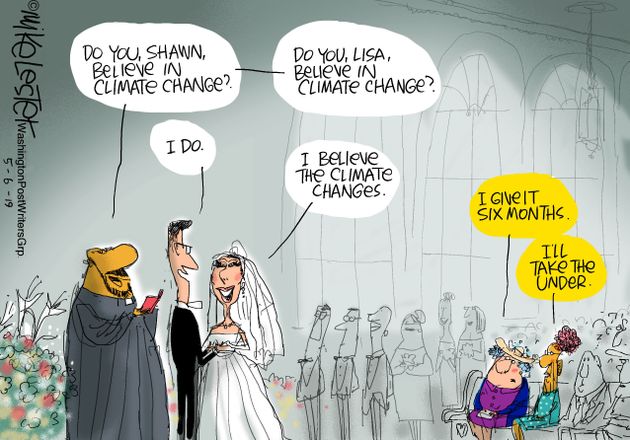
 

via Science Matters

https://ift.tt/BVZyF4r

January 31, 2023 at 09:52AM

Forget Net Zero: Oil and gas investment needed for another 30 years, BP warns

From NOT A LOT OF PEOPLE KNOW

By Paul Homewood

From the Telegraph:

Investment in oil and gas production will be needed for the next three decades if the world is to avoid more shortages and price swings, BP has warned.
The oil giant said in its annual energy outlook published on Monday that fossil fuels are still likely to account for about 20pc of primary energy in 2050 even under a significant tightening of climate policies.
Spencer Dale, chief economist at BP, said investment in new wells would therefore be needed until 2050 to ensure supply of fossil fuels matches demand.
“Natural declines in existing production sources mean there needs to be continuing upstream investment in oil and natural gas over the next 30 years,” he wrote in the report.
The assessment is likely to spark backlash from climate groups and campaigners who argue that investment should be immediately stopped in order to meet net zero goals.
Greta Thunberg told world leaders at Davos earlier this month that new extraction should be stopped immediately, while UN chief António Guterres said last June: “New funding for fossil fuels is delusional.” The International Energy Agency said in 2021 that no new oil, gas or coal projects should be approved if the world was to stay on track to meet a goal of net zero emissions by 2050.
However, BP said continued supply of oil and gas was needed to prevent a repeat of the kind of disruption seen last year when Russian oil and gas supplies were drastically cut back following the invasion of Ukraine. 
Full story

via Watts Up With That?

https://ift.tt/gu97Czy

January 31, 2023 at 09:02AM

Desert dusts convert coral reefs into carbon storage

Australian coral [image credit: heraldsun.com.au]

Professor: “this study actually contributes to more accurate accounting of carbon around the globe.” Nature’s carbon cycle continues to surprise researchers.
– – –
An international study comparing data from Heron Reef and the Middle East’s Gulf of Aqaba has disproved the long-held theory that coral reefs only have the capacity to emit CO2, reports Phys.org.

The first-of-its-kind discovery is the result of an international study led by The University of Queensland which found that dust blown in from nearby deserts can convert coral reefs into CO2 sinks.

Professor Hamish McGowan from UQ’s School of Earth and Environmental Sciences said the discovery was made after researchers observed a correlation between influxes of CO2 and periods of increased dust concentrations in the atmosphere around the reefs.

“We were surprised at how significant a role dust accumulation played in switching coral reefs from a CO2 source to a CO2 sink,” Professor McGowan said.

“This process was previously thought to be impossible, but our research proves otherwise.

“We found that the build-up of dust in the traditionally low-nutrient and low-chlorophyll waters of the Gulf of Aqaba actually fertilizes and improves coral-growing conditions and photosynthesis in reef ecosystems.”

Professor McGowan said the results will allow for the development of more accurate carbon budgets for the world’s oceans.

“The process we have identified in this study actually contributes to more accurate accounting of carbon around the globe,” Professor McGowan said.

“This informs predictions of the impact of atmospheric carbon on climate and climate sensitive ecosystems such as coral reefs.”
. . .
The research establishes the causal controls on reef water temperatures, as opposed to previous predictions which were more focused on the correlation of global warming and coral bleaching.

Professor Lensky said these findings will allow researchers to correctly attribute the cause of, for example, extreme high water temperature events that result in coral bleaching.

“Our research, which included analysis of data collected at Heron Reef on the Great Barrier Reef, has confirmed the crucial role of local meteorology and the prevailing weather patterns in determining reef water temperatures,” Professor Lensky said.

Full report here.
– – –
Earlier research: Dust in Earth system can affect oceans, carbon cycle, temperatures, and health (2010) – ScienceDaily

via Tallbloke’s Talkshop

https://ift.tt/mvBJoZK

January 31, 2023 at 05:24AM

The Washington Post Gets Iceberg Story Right

From ClimateREALISM

By Linnea Lueken

The Washington Post (WaPo) published a story that explains how a 600 square mile chunk of iceberg has broken off from Antarctica, and that scientists do not believe it is due to climate change.

This is factually true, and WaPo should be praised for publishing a scientifically-sound article on spectacular natural phenomena without attempts trying to tie it to climate change.

WaPo writer and meteorologist Dan Stillman covered the recent drama of a large segment of iceberg breaking off from Antarctica’s Brunt Ice Shelf, in a post titled “Giant iceberg breaks off from Antarctica. Aerial view is ‘spectacular.” Stillman reports that the calving occurred “during a particularly high tide known as a spring tide,” and has been expected by Antarctic researchers for years now after a large crack formed and expanded.

The article goes into detail about the theory and mechanics of the ice shelf and the natural growth of the chasm that eventually caused a split—in part due to the growth of the ice shelf itself.

Stillman wrote, “Unlike some previous icebergs and collapsed ice shelves that have been linked to climate change, the BAS press release said the break is a “natural process” and there is “no evidence that climate change has played a significant role.”

This is the only time in the article that Stillman attempts to attribute Antarctic ice calving in general to climate change. To Stillman’s credit, it is far more reasonable compared to the blind hysteria surrounding an earlier ice calving in spring 2022, in which a smaller section of an eastern Antarctic ice shelf broke up, and media headlines falsely claimed that it was the “first time in human history” that such an ice shelf collapsed. When those stories ran, Climate Realism pointed out, here, that this was only the first time a satellite observed an ice shelf collapse in east Antarctica.

There is very little to be worried about when it comes to Antarctic ice melt. Collected data from Climate at a Glance: Antarctic Sea Ice Melt shows that recent ice loss in Antarctica is barely a drop in the bucket compared to the total volume of ice on the continent, nor are losses causing any significant or alarming acceleration in sea level rise.

The figure below illustrates how a seemingly impressive amount of ice loss barely makes a dent, compared to all of the ice existing on the Antarctic continent.

Figure 1: Comparison of satellite data for Antarctic ice mass loss. Cumulative ice mass loss on the left and that same data compared to the total mass of ice on the right. Data source: http://imbie.org. Graphs originally by Willis Eshenbach, adapted and annotated by Anthony Watts.

Later in the article, the WaPo journalist quoted senior researcher at the University of Colorado at Boulder, Ted Scambos, reiterating that this calving event is “just a part of how Antarctica’s ice sheet works,” and that it usually has “nothing to do” with any climate change related forcings.

Praise is in order for the scientists and journalists like Dan Stillman who refrained from attempting to rope this natural event into the climate alarm narrative, which all too often overshadows good science.

Linnea Lueken

https://www.heartland.org/about-us/who-we-are/linnea-lueken

Linnea Lueken is a Research Fellow with the Arthur B. Robinson Center on Climate and Environmental Policy. While she was an intern with The Heartland Institute in 2018, she co-authored a Heartland Institute Policy Brief “Debunking Four Persistent Myths About Hydraulic Fracturing.”

via Watts Up With That?

https://ift.tt/vRMxuqC

January 31, 2023 at 05:04AM