Polar bears are neither cuddly friends, nor drowning or starving because you live in freedom and prosperity. It is well past time to end polar bears as propaganda.
highlights the lack of any opportunity for the public to hear any opposing views on any aspect of the current drive to net zero. It also looks at the lack of any realistic opposition party to vote against the onslaught of the policy. As the results of the current policy continue to reduce ordinary people’s quality of life, this can only lead to increased dissatisfaction. With no democratic way of expressing this, it is quite likely to lead to frustration boiling over.
Ed. note: Julián Salazar Velásquez, geologist and petroleum engineer in the Mexican and Venezuelan oil industries, is a leading educator and proponent of free market energy. He is author of numerous articles andGerencia Integrada de Campos de Hidrocarburos” (2020), a primer on the oil industry value chain. His four-part world view began with Part I and Part II and concludes tomorrow with Part IV.
If institutions and governments consider hydrocarbons and coal as a curse, what will follow is a great retrogression, not unlike historical precedents of collapsed civilizations. Incredibly, this has already occurred in several countries.
Most have witnessed the benefits from fossil fuels, first coal and then oil and gas. Yes, atmospheric CO2 emissions have increased, but so have the living standards of a record number of people, what is called The Great Breakthrough. Examine the data for yourself: economic, demographic, educational, health, quality of life, political, science and technology, productivity and food consumption, and others that are too many to list.
In the economic aspect, the impact in recent years can be observed according to the indicators of: Gross Domestic Product per capita (GDP), world exports, and poverty rate. Dwell upon the growth in world population and life expectancy.
From the perspective of education, health, quality of life, politics, science and technology, and food production, note the improvement in basic education, literacy, vaccination, infant mortality, and democracy.
——————–
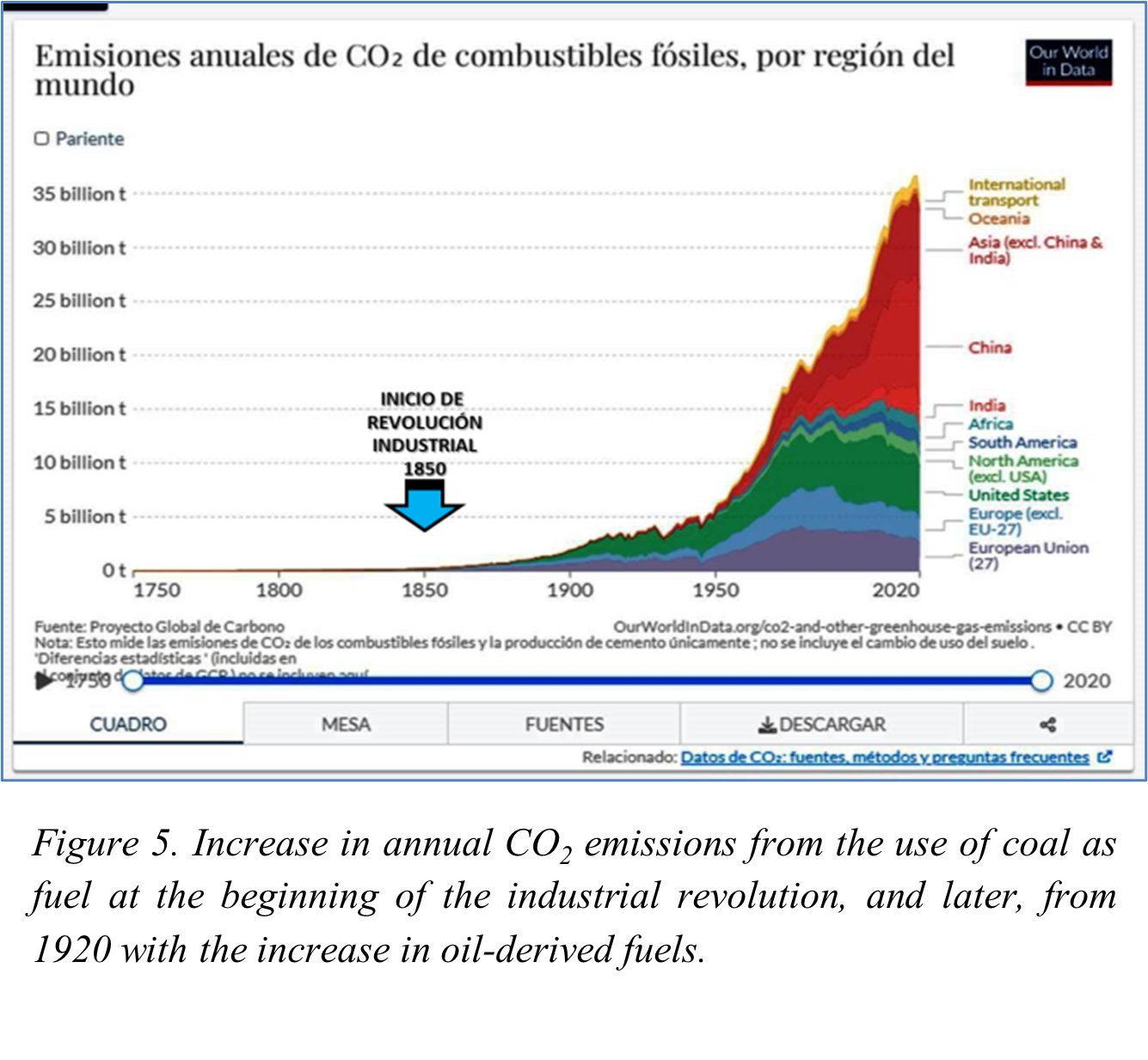
As shown in Figure 5 below, it is since the Industrial Revolution—which had as a triggering factor the use of coal as fuel to power steam engines, steamboats, railways, spinning machines and other innovative technologies— that CO2 emissions began to be generated into the atmosphere. Simultaneously, the world’s prosperity stage began, and then accelerated at the beginning of the 20th century with the use of energy sources derived from oil and gas, making the 20th century the century of exponential development. Such development continues to this day.
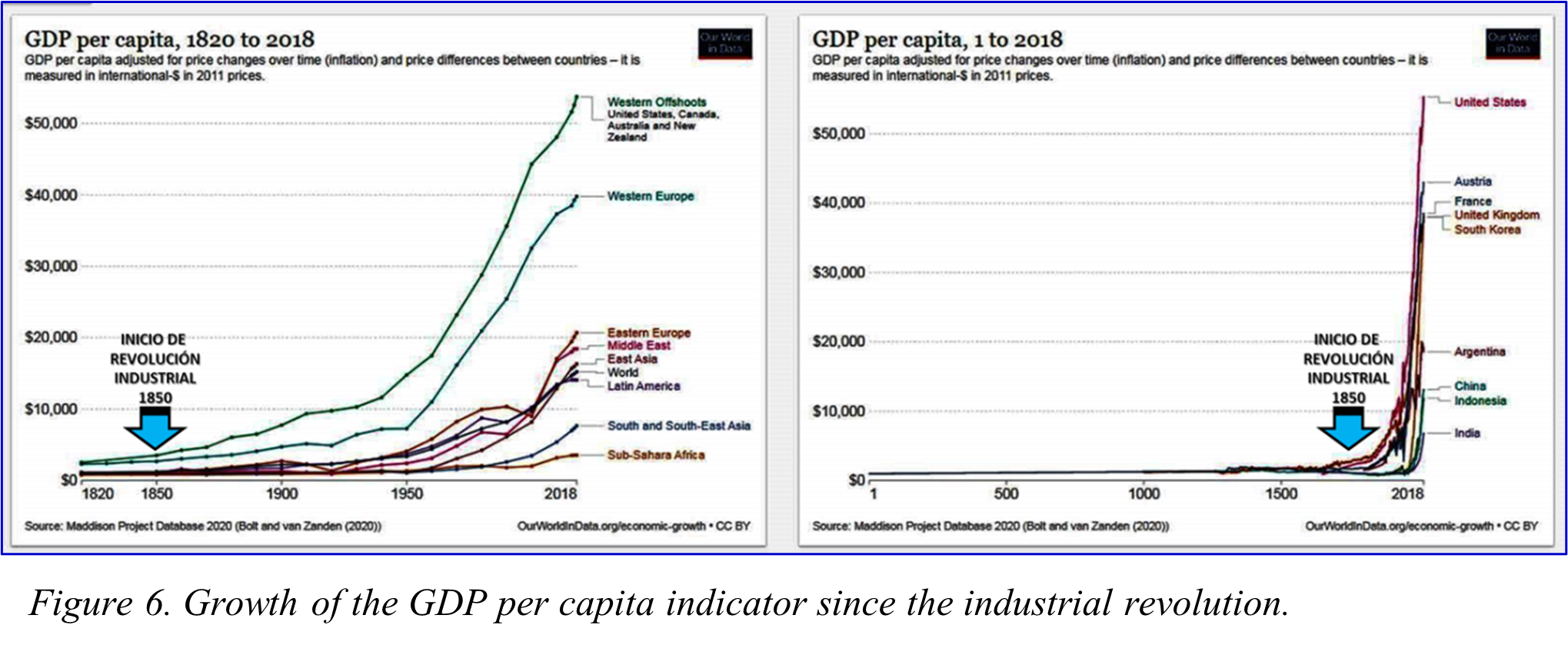
The most used macroeconomic indicator to measure the wealth of countries and their inhabitants, the Gross Domestic Product per Capita (GDP per capita), begins its sustained growth from the use of coal as an energy source that sustains the Industrial Revolution (Figure 6). This indicator skyrockets from the beginning of the 20th century with the incorporation of petroleum-derived fuels such as gasoline, fuel oil, kerosene and gas and oil that give movement to the global productive apparatus.
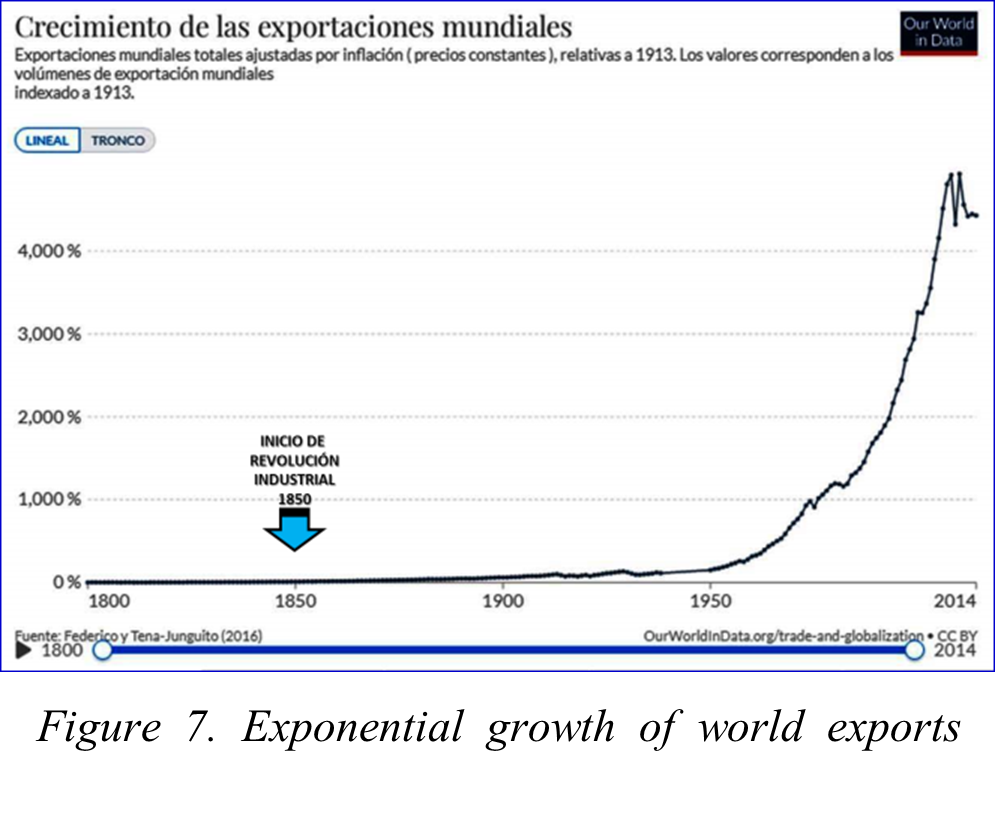
That prosperity is reflected in the global export growth indicator that follows an exponential trend like most 20th and 21st century indices (Figure 7).
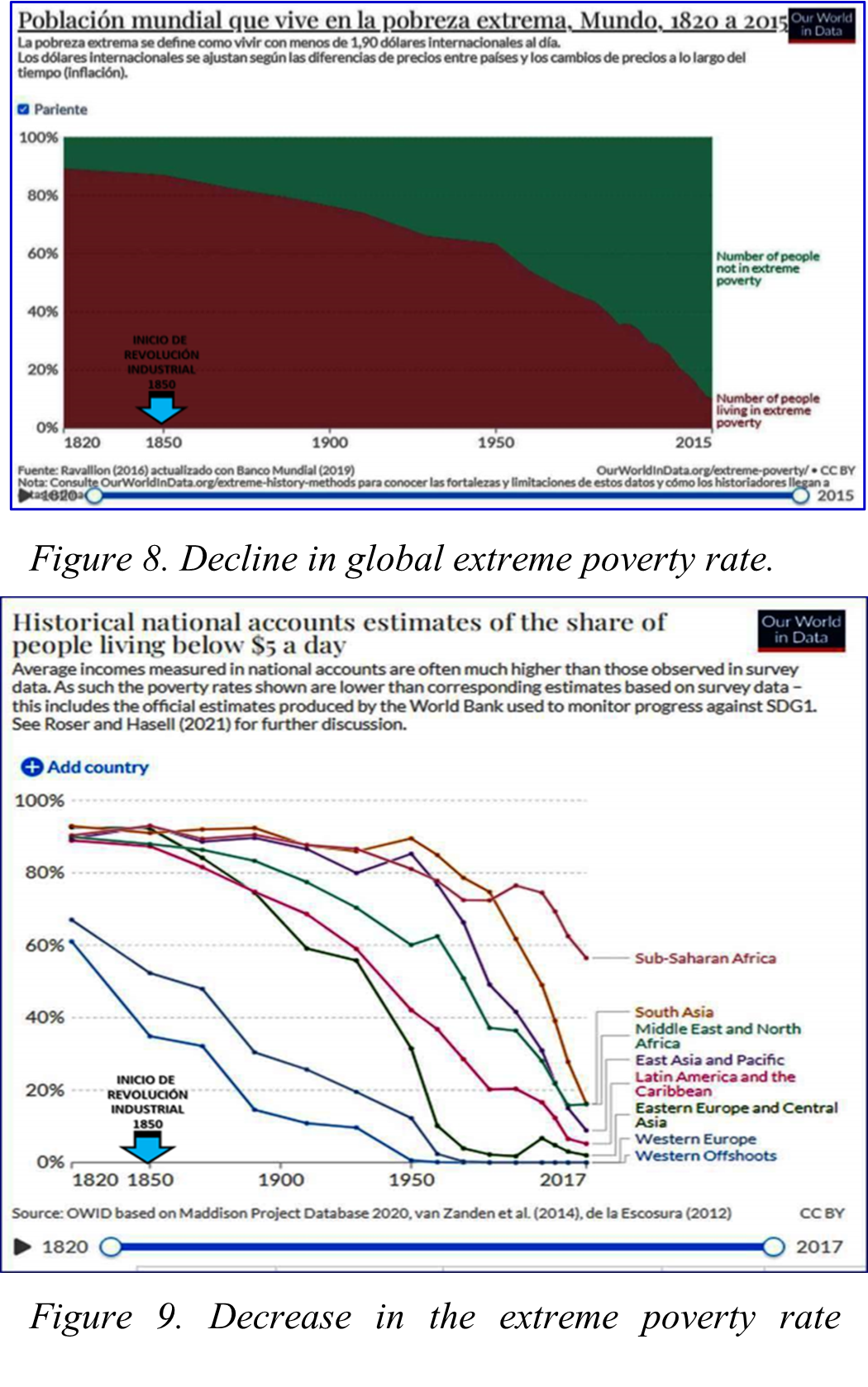
The most important indicator of global prosperity is declining poverty. As shown in Figure 8, the indicator of extreme poverty (that is, those inhabitants who live with an income of less than 1.90 international dollars per day) has trended downward as fossil fuels came to dominate the energy market. In 1820, 88.2% of the world population lived in extreme poverty; in 2015, less than 10%, which correlates with the substitution of fossil fuels for dilute, intermittent renewable energies (primitive biomass, falling water, etc.).
Figure 9 shows the distribution of extreme poverty by region. Poverty is below 10% in the most economically developed countries, such as USA , Canada, Australia and New Zealand (Western Offshoots), Western Europe, Eastern Europe, Central Asia, Latin America and the Caribbean, and East Asia. However, extreme poverty in Sub-Saharan Africa is at 56% of the population, characterized by its very low energy consumption.
The rate for Latin America is 5%, which does not include the terrible condition of Venezuela. This country has regressed to pre-industrial levels with a poverty rate in excess of Africa’s 56% according to a study by the Andres Bello Catholic University (UCAB) in 2021. Little surprise, Venezuela is marked by an almost total lack of freedom with the implementation of unfeasible communist projects and policies.
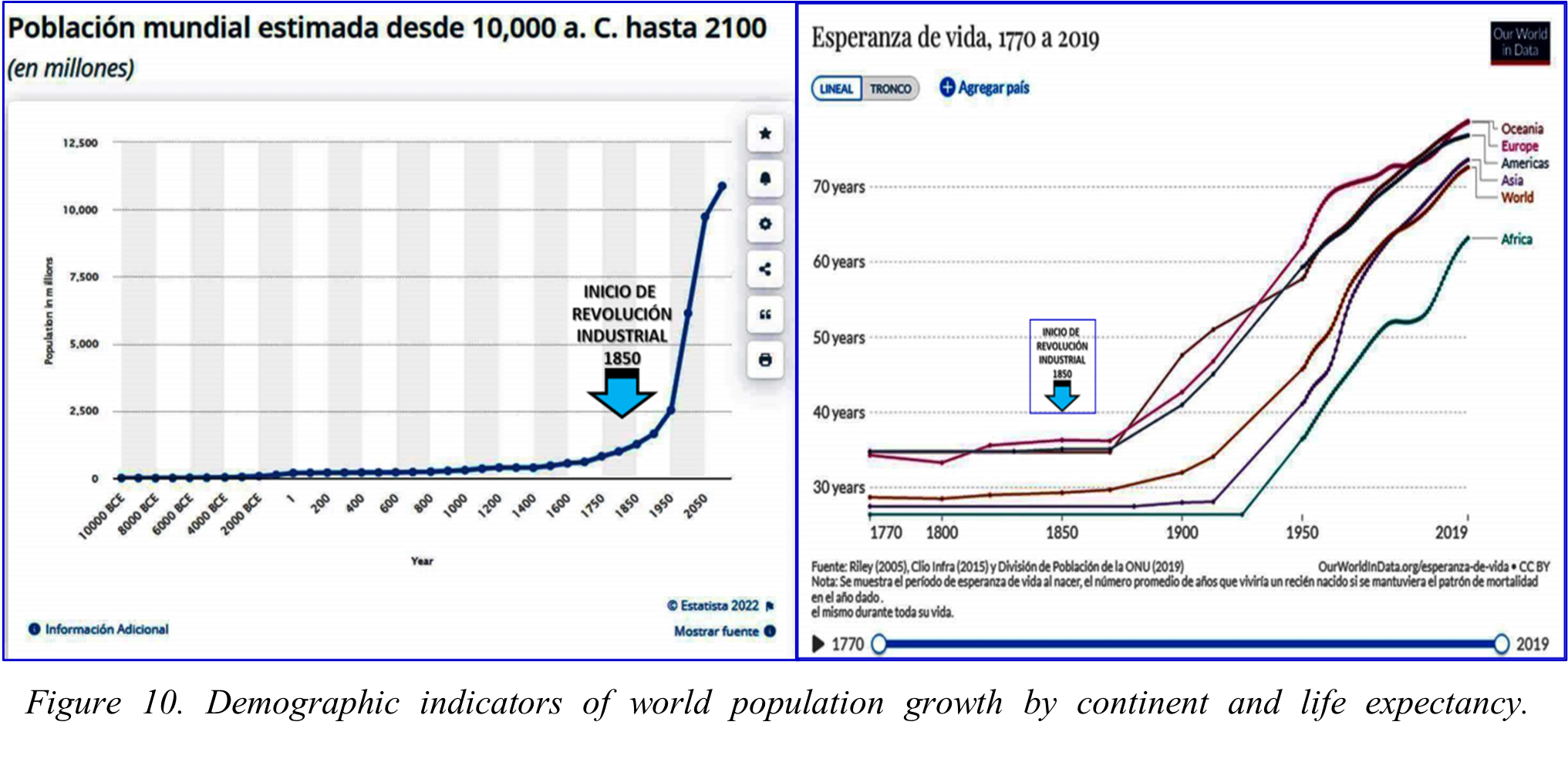
The behavior of the demographic indicators corresponds to those previously analyzed, in the sense that the variation of the world population and life expectancy are also influenced by the start of the Industrial Revolution and the use of fossil fuels. According to the graphs in Figure 10, the world population begins a substantial increase from the Industrial Revolution, which was 1.26 billion in 1850 until it grows and reaches 7.5 in 2020, estimating 8.91 for 2050.
Similarly, life expectancy was around 35 years in the continents of America, Europe and Oceania, which has grown steadily from that time until reaching 80 years in 2019; while the rest of the world ranged from under 30 years old to slightly over 60 years old in the same period. This important improvement has been due to the decrease in infant and adult mortality, due to the progress of medical technology and public health and, to the improvement of the aforementioned indicators such as: the rate of poverty and GDP per capita, plus others related to basic education, literacy, vaccination, and infant mortality.
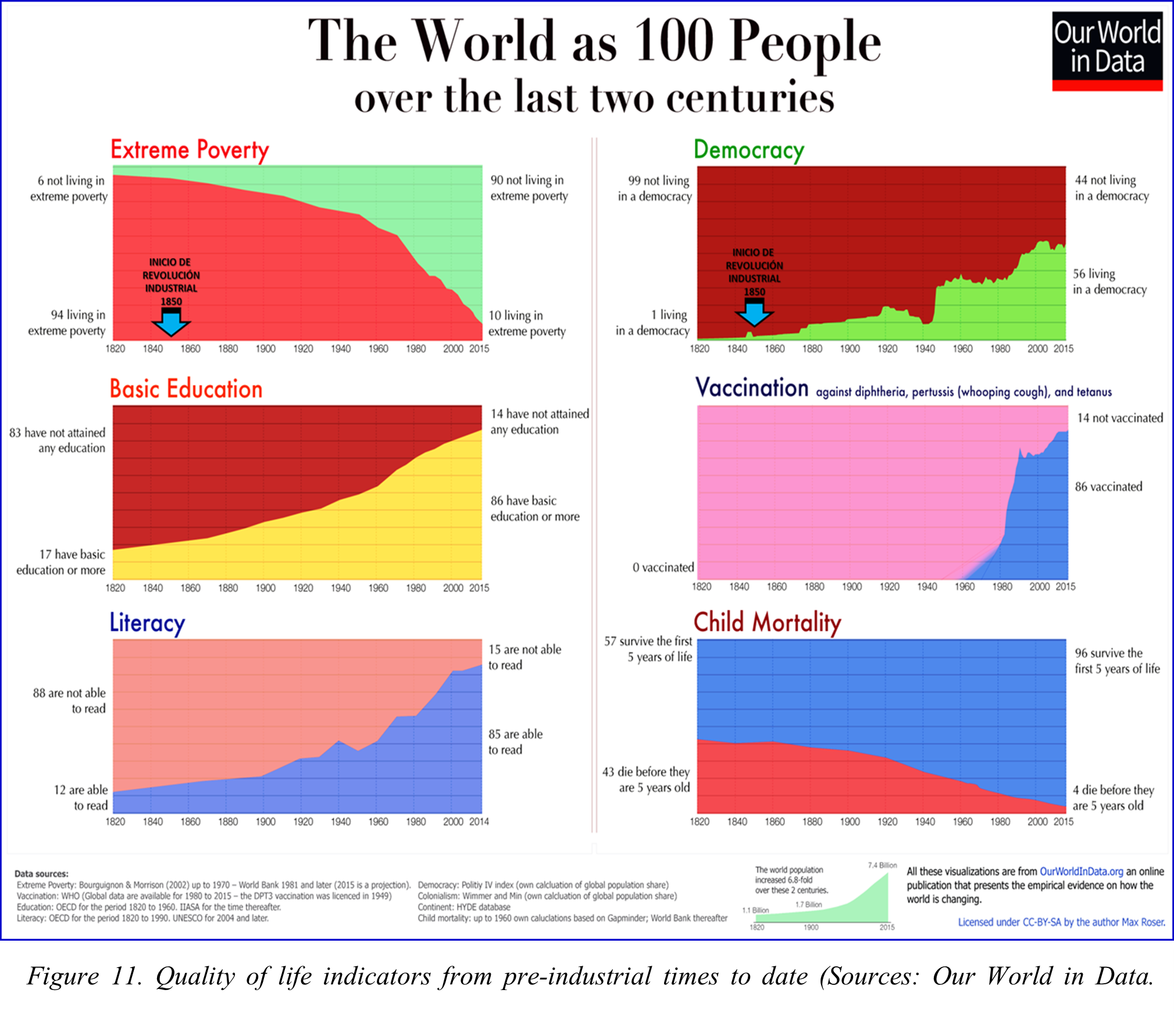
In the composite Figure 11, human progress is evident in terms of quality of life, which improves transcendentally from the widespread use of coal as an enabler of the Industrial Revolution and the addition of fuels derived from oil from the 20th century, which is manifested by 17% with basic education in 1820 rising to 86% in 2015; as well as an literacy improvement from 12% to 85% in 2014.
On the other hand, only 1% of the population in 1820 lived in countries governed in democratic freedom, while in 2015 it reached 56%. By 1820 the benefits of vaccination campaigns against diphtheria, whooping cough, and tetanus were unknown; in 2015, a 86% vaccination rate was achieved. This was a high-impact factor in the decline in infant mortality from 43% in 1820 to just 4% in 2015.
Part IV tomorrow continues and completes the analysis above.
Planting 300 tonne whirling juggernauts out to sea has a variety of endangered species on a greasy path to extinction. One of them is the South-east Australia’s Orange-bellied Parrot – a timid and migratory species – at last count, its remaining numbers would struggle to fill a symphony orchestra.
The North Atlantic Right Whale’s numbers are little better.
The future existence of both parrot and whale is threatened by industrial wind turbines: 60m blades with their tips travelling at over 350 kph make short work of any bird on the wing; the insidious low-frequency noise and vibration generated rattles the nerves of all brands of cetaceans, over time causing deafness and, thereby, messing with their ability to navigate using underwater sound.
The modern eco-zealot continues to parrot the line about wind power saving the planet, but the inconvenient truth about the monstrous harm these things cause to all manner of creatures is becoming harder for real environmentalists to ignore.
Here’s Robert Bryce with a whale a story on that score.
Big Wins for Parrots and Whales as Wind Projects in Tasmania and Massachusetts Are Scuttled
Real Clear Energy
Robert Bryce
23 December 2022
There’s one inescapable truth about the headlong rush to cover vast swaths of our countryside and oceans with 600-foot-high wind turbines: the more turbines that get built, the more wildlife will be harmed or killed. And no amount of propaganda — and there’s a veritable tsunami of that coming from the alt-energy crowd — can change that fact.
That’s why people who really care about the environment — and our wildlife — should be pleased by the recent news that two large wind projects are likely to be canceled. If that happens, it will be positive news for two critically endangered species: the Orange-bellied Parrot and the North Atlantic Right Whale.
Let’s start with Orange-bellied Parrot (species name: Neophema chrysogaster). A few days ago, the Australian government gave approval to a huge (900 megawatt) wind project on Robbins Island, which is located north of Tasmania. But the approval requires the project to be completely shut down for five months of the year due to concerns that the wind turbines on the project will kill Orange-bellied Parrots, which migrate from Tasmania to Australia. The Australian Broadcasting Corporation quoted an official with the company that is proposing the project, ACEN Australia, as saying the requirement to shut down the facility for nearly half of the year was “completely unexpected” and that the company would “need to consider our options going forward.”
The Orange-bellied Parrot is endemic to southern Australia and is reportedly one of only three parrot species that migrate. It breeds in Tasmania and flies north to winter on the southern coast of mainland Australia. According to Wikipedia, it is rated as “critically endangered on the International Union for Conservation of Nature’s Red List of Endangered Species.”
If the government’s five-month shutdown rule stays in place, it should doom the Robbins Island project. Most wind facilities operate at about a 33% capacity factor. Shutting down for five months per year will reduce that number to about 19%. Given the ongoing cost increases for steel, copper, and other commodities, as well as the soaring cost of capital, it will be very difficult, if not impossible, for the project developer to get financing for the deal.
Meanwhile, in Massachusetts, a proposed 1,200-megawatt offshore wind project known as Commonwealth Wind, is on life support after Avangrid, the Spanish company that had been planning to build the project, pulled out of the project earlier this week. The company claims the power purchase agreements now in place aren’t lucrative enough to cover the rising cost of commodities and capital. Avangrid’s move is positive for wildlife because the Commonwealth Wind project sits right in the middle of habitat for the North Atlantic Right Whale (species name: Eubalaena glacialis) of which there are only about 340 left on the planet.
Unfortunately for the whales, America’s biggest NGOs including the Sierra Club, Natural Resources Defense Council, and others, have been eerily silent about the negative impact that offshore wind development will have on the super-rare cetacean. Over the past decade or so, the North Atlantic Right Whale’s population has plunged by about 26% and there are only about 70 breeding females left.
Imagine for a moment what the Sierra Clubbers would be saying if the oil industry tried to get permits for a few offshore drilling platforms in the middle of whale habitat. The hue and cry would be audible from here to Nova Scotia. But because of the delusion that offshore wind energy is somehow “green” or “clean,” the only noise coming from the big alt-energy NGOs is, well, crickets.
Fortunately, federal wildlife officials are speaking out for whales. On May 13, Sean Hayes, the chief of the protected species branch at the National Oceanic and Atmospheric Administration’s National Northeast Fisheries Science Center, sent a letter to the lead biologist at the Bureau of Ocean Energy Management, warning him about the deadly effect offshore wind will have on whales. Hayes proposed that a buffer zone be established around the whales’ habitat to protect them from the turbines. He wrote that “Additional noise, vessel traffic and habitat modifications due to offshore wind development will likely cause added stress that could result in additional population consequences to a species that is already experiencing rapid decline.” He continued, saying that disturbance to the North Atlantic Right Whales’ foraging areas “could have population-level effects on an already endangered and stressed species. The right whale population is food resource-limited and generally in poor body condition. Right whales are chronically stressed from food limitations, entanglement, sub-lethal vessel strikes, and noise. Displacement from a prime portion of their only winter foraging grounds due to disruptions in forage availability/distribution and/or exposure to other stressors (e.g., increased vessel traffic) could have extremely detrimental energetic effects, resulting in reduced calving success.”
But that’s not even the strongest part of the letter. Hayes also said that the “oceanographic impacts from installed and operating turbines cannot be mitigated for the 30-year lifespan of the project, unless they are decommissioned.”
Read that again: the impacts of the turbines “cannot be mitigated.” In other words, if the Biden administration continues its push for 30,000 megawatts of offshore wind capacity – a plan that will require installing hundreds of offshore platforms smack in the middle of North Atlantic Right Whale habitat – this iconic species will continue its precipitous decline.
Several groups have filed lawsuits against the federal government seeking to block the growth of offshore wind energy on the East Coast, including the Responsible Offshore Development Alliance (RODA), a national coalition of “fishery-dependent businesses and associations.” Last month, RODA filed a motion for summary judgment in its lawsuit against the Bureau of Ocean Energy Management and other federal agencies, for their approval of an offshore wind project called Vineyard Wind 1. In a November 14 press release, the group said the federal approval of an offshore wind project known as Vineyard Wind was “arbitrary, capricious, and contrary to law,” and that the approval violated several federal statutes “including the Outer Continental Shelf Lands Act, National Environmental Policy Act, Clean Water Act, Endangered Species Act, Marine Mammal Protection Act, Merchant Marine Act, and Administrative Procedure Act.”
Whales and lawsuits aren’t the only problems facing offshore wind projects. There’s also the sticky issue of bringing the electricity from offshore wind turbines ashore. That requires big power lines. And communities up and down the East Coast are not eager to have those power lines come through their neighborhoods. On Monday, the town of Falmouth, Massachusetts dealt the proposed 2,400-megawatt Mayflower Wind project a big setback. Here’s how Noelle Annonen of Falmouth’s The Enterprise newspaper reported it: “The Falmouth Select Board voted 4-1 on Monday, December 19, to deny Mayflower Wind Energy LLC access to town property to study landfall sites for electric cables connecting its proposed offshore windfarm to the electrical grid.”
The Mayflower project would cover a huge swath of ocean about 20 miles south of Nantucket. Annonen reported that residents of Falmouth “packed the select board meeting room…Several voiced opposition during public comment, citing damage to the neighborhood and small businesses, harm to the public park that Mayflower Wind selects for landfall and the loss of the neighborhood’s aesthetic appeal.”
Thus, it’s no surprise that numerous big corporations — many of them foreign companies like Avangrid, Copenhagen Infrastructure Partners, Britain’s BP, Norway’s Equinor, and Denmark’s Ørsted — are all pushing to develop thousands of megawatts of offshore wind capacity. And if their projects harm whales, or local communities don’t want power lines cutting through their neighborhoods, well, those are just the costs that must be paid for the “energy transition.”
I’ll conclude with a line I’ve used before: the only thing dumber than onshore wind energy is offshore wind energy. Real Clear Energy
Another endangered creature on the wind industry’s hit list.