

Wistful children playing in flowery fields beneath fleets of whirling wonders is how the wind industry sells itself. The reality ain’t so pretty.
Embedded in every 300 tonne juggernaut is a bevy of minerals and a mountain of energy used to create the feelgood fiction that the kiddies are safely frolicking beneath a truly useful power source.
The same goes for every solar panel.
The grand wind and solar ‘transition’ has been running for barely 20 years, but already landfills are filling up with spent and busted wind turbine blades, joining millions of worn out solar panels and their cocktail of forever toxic chemicals.
Don’t confuse STT, however, with the anti-mining crowd. We’re all for it. Provided there’s a net energy – and therefore economic – benefit to be had.
Modern civilisation depends upon an enormous range of minerals, which miners deliver up for a profit, paying royalties and taxes to governments in the process. Done with due and reasonable care to the environment, it’s all to the good.
One tell-tale sign that wind turbines and solar panels can (and will never) payout more energy than they consume is the critical need for massive and endless subsidies. They don’t work as serious power sources – they’re incapable of delivering power on demand – and they don’t last. Which means the only reason anyone invests in them is to pocket the subsidies, for as long as the subsidies last.
The recent collapse of a (delusional) plan by a pair of virtue-signalling billionaires to carpet great tracts of Australia’s Northern Territory with solar panels and send their intermittent produce to Singapore via an undersea cable (of at least 4,200 km in length) makes the point.
It was never viable, on any reckoning. Much like the purported wind and solar transition, itself, it simply didn’t add up.
In the article below, The Australian’s Nick Cater explains why, on any critical analysis, efforts to run on nothing but sunshine and breezes are doomed to inevitable failure.
Green rejection of nuclear a load of garbage
The Australian
Nick Cater
18 January 2023
Chris Bowen’s ambition to turn Australia into a renewable energy export powerhouse stalled last week when the giant Sun Cable Australia-Asia PowerLink entered voluntary liquidation.
It seems that exporting rays of sunlight to Singapore is as difficult as it sounds. Writing a convincing business plan to install millions of solar panels in the Northern Territory, capturing their intermittent output in giant batteries and sending this through thousands of kilometres of underwater cables is a formidable challenge, even if it’s backed by two renewable energy devotees with very deep pockets.
Australia’s best hope of cashing in on the global clean-energy boom stems not from the thought bubble of a hirsute software entrepreneur, but from the sweat and genius of its mining engineers. Kalgoorlie is at the centre of the so-called green mining boom. It is fast becoming the Dallas of clean energy by doing what it does best: digging up dirt, extracting minerals and sending them to market. The WA outback is to lithium-ion batteries what Texas is to oil. It is rich in deposits of lithium, cobalt, nickel and rare earth elements for which global demand is insatiable.
Finding the half tonne of minerals contained in a Tesla battery requires digging up 250 tonnes of dirt, which is good news for a town that makes its money that way. Global car manufacturers have been competing to secure deals with Australian lithium miners. Last July, for example, Ford Motor Co bought up a third of Liontown Resources’ production and threw in a $300m loan facility to expand Kathleen Valley mine, 350km north of Kalgoorlie.
The love for electric vehicles, however, like the love of sausages, is severely tested by seeing how the object of one’s affection is made. The green mining boom is as gritty and dirty as every other boom that has graced the WA goldfields region since the discovery of gold in 1893. Surrounding roads are lined with road trains hauling ore, giant earth movers, chemicals and explosives. Massive new creators are transforming the natural landscape, but this time the wilderness campaigners don’t seem particularly bothered.
The new green job opportunities we have been frequently promised are as dirty and sweaty as the old ones. Ardea Resources plans to employ 500 people over the 25-year life of its Kalgoorlie Nickel Project’s integrated nickel manganese cobalt battery material refinery hub, assisted by $119m in investment by the former federal Coalition government. They will be driving a fleet of 120-tonne excavators and 90-tonne trucks at 13 open-cut sites at Goongarrie Hill, 80km from Kalgoorlie. They will process ore in high-pressure acid-leached autoclaves. The resulting discharge will be filtered and the solids dry-stacked.
This energy-intensive, chemical-thirsty and land-hungry process adds to the substantial carbon debt that is attached to every electric vehicle. If the unrefined ingredients of a single EV battery were to be transported by train to Esperance, they would fill at least four wagons. Figures produced by car manufacturers show an electric vehicle must be driven for approximately 100,000km before its overall emissions are lower than an equivalent diesel or petrol vehicle.
These material realities of the imagined transition to a green economy are discounted by the renewable energy lobby. As US policy analyst Mark P. Mills bluntly points out, no energy system is actually “renewable” since all machines require the continual mining and processing of millions of tonnes of primary materials and the disposal of hardware that inevitably wears out.
Mills estimates that compared with hydrocarbons, the machines to produce renewable energy require a 10-fold increase in the quantities of materials extracted and processed to produce the same amount of energy.
Mills calculates that by 2050 the quantity of worn-out solar panels will constitute double the tonnage of all today’s global plastic waste together with more than three million tonnes a year of un-recyclable plastics from worn-out wind turbine blades. By 2030, more than 10 million tonnes per year of batteries will become garbage.
The failure to offset the costs against the supposed environmental benefits of renewable energy is part of the dodgy accounting clean-energy advocates would like us to ignore. They turn a blind eye to the 8000 tonnes of steel required to generate a terawatt of electricity with solar panels. They look the other way while 8000 tonnes of concrete are delivered by a conga-line of trucks and poured into the ground to support wind turbines with the same capacity. Coal, gas and nuclear require something less than a tenth of those basic raw materials to generate the same amount of power.
The truth seldom acknowledged by advocates of renewable energy is that reducing dependence on hydrocarbons by shifting to wind, solar and batteries alone will dramatically increase our dependence on minerals. The assumed benefits of decarbonising the electricity grid must be offset against corresponding increases in mining and processing.
In 2005, the mining sector produced 9 per cent of Australia’s greenhouse gas emissions. In 2020 it was 20 per cent. While the sector has been making considerable strides in reducing emissions, there is no scalable technology available to achieve the massive gains a target of net zero by 2050 requires.
The task will be even harder if we want to bring more of the processing onshore, as we must if we are to avoid increasing our energy dependence on China, currently by far the world’s biggest processor of lithium and other critical minerals.
That might change were we ever to elect federal and state governments with the courage and foresight to decriminalise nuclear power, freeing up mining companies to scope the use of mine-based small modular reactors. A 2021 report commissioned by the Minerals Council flagged SMRs as a realistic option for decarbonising large regional settlements and off-grid mining operations. Water-free and offering decades of uninterrupted power, they could replace reliance on diesel generation in many situations and potentially power the production of green hydrogen. The federal government’s outright rejection of nuclear energy, however, leads inexorably to a future based on wishful thinking that is green in name only.
The Australian
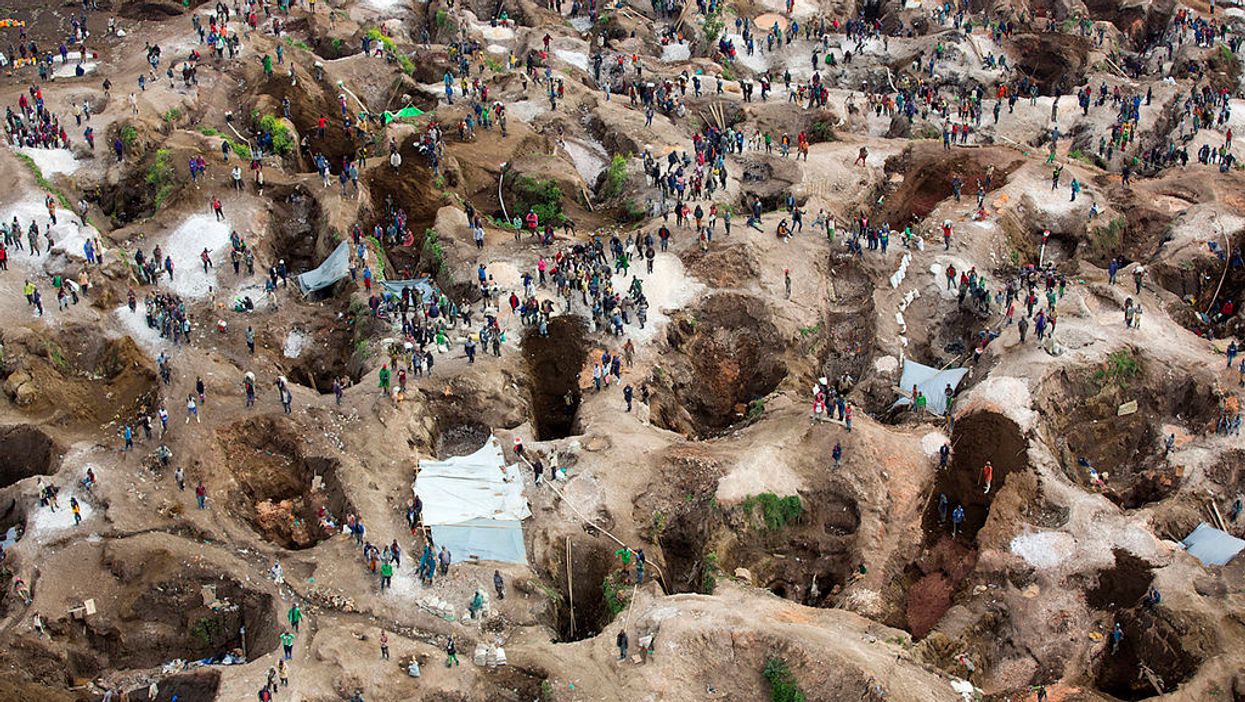
Where the ‘green’ energy ‘transition’ begins.
via STOP THESE THINGS
January 22, 2023 at 12:30AM


