
My good friend Patrick Lloyd, enamoured with the new Artificial Intelligence ChatGPT, sent me the maximum temperatures for Tasmania as an annual average of daily values for all 155 weather stations since 1882. He had downloaded these values from the Australian Bureau of Meteorology’s website with the help of ChatGPT. He wanted to know from me if they showed global warming.
After importing the numbers into my statistical program, I drew a scatter plot with a fitted regression line, Chart 1. It suggests that maximum temperatures in Tasmania are not as high now as they were back in the early 20th century, and that there was a period of cooling to about 1950.
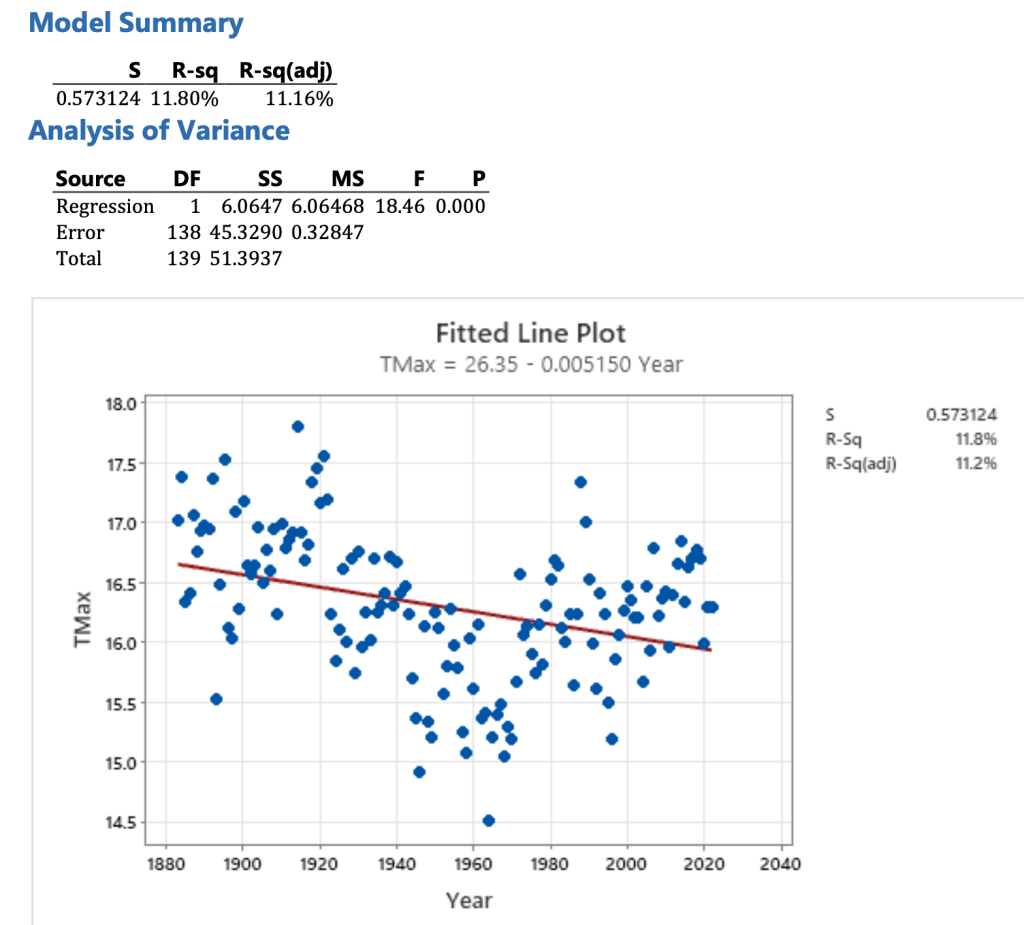
The regression equation indicates that overall, there has been cooling at a rate of 0.0051 degrees Celsius per year. Converting this into climate change speak we get a rate of cooling of 0.5 C per 100 years. This doesn’t sound right, does it?
The official historical reconstruction for Tasmania also shows temperatures cooling to about 1950, and then temperatures increasing such that since at least the year 2000, it has been hotter than it has ever been, Chart 2.
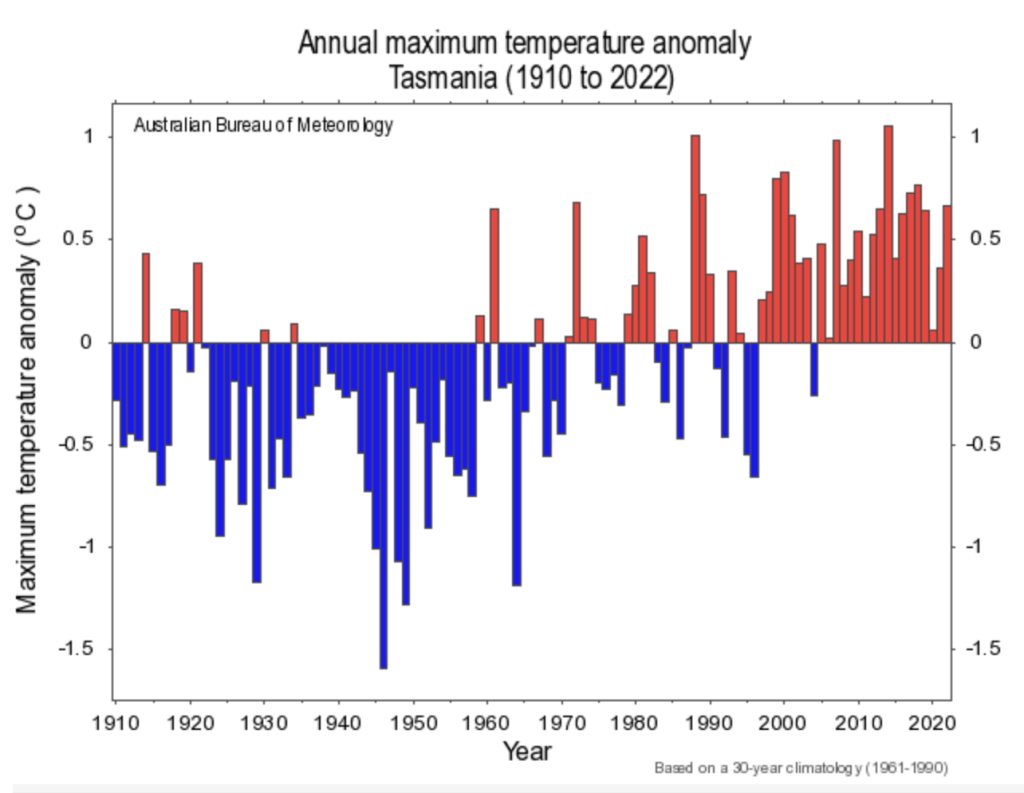
Clearly the official reconstruction for Tasmania is not just an amalgamation of all the maximum temperature series.
Is Chart 2, the Bureau’s historical reconstruction, a more accurate representation of historical temperatures for Tasmania than the annual mean of all the daily values that ChatGPT sourced for Patrick?
Every temperature series has its limitations, and sometimes issues are just compounded when many temperature series, beginning at different times and from different locations and altitudes, are just combined. That is what Chart 1 represents, a simple compilation of everything available.
Patrick suggested a solution might be to just combine the longest and most complete maximum temperature series, perhaps the best 10 percent of the 155 weather stations, and throw the rest out.
But there is an additional potential problem.
Since 1 November 1996, the Bureau have been transitioning from mercury thermometers to probes in automatic weather stations for the collection of this temperature data. Probes in automatic weather stations represents a fundamentally different way of measuring temperatures than the traditional mercury thermometer where the daily maximum used to be manually read at 9am each morning and then the mercury reset.
Could it be that the automatic weather stations are recording hotter for the same weather?
Considering just Larapuna (also known as Eddystone Point, station number 092045), as an example, this weather station has a long and relatively compete temperature record. Larapuna would represent one of the ‘best 10 percent’ from Tasmania.
Chart 3 shows the annual average maximum temperatures (unhomogenised) as measured at Larapuna first using a mercury thermometer, and since 1997 with a probe in an automatic weather station.
Considering maximum temperatures for this location there does appear to be a jump-up of about 2 degrees Celsius after about 1997.
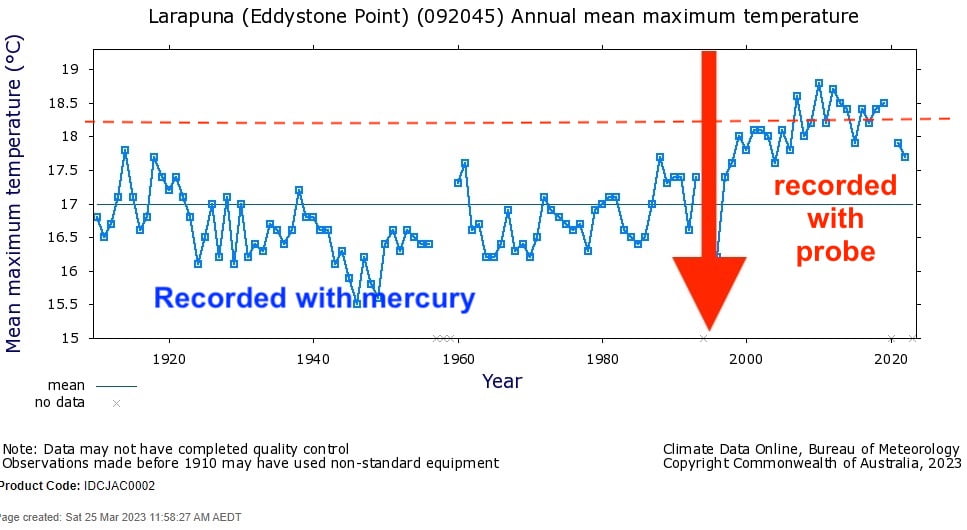
How can we know if this apparent step-change circa 1997 was caused by a change in the weather, or a change in the equipment used to measure the temperatures at Larapuna?
I’ve said to Patrick, that before we begin combining the individual temperature series I would like to sort out the issue of the change from mercury to probe.
The probes are generally considered to be more responsive to fluctuations in temperatures and, therefore, likely to record both hotter and colder for the same weather.
This is stated in the Bureau’s Research Report No. 032 The Australian Climate Observations Reference Network – Surface Air Temperature (ACORN-SAT) Version 2 (October 2018) by Blair Trewin:
In the absence of any other influences, an instrument with a faster response time will tend to record higher maximum and lower minimum temperatures than an instrument with a slower response time. This is most clearly manifested as an increase in the mean diurnal range. At most locations (particularly in arid regions), it will also result in a slight increase in mean temperatures, as short-term fluctuations of temperature are generally larger during the day than overnight.” (Page 21)
Tasmania is neither particularly hot, nor particularly arid, so perhaps we don’t need to worry about the change over? If only we had parallel data for Larapuna, that is measurements taken from mercury thermometers and also probes in the same Stevenson screen, we could know the extent of the equivalence between the temperatures as measured with the different types of equipment.
What are some of the other possible issues we might encounter as we combine the temperature series in search of an accurate historical temperature reconstruction for Tasmania?
*****
This is the first of a new series of blog post about reconstructing Tasmania’s temperature history with the help of Patrick and ChatGPT.
If you would like to follow along as the three of us attempt to understand how and why the two temperatures series (Chart 1 versus 2) are so different and attempt our own historical temperature reconstruction for Tasmania then, consider subscribing at my website, specifically click the box ‘Temperature Trends’ and you will start receiving information on this topic.
via Jennifer Marohasy
March 26, 2023 at 12:23AM
 Iowa Climate Science Education