In the satellite era scientists have continued to observe the Earth’s total greenhouse effect (which includes effects from greenhouse gases and clouds) exerting an overall negative impact (cooling) on surface temperatures since the 1980s. This rules out both CO2 and an enhanced greenhouse effect as drivers of global warming.
Earth’s total greenhouse effect impact on climate is realized by the sum of all contributors to it: water vapor, clouds, and the “anthropogenic” greenhouse gases CO2 and CH4.
Given the modern assumption that humans are responsible for global warming due especially to our CO2 and CH4 emissions, it stands to reason that Earth’s downwelling longwave (LWdn) should be increasing and thus the Earth’s greenhouse effect should be enhanced due to the rising greenhouse gases emissions.
But, as Cess and Udelhofen (2003) reported 20 years ago, Earth’s greenhouse effect has not been enhanced in recent decades. Instead, it has been in a state of decline since the 1980s.
“[T]he negative trend in G [greenhouse effect] indicates that the atmospheric greenhouse effect is temporarily [1985-1999] decreasing despite the fact that greenhouse gasses are increasing.”
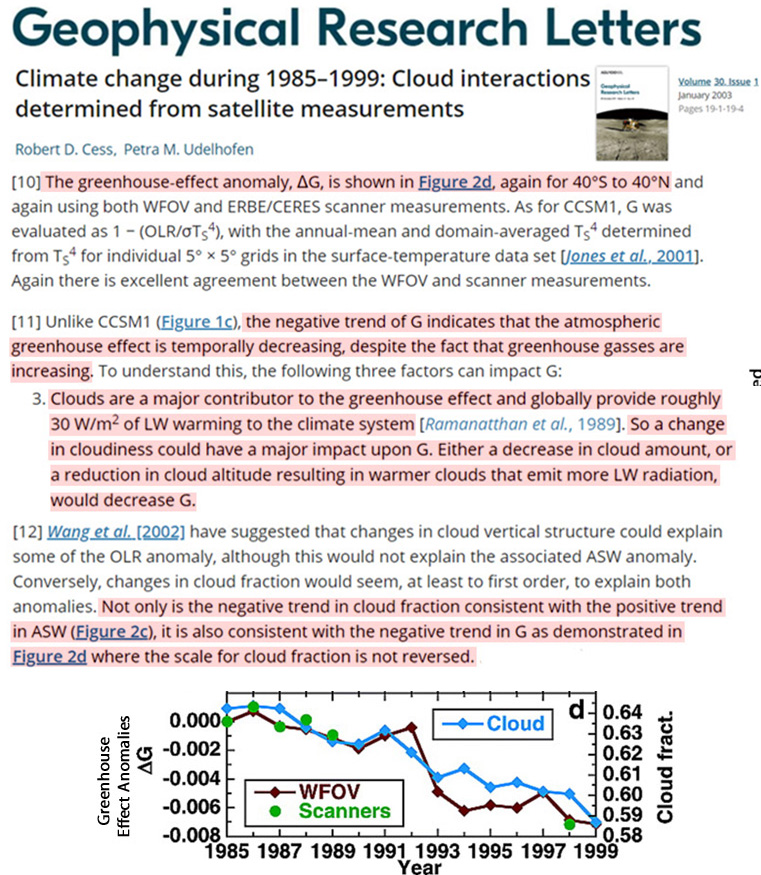
Image Source: Cess and Udelhofen, 2003
Song et al. (2016) also reported a flat (declining) greenhouse effect trend (shown in red) from 2002 to 2014 when all greenhouse effect factors (“all-sky”), including clouds and water vapor, are considered. The effects of greenhouse gases like CO2 were “offset” by the effects of clouds in producing the “zero-trend greenhouse effect” over this period.
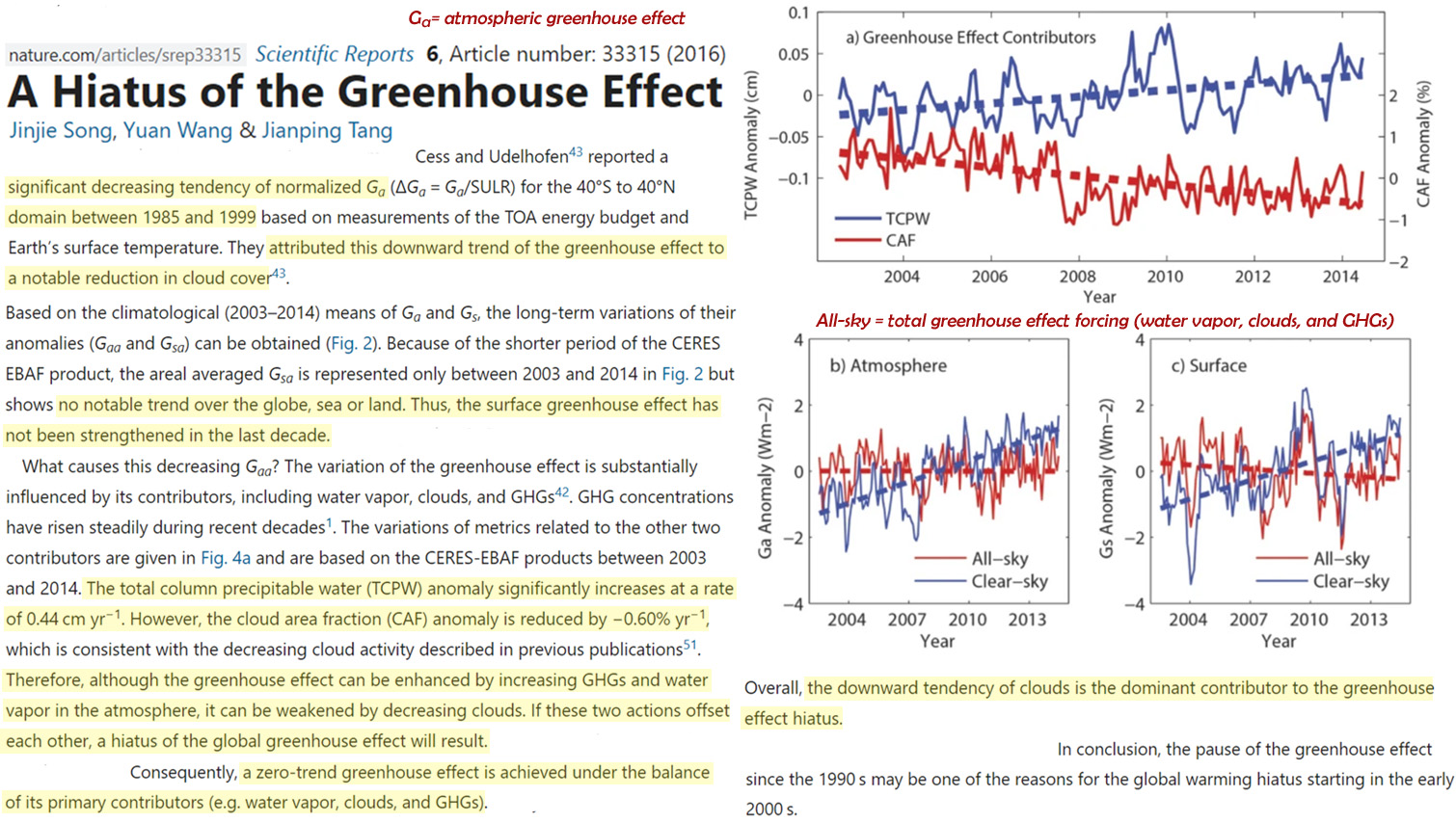
Image Source: Song et al., 2016
A new study (Zhang and Rossow, 2023) employs another data set (FH) and also shows the total greenhouse effect (expressed as downward longwave, or LWdn) declining from 1983 to 2017 (and 2001 to 2020 in the CERES record) even though the data “account for increasing CO2 and CH4” and this “should produce an increase in LWdn”. It doesn’t, of course, as CO2 and CH4 are not influential enough to compete with the greenhouse effect of clouds.
“The LWdn [longwave net at TOA (W/m²)] shows a very large anomaly declining rapidly at the beginning of the record until the late 1990s. … The FH calculations (and previous versions) account for increasing CO2 and CH4 abundances, which should produce an increase in LWdn, all other things being equal; but as Fig 3…shows, the near surface air temperature (Ta) and skin temperatures (Ts) from ISCCP-H used in FH are generally decreasing. … [July 1983 to June 2017] overall downward trend in FH LWdn [longwave net at TOA (W/m²)]”
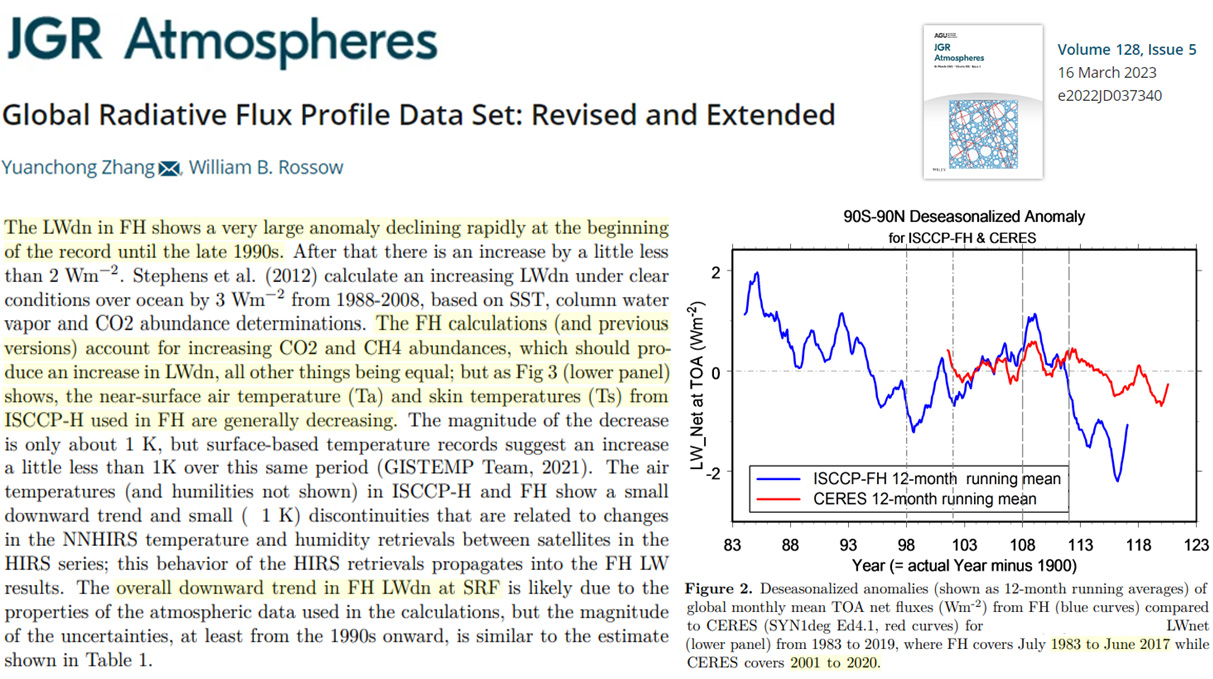
Image Source: Zhang and Rossow, 2023
The scientists also point out that trends in global mean albedo correspond to an “increase in surface solar radiation” since the 1980s (which can explain the warming over this period). Also, the W/m² trends in shortwave and longwave top-of-atmosphere fluxes are “dominated” by cloud cover changes or “caused almost entirely by cloud effects.”
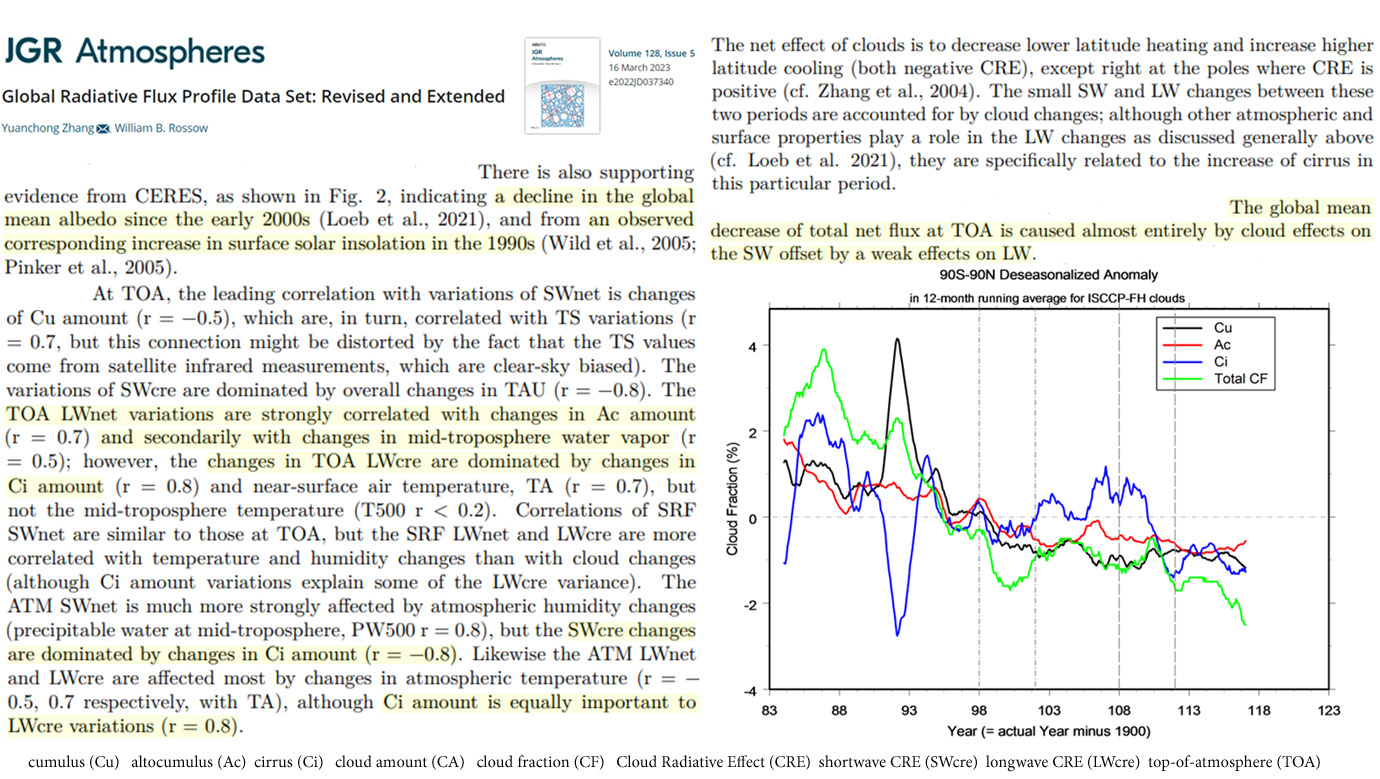
Image Source: Zhang and Rossow, 2023
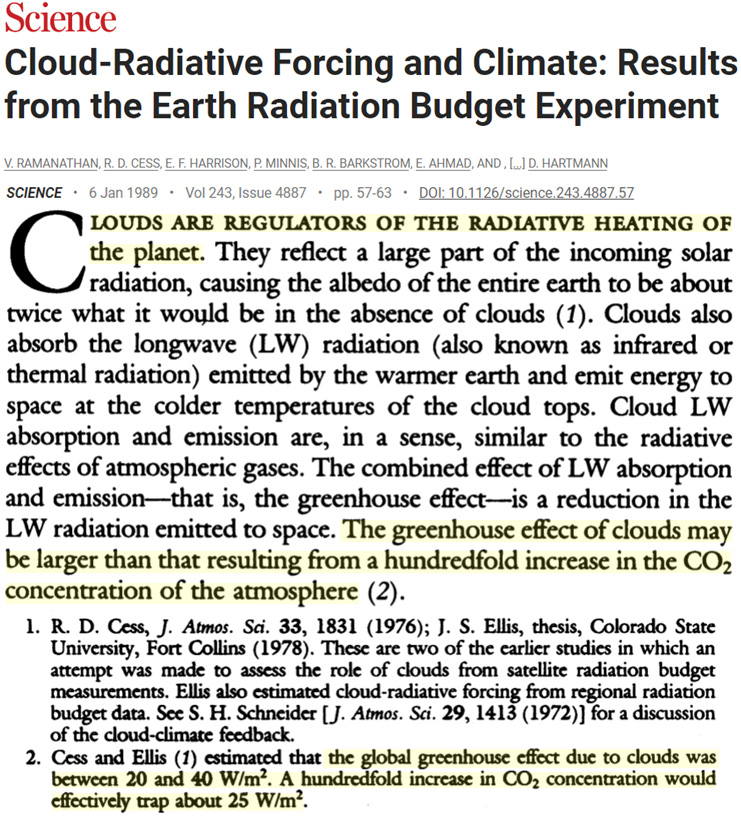
In recent years there have been several other studies documenting an observed decreasing greenhouse effect despite the increase in greenhouse gases like CO2 and CH4 (Stephens et al., 2022, Dübal and Vahrenholt, 2021, Swift, 2018, Su et al., 2020). All of them note that natural cloud variations, which have a greenhouse effect impact larger than that resulting from a 100-fold increase in CO2 (Ramanathan et al., 1989), are driving the recent greenhouse effect decline, overriding the anthropogenic emissions impact.
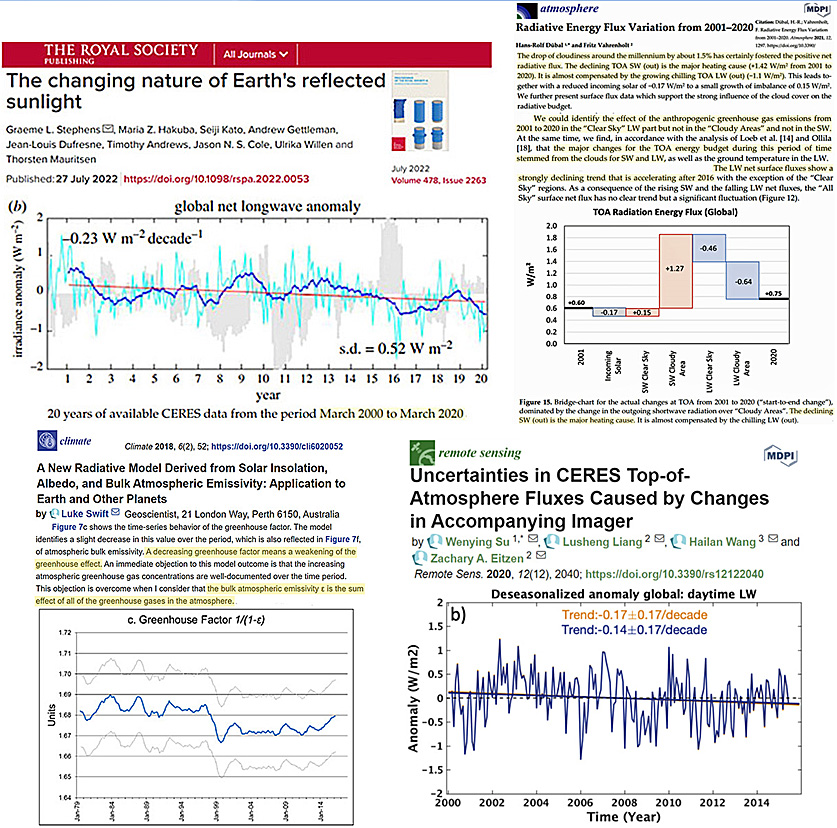
Image Source: Stephens et al., 2022, Dübal and Vahrenholt, 2021, Swift, 2018, Su et al., 2020
The clear implication of these observations is that an enhanced greenhouse effect has not been driving any warming trend since the 1980s.
Further, a decline in the greenhouse effect means the impact of human CO2 emissions on the global climate are too weak to be a driver of total greenhouse effect trends or climate change.
via NoTricksZone
April 10, 2023 at 02:19PM
 Iowa Climate Science Education