
The global mean surface temperature (GMST) effects of a 1 W/m² radiative forcing, or positive/negative energy imbalance, has been gleaned from the observations from the 1991 Mt. Pinatubo eruption. CO2’s climate effects are claimed to be many times larger than observations indicate.
The observed climate sensitivity (CS) to a perturbation to Earth’s Energy Imbalance (EEI) is, in a new study (Pauling et al., 2023), defined as -0.4°C per -9 W/m², or 0.044°C per W/m². These values were gleaned from observations from Mt. Pinatubo.
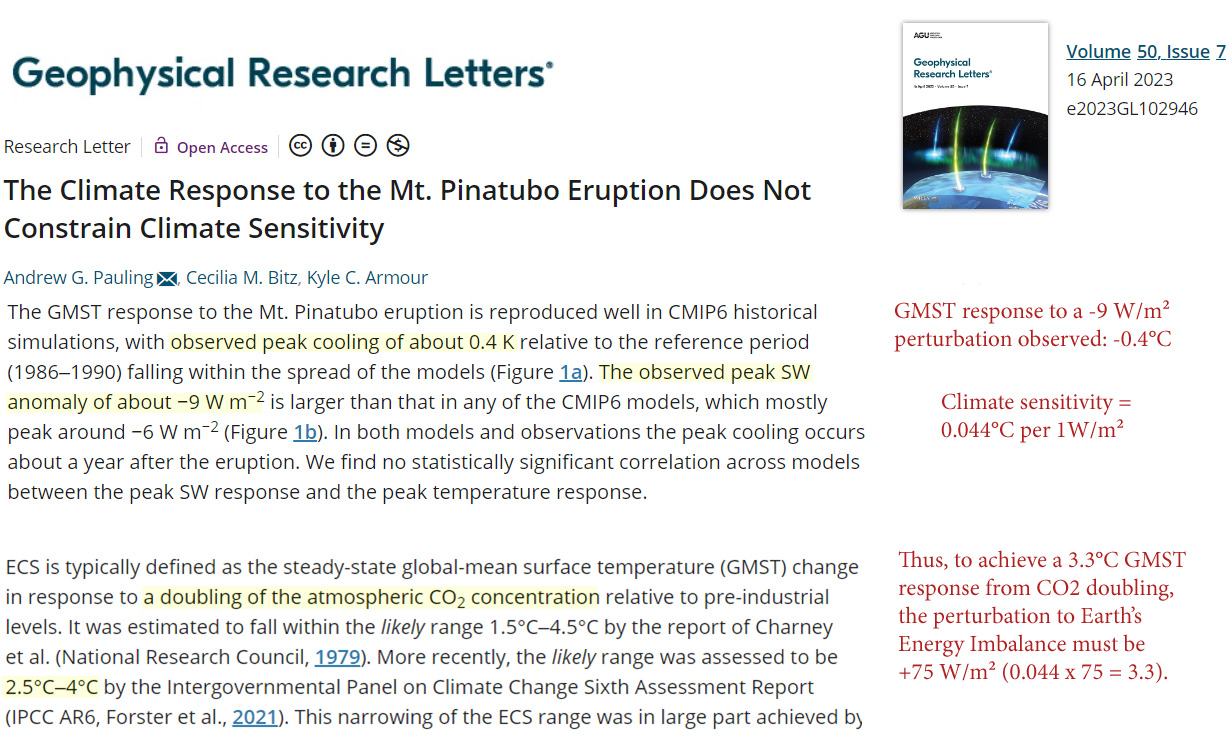
Image Source: Pauling et al., 2023
Anthropogenic global warming advocates suggest it takes an increase of 22 ppm CO2 (about 10 years) to produce a surface forcing change of 0.2 W/m² (Feldman et al., 2015).
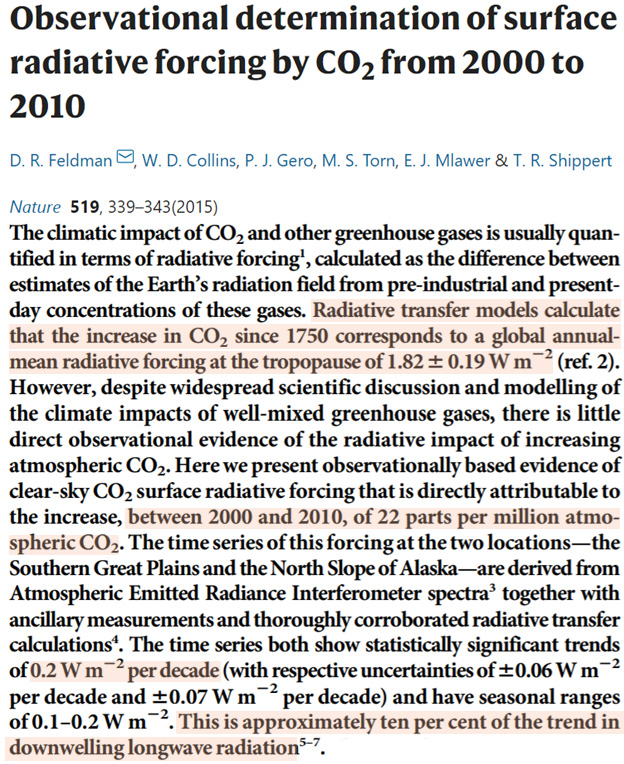
Image Source: Feldman et al., 2015
So, using the Feldman formula, it would take 110 ppm (40-50 years) to produce a positive 1 W/m² surface forcing imbalance.
If the 0.044°C per W/m² CS to a radiative forcing is accurate, this means an accumulated +75 W/m² perturbation is ultimately required to produce the alleged GMST response (3.3°C) to a doubling of the CO2 concentration (from 280 to 560 ppm) with feedbacks.
These results are clearly not realistic.
via NoTricksZone
April 13, 2023 at 10:26AM
 Iowa Climate Science Education