Month: May 2023

Justin Welby Caught Speeding

By Paul Homewood

h/t Ian Magness

Meanwhile the godly Justin Welby has fallen foul of Comrade Khan’s speed cameras!

image

when the offence took place

https://www.dailymail.co.uk/news/article-12075833/Archbishop-Canterbury-Justin-Welby-convicted-speeding.html

If he cares so much about climate change, why is not he using that cycle lane? After all Lambeth Palace is only a couple of miles away.

And if he does not fancy that, what is wrong with the Underground?

via NOT A LOT OF PEOPLE KNOW THAT

https://ift.tt/UDn3ghi

May 12, 2023 at 10:22AM

Archbishop Blames Climate Change For Illegal Immigrants

By Paul Homewood

h/t Ian Magness

image

The Archbishop of Canterbury has torn shreds out of the Illegal Immigration Bill, labelling it "isolationist, morally unacceptable and politically impractical", with "too many problems" to highlight in one speech.

Justin Welby attacked Rishi Sunak’s plan to ‘stop the boats’, which is facing its second major Parliamentary hurdle, with peers in the House of Lords scrutinising the controversial proposal.

"This bill has no sense at all of the long term and the global nature of the challenge that the world faces," the religious leader said.

"It ignores the reality that global migration must be engaged with at source as well as in the Channel as if we as a country were unrelated to the rest of the world."

The archbishop added the Bill does not address issues that are causing mass migration, including wars and climate change, saying it is "isolationist, it is morally unacceptable and politically impractical" to leave those problems to poorer countries.

https://www.itv.com/news/2023-05-10/morally-unacceptable-archbishop-welby-tears-apart-small-boats-bil

It is a sin to lie, so maybe the Archbishop would care to explain just how many migrants are coming here because of climate change, which countries they are coming from, and provide the data to prove it.

Otherwise people might rightly think you are talking through that pointy hat of yours!

They might also suggest that you are so woefully out of touch with the real world that you do not belong in your job.

via NOT A LOT OF PEOPLE KNOW THAT

https://ift.tt/dozgeKU

May 12, 2023 at 10:22AM

The wind and solar power myth has finally been exposed

By Paul Homewood

The necessary miracle doesn’t exist
By Bryan Leyland
Many governments in the Western world have committed to “net zero” emissions of carbon in the near future. The US and UK both say they will deliver by 2050. It’s widely believed that wind and solar power can achieve this. This belief has led the US and British governments, among others, to promote and heavily subsidise wind and solar.
These plans have a single, fatal flaw: they are reliant on the pipe-dream that there is some affordable way to store surplus electricity at scale.


In the real world a wind farm’s output often drops below 10 per cent of its rated “capacity” for days at a time. Solar power disappears completely every night and drops by 50 per cent or more during cloudy days. “Capacity” being a largely meaningless figure for a wind or solar plant, about 3000 megawatts (MW) of wind and solar capacity is needed to replace a 1000 MW conventional power station in terms of energy over time: and in fact, as we shall see, the conventional power station or something very like it will still be needed frequently once the wind and solar are online.
The governments of countries with a considerable amount of wind and solar generation have developed an expectation that they can simply continue to build more until net zero is achieved. The reality is that many of them have kept the lights on only by using existing fossil fired stations as backup for periods of low wind and sun. This brings with it a new operating regime where stations that were designed to operate continuously have to follow unpredictable fluctuations in wind and solar power. As a result operating and maintenance costs have increased and many stations have had to be shut down.
In fact it’s already common to see efficient combined-cycle gas turbines replaced by open-cycle ones because they can be throttled up and down easily to back up the rapidly changing output of wind and solar farms. But open-cycle gas turbines burn about twice as much gas as combined cycle gas turbines. Switching to high-emissions machinery as part of an effort to reduce emissions is, frankly, madness!
Certain countries are helped because their power systems are supported by major inter-connectors to adjacent regions that have surplus power available. The increasingly troubled French nuclear fleet, which formerly had plenty of spare energy on tap, for a long time helped to make renewables plans look practical across Western Europe.
But this situation is not sustainable in the long term. Under net-zero plans, all nations will need to generate many times more electricity than they now can, as the large majority of our energy use today is delivered by burning fossil fuels directly. Neighbouring regions will be unable to provide the backup power needed; emissions from open cycle gas turbines (or new coal powerplants, as in the case of Germany at the moment) will become unacceptable; more existing base load stations will be forced to shut down by surges in renewables; more and more wind and solar power will have to be expensively dumped when the sun is shining and the wind is blowing.
Power prices will soar, making more or less everything more expensive, and there will be frequent blackouts.
None of this is difficult to work out. Building even more renewables capacity will not help: even ten or 100 times the nominally-necessary “capacity” could never do the job on a cold, windless evening.
Only one thing can save the day for the renewables plan. Reasonable cost, large scale energy storage, sufficient to keep the lights on for several days at a minimum, would solve the problem.
What are the options?
First we need to consider the scale of the issue. Relatively simple calculations show that that California would need over 200 megawatt-hours (MWh) of storage per installed MW of wind and solar power. Germany could probably manage with 150 MWh per MW. Perhaps this could be provided in the form of batteries?
The current cost of battery storage is about US$600,000 per MWh. For every MW of wind or solar power in California, $120 million would need to be spent on storage. In Germany it would be $90 million. Wind farms cost about $1.5 million per MW so the cost of battery storage would be astronomical: 80 times greater than the cost of the wind farm! A major additional constraint would be that such quantities of batteries are simply not available. Not enough lithium and cobalt and other rare minerals are being mined at the moment. If prices get high enough supply will expand, but prices are already ridiculously, unfeasibly high.
Some countries are gambling on hydro pumped storage. Here the idea is to use electricity to pump water uphill into a high reservoir using surplus renewables on sunny, windy days: then let it flow back down through generating turbines as in a normal hydropower plant when it’s dark and windless.
Many pumped systems have been built in China, Japan and United States but they have storage sufficient for only 6 to 10 hours operation. This is tiny compared with the several days storage that is needed to back up wind and solar power through routine sunless calm periods. Much larger lakes at the top and bottom of the scheme are needed. There are very few locations where two large lakes can be formed with one located 400-700 m above the other and separated by less than 5-10 km horizontally. Such a location must also have an adequate supply of make-up water to cope with evaporation losses from the two lakes. Another problem is that at least 25 per cent of the energy is lost while pumping and then generating.
Hydro pumped storage will seldom be a feasible option. It cannot solve the problem on a national scale even in countries like the USA which have a lot of mountains.
Carbon capture and storage (CCS) for fossil fuel stations is also touted as way of avoiding the problems of wind and solar power. But this is not a technology, just a case of wishful thinking. In spite of many years of work and enormous amounts of money spent, nobody has yet devised a technology that can provide large scale, low cost CCS. Even if capture worked and didn’t consume most or all the energy generated, storing the carbon dioxide is a huge problem because three tonnes of carbon dioxide are produced for every tonne of coal burned.
Hydrogen is another technology which is often suggested for energy storage: but its problems are legion. At the moment hydrogen is made using natural gas (so-called “blue” hydrogen). This, however, will have to stop in a net-zero world as the process emits large amounts of carbon: you might as well just burn the natural gas. Proper emissions-free “green” hydrogen is made from water using huge amounts of electrical energy, 60 per cent of which is lost in the process. Storing and handling the hydrogen is extremely difficult because hydrogen is a very small molecule and it leaks through almost anything. At best this means that a lot of your stored hydrogen will be gone by the time you want to use it: at worst it means devastating fires and explosions. The extremely low density of hydrogen also means that huge volumes of it would have to be stored and it would often have to be stored and handled cryogenically, creating even more losses, costs and risks.
The conclusion is simple. Barring some sort of miracle, there is no possibility that a suitable storage technology will be developed in the needed time frame. The present policies of just forcing wind and solar into the market and hoping for a miracle have been memorably and correctly likened to “jumping out of an aeroplane without a parachute and hoping that the parachute will be invented, delivered and strapped on in mid air in time to save you before you hit the ground.”
Wind and solar need to be backed up, close to 100 per cent, by some other means of power generation. If that backup is provided by open-cycle gas or worse, coal, net zero will never be achieved: nor anything very close to it.
There is one technology that can provide a cheap and reliable supply of low-emissions electricity: nuclear power. Interest in nuclear power is increasing as more and more people realise that it is safe and reliable. If regulators and the public could be persuaded that modern stations are inherently safe and that low levels of nuclear radiation are not dangerous, nuclear power could provide all the low cost, low emissions electricity the world needs for hundreds or thousands of years.
But if we had 100 per cent nuclear backup for solar and wind, we wouldn’t need the wind and solar plants at all.
Wind and solar are, in fact, completely pointless.

https://www.telegraph.co.uk/news/2023/05/10/wind-solar-renewables-pointless-waste/

Bryan Leyland MSc, DistFEngNZ, FIMechE, FIEE(rtd) is a power systems engineer with more than 60 years experience on projects around the world. He is a member of the GWPF’s Academic Advisory Council

via NOT A LOT OF PEOPLE KNOW THAT

https://ift.tt/pNfVCy5

May 12, 2023 at 09:56AM

El Nino Comes to Save Global Warming April 2023

The best context for understanding decadal temperature changes comes from the world’s sea surface temperatures (SST), for several reasons:

  • The ocean covers 71% of the globe and drives average temperatures;
  • SSTs have a constant water content, (unlike air temperatures), so give a better reading of heat content variations;
  • A major El Nino was the dominant climate feature in recent years.

HadSST is generally regarded as the best of the global SST data sets, and so the temperature story here comes from that source. Previously I used HadSST3 for these reports, but Hadley Centre has made HadSST4 the priority, and v.3 will no longer be updated.  HadSST4 is the same as v.3, except that the older data from ship water intake was re-estimated to be generally lower temperatures than shown in v.3.  The effect is that v.4 has lower average anomalies for the baseline period 1961-1990, thereby showing higher current anomalies than v.3. This analysis concerns more recent time periods and depends on very similar differentials as those from v.3 despite higher absolute anomaly values in v.4.  More on what distinguishes HadSST3 and 4 from other SST products at the end. The user guide for HadSST4 is here.

The Current Context

The chart below shows SST monthly anomalies as reported in HadSST4 starting in 2015 through April 2023.  A global cooling pattern is seen clearly in the Tropics since its peak in 2016, joined by NH and SH cycling downward since 2016. 

Note that in 2015-2016 the Tropics and SH peaked in between two summer NH spikes.  That pattern repeated in 2019-2020 with a lesser Tropics peak and SH bump, but with higher NH spikes. By end of 2020, cooler SSTs in all regions took the Global anomaly well below the mean for this period.  In 2021 the summer NH summer spike was joined by warming in the Tropics but offset by a drop in SH SSTs, which raised the Global anomaly slightly over the mean.

Then in 2022, another strong NH summer spike peaked in August, but this time both the Tropic and SH were countervailing, resulting in only slight Global warming, later receding to the mean.   Oct./Nov. temps dropped  in NH and the Tropics took the Global anomaly below the average for this period. After an uptick in December, temps in January 2023 dropped everywhere, strongest in NH, with the Global anomaly further below the mean since 2015.

Now comes El Nino as shown by the upward spike in the Tropics since January, the anomaly nearly doubling from 0.45C to 0.83C.  SH stayed the same as March, but NH also increased 0.13, resulting in a Global anomaly of 0.85C.  That’s above the average for this period by 0.17C, while Global January was slightly below the mean for this period.

A longer view of SSTs

To enlarge image open in new tab.

The graph above is noisy, but the density is needed to see the seasonal patterns in the oceanic fluctuations.  Previous posts focused on the rise and fall of the last El Nino starting in 2015.  This post adds a longer view, encompassing the significant 1998 El Nino and since.  The color schemes are retained for Global, Tropics, NH and SH anomalies.  Despite the longer time frame, I have kept the monthly data (rather than yearly averages) because of interesting shifts between January and July.1995 is a reasonable (ENSO neutral) starting point prior to the first El Nino. 

The sharp Tropical rise peaking in 1998 is dominant in the record, starting Jan. ’97 to pull up SSTs uniformly before returning to the same level Jan. ’99. There were strong cool periods before and after the 1998 El Nino event. Then SSTs in all regions returned to the mean in 2001-2. 

SSTS fluctuate around the mean until 2007, when another, smaller ENSO event occurs. There is cooling 2007-8,  a lower peak warming in 2009-10, following by cooling in 2011-12.  Again SSTs are average 2013-14.

Now a different pattern appears.  The Tropics cooled sharply to Jan 11, then rise steadily for 4 years to Jan 15, at which point the most recent major El Nino takes off.  But this time in contrast to ’97-’99, the Northern Hemisphere produces peaks every summer pulling up the Global average.  In fact, these NH peaks appear every July starting in 2003, growing stronger to produce 3 massive highs in 2014, 15 and 16.  NH July 2017 was only slightly lower, and a fifth NH peak still lower in Sept. 2018.

The highest summer NH peaks came in 2019 and 2020, only this time the Tropics and SH were offsetting rather adding to the warming. (Note: these are high anomalies on top of the highest absolute temps in the NH.)  Since 2014 SH has played a moderating role, offsetting the NH warming pulses. After September 2020 temps dropped off down until February 2021.  Now in 2021-22 there are again summer NH spikes, but in 2022 moderated first by cooling Tropics and SH SSTs, then in October to January 2023 by deeper cooling in NH and Tropics.  

Now in 2023 the Tropics flip from below to above average, and NH starts building up for a summer peak comparable to previous years.

What to make of all this? The patterns suggest that in addition to El Ninos in the Pacific driving the Tropic SSTs, something else is going on in the NH.  The obvious culprit is the North Atlantic, since I have seen this sort of pulsing before.  After reading some papers by David Dilley, I confirmed his observation of Atlantic pulses into the Arctic every 8 to 10 years.

Contemporary AMO Observations

Through January 2023 I depended on the Kaplan AMO Index (not smoothed, not detrended) for N. Atlantic observations. But it is no longer being updated, and NOAA says they don’t know its future.  So I find only the Hadsst AMO dataset has Feb. and March data.  It differs from Kaplan, which reported average absolute temps measured in N. Atlantic.  “Hadsst AMO  follows Trenberth and Shea (2006) proposal to use the NA region EQ-60°N, 0°-80°W and subtract the global rise of SST 60°S-60°N to obtain a measure of the internal variability, arguing that the effect of external forcing on the North Atlantic should be similar to the effect on the other oceans.”  So the values represent differences between the N. Atlantic and the Global ocean.

The chart above confirms what Kaplan also showed.  As August is the hottest month for the N. Atlantic, its varibility, high and low, drives the annual results for this basin.  Note also the peaks in 2010, lows after 2014, and a rise in 2021. An annual chart below is informative:

Note the difference between blue/green years, beige/brown, and purple/red years.  2010, 2021, 2022 all peaked strongly in August or September.  1998 and 2007 were mildly warm.  2016 and 2018 were matching or cooler than the global average.  2023 is starting out slightly warm.

Summary

The oceans are driving the warming this century.  SSTs took a step up with the 1998 El Nino and have stayed there with help from the North Atlantic, and more recently the Pacific northern “Blob.”  The ocean surfaces are releasing a lot of energy, warming the air, but eventually will have a cooling effect.  The decline after 1937 was rapid by comparison, so one wonders: How long can the oceans keep this up? 

Footnote: Why Rely on HadSST4

HadSST is distinguished from other SST products because HadCRU (Hadley Climatic Research Unit) does not engage in SST interpolation, i.e. infilling estimated anomalies into grid cells lacking sufficient sampling in a given month. From reading the documentation and from queries to Met Office, this is their procedure.

HadSST4 imports data from gridcells containing ocean, excluding land cells. From past records, they have calculated daily and monthly average readings for each grid cell for the period 1961 to 1990. Those temperatures form the baseline from which anomalies are calculated.

In a given month, each gridcell with sufficient sampling is averaged for the month and then the baseline value for that cell and that month is subtracted, resulting in the monthly anomaly for that cell. All cells with monthly anomalies are averaged to produce global, hemispheric and tropical anomalies for the month, based on the cells in those locations. For example, Tropics averages include ocean grid cells lying between latitudes 20N and 20S.

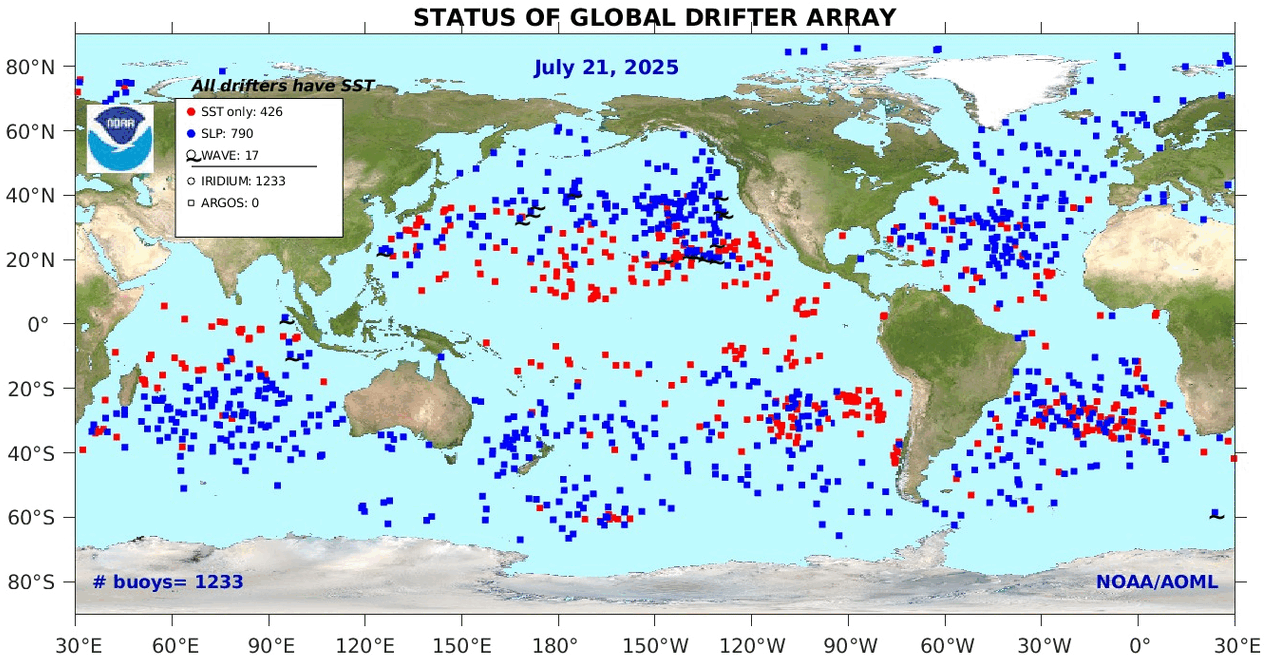
Gridcells lacking sufficient sampling that month are left out of the averaging, and the uncertainty from such missing data is estimated. IMO that is more reasonable than inventing data to infill. And it seems that the Global Drifter Array displayed in the top image is providing more uniform coverage of the oceans than in the past.

uss-pearl-harbor-deploys-global-drifter-buoys-in-pacific-ocean

USS Pearl Harbor deploys Global Drifter Buoys in Pacific Ocean


via Science Matters

https://ift.tt/rtoqpUB

May 12, 2023 at 09:05AM