The western US has had an historic winter. From record-breaking cold spells to unprecedented amounts of snow, this has been a memorable cold season – and one that runs counter to the prophecies of the AGW party.
Starting with the cold – and according to data from the warmth-addicted NOAA – the US has set 7 all-time low temperature records so far this year (through April 24) compared to just one heat record, while 321 monthly lows have fallen in April alone (also through April 24) compared to 66 heat records.
Highest April 1st snow cover recorded this year
Regrading snow, in the official books going back to 2001, the largest area ever covered with snow/ice in the western US at the beginning of April so far was 2019’s 1,030,820 sq km, but this year that figure was far exceeded, with satellite imagery showing that more than 1,149-960 sq km of the West was covered with snow and ice on 1 April.
By comparison, the average snowpack in the western US at the end of March is 242,000 square miles.
According to NSIDC data, snowpack this season was well above the April 1 average in all western states. In the table below, South Dakota, Nebraska and Arizona lead the way with 350% of the average, followed closely by Nevada:
Source: NSIDC
All western US states have seen above-average snowfall; in fact, all have set records:
Meanwhile across the pond, the official UK low of -7.4°C was recorded on April 27 in Loch Glascarnoch, Scotland. This broke the previous low of -6.1°C recorded in 1956 in Glenlivet. It’s been quiet for Britain’s climate alarmists, as record cold blanketed the country.
NASA data show no planetary warming over the past decade. Are we heading for cooling?
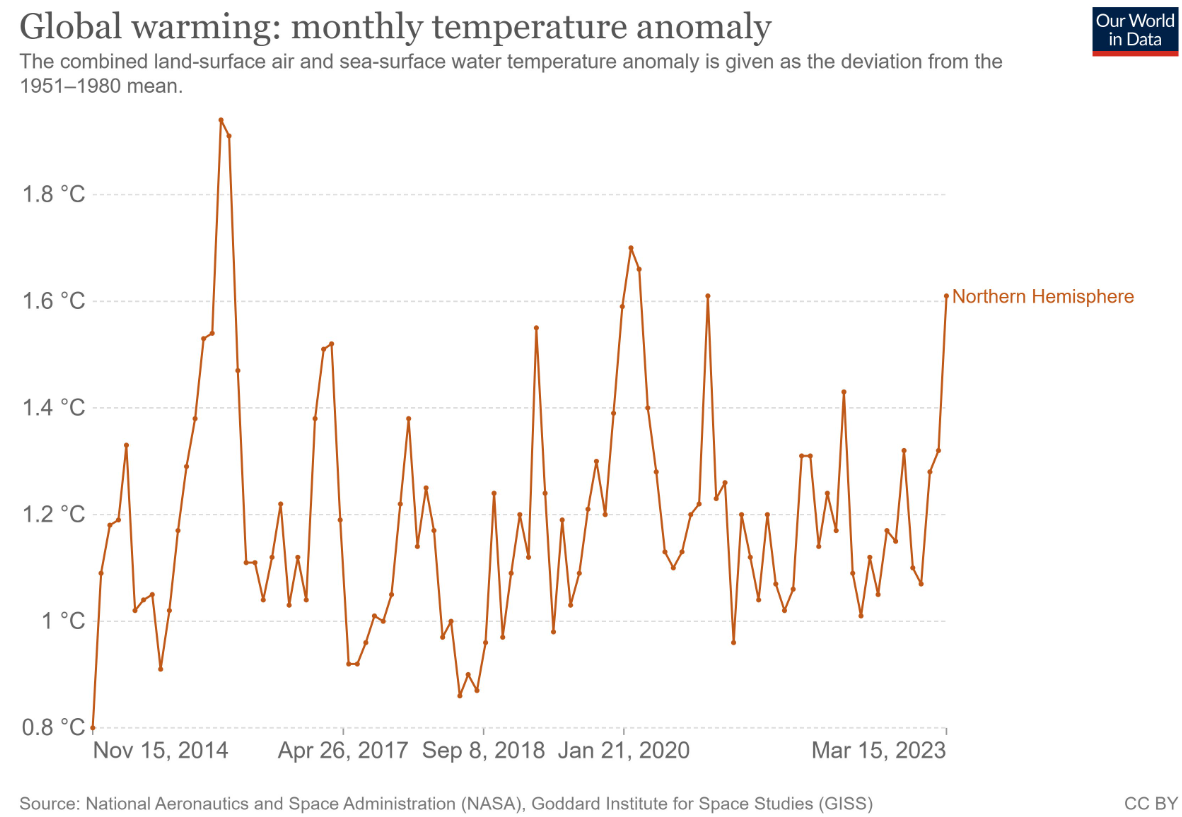
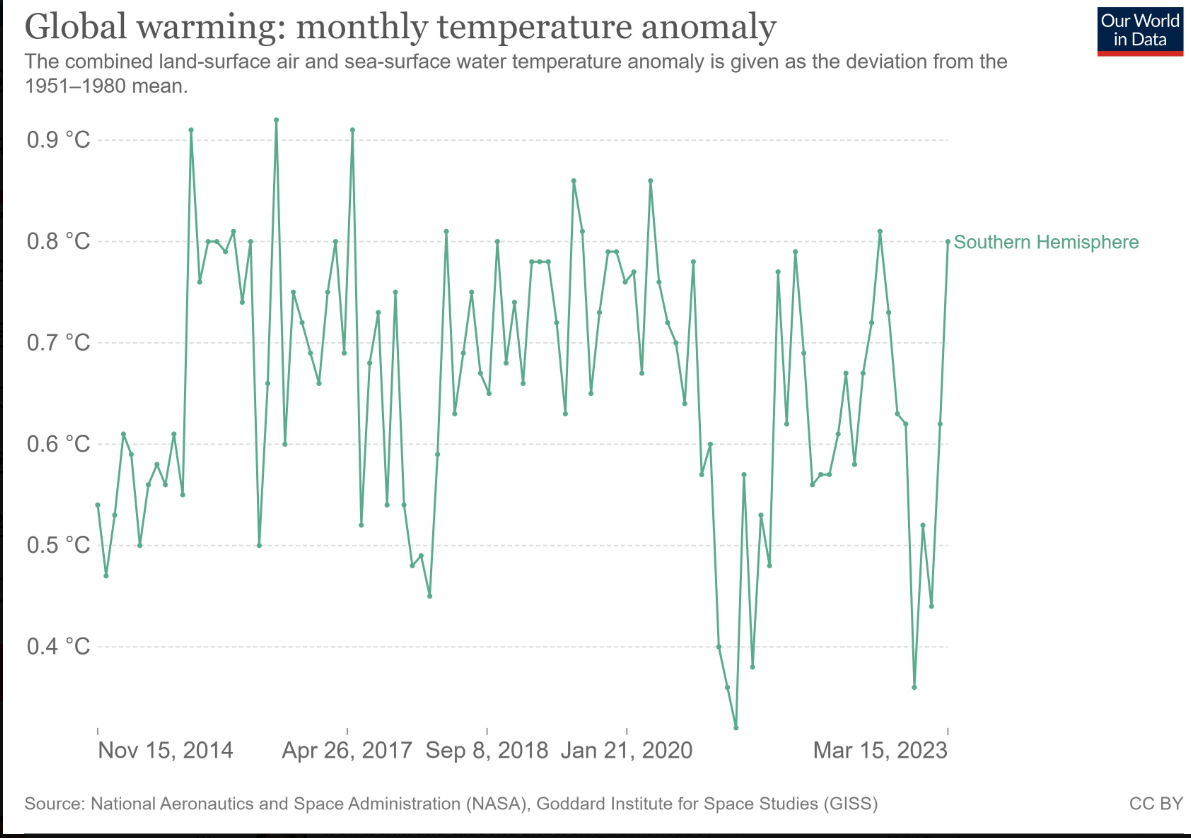
Twitter account Zacki here tweeted on the northern and southern hemisphere sea land land surface temperature trend over the past decade, using NASA GISS data.
First lets begin with the northern hemisphere for the past 9 years:
There’s been no general rise in temperature, despite all the claims of a planet that is allegedly rapidly heating.
Next we look at the southern hemisphere:
What a surprise! Global warming isn’t global any more. As the chart shows, the southern hemisphere has in fact cooled over the recent years.
NASA may have to change the chart heading to: “Global cooling: monthly temperature anomaly”
Edward Ring explains the importance of dispelling CO2 hysteria in his American Greatness article Challenging the Premise of Our Destruction. Excerpts in italics with my bolds and added images.
Claiming that anthropogenic CO2 will not cause catastrophic climate change is a
credible, necessary point of view backed up by scientific evidence.
The most powerful and destructive perception in the world today is that using fossil fuels will cause catastrophic climate change. This belief, marketed by every major government and corporate institution in the Western world, is the foundational premise underlying a policy agenda of stunning indifference to the aspirations of ordinary people.
The war on fossil fuel is a war on freedom, prosperity, pluralism, independence, national sovereignty, world peace, domestic tranquility, and, most ironically, the environment itself. It is a war of rich against poor, the privileged against the disadvantaged, corporate monopolies against competitive upstarts, Malthusians against optimists, regulators against innovators, and authoritarians against freedom-loving people everywhere.
But this war cannot be won unless the perception is maintained. If fossil fuel is allowed to compete against other energy alternatives for customers as a vital and growing part of an all-of-the-above energy strategy, this authoritarian political agenda falls apart.
It is reasonable to question the assertion that eliminating fossil fuels will inevitably result in an impoverished society subject to punitive restrictions on individual behavior. But the numbers are compelling and can be distilled to two indisputable facts: First, fossil fuel continues to provide over 80 percent of all energy consumed worldwide. Second, if every person living on planet Earth were to consume half as much energyper year as the average American currently consumes, global energy production would need to double.
Several inescapable conclusions derive from these two facts, if one assumes that energy is the driver of prosperity. Just in case that is not obvious, imagine Americans living with half as much energy as they use today. Where would the cuts occur? Would they drive their cars half as much? Heat their homes half as much? Operate manufacturing, farming, and mining equipment half as much? They would need to do all those things and more. The economy would collapse.
These consequences don’t escape the intelligentsia who promote “net zero” policies. These consequences explain the policies they advocate. The recent promotion of “15-minute cities” that will inform rezoning and redevelopment to put all essential services within a 15-minute walk of every residence. The rise of “congestion pricing” to charge automobiles special tolls if they drive into an expanding footprint of urban neighborhoods. “Smart growth.” “Infill.” “Urban Service Boundaries.” Bike lanes. “Smart buildings,” “smart meters,” and “smart cities.”
These innovations, all in progress, only begin to describe what is coming.
By restricting new development and systematically reducing the use of fossil fuels, the global middle class will shrink instead of grow. The wealthiest elites will buy their way out of the smart slums. Everyone else will be locked down. This is how energy poverty will play out in the modern era. It cannot be emphasized enough: If energy production is restricted, this will happen. It’s algebra. It is objective fact.
Hardly less speculative is the reaction outside the Western world. What are our elites thinking? Do they intend to start World War III? Perhaps they do. Because nothing short of war is going to stop the Chinese, Indians, Indonesians, Pakistanis, Brazilians, Nigerians, or Bangladeshis from developing every source of energy they possibly can. Just those seven nations account for half the world’s population. That’s 4 billion people. Will they stop developing energy until they at least achieve half the per capita energy consumption that Americans currently enjoy? Not a chance.
Will they get there by relying exclusively on wind and solar? Dream on.
Fossil Fuel Will Not Cause a Climate Catastrophe
If you only believe half of the preceding arguments, you must realize that Americans have been backed into a corner. If anyone calls for abundant energy—or abundant anything, since energy, and fossil fuel in particular, is the prerequisite for virtually all goods and services—they are shouted down as “climate deniers.” And the way to upset the entire edifice is not to merely argue that fossil fuel is essential to the survival of civilization. Because the counterargument is that eliminating fossil fuel is essential to the survival of the planet.
That is an unwinnable argument. It is not possible to reason with an opponent of fossil fuel if you concede their fundamental premise: that burning fossil fuel will cause catastrophic climate change. You either become a “denier,” or you submit to energy poverty.
This is the tough decision facing Americans.
And it’s accurate to also say it is a decision facing Republicans since literally every prominent, mainstream, housebroken, accommodating establishment Republican will not challenge the assertion that we’re experiencing a “climate crisis,” even though most of them know better. But this should be a bipartisan issue. For Republicans, this is an opportunity to show some backbone by rejecting the most destructive and fraudulent premise of our time. In so doing, they would unify their party, attract independent voters, and realign the nation.
The irony is stupefying. Without fossil fuel, America will enter a dark age, and the only way to control a restive population that’s seen its standard of living plummet will be through the establishment of a technology-driven police state. They are the fascists. The so-called climate deniers are fighting for prosperity and freedom.
If you want to save civilization, be a denier.
Say it loud and without reservations, and say it every chance you get. Demand that politicians publicly refute climate alarmism. It isn’t necessary to claim that the powers behind the climate cult want to enslave the world. We don’t know what motivates them. Some just want to get rich on renewables. Some want to use climate change to advance American global hegemony. But all of them rely on a fundamental moral justification: By eliminating fossil fuel, we are saving the planet from certain destruction. Focusing on the possible ulterior motives of climate alarmist leaders without first challenging their core moral argument is a fool’s errand.
There are plenty of environmental challenges. Being an environmentalist is a good thing. But there has to be balance, and there has to be debate. Claiming that anthropogenic CO2 will not cause catastrophic climate change is a credible, necessary point of view backed up by scientific evidence. If more people make that claim, the climate cult can be broken, and civilization can be rescued from oblivion.
* IPCC hides good news about disaster losses and climate-related deaths * IPCC wrongly claimed the estimate of climate sensitivity is above 2.5°C; it is more likely below 2°C * IPCC misleads policy makers by focusing on an implausible worst-case emissions scenario * Errors in the AR6 report are worse than those that led to the IAC Review in 2010 The IPCC ignored crucial peer-reviewed literature showing that normalised disaster losses have decreased since 1990 and that human mortality due to extreme weather has decreased by more than 95% since 1920. The IPCC, by cherry picking from the literature, drew the opposite conclusions, claiming increases in damage and mortality due to anthropogenic climate change. These are two important conclusions of the report The Frozen Climate Views of the IPCC, published by the Clintel Foundation. The 180-page report is – as far as we know – the first serious international ‘assessment’ of the IPCC’s Sixth Assessment Report. In 13 chapters the Clintel report shows the IPCC rewrote climate history, emphasizes an implausible worst-case scenario, has a huge bias in favour of ‘bad news’ and against ‘good news’, and keeps the good news out of the Summary for Policy Makers. The errors and biases that Clintel documents in the report are far worse than those that led to the investigation of the IPCC by the Interacademy Council (IAC Review) in 2010. Clintel believes that the IPCC should reform or be dismantled.
With the recently published Synthesis Report, the IPCC finished its sixth assessment cycle, consisting of seven reports in total. An international team of scientists from the Clintel network has analysed several claims from the Working Group 1 (The Physical Science Basis) and Working Group 2 (Impacts, Adaptation and Vulnerability) reports. This has now led to the report The Frozen Climate Views of the IPCC.
In every chapter the Clintel report documents biases and errors in the IPCC assessment. The errors are worse in the WG2 report than in the WG1 report. Given the political relevance of what is known as “Loss and Damage” (at the yearly COP meetings, countries currently negotiate donations to a Loss and Damage fund) one would expect a thorough review of the relevant literature. However, Clintel shows that the IPCC has totally failed in this respect. For example, a review article on the subject, published in 2020, showed that 52 out of 53 peer reviewed papers dealing with “normalised disaster losses” saw no increase in harms that could be attributed to climate change. The IPCC highlighted the single paper that claimed an increase in losses. That paper is – unsurprisingly – flawed, but its cherry picking by the IPCC suggests they found its conclusions irresistible.
Climate-related deaths “We are on a highway to climate hell”, said UN-boss Guterres recently. But an in-depth look at the mortality data shows that climate-related deaths are at an all-time low. Well-known economist Bjorn Lomborg published that important information in a 2020 peer-reviewed paper, but the IPCC, again, chose to ignore it. The strategy of the IPCC seems to be to hide any good news about climate change and hype anything bad.
Erasing climate history The Working Group 1 report is not free from bias and misleading conclusions either. The report documents problems in every chapter the Clintel team reviewed. The IPCC has tried to rewrite climate history by erasing the existence of the so-called Holocene Thermal Maximum (or Holocene Climate Optimum), a warm period between 10,000 and 6000 years ago. It has introduced a new hockey stick graph, which is the result of combining cherry-picked proxies. And it has ignored temperature reconstructions that show more variability in the past, such as the well-documented Little Ice Age.
The IPCC claims there is an acceleration in the rate of sea-level rise in recent decades. Clintel has shown this claim is flawed, because the IPCC ignores decadal variability in sea level. We also show that its sea-level tool – made available for the first time – shows a mysterious and improbable jump upward in 2020.
Climate sensitivity Canadian economist Ross McKitrick has pointed out that all global climate models used by the IPCC show too much warming in the troposphere, both globally and in the tropics (where models predict a ‘hotspot’). This probably indicates some fundamental problems in the way that these models simulate the climate system.
A ’spectacular’ result of the IPCC AR6 report was the rise of the lower bound for the climate sensitivity likely range from 1.5°C to 2.5°C, therefore claiming that low values for climate sensitivity are now unlikely. The Clintel report shows this rise is not justified. The Clintel report suggests that observed warming and other evidence indicates that the true figure is more likely to be below 2°C than above 2.5°C. This also means that the best estimate for climate sensitivity, which the IPCC says is 3°C, is not justified.
On top of that, the IPCC is ‘addicted’ to its highest emissions scenario, so-called RCP8.5 (or now SSP5-8.5). In recent years, several papers have demonstrated that this scenario is implausible and should not be used for policy purposes. Deep inside the WG1 report, the IPCC acknowledges that this scenario has a ‘low likelihood’ but this very important remark was not highlighted in the Summary for Policymakers, so these important audiences are unaware of the issue. RCP8.5 is the scenario most often referred to in the IPCC report.
IAC Review Back in 2010, errors in the WG2 report of the Fourth Assessment led to the investigation of the IPCC by the U.N. Interacademy Council (IAC). This review recommended, amongst other things, that “[h]aving author teams with diverse viewpoints is the first step toward ensuring that a full range of thoughtful views are considered.” This important recommendation is still being ignored by the IPCC. Worse, we document that Roger Pielke Jr, a scientist with considerable expertise in these areas, is regarded as a kind of ‘Voldemort’ by the IPCC, and they deliberately avoid mentioning his work or even his name. This leads to biased conclusions.
Reform We are sorry to conclude that the IPCC has done a poor job of assessing the scientific literature. All countries rely on the IPCC reports to support their climate policies and most of the media blindly trust its claims. The Clintel report The Frozen Climate Views of the IPCC shows that this trust is not justified. In our view the IPCC should be reformed, and should include a broader range of views. Inviting scientists with different views, such as Roger Pielke Jr and Ross McKitrick, to participate more actively in the process is a necessary first step. If, for some reason, such inclusion of different views is unacceptable, the IPCC should be dismantled.
Our own conclusions about climate – based on the same underlying literature – are far less bleak. Due to increasing wealth and advancing technology, humanity is largely immune to climate change and can easily cope with it. Global warming is far less dangerous to humanity than the IPCC tells us.
The press release (in English) can be downloaded here in pdf. Dutch press release here. Hungarian press release here.
ABOUT CLINTEL The Climate Intelligence foundation (Clintel) was founded in 2019 by emeritus professor of geophysics Guus Berkhout and science journalist Marcel Crok. Clintel’s main objective is to generate knowledge and understanding of the causes and effects of climate change, as well as the effects of climate policy. Clintel published the World Climate Declaration, which has now been signed by more than 1500 scientists and experts. Its central message is “there is no climate emergency”.



 Iowa Climate Science Education