Month: May 2023

Americans Increasingly Choose a Warmer Life

From Dr. Roy Spencer’s Blog

Roy W. Spencer, Ph. D.

We hear that a new El Nino forming in the Pacific Ocean is likely to push global-average temperatures to new record highs in 2023.

Setting aside the fact that we have no idea if current temperatures are warmer than during the Medieval Warm Period of ~1,000 years ago, I have to ask…

So what?

Doing something about global warming depends a lot on how much we are asked to pay to fix it. If it was cheap and practical, we would have already transitioned to renewable energy sources.

It also depends upon just how much global warming we have experienced, and whether it is enough to be concerned with. For the global oceans, the climate models enlisted to scare us in a steady stream of alarmist news reports over-predict ocean warming by a factor of 2. In America’s heartland during the summer, the discrepancy is a factor of 6(!). So, clearly, public concern is being inflated by factually incorrect information.

What Temperature do Americans Choose?

When it comes to life in these United States, roughly 50% of U.S. residents have at least a moderate worry about climate change and global warming. As mentioned above, I believe this is largely due to their response to what is reported by the news media, which is routinely exaggerated.

An interesting question that the late Dr. Pat Michaels asked about 25 years ago is, what temperature do Americans choose to live with? We have a large country with a wide range of climates, from frigid winters to tropical year-round, so there is considerable choice of what climate we decide to live in.

Dr. Michaels pointed out (most recently in 2013) that over the years, Americans tend to migrate to warmer climates. Some of us might claim to be concerned about global warming, but we increasingly choose to live where it’s warmer. I’ve updated those calculations to 2022, and the results are the same:

The blue curve is the usual area-averaged temperatures for the Lower 48, while the orange curve is the state population-weighted average. While the area average temperatures have warmed modestly over the last century, the temperatures where people choose to live have increased by twice that amount. (The possibility that Urban Heat Island effects have spuriously warmed these NOAA-reported temperatures is part of a research project we have been involved in).

Some might claim that the migration to states with warmer temperatures has more to do with economic opportunity than with temperature. But who creates economic opportunity? People. And where do people choose to live? Where the weather is warmer.

There’s a reason why people are flocking to Texas and Florida, and not to the Dakotas or Maine. Ultimately, it’s due to the climate. So, while some of us like to think we are Saving the Earth by buying a Tesla, our migration habits are telling a different story.

4.5
4
votes

Article Rating

via Watts Up With That?

https://ift.tt/IwORD9r

May 9, 2023 at 08:59PM

“Support Our Mission”

Scientific American wants you to support their mission to eliminate large numbers of humans from the planet. They say that wiping out the human population will prevent bad weather and fires. “Deloitte recently estimated climate chaos could cost the United … Continue reading

via Real Climate Science

https://ift.tt/iQKLFhv

May 9, 2023 at 08:31PM

If the data doesn’t illustrate the narrative, then just make up your own

There was something else that was odd about the Arctic sea ice volume graph that was used in the Benton lecture of 2018 (see previous post). Besides the ambuigity of the last data point and its weird position relative to the previous data points, there also seemed to be something a bit off at the 2012 data point (the lowest point of the graph). When I tried to overlay the Benton lecture graph over the actual annual minimum volume graph, it seemed that the 2012 data point was situated somewhat lower on the Benton lecture graph than it was in the PIOMAS dataset (the dataset this graph was based on). It didn’t seem to be that much at the time, so I wasn’t initially too bothered about it.

I later decided nevertheless to look into it and digitized the whole graph, instead of just looking at that last data point as I did in previous post. This indeed showed that the 2012 value was somewhat lower in the Benton lecture graph.

It also showed that both graphs are identical until 2009, but there is a small phase-shift from 2010 until 2012:

Chart 0022c: PIOMAS vs Benton lecture graph on slide 18

That means that the complete bottom part of the Benton lecture graph dropped about 300 km3 relative to PIOMAS. Weirdly enough, the 2013 value seems to be unaffected.

This means that the person who fabricated the downwards trend after 2013 used a graph that already went a bit lower than what was observed in reality. After this lowered part of the he graph, it went towards the correct 2013 value (exaggerating that increase by 300 km3) and then it plummeted down ending up close to the 2012 value (instead of rising further as is seen in reality). This accentuating the (already lowered) downward trend even more. The difference between the 2015 value of the Benton lecture graph and reality is about 2300 km3.

Then the big question: why the need for those fabrications at the end of the Benton lecture graph graph? In 2018, there was data available until September 2017, so it would have been possible to add four more data points to that graph.

I think the reason could be rather straight forward. Just look at a comparison that I made between what was shown in the lecture and how the minimum volume data would have looked like back then:

PIOMAS 2018 vs Benton lecture graph of January 2018

So, if you wanted to convey in January 2018 that the Arctic is prime evidence of irreversible changes in the climate system and that the Arctic would be ice-free by 2022, then which one of the two graphs would you choose to illustrate this narrative? Would you choose the one with the fabricated tail end on the left or the one with the actual data on the right?

via Trust, yet verify

https://ift.tt/yKek61o

May 9, 2023 at 05:34PM

Sea Turtles, Florida Lore, and Hurricane Prediction

This article is a about hypothesis based on folklore and its potential plausibility. It is not presented as a scientific study.

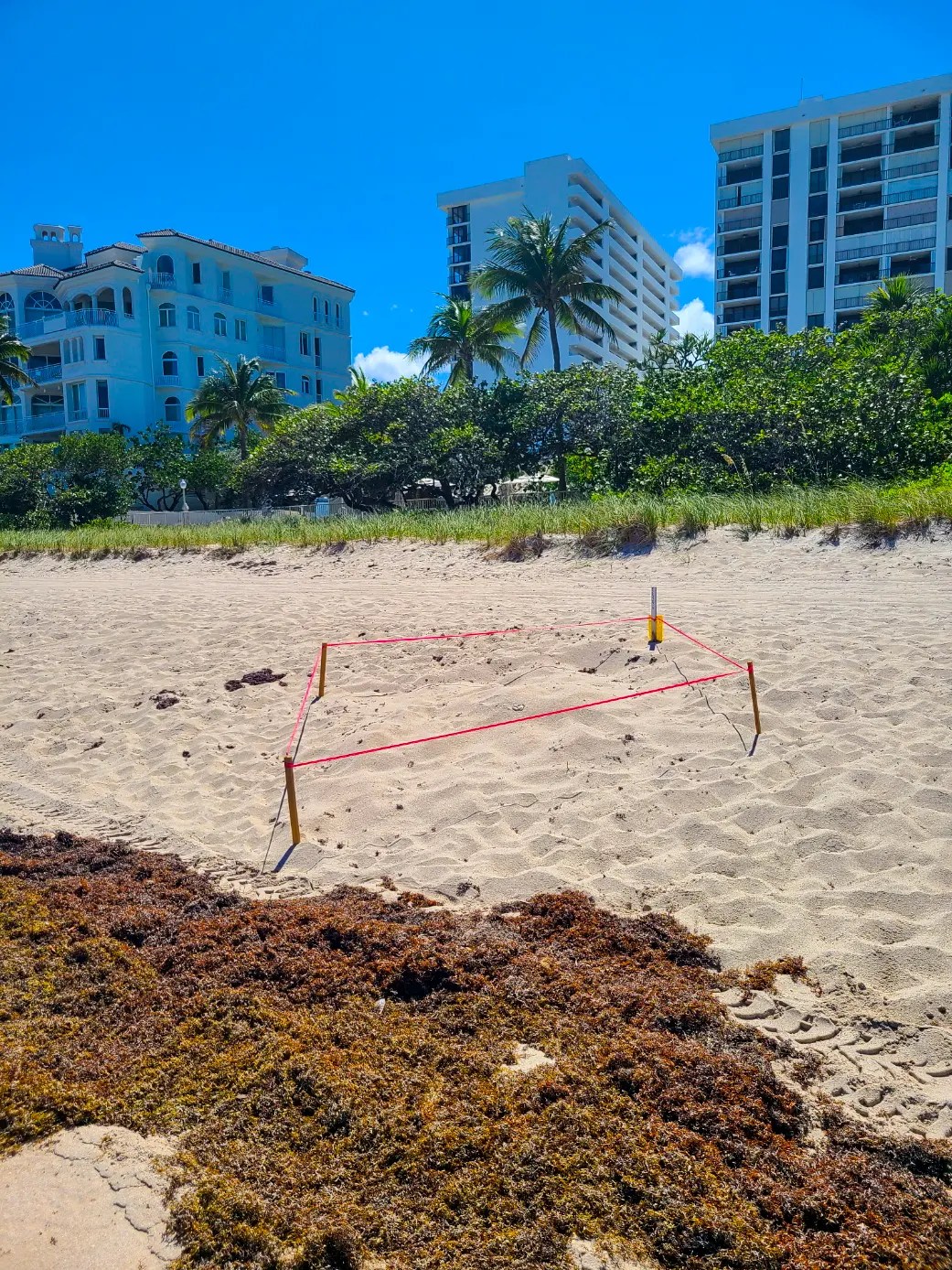
Turtle nesting season has begun in Florida. A bartender, “A”, at my local watering hole is a big turtle enthusiast. So I let “A” know that on my recent walks along the beach, I’ve been seeing lots of new roped-off nests popping up as the nesting season begins.

“A” asked me how far away the nests were located from the water. This is something I hadn’t considered and hadn’t really taken note of. She explained that many locals believe that if a hurricane season is going to be intense the turtles would place their nests up the beach, farther away from the surf than normal. So, a nesting season where turtles lay their eggs close to the high tide line is a prediction for a calm season.

In subsequent walks I paid attention to where the nests are located on the beach. As luck would so have it, this month we had a big flood of seaweed at the same time the King tide occurred. This clearly marked the high tide level making it easy to spot. It turns out that every turtle nest I’ve seen this season are located just above the King tide line.

Sea Turtle Nest on Fort Lauderdale Beach, Florida, May 2023, by Charles Rotter

According to Florida folklore this will be calm storm season. The incubation period for sea turtles is 30 to 90 days. A prediction three months out, and subsequent change in nesting behavior would have a tremendous evolutionary advantage on breeding success.

Nests placed farther than necessary from the water expose the eggs to dehydration and excess predation, especially on that precarious night the young turtles hatch and make a dash for the water. Sea birds and crabs lie in wait for such events.

When nests are placed too close to the water the risk of drowning the eggs occurs,

For the eggs to survive and have a chance of hatching, sea turtles must lay their eggs on sandy beaches. As they are developing, the embryos breathe air through a membrane in the eggs, and so they cannot survive if they are continuously covered with water. 

https://conserveturtles.org/information-sea-turtles-frequently-asked-questions/#21

as well as the physical danger of being washed away in the storm.

Strong wave action can also cause beaches to erode, washing sand away. This can expose sea turtle eggs, leaving them prone to drying out or predation. They can also destroy the nests completely, washing the eggs into the sea where they will drown.

https://blogs.ifas.ufl.edu/news/2020/08/06/sea-turtle-nests-and-hurricanes-here-is-what-uf-ifas-experts-want-you-to-know/

Sea turtles have been around for around 150 million years. If it this level of predictive accuracy for seasonal storm levels were somehow possible, that’s plenty of time for selective pressure to cause turtles to evolve this survival edge. Whatever the turtles may be using to forecast, be it currents, temperature, salinity, barometric pressure, if it’s possible, they would likely have evolved to be able to do it.

We should hope this folklore is true, and then someday we may be able to use the same indicators the turtles use to improve our seasonal storm predictions, (which haven’t been very accurate the last few years).

HT/”A”

Addendum. Here’s a photo from July of last year helping errant hatchlings get to the Ocean after they’ve headed in the wrong direction.

Sea Turtle Rescue, July 30, 2020, by Charles RotterSea Turtle Rescue, July 30, 2020, by Charles RotterSea Turtle Rescue, July 30, 2020, by Charles Rotter
Sea Turtle Rescue, July 30, 2020, by Charles Rotter

via Watts Up With That?

https://ift.tt/epOBgCh

May 9, 2023 at 04:59PM