Month: May 2023

That’s a big climate surprise: Frost season growing longer across Australia (and for years!)

Climate experts wrong on Australian frosts, and media say nothing

The IPCC experts were sure would be less frosts in Australia, but buried in a government funded ABC weather report was the virtually unknown admission that the frost season is actually growing across southern Australia, not shrinking. And in some places by an astonishing 40 extra days a year. What’s more, the researchers have known about this long term trend for years but didn’t think to mention it, and the ABC didn’t have a problem with that either. (It’s not like farmers need to know these things?)

When asked for an explanation for the increase in frosts, the ANU climate expert said “I think this is one of those climate surprises,” as if the IPCC unexpectedly won a game of Bingo, instead of getting a core weather trend 100% wrong.

We note the ABC feigned journalism to cover up for the Bureau of Meteorology and IPCC failures. Where were the headlines: “Climate Change causes more frosts, not less”, or “IPCC models dangerously misleading on frosts?” Did any Australian farmers and investors buy up properties and plant the wrong crops based on the global warming misinformation repeated or tacitly endorsed by the ABC, BoM and CSIRO?

Frost damage costs Australian farmers around $400 million each year. (Perhaps if we sold the ABC we could cover that).

By Tyne Logan, ABC Australia

Buried under 450 words of weather, trite caveats, and preamble the ABC journalist finally gets to a new virtually unknown climate trend that affects farmers, investors, researchers, and rural Australia:

The latest Intergovernmental Panel on Climate Change report projected, with high confidence, that frost events would decrease, in general, across southern Australia in the future with climate change.

ANU climate applications scientist Steven Crimp said some parts of New South Wales were now experiencing five more frost events on average each year, compared to 1960.

And he has known for years:

He said this was based on local weather station data between 1960 and 2018, but the trend was unlikely to have changed much in the past five years.

“I think this is one of those climate surprises,” he said.

Scientifically they are not caught unaware because climate models are useless politicized fantasies, it’s because there is more “climate-nuance” around now:

“Despite the sort of overall warming trend in our temperatures, the extremes of our temperatures, be they hot or cold, are acting in a slightly more nuanced and complex way, which can be quite surprising at times,” he said.
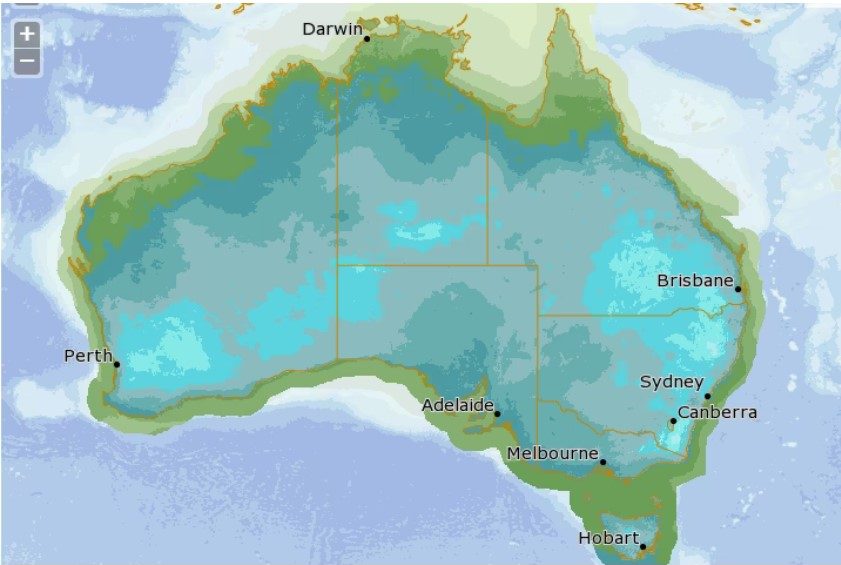
Below zero temperatures in Australia.

BOM forecast overnight minimum temperatures to fall well below zero across large swathes of the country [last] Sunday.

But jokes aside, this actually seems like a trend that matters:

Dr Crimp said they had also found the frost season was lengthening across southern Australia.

“So if we think about the east coast first, we see an earlier start and a later finish to that frost window,” he said. “In some cases, the extension of that frost window is greater than 40 days.

“But in Western Australia in particular, we see that it’s less to do with the later frost occurrence, but more earlier frost occurrence.”

The frosts are due to the dry conditions, says Dr Crimp, putting in an admirable effort at scientific-word-salad to cover up for what he’s not allowed to say — that they have no idea.

Why aren’t frost days decreasing?

Dr Crimp said, ironically, the observations could be explained by the types of weather system that brought warmer, drier weather. That was high pressure systems which often produced the clear, still nights needed for frost to settle.

“As anyone knows who’s outside at night in winter, you have to have those clear night skies and the atmosphere needs to be very dry,” he said.

“That way the surface of the Earth loses heat very rapidly and any moisture in the air then condenses as a frost. “So because we are getting those dry conditions that are starting to emerge, that is more conducive for frosts to occur.”

But the truth is that, on average, and a priori — global warming would increase humidity and global cooling would  dry the air out. And carbon dioxide is supposed to work at night time too — increasing minimum temperatures. All these factors make frosts less likely.

And yet the frosts happen.

h/t to A happy little debunker who points out we’ve had three wet La Nina years as well.


10 out of 10 based on 1 rating

via JoNova

https://ift.tt/qQTYHBJ

May 29, 2023 at 03:32PM

Google and Microsoft Choke Independent Thought

Google punishes websites for merely hosting conservative and independent third-party authors. Worse, it is believed to penalize websites for linking to content that it does not like.

Google and Microsoft continue choking independent thought on the Internet. The following are screenshots from SimilarWeb.com, showing traffic sources of Substack and Medium.com.

They have the same business model: hosting medium-sized articles of multiple authors, allowing access to free and to some of them for a fee. Substack hosts many conservative and non-conformist authors. Medium.com purged them a few years ago. The difference in the search traffic (mainly from Google) is enormous: Substack receives <12% of the traffic from the search, while Medium.com gets more than 57%. Take a look at the red columns in both figures. This percentage would be approximately the same if Google were honest.

Substack.com, traffic sources,  2023-05-28Substack statistics on SimilarWeb


Medium.com traffic sources, 2023-05-28

medium.com statistics on SimilarWeb

Google’s intentional malicious bias was first calculated by the author in 2017. The bias can be determined as malicious because Google had promised its consumers the most relevant, helpful, useful, and authoritative (for each consumer) results. An intentional and significant departure from this promise shows actual malic. The bias has been getting worse since then.

Google de-ranks websites for merely hosting independent thought and is believed to do the same simply for linking to pages that Google does not like, calling them not credible or low authority.  For example, SEO professionals recommend: “Make sure you link to credible sites though, because the websites you link to can also affect your authority. … If you are linking to a low authority site, the fact … might be questionable to search engines like Google.”

That suppresses independent thought nationwide, globally, in the most unexpected way on and off the Internet.

Google consumers do not know that. Most independent writers and reporters do not know that either. Internet users not using Google do not know how Google impacts what they read and view. Liberals are more likely not to understand that than conservatives. However, the Democrat political apparatus and owners and webmasters of large websites know that.

Google promises its users it will deliver results that are most relevant, helpful, useful, and authoritative (for each user)  that is the most useful, relevant, and helpful for them but does not abide by this promise. “The user then receives results that are rank-ordered based on the search engine’s judgment of the likelihood that each result matches what the user was seeking in entering the search terms.” (Google’s CEO Eric Schmidt, Congressional Testimony, 2011)

Google also has obligations to the websites from which Google pilfered content. In light of the Twitter Files, we know that Google and its executives act on behalf of governments.

via Science Defies Politics

https://ift.tt/gho6HqK

May 29, 2023 at 03:03PM

Dumping Coal Assets Near the Bottom of the Market a Green Energy Success?

Essay by Eric Worrall

“Her … contract was not renewed”: A recent 4000 attendee climate change summit in Paris came up with some interesting ideas on promoting renewable energy to company boards.

Incentivizing Boards Of Directors To Address Climate Change, At ChangeNow Summit

Joan Michelson
Contributor

To truly avoid reaching that potentially irreversibly devastating 1.5 degrees Celsius warming – which the UN’s World Meteorological Organization just announced that we’ll cross in a few years – we need every aspect of the economy to take action, literally.

At the ChangeNow 2023 Summit in Paris, France last week with over 4,000 attendees from 120 countries and across industries, gathered to strategize how to do that and share solutions, as well as to make deals.

Isabelle Kocher de Leyritz explained in one of my sessions at ChangeNow how she did just that as CEO of Engie, one of Europe’s largest fossil fuel energy companies. She talked about how the board asked her, then CFO, to develop a plan to transition the company and then elevated her to the CEO role to execute her plan. She told us about the robust debates she had with Engie’s board of directors, and how she persuaded them to sell off coal assets and invest that money into renewable energy assets instead. Now CEO of Blunomy, a consultancy, her Engie contract was not renewed, but Engie remains in renewable energy.

Read more: https://www.forbes.com/sites/joanmichelson2/2023/05/28/incentivizing-boards-of-directors-to-address-climate-change-at-changenow-summit/?sh=24d9ee77722d

Engie CEO Isabelle Kocher de Leyritz announced the deal to sell Engie’s European coal assets on the 26 April 2019, close to the bottom of the coal price cycle.

Shortly after disposing of European coal assets in 2019, in February 2020, Engie announce they would not be renewing Isabelle’s CEO contract.

… In an interview with French newspaper Les Echos, Clamadieu explained the board blamed Kocher for Engie “falling behind over four years in the area of electricity generation and gas infrastructure, which now represents 80% of our profits”.

Engie’s stock price opened at €15.63 on 7 February — down from the previous close of €15.71/share — following the announcement. Its shares continued to fall as low as €15.51. …

Read more: https://www.windpowermonthly.com/article/1673343/engie-will-not-renew-ceo-kochers-contract

Engie didn’t just own coal plants, they also owned at least some of the adjacent coal mines. Isabelle was CEO when Engie decided to close the Australian Hazelwood plant, which used to provide 25% of the State of Victoria’s energy.

… Engie shuttered Hazelwood with just five months’ notice in 2017 – a scenario that the Victorian government has avoided with Yallourn by arranging with its owner to close the plant, which delivers about 20% of Victoria’s electricity, in 2028, four years earlier than planned.

Before Engie closed it, Hazelwood produced about 25% of Victoria’s electricity and was responsible for about 14% of the state’s emissions.

The nearby open-cut mine from which it sourced brown coal also burned out of control for 45 weeks in 2014 after a bushfire spread into it.

Engie’s chief executive for Australia and New Zealand, Augustin Honorat, said the company had a “long-term commitment” to Hazelwood and the Latrobe valley that included remediating the site and acting as “the builder and owner of a new energy asset that helps with the decarbonisation of the energy system”. …

Read more: https://www.theguardian.com/australia-news/2021/dec/01/australias-biggest-privately-funded-battery-under-construction-at-hazelwood-power-station-site

Hazelwood produced $387 billion dollars profit in 2010. Even if Hazelwood needed to be completely scrapped, a brand new 1GW HELE coal plant would cost around AUD $2.2 billion according to APO, an Aussie think tank. $387 million / year profit on a $2.2 billion investment would have been a 17.5% return on investment, as opposed to what actually happened – a site rehabilitation money pit and speculative, subsidy dependent 150MWH green battery investment, which is still struggling to arrange connection to the grid.

Obviously my interpretation of events could be wrong, my apologies to Isabelle if I have misunderstood the situation. I would be happy to publish her version of events if she gets in contact.

But something obviously went very wrong with the relationship between Isabelle Kocher de Leyritz and Engie, otherwise they would have renewed her CEO contract.

What can I say? If I have understood the situation correctly, if this is the green movement’s idea of successfully influencing an energy company to go green, I’d hate to see their idea of a failure.

via Watts Up With That?

https://ift.tt/x4GOL5z

May 29, 2023 at 12:14PM

New Study Destroys ‘Doomsday Glacier’ Narrative…Today’s Ice 8 Times 𝘛𝘩𝘪𝘤𝘬𝘦𝘳 Than Last 8000 Years

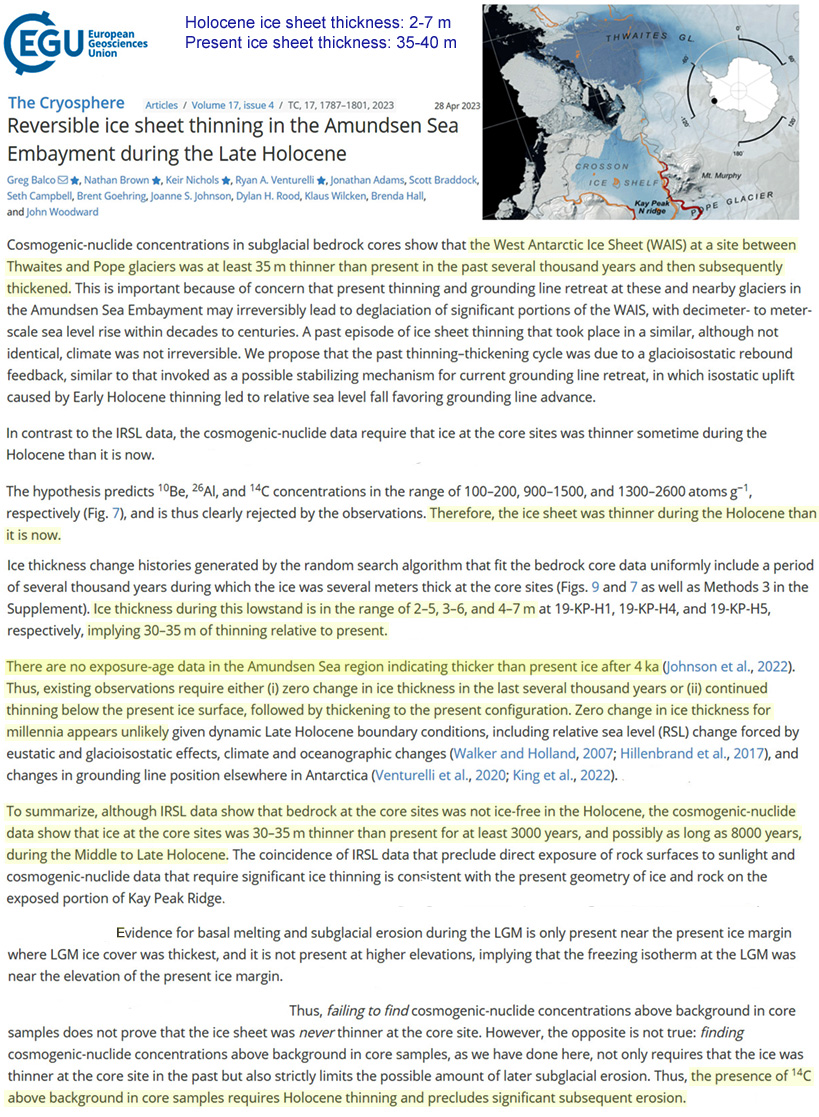
Scientists have determined there is no measured data to “indicate thicker than present ice after 4ka” at a West Antarctic study site near the Thwaites “Doomsday” Glacier. Any ice melt observed today is thus “reversible”… and natural.

The Thwaites, Pine Island, and Pope Glaciers in the Amundsen Sea region of West Antarctica are all situated on a hotbed of active geothermal heat flux, which has led to anomalously high regional melt rates. Indeed, “there is a conspicuously large amount of heat from Earth’s interior beneath the ice” in the very locations where the ice melt is most pronounced.

While the Earth’s crust has an average thickness of about 40 km, in the Thwaites-Pine Island-Pope Glacier region the anomalously thinner crust (10 to 18 km) more readily exposes the base of the ice to 580°C tectonic trenches. The “elevated geothermal heat flow band is interpreted as caused by an anomalously thin crust underlain by a hot mantle,” which is exerting a “profound influence on the flow dynamics of the Western Antarctic Ice Sheet” (Dziadek et al., 2021).

Despite the established natural causes of ice melt this region (see also Schroeder et al., 2014, Loose et al., 2018), it has nonetheless become commonplace for those who believe human behaviors are the climate’s “control knob” to claim the melting of the Thwaites Glacier – dubbed the “Doomsday Glacier” by alarmists – is caused by humans driving gasoline-powered trucks or using natural gas for energy.

But a new study categorically undermines claims that the ice melt occurring in the Thwaites-Pine Island-Pope Glacier region is unusual, unprecedented, or unnatural.

The thickness of the ice sheet at this Amundsen Sea region site averages about 40 m today.

Scientists (Balco et al., 2023) have used cosmogenic-nuclide concentrations and bedrock cores to determine the ice sheet is presently around 8 times thicker than it was for most of the last 8,000 years of the Holocene, when the ice thickness ranged between 2 m and 7 m.

“…the West Antarctic Ice Sheet (WAIS) at a site between Thwaites and Pope glaciers was at least 35m thinner than present in the past several thousand years”

Image Source: Balco et al., 2023

Even more interesting, the scientists found there are “no exposure-age data in the Amundsen Sea region indicating thicker than present ice after 4 ka,” suggesting that the present thickness is close to the most pronounced it has been over the last 4,000 years.

Any ice melt from this region, then, is not only natural, but the opposite of “unprecedented.” The scientists thus characterize modern changes to the West Antarctic ice sheet as “reversible” instead.

via NoTricksZone

https://ift.tt/fYweWp5

May 29, 2023 at 12:07PM