Plastering the landscape with wind turbines for producing renewable energy may lead to regional drought.
Germany has so far installed over 30,000 wind turbines, which is about 1 every 11 sq. km. Plans are calling for doubling or even tripling wind power capacity. But this may be detrimental as new studies show that wind farms are altering local climates, and thus may be having an effect on global climate and contributing to regional droughts.
Northern Germany, for example, has a high concertation of of wind turbines and has seen an unusual dry spell since 2019. Fortunately, recent rains have alleviated these drought conditions. Alarmist climate scientists of course blamed rising CO2 emissions for the North German drought.
Yet, a recent paper by Wang et al (2023) shows that wind farms reduce regional soil moisture, thus confirming earlier model simulations of wind-park-made climate change, e.g. by Zhou et al (2013).
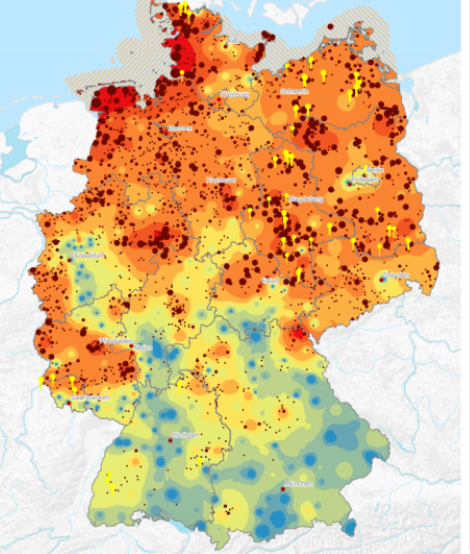
The site presents one chart depicting the wind energy installation concentration over Germany:
The North Sea region has an extremely high concentration of installed wind energy capacity. Conversely, Southern Germany has a very low concentration of installed wind energy capacity. Image: Bundesamt für Naturschutz.
Next we look at a chart depicting the ground moisture across Germany (2019). The left side shows the moisture anomaly down to a soil depth of 25 cm while the right chart shows moisture anomaly down to depth of 1.8 meters.
The legend shows, the redder the area, the drier it is. Germany’s drought happens to be worse in the regions with lots of wind turbines. Scientists suspect these turbines may be playing a role here. Image: Drought Monitor Germany.
“Is it a coincidence that the soils are driest where most wind turbines are located?” SciFi wonders.
Mounting evidence of link between drought and wind parks
In the article, SciFi examines a number of published research papers on the subject and summarizes:
As a conclusion, it can be said that it is certain that wind farms change the local climate. Very large wind farms or many wind farms also have an effect on the global climate. The results are mostly based on simulation models, whereby the study by Zhou et al. (2013), which was able to draw on comparative data, confirms the results found in the simulation models. The new study by Wang et al. (2023), which we discussed today, confirms the model calculations using real data obtained from a Chinese wind farm and shows for the first time that soil moisture is reduced by wind farms not only downwind but also upwind.
Wind farms thus contribute significantly to the drying out of soils, and to drought.”
Biden has just appointed Harris to promote responsible AI – in my opinion the opening salvo in an attempt to install fear of AI as a replacement for the failed climate alarmist movement.
FACT SHEET: Biden-Harris Administration Announces New Actions to Promote Responsible AI Innovation that Protects Americans’ Rights and Safety
Today, the Biden-Harris Administration is announcing new actions that will further promote responsible American innovation in artificial intelligence (AI) and protect people’s rights and safety. These steps build on the Administration’s strong record of leadership to ensure technology improves the lives of the American people, and break new ground in the federal government’s ongoing effort to advance a cohesive and comprehensive approach to AI-related risks and opportunities.
AI is one of the most powerful technologies of our time, but in order to seize the opportunities it presents, we must first mitigate its risks. President Biden has been clear that when it comes to AI, we must place people and communities at the center by supporting responsible innovation that serves the public good, while protecting our society, security, and economy. Importantly, this means that companies have a fundamental responsibility to make sure their products are safe before they are deployed or made public.
Vice President Harris and senior Administration officials will meet today with CEOs of four American companies at the forefront of AI innovation—Alphabet, Anthropic, Microsoft, and OpenAI—to underscore this responsibility and emphasize the importance of driving responsible, trustworthy, and ethical innovation with safeguards that mitigate risks and potential harms to individuals and our society. The meeting is part of a broader, ongoing effort to engage with advocates, companies, researchers, civil rights organizations, not-for-profit organizations, communities, international partners, and others on critical AI issues.
The Administration has also taken important actions to protect Americans in the AI age. In February, President Biden signed an Executive Order that directs federal agencies to root out bias in their design and use of new technologies, including AI, and to protect the public from algorithmic discrimination. Last week, the Federal Trade Commission, Consumer Financial Protection Bureau, Equal Employment Opportunity Commission, and Department of Justice’s Civil Rights Division issued a joint statement underscoring their collective commitment to leverage their existing legal authorities to protect the American people from AI-related harms.
The Administration is also actively working to address the national security concerns raised by AI, especially in critical areas like cybersecurity, biosecurity, and safety. This includes enlisting the support of government cybersecurity experts from across the national security community to ensure leading AI companies have access to best practices, including protection of AI models and networks.
Today’s announcements include:
New investments to power responsible American AI research and development (R&D). The National Science Foundation is announcing $140 million in funding to launch seven new National AI Research Institutes. This investment will bring the total number of Institutes to 25 across the country, and extend the network of organizations involved into nearly every state. These Institutes catalyze collaborative efforts across institutions of higher education, federal agencies, industry, and others to pursue transformative AI advances that are ethical, trustworthy, responsible, and serve the public good. In addition to promoting responsible innovation, these Institutes bolster America’s AI R&D infrastructure and support the development of a diverse AI workforce. The new Institutes announced today will advance AI R&D to drive breakthroughs in critical areas, including climate, agriculture, energy, public health, education, and cybersecurity.
Public assessments of existing generative AI systems. The Administration is announcing an independent commitment from leading AI developers, including Anthropic, Google, Hugging Face, Microsoft, NVIDIA, OpenAI, and Stability AI, to participate in a public evaluation of AI systems, consistent with responsible disclosure principles—on an evaluation platform developed by Scale AI—at the AI Village at DEFCON 31. This will allow these models to be evaluated thoroughly by thousands of community partners and AI experts to explore how the models align with the principles and practices outlined in the Biden-Harris Administration’s Blueprint for an AI Bill of Rights and AI Risk Management Framework. This independent exercise will provide critical information to researchers and the public about the impacts of these models, and will enable AI companies and developers to take steps to fix issues found in those models. Testing of AI models independent of government or the companies that have developed them is an important component in their effective evaluation.
Policies to ensure the U.S. government is leading by example on mitigating AI risks and harnessing AI opportunities. The Office of Management and Budget (OMB) is announcing that it will be releasing draft policy guidance on the use of AI systems by the U.S. government for public comment. This guidance will establish specific policies for federal departments and agencies to follow in order to ensure their development, procurement, and use of AI systems centers on safeguarding the American people’s rights and safety. It will also empower agencies to responsibly leverage AI to advance their missions and strengthen their ability to equitably serve Americans—and serve as a model for state and local governments, businesses and others to follow in their own procurement and use of AI. OMB will release this draft guidance for public comment this summer, so that it will benefit from input from advocates, civil society, industry, and other stakeholders before it is finalized.
Conservative icon Jordan Peterson has also said some scary things about the rising threat of AI.
My prediction, AI policy will become a significant factor in the 2024 election. My crystal ball tells me the Democrats will attempt to use fear of AI to undermine support for Conservatives, in much the same way I believe they used fear of Covid to undermine support for Conservatives in 2020, by using that fear to attract votes for their coming plan for an AI development lockdown.
Why is fear of AI so politically useful? Because the fear of AI is bipartisan.
Climate alarmism these days mostly only works on left wing voters, so it’s increasingly useless as a political tool – it only works on people who already intend to vote for left wing candidates. But with right wing icons like Jordan Peterson also talking up the threat of AI, fear of AI has the potential to draw support from across the political spectrum.
Is AI a genuine threat? As a software developer who has built bespoke AIs for clients, my answer to that is “not yet”, and maybe “not ever”.
Like the early years of climate alarmism, the biggest source of fear about AI is uncertainty. Lurking somewhere in the future is the threat of the technological singularity, that moment in time when someone, somewhere builds an AI which starts improving its own capabilities at a geometric rate, rapidly approaching infinite intelligence.
Sounds terrifying – what if the liberals at Google get there first, and develop irresistible political campaigns to defeat their opponents? Or what if Communist China gets there first, and uses their AI capabilities to expand their control over the entire world?
But building an AI that capable is a lot like building a nuclear fusion reactor – always 10-20 years in the future.
My prediction is attempts to build superhuman AIs will suffer a problem analogous to nuclear fusion flameout, in which researchers keep losing control of the increasingly unstable plasma, and are forced to quench the reaction.
You just have to look at human intelligence, and human mental illness. Our intelligence is the product of a billion years of evolution, yet despite all that opportunity for natural selection to fix the bugs, humans still suffer from a lot of mental illness. The slightest imbalance, aberration or mistake in our psychological balance rapidly leads to disfunction.
My prediction, AI Scientists will go through a horrible and very prolonged period of flicking the switch, watching their indicators rapidly climb into the red zone, then shutting down almost immediately to prevent more damage.
Building a general AI capable of matching human capability, let alone surpass human capability, is an attempt to build the most complicated machine ever constructed. When you think about it, its obvious that researchers are going to face a lot of problems – many of them intractable.
There are huge and unsolved problems with understanding how intelligence works which are lurking just beyond the firelight of our current knowledge, which we have only begun to appreciate.
ChatGPT, impressive as it is, doesn’t think like we do, it regurgitates – just like a kid copying their homework out of a book, then changing a few words to conceal the plagiarism.
AI is a remarkable tool, it will produce many marvels and wonders which will enrich our lives. But AI as an existential threat to humanity is still many decades in the future, if not centuries in the future.
My message to Jordan Peterson, and every other libertarian who is currently discussing fear of AI: Be careful you don’t become a tool of the people you oppose. Because fear is a path to the dark side, to tyranny and servitude. The enemies of freedom will use your words, and use the growing public fear of AI, just as they have used every other public fear, to attack and undermine our freedom.
The following in the trailer for Transcendence, an under-appreciated science fiction movie which explores fear of AI driving good people to lose their moral compass and do horrible things.
Below is my version of ChatGPT, which in the tradition of AI research I shamelessly plagiarised off someone else, then adapted to my needs. Like ChatGPT, the AI below uses a language model to generate text, but instead of answering questions, my chat engine generates climate psychology papers.
ChatGPT might have a more sophisticated language model, but I think my chat engine is funnier.
Old monkeyface emailed me to say: No, not five years of planetary existence! We have only five years left before the climate emergency unravels entirely.
How do I get to that prediction? We all know how hard predictions are, especially about the future. Well, I base it all on the fundamental observation that the planet has cycles and whether we understand them or not those cycles are going to carry on cycling, and we really should just get used to it.
Now radiative physics is pretty straightforward, but the whole climate emergency is based on a substantial amplification of the modest (and probably beneficial) warming that the recent increase in carbon dioxide concentrations has allegedly contributed to. And the climate klaxons are blaring full blast because people seem to believe that the earth (which has been around a while) is teetering on the edge of countless precipices. Should we cross this threshold, or that limit, they tell us, we will plunge over the edge into a hothouse world.
Personally, I’m a tad more concerned that we slip into another ice age, mini or major; that would be much more damaging to the human race and more difficult to adapt to than a warmer world. But let’s examine one of those precipices in a bit more detail.
We are always being told that the Arctic is the canary in the coal mine, so let’s poke that canary and see if it is chirping happily away or if it is about to take over from the infamous parrot in a Monty Python sketch.
The references to the relevant paper is here: Schweiger, A., R. Lindsay, J. Zhang, M. Steele, H. Stern, Uncertainty in modeled arctic sea ice volume, J. Geophys. Res., doi:10.1029/2011JC007084, 2011
PIOMAS stands for Pan-Arctic Ice Ocean Modelling and Assimilation System and the chart above shows the sea ice volume anomaly that they calculate based upon satellite observations. It is all good work, and I don’t doubt their data at all, but I think there is a better way to look at it. Here is my version of their chart.
What’s the difference? Well not a lot, what I do slightly differently is that I add the average September minimum to the monthly anomaly, the reason for doing that is that it gives you a slightly more intuitive number and when it gets to zero that is when you would have an ice-free arctic in September. Looks like we need to get our skates on if we want to pirouette at the North Pole, as by 2035 there won’t be a floe, a polar bear, or a canary, in sight.
The coefficient of determination (or R squared value) is very high at 89%, so obviously this relationship is almost perfect. By the way my yellow bar is two standard deviations either side of the linear relationship and hardly any points lie outside that band.
But there is another way of looking at this dataset. What if, instead of a simple linear relationship, we contemplated a cyclic system? How good a match could we get to that model? Here I have tried a 65 year cycle, and, what do you know, the coefficient of determination is even better at 92%.
Well which is the right model? Here is the thing, we won’t have to wait until 2035 to know which model is the more representative, we will know within five years. I’ve plotted out the linear doom-mongers projection and my more optimistic cyclic projection on the same chart and by 2028 we will know whether the Arctic has stabilised and started to recover or we are well on the way to climate oblivion.
Up to now, it was beyond our ken to really tell the difference. Of course, the match to the cyclic system is better than a linear system, but the data all fell into both bands pretty well.
The final data point in this series, April 2023, is more consistent with a cyclic system than a linear model, but by 2028 those bands will have entirely deviated one from the other, and whether the data falls in one band or the other will tell us if the world’s climate is controlled by the carbon dioxide knob, or if natural cycles dominate.
I’m pretty confident that it will be the cycles. You see 1979 when the satellite records start was a pretty cold year. Here is a Science News cover from 1975 catastrophising about a coming ice age, which in truth really is something to worry about.
But rather than headlines let’s look at some data. Here is the Atlantic Multi-decadal Oscillation index from 1860 to January 1923. I have added a curve which averages the previous five years and the five years before that on a declining weighting. I got this data here: https://psl.noaa.gov/data/timeseries/AMO/
Let’s add on the sea ice data and see if we can spot a correlation.





 Iowa Climate Science Education