From the camp of “let’s scare airline travelers without checking the data first” are a number of news reports that hit the press about a month ago claiming that climate change is making aircraft turbulence worse. Below is one such article from NPR, but many more can be found at the usual climate crisis web sites (CNN, Washington Post, Newsweek, etc..): https://www.npr.org/2023/04/06/1166993992/turbulence-climate-change
Of course the news articles are laced with anecdotal observations and the usual reference to a climate model study featuring predictions 60 years into the future. What is odd, however, is that none of the news reports contained any actual turbulence data to see if this is actually becoming a problem in a warming world.
The graph below is from a 2021 National Transportation Safety Board (NTSB) safety research report on preventing turbulence-related injuries in air carrier operations. It indicates the total number of accidents (light blue) and the number of accidents due to turbulence (dark blue) per 100,000 flight hours over the past 30 years. Accidents are defined as an incident where at least one passenger suffers a serious injury or the aircraft receives substantial damage. The NTSB concluded “there was no obvious trend in turbulence-related accidents during this period.” Once again, the real data is counter to the scare reports from the climate change community.
Reposted from the late Philip Eden’s website, originally published in 2009:
Coronation Weather, 1953
Worst June weather of the century? by Philip Eden
A very large woman wreathed in smiles and a rather small austere-looking man rode down the Mall in an open carriage. The Queen of Tonga’s happy mien contrasted strongly with the lowering weather, and this particular image has proved to be one of the most enduring memories of our own Queen’s coronation day – 56 years ago this month.
Weatherwise, 2 June 1953 was an atrocious day in the middle of a lengthy spell of atrocious weather. May that year had been a superb month with weeks of warm sunshine interspersed with occasional thundery downpours. Eight days before Coronation Day, on the Whit Monday holiday, the temperature soared to 31.7°C in London and Surrey but there was a sudden and complete change in the weather the following day.
A cold front brought thunder-showers and a sharp drop in temperature on May 26, and from then until the middle of June the British Isles lay between high pressure over the Atlantic, usually located somewhere between Ireland and Iceland, and low pressure over the near-continent. As a result the country lay under a very cool and moist northerly airflow throughout this period. June 2 itself was a miserable, November-like day in London as far as the weather was concerned, with dull skies, a chill wind and sporadic outbreaks of rain during the morning, although it dried out gradually later on. The afternoon temperature climbed no higher than 12°C – several degrees lower than the Queen’s wedding day in November six years before.
It could have been worse – other parts of England had torrential downpours that day and there were floods in Northumberland after 70mm of rain fell in short order. And the following day was even colder; the maximum on 3rd June in London was 11°C, in Birmingham it was just 8°C, and at Aberdeen only 7°C.
None of the 20th century’s coronation days had been blessed with really good weather. George VI’s, on May 12, 1937, was similarly cool and cloudy with rain during the first part of the morning and again in the evening; George V’s, on June 22, 1911, was a disappointingly cloudy day with a chilly breeze although the rain held off; and Edward VII’s, on August 9, 1902, was similarly cool and cloudy but dry with just a few fleeting flickers of sunlight.
Recalling the pictures of that procession down the Mall, I am also reminded of Noël Coward’s response when asked who Queen Sarote of Tonga’s companion was. "Her lunch", he said.
I watched the coronation of King Charles III last night with my 92-year-old mother. She is from the same generation as the late Queen Elizabeth II, both of them having lived through World War II in London. The air raids, the bombings, the not knowing if it was ever going to end. After days of rain, my mother still remembers waking up to clear skies on 6 June 1944 and to the drone of aircraft overhead.
My mother used to think the war would end with, ‘Hitler gassing us all in the bomb shelter at school.’ But as she remembers it:
The whole blue sky was covered in thousands of aircraft each one pulling a glider. Then came the broadcast on the wireless by Mr Churchill that the Allied troops had landed in Normanby. It was D-Day [Deliverance Day], and Europe was about to be liberated.
The D-Day landing had been postponed by two days because British Meteorologist James Stagg knew how to forecast the weather, enabling the Allies to take the Germans by surprise and stage the landing during a lull in the stormy weather. Otherwise, it may never have happened, or it could have been a failure, a casualty of bad weather. My mother could have been right after all, and the war may indeed have ended quite differently.
Meteorologist James Stagg understood the key variables affecting the weather (including lunar cycles) and he relied on a network of weather stations (mostly at post offices, including at Blacksod Point in the far west of Ireland) to provide information on temperatures and barometric pressure in order to provide accurate weather forecasting.
While the late Queen will always be remembered for never leaving London, even during the ‘Blitz’ – from the German term Blitzkrieg, this was the sustained campaign of aerial bombing attacks on British towns and cities from September 1940 to May 1941 – and being a part of the war effort more generally, the back story that King Charles has fostered is quite different. The new King’s story is all about him being one of the first to realise what he still believes is the real threat posed by human-caused climate change.
I read former Prince Harry, the Duke of Sussex’s memoire Spare when it first came out, and at the same time The King by Christopher Andersen. In both books it becomes evident that despite tragedy after tragedy befalling his immediate family, and Harry perhaps needing some of his father’s time, if not access to therapy, Charles distracts himself by attempting to save the world from climate change.
When Camilla was ‘utterly devastated’ following the death of her brother in New York City, Charles apparently ‘continued to sound the alarm about global warming’. While on the one hand crediting his grandchildren for bringing the issue into sharper focus, Prince Charles missed his first grandson’s birthday instead opting to be part of a ‘saving squirrels from climate change’ campaign in Scotland.
Harry is not critical of any of this in his book, rather appearing in awe of his father’s ability to spend evening after evening reading IPCC white papers on climate change. Camilla, and William, with perhaps less of the warrior spirit so evident in Harry, are less enamoured with King Charles’s obsessions with environmental campaigning if you read between the lines in Christopher Andersen’s book.
So, it is perhaps in deference to the new King’s long-standing penchant for all things catastrophic climate-change, including a stoush with a denier, that the British tabloid newspaper The Guardian has included something on this topic among all the Coronation stories today. Of course, their climate-change article is big on politics while being misleading when it comes to the actual science.
It paints me as the leading protagonist and villain. While never articulating the essence of ‘the campaign’, the article is titled ‘Climate scientists first laughed at a bizarre campaign against the BoM – then came the harassment.’
The title reminded me of the famous quote from Mahatma Gandhi: ‘First they ignore you, then they laugh at you, then they fight you, then you win.’
Apparently, Gandhi was borrowing from Nicholas Klein, a trade union activist who in a 1918 speech, said: ‘First, they ignore you. Then they ridicule you. And then they attack you and want to burn you. And then they build monuments to you.’
John Abbot is identified as my ‘side-kick’ – ‘her IPA colleague’. Certainly, the work that Abbot and I have pioneered over the last ten years should be of immense public interest as it shows a revolutionary and better way to forecast weather and climate. Further, for a period from 2012 until 2017, we had a series of key papers published in the mainstream international climate science journals.
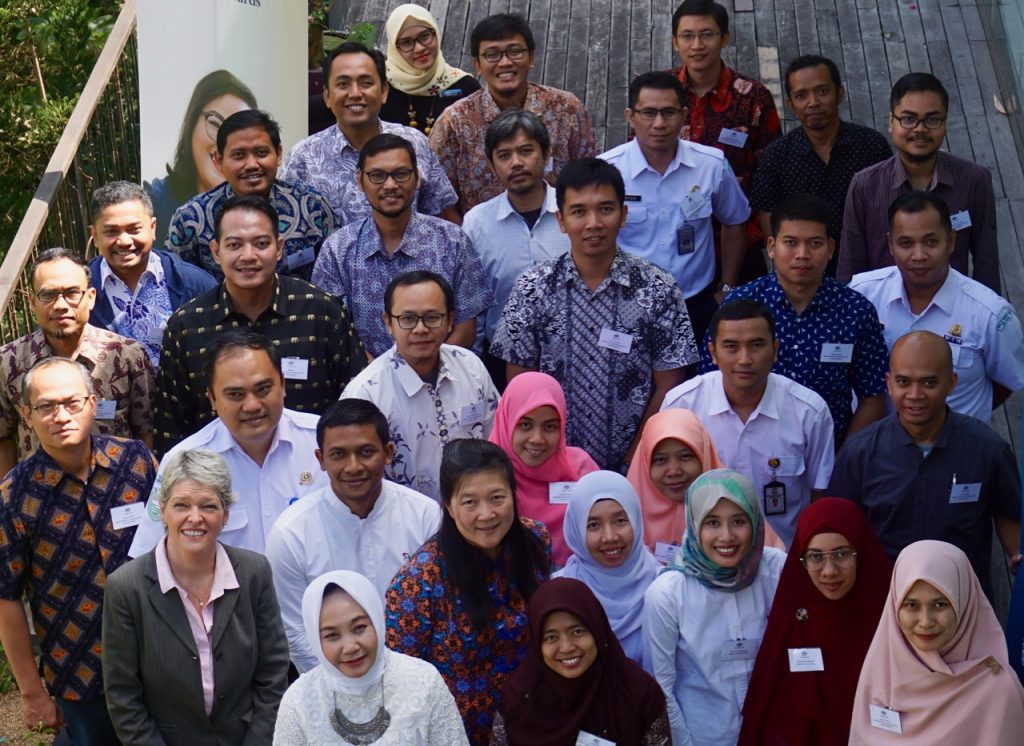
It is disappointing that while peer review is repeated by the Bureau of Meteorology as being a prerequisite for open discussion (and bearing in mind that our peer-reviewed articles have, in fact, been published in reputable climate science journals) and after Professor Rita Karnawati, the head of the Indonesian Bureau of Meteorology, nominated me to head a 25-strong delegation from Jakarta via Brisbane to Melbourne to discuss, among other things, the advantages of using statistical models driven by Artificial Intelligence (AI) as a replacement to General Circulation Modelling for better medium term climate forecasting, the Bureau refused me entry to their headquarters.
These are the circumstances: the 25 Indonesian meteorologists were welcome inside the headquarters, but not me as the Australian leading the group. Before I boarded the plane in Brisbane, the project’s co-ordinator was told that if I landed in Melbourne and proceeded to the Bureau, it would result in a diplomatic incident. So much for The Guardian’s claim that it was me who harassed the Bureau.
Me with the Indonesian delegation and Professor Karnawati (front centre in white hijab) in Bandung in early 2018.
The Bureau followed this up by ensuring that the contract we had with the Queensland University of Technology through my company ClimateLab Pty Ltd was terminated. That contract was set up by a Stanford University MBA graduate who told me at our first meeting a year earlier that he was not concerned about the politics of climate change because he was a skilled negotiator. He said he’d even been successful in Kosovo where he had been part of a team sent by then US president Barack Obama to negotiate a peace deal.
But you see the Bureau don’t want peace, at least not if it means they must hand over the most basic of comparative temperature data.
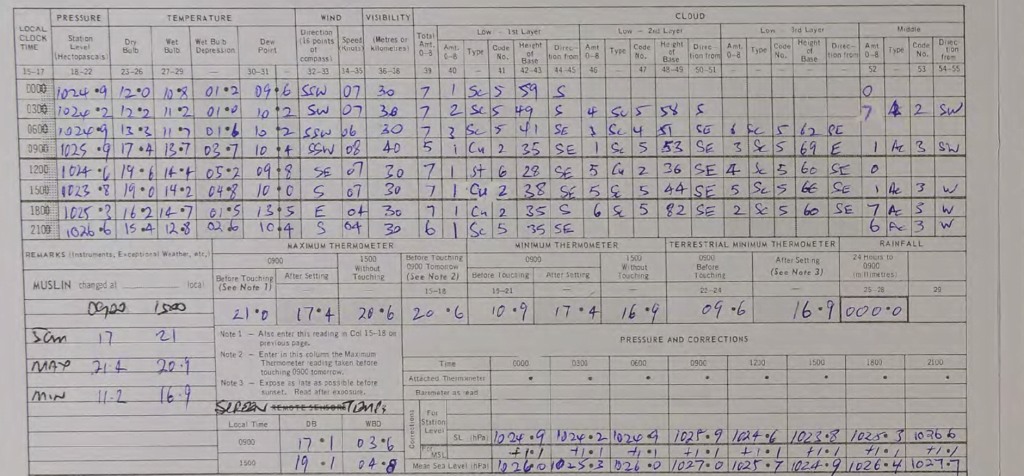
In 1996, the bureau began transitioning from measuring temperatures using mercury thermometers to using platinum resistance probes connected to data loggers. At a small number of weather station some comparative data was recorded into meteorological field books, as hand written entries. It has never been made public. As I see it, they don’t want to transcribe the manually recorded measurements, lest they betray a high level of incompetence, if not malfeasance.
Access to that data would enable a critical assessment of whether the temperature measurements from different types of equipment are comparable enough for the construction of reliable continuous temperature records extending back to at least 1910.
This is the essence of my current ‘campaign against the Bureau’, as Graham Readfearn writing in today’s The Guardian characterises it, the article is here.
John Abbot and I want the 10 to 20 years of data for each of the 38 weather stations where the Bureau has been recording temperatures from both mercury thermometers and resistance probes at the same place and time to be made public. We are happy to transcribe the manual recordings from the A8 reports, which the bureau has variously argued is too onerous a task for its own staff.
It is my contention that the Bureau is only transcribing a tiny fraction of this data, and analysing a still smaller component, because proper scrutiny of its entirety will show that the resistance probes connected to the data loggers are producing readings that are not fit-for-purpose. Certainly, there is no equivalence between the readings from probes and mercury considering the limited amount of data that I have wrangled from the Bureau to date.
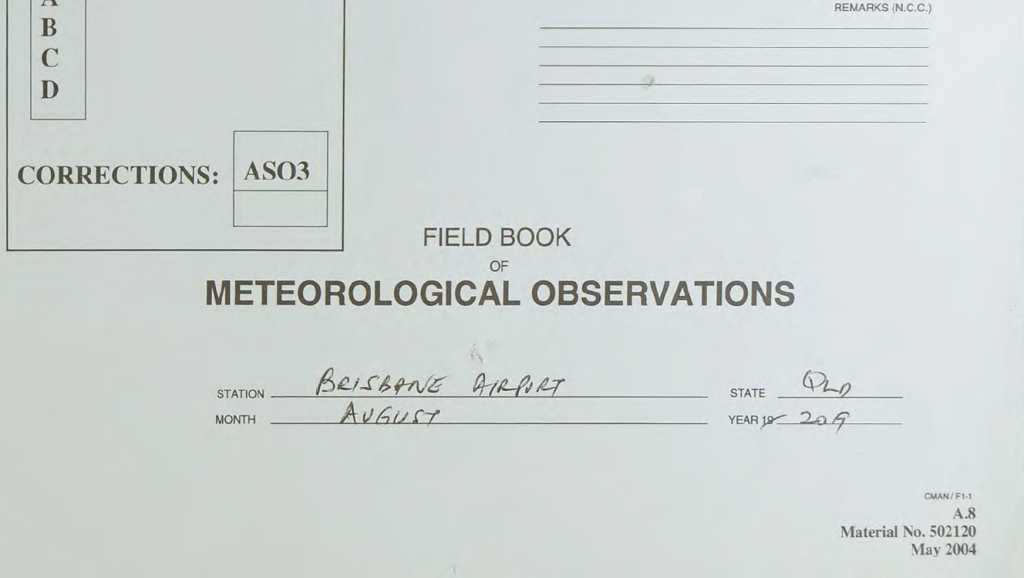
This is an extract from the Brisbane Airport Field Book. Temperatures as shown were recorded on 1st August 2019.
The Bureau claims, otherwise, specifically that the reading from the probe are within tolerance without defining what that means. All the time carefully avoid any mention of statistical significance – the usual measure of whether two means (the average temperature from the probe compared to the average temperature from mercury, for example) are equivalent, or not.
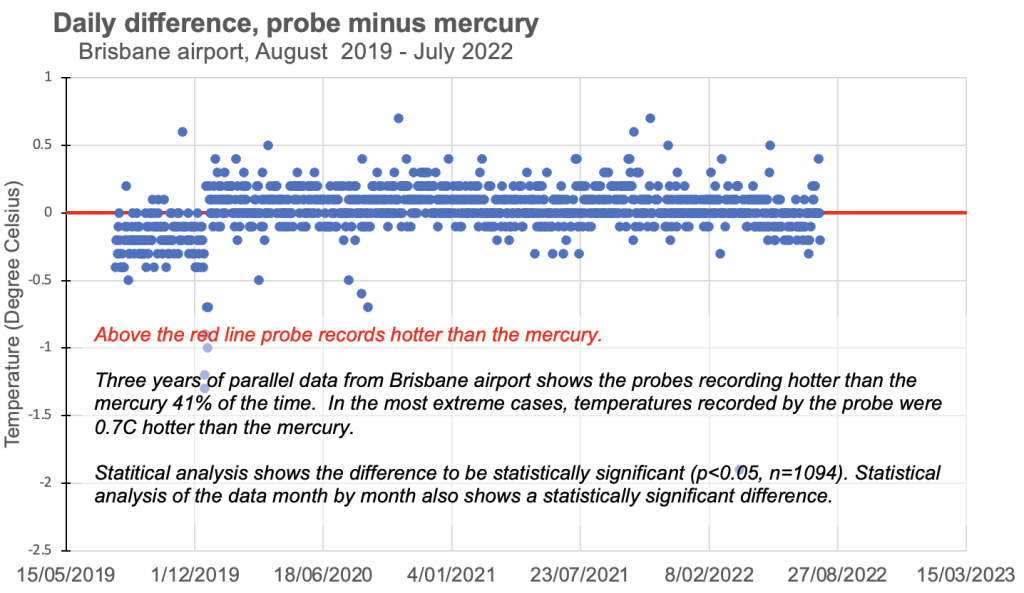
According to the article in today’s The Guardian, the Bureau claims that the mercury at Brisbane Airport was on average within 0.02 C of the automatic probe for a period of three years. And I get the same result across the three years. But this overall mean difference is small because there is an abrupt change/discontinuity in the direction of the difference after January 2020.
The readings before January 2020 show the mercury thermometer recording warmer, and the readings after January 2020 show that it is the probe that is recording warmer. This difference balances out mathematically; however, the discontinuity creates havoc if one is interested in climatology and the integrity of long continuous temperature measurements to feed into a statistical model underpinned by AI.
The overall difference (across the three years for Brisbane Airport) is statistically significantly different (n= 1094, p = 0.003, standard deviation = 0.18). The readings from the probe relative to the mercury are all over the shop: that is, they show significant scatter and it is not random.
The three years of parallel temperature data from Brisbane Airport shows that 41% of the time the probe is recording hotter than the mercury, and 26% of the time cooler. To reiterate, the difference is statistically significant (paired t Test, n = 1094, p < 0.05). The differences are not randomly distributed, and there is a distinct discontinuity after December 2019.
I initially thought that this step-change from an average monthly difference of −0.28 C in December 2019 to +0.11 in January 2020 (a difference of 0.39C) represented recalibration of the probe.
The bureau has denied this, explaining there was a fault in the automatic weather station that was immediately fixed and operating within specifications from January 2020 onwards. Yet even after January 2020, the probe was recording up to 0.7C warmer than the mercury thermometer at Brisbane Airport.
A 0.7C difference is enough to generate more record hot days for the same weather, supporting the narrative of the new King – that the planet risks overheating.
****
I will continue this saga in Part 3 soon. In it, I will explain how Anthony Rea, Readfearn’s spokesperson for the World Meteorological Organisation (WMO) passing judgement on the Bureau’s methods, was until recently an Australian Bureau of Meteorology employee.
Indeed, back in 2017, in order to manage a directive from the then Minister for the Environment Josh Frydenberg to provide me with the parallel measurements for Mildura, Rea was hastily moved into the newly created position of the Bureau’s Chief Data Officer.
John Abbot chatting with Gideon Rozner and me at the Administrative Appeals Tribunal in Brisbane on 3rd February. We were seeking the release of the parallel data for Brisbane Airport, following an FOI request made by John Abbot in December 2019.


 Iowa Climate Science Education