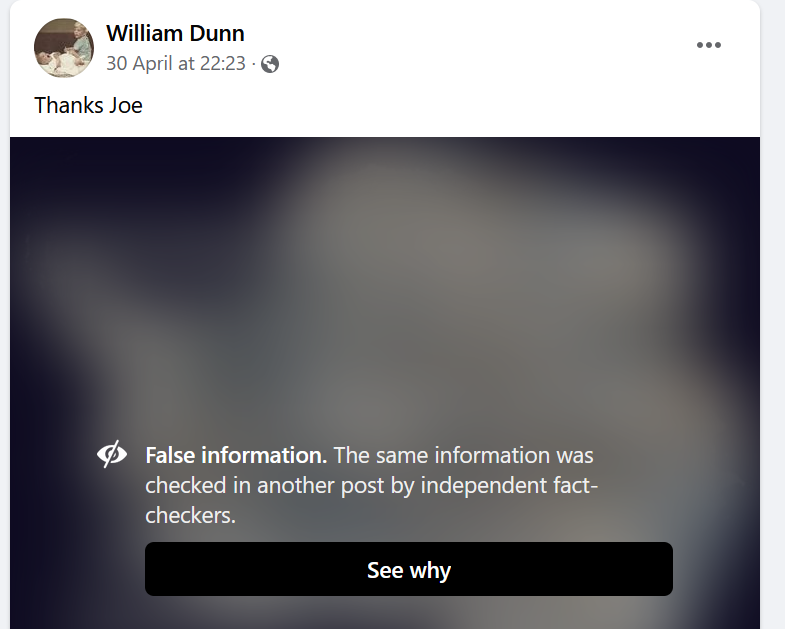
And this is the story the Facebook censors don’t want you to see:
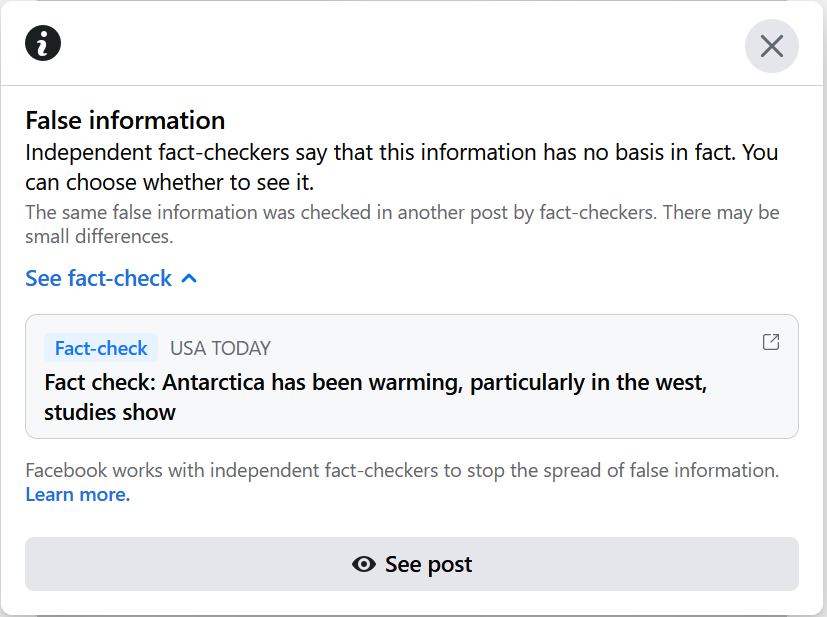
Quite why Facebook would want to rely on the USA Today for its source of science is a mystery. Perhaps they should have actually checked what real scientists are saying:
Abstract
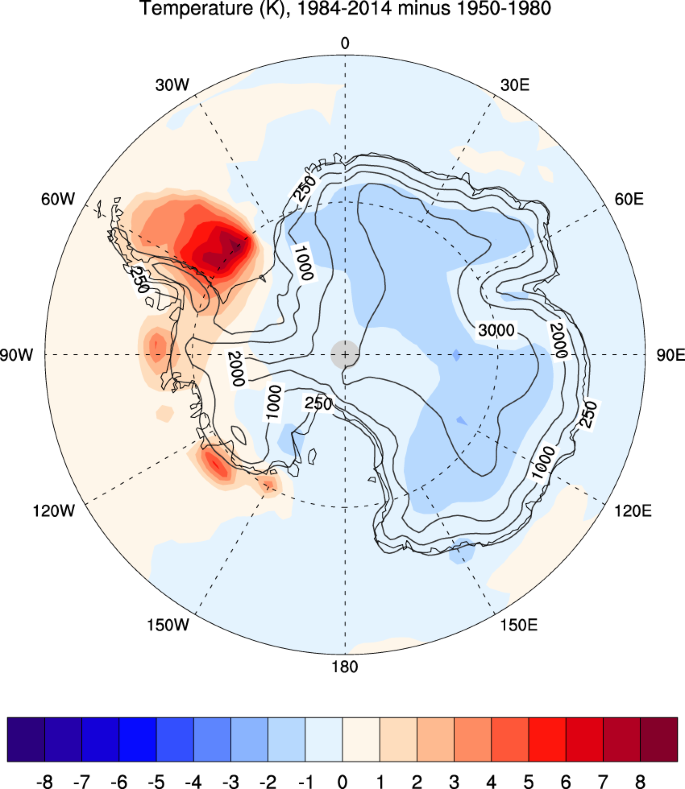
The Antarctic continent has not warmed in the last seven decades, despite a monotonic increase in the atmospheric concentration of greenhouse gases.
In this paper, we investigate whether the high orography of the Antarctic ice sheet (AIS) has helped delay warming over the continent. To that end, we contrast the Antarctic climate response to CO2-doubling with present-day orography to the response with a flattened AIS. To corroborate our findings, we perform this exercise with two different climate models. We find that, with a flattened AIS, CO2-doubling induces more latent heat transport toward the Antarctic continent, greater moisture convergence over the continent and, as a result, more surface-amplified condensational heating. Greater moisture convergence over the continent is made possible by flattening of moist isentropic surfaces, which decreases humidity gradients along the trajectories on which extratropical poleward moisture transport predominantly occurs, thereby enabling more moisture to reach the pole. Furthermore, the polar meridional cell disappears when the AIS is flattened, permitting greater CO2-forced warm temperature advection toward the Antarctic continent. Our results suggest that the high elevation of the present AIS plays a significant role in decreasing the susceptibility of the Antarctic continent to CO2-forced warming.
Today we are crowning King Charles and we know that he is passionate about the environment. With the current obsession with climate change it should be a strong positive for him with the public. But this is a very controversial area and the public can change its mind when climate policies start to affect their everyday loves in a negative way. For example organic farming may sound like a wonderful thing, working in harmony with nature, but when food becomes scarce and expensive because we stop using man made fertilisers and GM crops are banned the result in Sri Lańka was a disaster. People were very angry ànd the economy crashed, the government fell and the President had to flee the country.
I like the New King and I wish him well, but he needs to be very careful wah he promotes.
Destroying coal-fired power plants is all part of the grand wind and solar ‘transition’ and precisely the point of the subsidies to wind and solar which are designed to allow the unreliables to undercut cheap and reliable coal-fired power, thereby driving coal-fired plants out of business. The inevitable consequences include rocketing power prices and rolling blackouts.
The Australian state of New South Wales has just shut Liddell (above) – a perfectly operable coal-fired plant, that once delivered 2,000MW to the grid, around-the-clock, whatever the weather.
Wholesale power prices jumped from $96 to $228 – almost overnight; an 80% increase within a week of the plant’s closure.
The loss of that volume of power to a grid already teetering on the brink of collapse, can only help ensure that result.
Liddell’s planned (yes, ‘planned’) closure was meant to be no big deal.
You see, back in March 2017 then PM, Malcolm Turnbull came up with a cunning plan to use huge volumes of electricity to pump water uphill in order to recover a fraction of that stored energy as electricity by letting it run downhill through hydro turbines.
Turnbull’s pumped Hydro plan – known as Snowy 2.0 – was meant to compensate for the chaotic output from wind and solar, filling the gaps, so to speak.
In turn, once Snowy 2.0 was up and running all of those ‘dirty’, ‘ageing’ coal-fired could be shut down and dynamited. So far, so ideological.
The construction of Snowy 2.0 has turned into a spectacular and costly debacle; the likelihood of the project ever being completed his next to nil (which we will cover in detail in a subsequent post).
It’s the mother of all white elephants and being a monumental failure, no one wants to own it.
Snowy Hydro’s former CEO, Paul Broad unleashed this week – quite rightly calling Labor’s 80% renewable target “bullshit”; he lambasted the unnecessary closure of Liddell and ridiculed the plan to close the even bigger coal-fired power plant, Eraring as a guarantee of further price hikes and blackouts.
Broad’s timely broadside went for the jugular the claim that the so-called transition would take “80 years not eight”. STT begs to differ, however.
Australian households and businesses – already suffering prices amongst the world’s highest – will not tolerate endless power price rises, coupled with routine load shedding and blackouts whenever the sun sets and/or calm weather sets in. The political reckoning will come much sooner than politicos think.
Here are three pieces detailing how the so-called wind and solar transition has just turned into a perfectly predictable high farce.
Energy prices soar as Liddell Power Station closes
The Australian
Jess Malcolm and Perry Williams
4 May 2023
Coalition analysis has found NSW wholesale electricity prices surged by 80 per cent in the first five days since the shutdown of the Liddell power plant, as energy experts warn of record high prices and reliability problems in the grid.
The average NSW wholesale electricity price in the week prior to the Liddell shutdown sat at $96.40 but spiked to $172.89 in the following week, hitting a peak of $228.86 on May 1 according to figures from the Australian Energy Market Operator.
AEMO issued at least 11 notices of a predicted lack of reserve generation capacity in the days after Liddell’s closure, sparking warnings from opposition climate change spokesman Ted O’Brien that Labor was “sleepwalking towards an energy crisis”.
Energy expert Josh Stabler said Liddell’s exit, aligned with unusually high overnight pricing events and warned supply risks were starting to be exposed with reliability a concern for the upcoming winter. “Futures price for most regions remain very robust,” Mr Stabler said. “With the exemption of winter 2022 conditions, these would be considered record high prices.”
The new figures come after former Snowy Hydro chief executive Paul Broad branded Labor’s target to reach 80 per cent renewables by 2030 as “bulls..t” after the project was hit with a fresh two-year delay.
Mr Broad accused Climate Change and Energy Minister Chris Bowen of misleading Australians about the difficulties of the nation’s transition to renewables, and hit out at Labor’s pledge to cut power bills by $275 as a lie.
Snowy Hydro chief executive Dennis Barnes on Wednesday revealed that first power from the mega pumped-hydro project was now expected between June and December 2029 at the latest, prompting fears of supply shortfalls, price surges and blackouts. …
The Australian
Ex-Snowy chief blasts Bowen’s renewables target
The Australian
Jess Malcolm
4 May 2023
Former Snowy Hydro chief executive Paul Broad has attacked Chris Bowen and branded Labor’s target to reach 80 per cent renewables by 2030 as “bull…t” after Snowy 2.0 was hit with a fresh two year delay.
Snowy Hydro chief executive Dennis Barnes on Wednesday revealed that first power from the mega pumped-hydro project was now expected between June and December 2029 at the latest, prompting fresh fears of supply shortfalls, price surges and blackouts.
Mr Broad – who sensationally quit last year after falling out with Mr Bowen over the NSW Kurri Kurri gas plant – said the nation’s transition to renewables would take eighty years, and accused Mr Bowen of misleading Australians about the complexity of decarbonisation.
He warned Australia’s national energy market was now on a “knife’s edge” after the closure of Liddell and that the nation should expect blackouts on hot and cold days into the future, as he urged the state government to extend the life of Eraring past 2025.
“The truth is with this transition if it ever occurs it will take 80 years not eight …there’s massive changes that need to occur and I’m deeply concerned about the rush, the notion that somehow this is all magic, we’re going to wave a magic wand we’ll close a peak baseload power plant that’s kept the lights on through yours and my life and the minister can float all these alternatives out there,” Mr Broad told 2GB.
“We’ll it’s not I can be absolutely 100 per cent certain its not available and the transmission lines are miles late, 2.0 which is part of it is late, and I think there are in report which tell them you’ll need at least eight years to achieve their goal and that’s 80 years not eight.”
“Eraring can’t close…even now we’re closing Liddell we’re on a knife’s edge, you watch when it gets really hot or really cold, if the lights don’t go out I’d be awfully surprised.”
“The notion that we can have 80 per cent renewables by 2030 is bull..t.”
Mr Broad told 2GB that Labor’s pledge to cut power bills through the nation’s transition to renewables was misleading and false, and that the biggest challenges for Snowy 2.0 was still to come with the project’s transmission lines “miles” behind schedule.
“The notion you can have all this occurring without transmission and all the other investment which will cost the customer, the consumer the lot…suggesting you can do all that and prices will come down is wrong. It’s absolutely wrong, it’s misleading, it’s false and to keep suggesting that I think eventually the average punter wakes up,” Mr Bowen said.
Mr Broad said he was “dead in the water” once Mr Bowen was elected reiterating that they clashed over the future of Kurri Kurri gas plant and suggested Mr Bowen was ideologically opposed to gas.
Mr Broad also said Mr Bowen’s claims that he failed to tell AEMO about previous delays in the project were “bull…t”.
“Take a big deep breath, you’re a minister now, you’ve got responsibilities, you’ve got to put it all on the line, you’ve got to be honest with everyone,” Mr Broad said. The Australian
‘It’s bullsh*t’: Former Snowy 2.0 boss SPRAYS Chris Bowen
2GB
Ben Forsham and Paul Broad
4 May 2023
Following delays, the Snowy Hydro 2.0 project, which is promised to store enough energy to power three million homes, will not be fully operational until December 2029.
Paul Broad, who was the CEO of Snowy 2.0 for a decade, believes that Minister for Energy Chris Bowen needs to face some “hard truths”.
“The notion that we can have 80 per cent renewables by 2030 is bullshit,” Broad told Ben Fordham.
“Eraring CANNOT close…If the lights don’t go out I’ll be awfully surprised,” he said.




 Iowa Climate Science Education