The China-Russia axis is dangerous for fossil-fuel-disarming America and the West
Don Ritter
The relationship between China and Russia poses the greatest danger faced by America and the West since the Hitler-Stalin Pact in 1939 initiated WWII. If alarm bells are not ringing all across Washington, DC, they should be. China was already a global power based on its expanding economy, modernizing military and diplomatic reach, but the burgeoning relations with Moscow provide Beijing with renewed energy, literally and figuratively.
What does that mean for the rest of the world?
The China-Russia symbiosis is easy to understand. Russia provides the oil, gas and raw materials at discount prices, while China trades its high technology and endless amounts of manufactured products. It’s a win-win.
Russia is fueling China’s technology-based economy and its military. Not to mention Russian agricultural production, which helps feed China’s 1.5 billion people. The relationship fulfills the long-term basic needs of the respective partners. It’s no wonder China’s President Xi Jinping gloats that “this hasn’t happened in 100 years.”
For the foreseeable future, China’s vast purchases of Russian natural resources perpetuates the war in Ukraine, making China wholly complicit in the ongoing death and destruction. Because of the China lifeline, Russian President Vladimir Putin can conceivably keep fighting until Western electorates lose patience and quit.
Since the Russians went on the warpath, the resulting global sanctions have so far not seriously wounded its economy, while fossil fuel sales at high prices have buoyed it. That’s thanks mostly to China – but also India, and to Europe itself! Russia’s GDP fell by only 2% in 2022, well below predictions, thanks to fossil fuel sales keeping it afloat.
Conversely, America’s economy is struggling with high inflation and bank failures, and experiencing a pressing need to mobilize its defense industries to keep up with its critical role in the war in Ukraine – producing ammunition, in particular. Perhaps worse, Biden administration climate change policies and priorities mean there’s been no mobilization of America’s vast fossil fuels capacity to push back on the current Russian and Saudi energy dominance.
Outside of America (add Canada, Western Europe and Australia), the rest of the world, including Eastern Europe, see Western democracies denuding themselves of the very fossil fuels that still-developing countries need to grow their economies and feed their people. These nations are committed to using fossil fuels and may only be giving lip service to climate change because they want friendly and financial relations with the West.
At the same time, the West will not help developing nations harness their own fossil fuel capacities. This is true for institutions like the USAID, World Bank and Asian Development Bank, among others.
Developing nations like India and Brazil are on the sidelines over the war in Ukraine largely because they see the West fossil fuel-energy disarming in the presentwhile over-focusing on the risks of climate change forthe future. These countries need oil, gas, coal and fossil fuel-derived fertilizers and petrochemicals to survive and prosper. Unfortunately for the West but fortunately for developing nations, these resources are readily available from Russia and the Middle East, along with manufactured products from China. This further marginalizes the U.S. and Europe.
America’s leadership is no longer the guiding North Star in the Global South, as the investments, products and markets of China and the fossil fuels and related products of Russia and the Middle East begin to supersede the advantages of tying their futures to Europe and the United States.
Adding to the West’s self-induced dilemma, most of these countries have traditional populations and governance that are not ready for the revolutionary social policies sweeping over the West – while Putin lays claim to “protecting traditional values” and such social policies have no traction in China.
The West faces a serious predicament: How to weigh the value of guarding against what many view as the potentially seriouslong-term effects of climate change versus the current phasing out of fossil fuels despite the risk of geopolitical failure. Unfortunately, the West is not even actually considering its options; it is denouncing and repressing fossil fuel production, thus inadvertently strengthening the China-Russia axis. Iran is already in the China-Russia bag and Turkey is more and more leaning that way.
Recently, oil and gas giant Saudi Arabia has made stunning moves in the China-Russia direction, in some large part because fossil fuels are their lifeblood, now and into the future – and the Saudis see America downgrading that life blood while at the same time seeking to cut back its presence in the Middle East.
Adding to the dilemma, China totally dominates the world in green energy raw materials, technologies and production. In that regard, “going green” means greater U.S. energy dependence on China for the foreseeable future – gravely affecting its ability to control its own foreign, domestic and defense policies.
The fact is, fossil fuels are by far the most indispensable component of all the world’s economies and the dominant weapon of war as militaries are built and run on fossil fuels. In fact, 85% of the world’s energy consumption comes from fossil fuels and we see China, ostensibly our main adversary, going full steam ahead on an “all-of-the-above” approach – which focuses on oil, gas and coal, plus some renewable wind, solar and hydropower. They are also actively engaged in nuclear power: 43 plants have been built, 13 are under construction and 45 are planned, while the West’s nuclear power atrophies.
The U.S. Energy Information Administration recently reported that, while the Biden administration is pushing for net-zero “carbon” emissions by 2050, a policy with potentially enormous negative impacts on the economy and military preparedness, the U.S. will still derive some 65% of its energy from fossil fuels as compared with some 79% today. But what will the geopolitical cost be for even a 14% reduction?
A long-term China-Russia axis is dangerous for a fossil-fuel-disarming America and West. France and the European Union recently urged Xi to hold back on supporting Russia, but begging or delaying is not enough to make us safer. Add a still developing, natural-resources-dependent Global South going along (by energy necessity) with this fossil-fuel-strong new world power structure, and the situation becomes even more precarious. It may soon give rise to a civilizational shift or true existential threat.
The “alarm bells” only ring for those willing to listen. It’s high time the West re-evaluates its energy and climate change approach – before it is too late.
Former Rep. Don Ritter (R-Pa.), Ph.D., served 14 years on the House of Representatives Energy and Commerce and Science and Technology Committees. After leaving Congress he created and led the National Environmental Policy Institute. He was a National Academy of Sciences fellow in the USSR, speaks fluent Russian and was ranking member on the Congressional Helsinki Commission and founding co-chair of the Baltic States-Ukraine Caucus. He is a trustee of the Victims of Communism Memorial Foundation and Museum and co-chairs its Capital Campaign.
As Russia threatens UK energy supplies, Britain needs to restart fracking now
London, 4 May – Campaigning group Net Zero Watch has warned the Government that its ban on fracking is now a direct threat to national security and has called for Prime Minister Rishi Sunak to change course as a matter of urgency.
It has been reported this week that NATO officials are extremely concerned that Russia may have mined gas pipelines and windfarm cables in the North Sea.
According to Net Zero Watch analysis, offshore wind generates 10% of the UK’s electricity supply, a figure that is rising rapidly.
According to Net Zero Watch director, Andrew Montford:
Offshore wind generation is increasingly concentrated in a small number of huge windfarms. If someone takes out the undersea grid connections of just the ten largest, 6% of our electricity supply could be eliminated at a stroke, and nobody would know who had done it.”
In addition, 77% of the UK’s gas imports come by undersea pipeline from Norway, and are thus also at risk. With geopolitical tensions on the rise, it is clear that pipelines, undersea wires and interconnectors have become a critical vulnerability, and experts are calling for an urgent rethink.
Security expert Professor Gwythian Prins said:
In time of ‘grey war’ the only secure energy sources are ‘firm’ power sovereign assets. That means onshore gas – and coal – starting with fracked gas. National security requires fully exploiting those resources, while giving the Royal Navy and the RAF the wherewithal fully to defend firm energy assets – first and foremost oil and gas rigs and pipelines and the Norwegian gas pipeline in the North Sea.”
Who’s the most important educator of Australian schoolkids? The learned amongst us might nominate my fellow-(ex)journo Derek Scott, CEO of Melbourne’s Haileybury College and current chair of ACARA (Australian Curriculum Assessment and Reporting Authority). Nah, not him.
My nomination is Jason Kimberley, whose dad, Craig Kimberley, sold the Just Jeans empire for $64 million in 2001. Jason’s 2008 brainchild, Cool Australia, is all about teaching kids to love the environment [1] and get with the anti-emissions program. But Jason’s own entertainments seem to have a giant carbon footprint – his Cool biography skites about travelling “throughout the globe”, climbing Mt Aconcagua (23,000ft), man-hauling sledges in Antarctica, walking Denali and kayaking Prince William Sound in Alaska for a month, trekking up Mt Everest and dogsledding in the Yukon.
Whatever, here’s Cool Australia’s impact on your kids and grandkids.
♦ 3.3 million kids last year engaged with the materials. Cool claims that since it started in 2008, it’s helped educate 16 million kids (2022 annual report, p2)
♦ Cool claims 205,000 “members” – i.e. teachers, but with a sprinkling of 20,000 parents/home-schoolers.
♦ The teachers downloaded and taught Cool’s lessons 340,000 times last year. Two million lessons have been downloaded since inception.
♦ Cool claims that each lesson teachers download is shared with two other teachers and used in more than two classes.
♦ Teachers love Cool’s pre-fabricated lessons because nearly half the teachers are teaching outside their expertise and three-quarters complain of unmanageable workloads.
♦ Cool’s ambition is for 1 million members (teachers, basically) enrolled by 2025, and 100 million kids educated by 2030. No, I haven’t added too many zeros. (Annual Report, p12)
So it’s clear that state education departments and private-sector schools have farmed out a good deal of education to Jason’s little team. Cool’s lessons cover the whole spectrum of school topics, and Cool’s design team ensure that every lesson they create is mapped to the official curricula. In other words, teachers can download the written and video material, set up the lesson and tick the box for teaching-job-accomplished.
Cool has partnered with green-left film-maker Damon Gameau to promote his films 2040 (92mins) and Regenerating Australia (17mins) with their absurd plot-lines based in the year 2040 and 2030 respectively. In those years all green policies are implemented and all are an unalloyed success in saving the planet from CO2 hell. The movie closes with rapturous music and vision of youngsters of all colors and creeds dancing through a forest to celebrate low CO2 levels. One 20-something gal in a white frock grows from her shoulder-blades giant butterfly wings that actually flap. This might well be the cheesiest movie clip ever made or even imaginable.
A teacher who screens or takes kids to see a screening of 2040 loses at least half a day’s serious teaching. Far from the leftist education authorities being concerned about indoctrination, we can safely assume they would see that as a bonus. After all, “Sustainability” is one of those three cross-curricula priorities, thanks to Labor’s then-education minister Julia Gillard and the “Melbourne Declaration” of December 2008. The “progressive” politicians and teachers’ unions, of course, endorse and promote Cool. Conservative politicians have never – to my knowledge – pushed back against it. They become their own pall-bearers as new cohorts of kids are brainwashed through the 13-year school system to voting age.
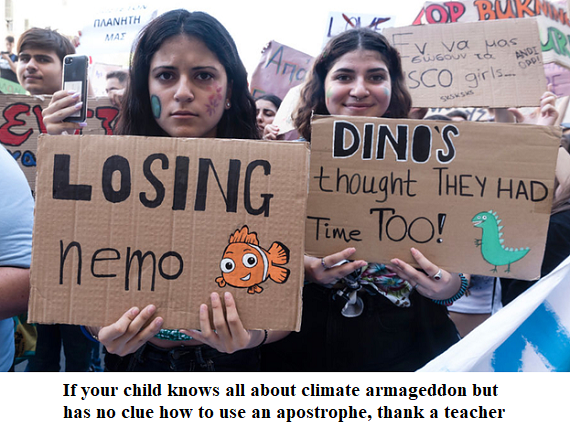
The half of all parents who lean conservative don’t enter the equation. Their kids come home spouting mantras about human-caused catastrophic global warming and how society can be transformed to net-zero emissions. Parents probably retain a vague idea that teachers are looking after their darlings’ best interest. They have no idea how the teachers have stepped back from the coalface (sorry, front-line) to let Cool’s zealots take over with their prefabricated lessons.
I’ve tracked Cool over the years, for example see here and here and here. I took a further look last week when preparing a short speech for the Carlton launch of Dr Mark Lopez’s new book, School Sucks(Connor Court). The talk gathers material on half a dozen leftist third-party institutions enjoying unfettered on-line rights to kids in the classrooms – access a transcript of the talk here. The fresh material from Cool rather threw me, with its naked green slant and palpable errors. Moreover Cool seems never to prune its old, stale material. Masses of it date from more than a decade ago – tired stuff then and trebly so when accessed by teachers today.
To take a random example, there’s a lesson for eight-year-olds about the Arctic and Antarctic. Apart from the supplied text, there’s a video of know-nothing teachers coaching the kids to regurgitate Cool’s messages. The cited data stops at 2008. The text says an increase of 0.5degC at the equator “would mean an increase of as much as 4-6 degrees at the poles [plural]”. Whatever might be happening in the Arctic, the Antarctic is making monkeys out of the global warming brigade’s theorising – it hasn’t warmed in 70 years despite a steady rise in atmospheric CO2, and that’s not even a controversial statement. Kids aren’t told about that, of course. Instead, Cool implies that “changing these patterns will affect our economy, people, crops, water supplies and pretty much everything we do.” Jason Kimberley himself stars in the video, claiming that “our continued burning of coil oil and gas is now having a direct effect on these frozen worlds.”
The film cuts to a teacher showing loss of Arctic sea ice for the decade to 2008 – which happened to be a low point followed by stability for the past decade. Eight-year-olds absorb the message, with a boy repeating back to the teacher that fossil fuel emissions and belching cows are hurting the poles, and a girl grieving that “if we lose the sea ice the animals will lose their homes and what they live on.”
Cool’s aim is not just to indoctrinate but to turn kids into horrid little activists. The video shows these eight-year-olds writing complaints to state and federal energy and resources ministers about emissions, and preparing two-minute-hates against fossil fuels for student radio. The kids say they want adults to cut down of fuels and driving cars around — an idea not entirely without merit, as last week I was cursing the parental traffic jams at the local school gates.
To complete the Soviet-style brainwashing, girls clap along to a song they created for the class:
[inaudible] melting ice, I wonder how they sleep at night. Global warming is so sad, Ice is melting really bad. People want to mine the ice: Oil and gas has a price.
To the strains of triumphant music, Jason Kimberley re-appears to harangue kids,
“We are mucking around with our planet’s thermostat by changing the balance of nature [cut to picture of power station belching steam]…Will we continue to destroy or can we learn to change? The choice is ours!”
Cool’s “Fact Sheets” present loaded and dubious material. One example is,
Fact Sheet:Angry Summer: Extreme Rainfall. All-time daily rainfall records for January. This presents the information that, in 2013 (note the staleness), a dozen east-coast hamlets such as Mundubbera (pop 1200), Monto (1100), Moogerah (250), and Old Koreelah (pop 800) had experienced record rain (weather “records” always pop up somewhere about something.) Cool’s intent is to demonstrate global warming’s ill effects. But the BoM report from which Cool takes the records, merely says the record rains stemmed from “the former tropical cyclone Oswald tracking southwards along a track just inland from the Queensland coast.” In a map in the same May 2013 document, the BoM clearly shows equivalent areas further inland at the same time suffering record or near-record low rainfall. (p7). This one-way “Fact Sheet” is an amateurish attempt by Cool to give schoolkids climate evidence based on one tropical cyclone’s unusual path.
Another stale “Fact Sheet” boosts China for its renewable energy expansion. It lauds China’s 7GW of installed solar and 63GW of installed windpower capacity as at 2012, without mentioning renewables (including hydro) represented only 8.5 per cent of China’s primary energy sources that year. A decade later (2021) fossil fuels were still providing 85 per cent of China’s energy. Cool is certainly not going to tell our schoolkids that the coal power capacity China began building in 2022 was six times as much as the rest of the world combined.
What really dropped my jaw, though, was Cool’s “Fact Sheet” on renewables. Its claims include
♦ Coal power plants are not very energy efficient and on average only 30-40% of the chemical energy in coal is converted to useful energy. The rest is lost as heat in the conversion process.
This is bizarre. Engineering has taken the thermal efficiency of modern coal plants close to the theoretical maximum. It’s an argument for coal power, not against it.
♦The alternative is renewable energy sources. These produce energy using natural resources that are constantly replaced and never run out.
♦ The amount of energy received from the sun in one hour could power the entire world for a year.
So what? That doesn’t make solar-panel energy cheap, clean or reliable 24/7.
♦ The best part about solar energy is that it creates almost no pollution — some pollution may be generated in building and transporting the solar panels.
Note that Cool makes no mention of horrific and polluting third-world mineral extraction for panels, the Chinese manufacturing near-monopoly, or future problems disposing of millions of toxic panels.
♦Every 24 hours, wind generates enough energy to produce roughly 35x more electricity than humanity uses each day. However, only 8 per cent of Australia’s electricity generation in 2019-20 came from wind power.
For the good reasons that wind power is intermittent, requires vast tracts of land for its low-density energy, and is only viable after massive taxpayer and consumer subsidies. Further, the material pretends that wind’s intermittency is no problem
♦ Wind is not constant and doesn’t blow in the same place all the time (although there will always be wind somewhere and it will never run out, making it a truly renewable source of energy). If the wind turbines are spread far enough they can be always capturing the wind energy and putting it into the grid.
Real fact: wind droughts are normal across the Eastern States grid and can last several days – way beyond any offset from any conceivable battery storage. It is hard to know if the Cool writers are knowingly misleading kids or merely believe their own nonsense.[4]
♦The trouble with wind energy has nothing to do with energy creation itself, but everything to do with the look of wind turbines.
What childish nonsense!
♦ Some people have a problem with them, and this has prevented a number of wind farms being constructed in Australia and other parts of the world.
Weirdly, Cool disparages emission-free hydro power because the power availability varies with rain levels. But Cool has no problem with solar power varying to zero at night, or wind power varying every ten minutes.
♦ Also, constructing the dams and diverting the rivers … can lead to environmental damage, both through the construction of the dam and also through reduced water flows to the natural environment.
So let’s litter the environment with wind turbines instead!
Nuclear: Cool tells kids to rule it out, despite zero-emissions, because it’s costly to build [so what, that’s for the market to decide], creates a nuclear waste problem [which the French and Western world have dealt with for more than half a century], and is a nuclear weapon risk [ditto]. It also lamely cites accidents at Three Mile Island in 1979, (with no fatalities and only ambiguous evidence of any radioactivity harms) and the outdated, Soviet-era, graphite moderated Chernobyl (1986).
Further fact-checking Cool material that teachers stuff down the throats of kids from age of five is just too depressing. In a democracy those with power are supposed to be accountable. But to whom are these leftist institutions intruding into our classrooms accountable?
_________________________
[1] “Jason identified the need to provide our current and future generations with relevant and engaging information about the three pillars of sustainability: social, economic and environmental. Our education system was identified as the most important and effective medium for connecting real-world education with kids.”
[2] “Step 2. Now explain to students that they will be watching a clip featuring Bruce Pascoe. Bruce Pascoe is a Yuin, Bunurong and Tasmanian man … In 2014 he published a book called Dark Emu which documents and argues “for a reconsideration of the hunter-gatherer label for pre-colonial Aboriginal Australians. The evidence insists that Aboriginal people right across the continent were using domesticated plants, sowing, harvesting, irrigating and storing – behaviours inconsistent with the hunter-gatherer tag” (source: Dark Emu, 2018).
[4]Rafe Champion, Spectator, Nov 9, 2022: “The [AEMO] records can be interrogated to the depth and duration of all the wind droughts from 2010 to the latest serious episode which lasted over 40 hours through the 7th, 8th, and 9th of August.”
The “climate hell” mentioned in the run-up to the latest COPout conference by the excitable Mr Guterres, Sekjen of the United Nations, is not a happening thing. As the New Pause in global warming lengthens inexorably, month by month, real-world global warming departs more and more visibly from what was and is predicted.
Yet the Thermageddonites, flogging the dead horse like a bull in a china shop even though the emperor has no clothes, are ignoring the elephants in the room.
Their latest wheeze is to point out that the real-world global-warming trend in the third of a century since IPCC’s First Assessment Report in 1990is greater than the trend from that year to June 2014, the month when the New Pause began. From 1990 to June 2014 the trend was 0.09 C/decade. However, despite the New Pause, the trend from 1990 to April 2023 was 50% greater, at 0.136 C/decade.
If the New Pause continues, of course, eventually the overall trend will match the trend to the beginning of the New Pause. If it continues long enough, it will fall below that prior trend, just as with the previous Long Pause.
Either way, these long Pauses are visible indicators of the elephant in the room: namely, the fact that the entire interval of predictions of global warming made by IPCC (1990), and still adhered to by IPCC (2021), has proven to be flagrantly in excess of observed reality:
Nor is gross over-prediction the only elephant in the room. Let us quickly summarize some other members of the growing herd. For instance, the approximately logarithmic forcing response to increased CO2 concentration means that each additional molecule of CO2 we add to the atmosphere causes less forcing, and hence less warming, than any of its predecessors:
Most official methods of predicting global warming rely on feedback analysis. Feedback strength implicit in the 3 [2, 5] C ECS predicted by IPCC (2021) is 0.24 [0.23, 0.26] Watts per square meter per degree of the reference temperature. The breadth of the interval is just 0.03 W m–2 K–1. Thus, adding only 0.01 W m–2 K–1 to feedback strength would increase ECS by 1 K. But feedback strength is not knowable to so tiny a precision as a hundredth of a Watt per square meter. Thus, all IPCC’s predictions are no better than mere guesswork, and provide no basis for the costly policies being pursued by imprudent Western governments.
The absence of the predicted tropical mid-troposphere “hot spot” confirms that the water-vapor feedback (the only one potentially big enough to matter: the rest self-cancel) is small:
Nor is misrepresentation of feedback the models’ only error. When Dr Pat Frank of the Stanford Linear Accelerator Laboratory first presented his finding that the general-circulation models had not accounted for propagation of error across the time-steps from here to 2100 and beyond, his audience – the World Federation of Scientists – were flabbergasted. His result, published in 2019, stands unrefuted in the learned journals to this day. His result renders all of the models’ predictions valueless. They are no better than mere guesswork:
Fortunately, there are observationally-based methods of temperature prediction that do not depend on diagnosing feedback strength from the outputs of general-circulation models, or on any other form of feedback analysis, and do not depend on the models’ failure to account for propagation of uncertainty. The energy-budget method, for instance, does not depend on knowing feedback strength. Monte Carlo distribution based on the mainstream, published uncertainties in the five listed initial conditions gives ECS as a harmless 0.13 [0.09, 0.20] K:
One may also use Monte Carlo distribution to derive the 0.1 C global warming that might be prevented in the unlikely event that the whole world attained net zero emissions by 2050:
The above graph generously assumes that global net zero emissions are possible. In reality, China, Russia, India and Pakistan are greatly increasing their coal-fired capacity so as to keep their electricity prices an order of magnitude below those of Western nations. On that assumption, each $1 billion spent on abatement would prevent less than 1/10,000,000 C:
The favored method of reaching net zero – installing wind and solar power – cannot further reduce CO2 emissions without costly static-battery or hydrogen-production backup once hourly mean demand on a national grid exceeds the installed nameplate capacity of wind and solar power – their output in ideal weather. Many Western countries are now above that limit. So the above estimates of warming prevented, of cost and of value for money are optimistic:
Finally, the lurid predictions of death by famine made by the profiteers of doom were false. Indeed, in the global warming era from the 1970s onward, deaths by famine have fallen to record lows:
Experience has shown that simple and irrefutable points such as those which are summarized in this set of diagrams exert a powerful influence on those whose minds are still open to the objective truth.
One of my projects for this summer will be to make the elephants in the room visible to all by drawing them together in a book of images such as these, with a necessary minimum of text. The graphs can then be updated for each annual edition. Not everyone will understand every point, but most people of goodwill can understand most of them. On any view, the organized hysteria reflected in Mr Guterres’ utterances is wholly misplaced.

 Iowa Climate Science Education
