Gordon Lightfoot – how can we say enough good things about the living breathing force of humanity that was Gordon Lightfoot? Born in 1938 and performing to the end: His concert schedule announced on 11 April, 2023:
“Gordon Lightfoot announces the cancellation of his U.S. and Canadian concert schedule for 2023. The singer is currently experiencing some health related issues and is unable to confirm rescheduled dates at this time.”
He passed over on the 1st of May, dying of natural causes in Toronto at age 84. The NY Times carried his obituary on 2 May 2023.
If you were alive in the 1960s and 1970s, you heard his songs performed by Lightfoot himself and also by the popular “folk singers” of the day. And not just “folkies” but almost everybody recorded at least one Lightfoot song. A very partial list includes: Barbra Streisand, Johnny Cash, Bob Dylan, Marty Robbins, Peter, Paul and Mary, Harry Belafonte, Anne Murray, Sarah McLachlan, Eddie Albert, Herb Alpert, Erik Clapton, Petula Clark, Chad and Jeremy, Judy Collins, Jim Croce, Percy Faith, The Grateful Dead, Richie Havens, Ian and Sylvia, Waylon Jennings, Dianne Krall, Trini Lopez, Jerry Lee Lewis, Tommy Makem and the Clancy Brothers, Johnny Mathis, Billy Joel, Don Mclean, Liza Minnelli, Peter Paul and Mary, Lou Rawls, Frank Sinatra Jr., Conway Twitty, Hank Williams Jr., Neil Young and many more.
Gordon Lightfoot songs are a part of the musical iconography of the 1960s through 1980s folk era and have lasted and passed the test of time having become true classics of several genres. YouTube offers a free listen to Gordon Lightfoot’s “greatest hits” album from Rhino Records.
Ed Note: “Electric natural gas compressors contributed to the near collapse of the Texas power grid in 2021,” Ed Ireland argues below. “All U.S. power grids face the same risk.” His first-hand knowledge of this instance of ‘deep decarbonization’ politics gets to the why-behind-the-why of the still-debated Texas blackout, the worst electricity debacle in the history of the industry.
“The anti-fossil fuel movement started pressuring North Texas cities and towns to require electric compressors on natural gas pipelines based on arguments that the air pollution from natural gas-powered compressors was causing increased asthma and other health problems…. I said that electrifying natural gas pipeline compressors was a terrible idea that could affect the availability of natural gas when it was needed most, such as during bad weather events. Unfortunately, I lost that debate….”
The study, which the authors say is the first rigorous effort to identify the number of U.S. electric compressor stations, examined data from 2008 to 2020 and found that:
During times of high gas demand, electric outages that disable compressors at these stations can significantly reduce gas available to downstream generating stations. In some cases, the resulting outages could be as large as or larger than the most severe single-cause failure currently considered in electric reliability planning (emphasis added).
Of these outages, they determined that several areas of the country were especially vulnerable to electric outages:
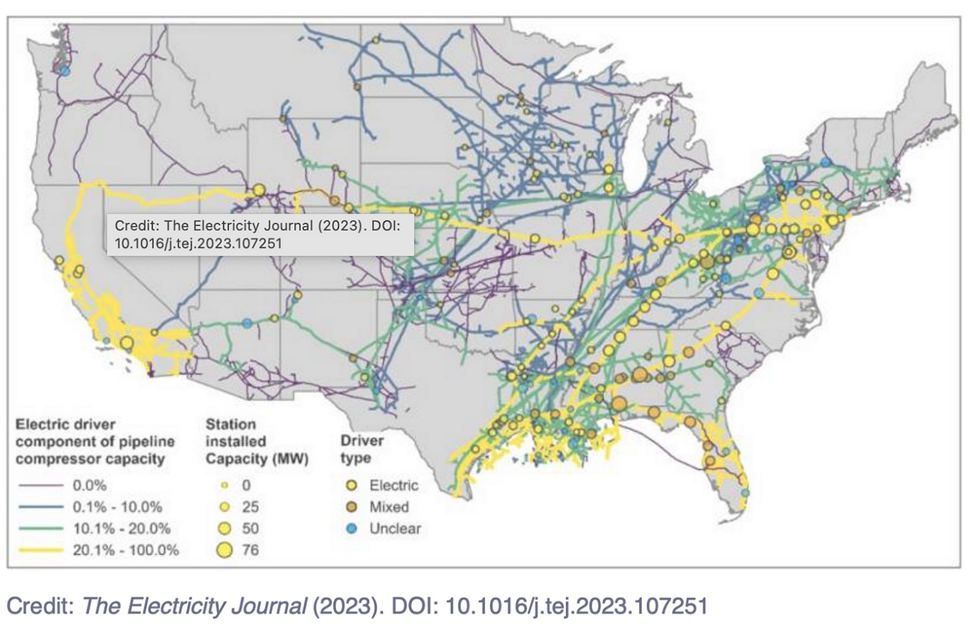
California, the Midwest, the Gulf Coast, and the East have high levels of installed electric compressor capacity. New hydraulic models, verified by past events, show that disrupting power to a single pipeline compressor station can force a loss greater than 2 gigawatts of downstream gas generators (emphasis added).
It is not generally known that natural gas pipelines have, little by little and under the radar, become increasingly dependent on electricity. Recall the parable of a frog in a pot of water that is gradually heated to boiling, but the frog overlooks the danger until it is too late. This describes the electrification of natural gas pipelines that occurred so slowly that it was virtually unnoticed.
The electrification of gas pipelines occurred as the compressors, which are required to keep the gas moving through pipelines, were changed from natural gas to electricity. Compressors are necessary to keep the natural gas moving through the pipeline network. The average distance between compressor stations in interstate pipelines in the U.S. varies, but compressors are usually required every 50 to 100 miles. If any of these compressors fail, the entire pipeline shuts down completely.
Based on their findings, the authors suggest that electric utilities immediately incorporate the identified facilities into critical facilities lists. The authors’ findings support the recommendations of a recent study by the National Academies of Sciences, Engineering, and Medicine:
In contrast to well-established reliability reporting and standards for the electrical system, the gas system has almost no reliability transparency or oversight.” Establishing a federal gas reliability organization, comparable to what is now done for electric power, could improve gas reliability by establishing appropriate reliability reporting, incident investigation, and minimum industry standards.
Background
From the beginning of natural gas pipelines, compressors were powered by natural gas. That made sense because the pipelines were full of natural gas, so pipelines powered themselves. But gradually, compressors were electrified so slowly that, to follow the parable, they, like the frog, didn’t notice what was about to happen.
I observed the early phase of the movement to replace natural gas-fired compressors with electric gas compressors starting around 2010 when I was Executive Director of the Barnett Shale Energy Education Council, headquartered in Fort Worth, Texas. As the Barnett Shale developed in the early 2000s, thousands of natural gas wells were drilled, many in urban areas, and pipelines and compressor stations were constructed to carry the natural gas to markets.
The anti-fossil fuel movement started pressuring North Texas cities and towns to require electric compressors on natural gas pipelines based on arguments that the air pollution from natural gas-powered compressors was causing increased asthma and other health problems. In 2012, the Denton City Council invited me to participate in their project to rewrite city ordinances that regulate natural gas drilling and pipelines.
I distinctly recall a public meeting in which I said that electrifying natural gas pipeline compressors was a terrible idea that could affect the availability of natural gas when it was needed most, such as during bad weather events. Unfortunately, I lost that debate, and the City of Denton changed its city ordinances to require electric natural gas compressors within its city limits. Similar ordinances quickly spread to other municipalities within the state of Texas and eventually to other natural gas-producing states that pipelines pass through.
As shown in the map above, the use of electric compressors on gas pipelines has now become so pervasive that the entire interstate natural gas pipeline network is effectively compromised. An interruption in the generation of electricity can cause some natural gas pipelines to shut down, which interrupts other parts of the natural gas pipeline grid and potentially shuts down multiple pipelines.
Here’s what happened. The entire state of Texas was hit by Winter Storm Uri, which resulted in all 254 counties in the state experiencing below-freezing temperatures, with much of the state temperatures in the teens and below zero in some areas for almost an entire week. Freezing temperatures affected all forms of electrical generation, starting with frozen wind turbines, freeze-offs at natural gas wells, and even problems with coal-fired generators and nuclear power generation plants.
As the temperatures dropped and people turned up their heat, the demand for electricity exceeded the supply, and rolling blackouts were ordered to maintain the integrity of the electrical grid. The grid operator, ERCOT, ordered rolling blackouts to balance supply and demand. Unfortunately, some local electricity companies did not have good information on the location of natural gas wells and compressor stations, so some blackouts shut down natural gas wells and pipeline compressors. In turn, this reduced the natural gas supply to gas-fired power generators. This caused a death spiral in electricity generation to the point where the Texas grid was within 4 minutes and 37 seconds of completely collapsing.
After Winter Storm Uri, ERCOT and the Texas Railroad Commission (RRC) recognized that they did not have good data on the location of critical natural gas pipeline infrastructure, including natural gas wells with on-site compressors and the location of all natural gas pipeline compressors that operate on electricity, in addition to the critical customers that depend on electricity to maintain their supply of natural gas.
The RRC highlighted the importance of this information by establishing a new department, the Critical Infrastructure Division, which maintains up-to-date data on all infrastructure required to maintain natural gas supplies to power generators. The RRC published new rules that require gas pipeline operators to provide that information and keep it updated on an ongoing basis.
While Winter Storm Uri caused the Texas power grid problems in 2021, such problems can be caused by the destabilizing impact of wind and solar on power grids, for example. If a sudden decline of wind and solar results in disruptions of electricity, natural gas pipelines can be shut down, which causes a domino effect of more power outages. With more power grids sounding alarms about the instabilities caused by wind and solar, power grids are increasingly facing blackouts and the resulting shut-downs of natural gas pipelines that, in turn, can cause a loss of electric generating capacity.
Where do we go from here?
U.S. power grids have been warning that they are destabilized by wind and solar power generation. Add to that the potential problems they may face as a result of the electrification of natural gas compressors, and the tenuous situation becomes clear.
More power grid operators need to consider their own versions of the rules that ERCOT and the Texas Railroad Commission are implementing.
—————
Ed Ireland, adjunct professor at TCU’s Neeley School of Business, received his B.S. from Midwestern State University and Ph.D. from Texas Tech University. This analysis was originally posted at Thoughts About Energy and Economics (free subscription).
“… Climate change deniers simplify the spectrum of possible scientific consensus into two categories: 100% agreement or no consensus at all. If it’s not one, it’s the other. …”
The thinking error that makes people susceptible to climate change denial
Published: May 2, 2023 10.13pm AEST Jeremy P. Shapiro Adjunct Assistant Professor of Psychological Sciences, Case Western Reserve University
Cold spells often bring climate change deniers out in force on social media, with hashtags like #ClimateHoax and #ClimateScam. Former President Donald Trump often chimes in, repeatedly claiming that each cold snap disproves the existence of global warming.
From a scientific standpoint, these claims of disproof are absurd. Fluctuations in the weather don’t refute clear long-term trends in the climate.
Yet many people believe these claims, and the political result has been reduced willingness to take action to mitigate climate change.
Why are so many people susceptible to this type of disinformation? My field, psychology, can help explain – and help people avoid being misled.
The allure of black-and-white thinking
Close examination of the arguments made by climate change deniers reveals the same mistake made over and over again. That mistake is the cognitive error known as black-and-white thinking, also called dichotomous and all-or-none thinking. As I explain in my book “Finding Goldilocks,” black-and-white thinking is a source of dysfunction in mental health, relationships – and politics.
…
Climate change deniers simplify the spectrum of possible scientific consensus into two categories: 100% agreement or no consensus at all. If it’s not one, it’s the other.
Do any of you seriously believe a single cold snap disproves global warming?
I personally support the premise that the world has warmed since the mid 1800s, and anthropogenic CO2 likely contributed. A single cold snap is not proof that global warming has stopped, that would be an absurd proposition.
But climate alarmists seem all too ready to promote the black and white thinking fallacy Professor Shapiro accuses deniers of embracing, they seem very ready to spin every heatwave as proof of the global warming end times.
For example;
3Q: Why Europe is so vulnerable to heat waves
Climate modeling shows that this summer’s devastating European heat wave may indeed be a harbinger of the future for that region.
David L. Chandler | MIT News Office Publication Date: October 11, 2022
This year saw high-temperature records shattered across much of Europe, as crops withered in the fields due to widespread drought. Is this a harbinger of things to come as the Earth’s climate steadily warms up?
Elfatih Eltahir, MIT professor of civil and environmental engineering and H. M. King Bhumibol Professor of Hydrology and Climate, and former doctoral student Alexandre Tuel PhD ’20 recently published a piece in the Bulletin of the Atomic Scientists describing how their research helps explain this anomalous European weather. The findings are based in part on analyses described in their book “Future Climate of the Mediterranean and Europe,” published earlier this year. MIT News asked the two authors to describe the dynamics behind these extreme weather events.
Q: Was the European heat wave this summer anticipated based on existing climate models?
Eltahir: Climate models project increasingly dry summers over Europe. This is especially true for the second half of the 21st century, and for southern Europe. Extreme dryness is often associated with hot conditions and heat waves, since any reduction in evaporation heats the soil and the air above it. In general, models agree in making such projections about European summers. However, understanding the physical mechanisms responsible for these projections is an active area of research.
What about Professor Shapiro’s claim that President Trump thinks cold snaps disprove global warming?
Do any of you seriously believe President Trump thinks cold snaps disprove global warming? Or is it more likely he is poking fun at alarmists?
Did this humorous tweet get included in Professor Shapiro’s analysis? Was it part of his proof that climate deniers, and he specifically cited President Trump, are black and white thinkers?
If so, how could Professor Shapiro make such an obvious mistake?
My personal theory is most greens don’t possess a sense of humour, so they have difficulty recognising humour when they see it. I accept that Professor Shapiro genuinely believes Trump is being serious when he pokes fun at climate alarmist tropes.
Of course, I’m not an adjunct assistant professor of psychological sciences, whatever that is. Feel free to share your own theory, about what might have gone wrong with Professor Shapiro’s analysis.

 Iowa Climate Science Education