Month: May 2023

SCOTUS KILLS WOTUS: Enormous Setback for Obama Era EPA Power Grab

Enormous setback for the fanatics at the EPA who would regulate ever puddle or ditch they could find.

A couple of hours ago the following headline went out.

Supreme Court rules against EPA in environmental case, limiting agency’s power over water

Now that the REEES are being heard the headline of the story has been changed to:

‘Significant repercussions.’ Supreme Court limits government power to curb water pollution

From USA Today via MSN

WASHINGTON – The Supreme Court on Thursday sided with a couple who have been battling the Environmental Protection Agency for more than a decade over a plan to develop a property in the Idaho panhandle, a decision with potentially sweeping national ramifications for water quality, agriculture and development.

The case, which was centered on the scope of the 1972 Clean Water Act, was arguably the most important environmental decision the Supreme Court has handed down since a majority last year invalidated an EPA effort to regulate power plant emissions. The plaintiffs asked the court to provide a clearer definition for what the law meant when it gave the agency power to regulate the “waters of the United States.”

In an opinion written by Justice Samuel Alito and joined by four other conservative justices, the court limited the scope of the EPA’s ability to control wetland pollution

https://www.msn.com/en-us/news/other/supreme-court-rules-against-epa-in-environmental-case-limiting-agency-s-power-over-water/ar-AA1bGgxA

What is the WOTUS Rule? Here are some links and excerpts.

https://www.epa.gov/wotus

You can see the back and forth from Obama administration to the Trump admin rescinding and then back full speed ahead under Biden.

The agencies amended their regulations defining “waters of the United States” in 2015 in the Clean Water Rule: Definition of “Waters of the United States.” 

The 2015 Clean Water Rule was repealed by the 2019 Rule, which reinstated the 1980s regulations, implemented consistent with the U.S. Supreme Court cases and applicable guidance.

The agencies replaced the 2019 Rule with the Navigable Waters Protection Rule (NWPR) in 2020. In light of the U.S. District Court for the District of Arizona’s August 30, 2021 order vacating and remanding the Navigable Waters Protection Rule in the case of Pascua Yaqui Tribe v. U.S. Environmental Protection Agency, the agencies halted implementation of the NWPR nationwide and interpreted “waters of the United States” consistent with the pre-2015 regulatory regime.

For additional information, see the History of the Effects of Litigation Over Recent Definitions of “Waters of the United States” (pdf) (66.74 KB)

The final “Revised Definition of ‘Waters of the United States’” rule was published in the Federal Register on January 18, 2023, and the rule took effect on March 20, 2023.  The final rule was codified in the Code of Federal Regulations (CFR) in place of the vacated NWPR. However, the final rule is not currently operative in certain states due to litigation. Please visit the Rule Status page for additional information about the status of the rule and litigation. More information about the final rule is available here

https://www.epa.gov/wotus/about-waters-united-states

Final Revised Definition of “Waters of the United States”

On December 30, 2022, the agencies announced the final “Revised Definition of ‘Waters of the United States’” rule. On January 18, 2023, the rule was published in the Federal Register and the rule took effect on March 20, 2023. However, the final rule is not currently operative in certain states and for certain parties due to litigation. Please visit the Rule Status page for additional information about the status of the rule and litigation. The agencies developed the 2023 Rule with consideration of the relevant provisions of the Clean Water Act and the statute as a whole, relevant Supreme Court case law, and the agencies’ technical expertise after more than 45 years of implementing the longstanding pre-2015 “waters of the United States” framework. This rule also considers the best available science and extensive public comment to establish a definition of “waters of the United States” that supports public health, environmental protection, agricultural activity, and economic growth. More information about the final rule is available below. 

https://www.epa.gov/wotus/current-implementation-waters-united-states

https://www.epa.gov/wotus/revising-definition-waters-united-states

And everything below is shot down by this ruling, as well as much more

Announcement of the Intention to Revise the Definition of “Waters of the United States”

On June 9, 2021, the U.S. Environmental Protection Agency and the Department of the Army announced their intent to revise the definition of “waters of the United States.”  

Executive Order 13990

Executive Order 13990 on Protecting Public Health and the Environment and Restoring Science to Tackle the Climate Crisis (Jan. 20, 2021) directed EPA and the Army “to immediately review and, as appropriate and consistent with applicable law, take action to address the promulgation of Federal regulations [including the Navigable Waters Protection Rule or “NWPR”] and other actions during the last four years that conflict with these important national objectives.”

The order also specifically revoked Executive Order 13778 of February 28, 2017 (Restoring the Rule of Law, Federalism, and Economic Growth by Reviewing the “Waters of the United States” Rule), which resulted in promulgation of the NWPR.

The order provides that “[i]t is, therefore, the policy of my Administration to listen to the science; to improve public health and protect our environment; to ensure access to clean air and water; to limit exposure to dangerous chemicals and pesticides; to hold polluters accountable, including those who disproportionately harm communities of color and low-income communities; to reduce greenhouse gas emissions; to bolster resilience to the impacts of climate change; to restore and expand our national treasures and monuments; and to prioritize both environmental justice and the creation of the well-paying union jobs necessary to deliver on these goals.”

In conformance with Executive Order 13990, the agencies reviewed the NWPR. See also Fact Sheet: List of Agency Actions for Review. The agencies have completed their review of the NWPR and determined that the rule must be replaced.

https://www.epa.gov/wotus/revising-definition-waters-united-states

It’s a good day for economic and regulatory sanity.

###

via Watts Up With That?

https://ift.tt/KvdtDL5

May 25, 2023 at 12:09PM

Haynesville Natural Gas Production Sets New Record… Again

Featured image from Midwest Capital Advisors

Guest “Déjà vu all over again” by David Middleton

From the US Energy Information Administration:

MAY 3, 2023

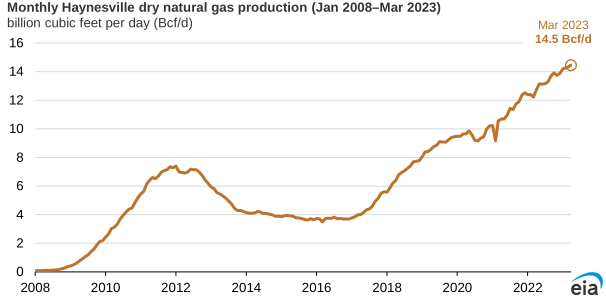
Haynesville natural gas production reached a record high in March 2023

monthly Haynesville dry natural gas productionmonthly Haynesville dry natural gas productionmonthly Haynesville dry natural gas production

Data source: Enverus, state administrative data


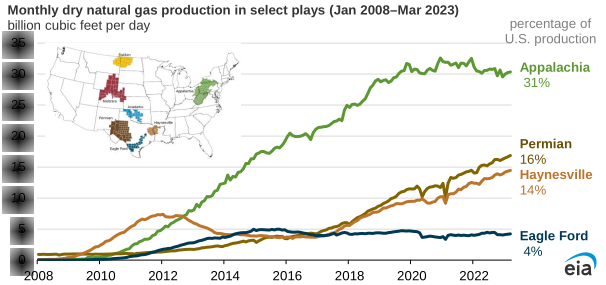
Dry natural gas production from the Haynesville shale play in northeastern Texas and northwestern Louisiana reached new highs in March 2023, averaging 14.5 billion cubic feet per day (Bcf/d), 10% more than the 2022 annual average of 13.1 Bcf/d, according to data from Enverus. Haynesville natural gas production currently accounts for about 14% of all U.S. dry natural gas production.

monthly dry natural gas production in select playsmonthly dry natural gas production in select playsmonthly dry natural gas production in select plays

Data source: Enverus, state administrative data


The Haynesville is the third-largest shale gas-producing play in the United States, behind the Marcellus play in the Appalachian Basin and the Permian play in Texas and New Mexico. In 2022, dry natural gas production averaged 25.2 Bcf/d from the Marcellus play (83% of Appalachian Basin production) and 15.4 Bcf/d from the Permian play. The Marcellus, the Permian, and the Haynesville plays combined account for 55% of U.S. dry natural gas production.

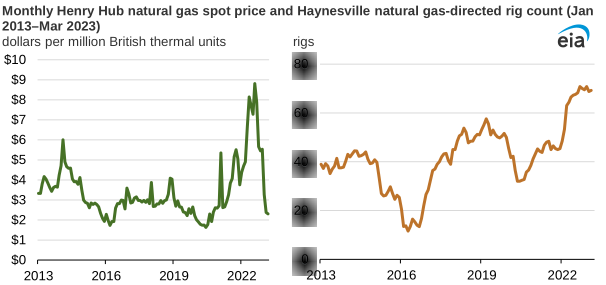
Natural gas production in the Haynesville increased in 2022, from an average 12.4 Bcf/d in January to 13.9 Bcf/d in December. Natural gas prices rose relatively steadily through the summer of 2022 as well. The U.S. benchmark Henry Hub, after reaching a monthly high for the year in August at $8.81 per million British thermal units (MMBtu), declined to average $5.53/MMBtu in December—still 26% higher than at the start of the year. Drilling costs in the Haynesville tend to be higher because natural gas wells in the play are deeper than in other plays. As natural gas prices rose in 2022, economics for developing new wells in the Haynesville improved, which led some producers to add more rigs in the play and increase production.

monthly Henry Hub and Haynesville natural gas-directed rig countmonthly Henry Hub and Haynesville natural gas-directed rig countmonthly Henry Hub and Haynesville natural gas-directed rig count

Data source: Thompson Reuters pricing data and Baker Hughes Company weekly rig count data


The rise in active natural gas-directed rigs in the Haynesville in 2022, as reported by Baker Hughes, followed rising natural gas prices. In the Haynesville, an average of 65 rigs were in operation in 2022, a 43% increase compared with 2021. In the first three months of 2023, as natural gas prices fell, the number of active rigs in the Haynesville plateaued at about 68 rigs.

Pipeline takeaway capacity out of the Haynesville is currently estimated to be around 16 Bcf/d, according to S&P Global Commodity Insights. The Enterprise Products Partners’ Gillis Lateral pipeline and the associated expansion of the Acadian Haynesville Extension, which both move natural gas from the Haynesville to demand centers and liquefied natural gas terminals along the U.S. Gulf Coast, were the most recent pipeline projects to enter service (December 2021) in the region.

In addition, three new pipeline projects, if completed on time, will add 5.0 Bcf/d of takeaway capacity out of the Haynesville by the end of 2024:

Principal contributor: Katy Fleury

Tags: production/supply, natural gas, Haynesville

Just over one year ago…

Haynesville Shale: Record Natural Gas Production

Guest “Fracking A, Bubba,” by David Middleton

The Haynesville Shale (technically Haynesville/Bossier) in northeast Texas and northwest Louisiana is the third largest natural gas play, in terms of production rate and proved reserves, in these United States. Haynesville gas production set a record high in 2021 and will likely break that record this month.

[…]

WUWT April 15, 2022

Frac On!

From 2000 to 2022, “shale” gas production soared from 3 Bcf/d to 80 Bcf/d. When you add in natural gas production from conventional reservoirs, the total is currently 113 Bcf/d… Pretty awesome… Right? Malthusians would be warning us that we are draining our reserves and should conserve the gas for… A rainy day, I guess.

“Riddle me this, Batman”…

Abiotic oil aficionados will be salivating like Pavlov’s dog when they see the following graph (the one for crude oil is very similar).

The data sources:

Riddle me this, Batman… How is it possible that we produced 1,302,951 Bcf (1,303 Tcf) of natural gas from 1963-2022, when the total proved reserves have never exceeded 625,373 Bcf (625 Tcf)?

Hint: The answer lies in the definition of “proved reserves.” To those who come up with other hypotheses to solve the riddle, Sasquatch says…

via Watts Up With That?

https://ift.tt/rNuLISJ

May 25, 2023 at 08:36AM

Record World Cereal Outputs Forecast for 2023/24

From NOT A LOT OF PEOPLE KNOW THAT

By Paul Homewood

What climate crisis?

Global corn production is forecast to sharply increase, driven primarily by a forecast of continued high production in Brazil and rebounds in the United States and Argentina. Supplies in Ukraine are forecast to fall as the ongoing war limits production. Trade is forecast to increase as ample supplies from major exporters Brazil, Argentina, and the United States lower prices and supports a rebound in global demand. Global consumption of corn for both feed and non-feed uses is forecast up. Ending stocks are also forecast to rise, primarily due to a strong surge in stocks in the United States.

 The global wheat outlook is for larger production and consumption with declining global trade and ending stocks. Production is projected to increase with larger crops in Argentina, Canada, China, the European Union (EU), India, and Turkey more than offsetting large declines for Australia, Kazakhstan, Russia, and Ukraine. Global trade will contract with lower imports for China. Declines in exports for Australia, India, Ukraine, and the United States will more than offset increases for Argentina, Canada, and the EU. Global consumption is forecast up on larger Food, Seed, and Industrial (FSI) use more than offsetting lower feed and residual use. Ending stocks are forecast down, with smaller stocks in the EU, Russia, and the United States.

 Global rice production is forecast at a record with larger production in Asia, especially on record crops in Bangladesh, India, and China along with a recovery in Pakistan. Global consumption is expected to rise to a new record, primarily from strong growth in India, Bangladesh, and Sub- Saharan Africa. Global trade is forecast virtually unchanged with India remaining the top exporter. Pakistan is expected to see significant growth in exports amidst a rebounding crop, while forecasts for Thailand and Vietnam – the next largest exporters – are down due to less demand from Indonesia. Global stocks continue a downward trend to a 6-year low.

https://netzerowatch.us4.list-manage.com/track/click?u=c920274f2a364603849bbb505&id=d891eb0d21&e=4961da7cb1

via Watts Up With That?

https://ift.tt/Kcz4RfB

May 25, 2023 at 04:21AM

Biden’s environmental injustice

Federal agencies proclaim ‘climate justice’ to justify controlling every aspect of our lives

The post Biden’s environmental injustice appeared first on CFACT.

via CFACT

https://ift.tt/yP6d2Zc

May 25, 2023 at 04:16AM