
On January 17, 1961 President Eisenhower warned about the grave dangers of the Military Industrial Complex and the government’s takeover of science. Now we have Joe Biden in the White House
via Real Climate Science
May 31, 2023 at 06:46AM
On January 17, 1961 President Eisenhower warned about the grave dangers of the Military Industrial Complex and the government’s takeover of science. Now we have Joe Biden in the White House
via Real Climate Science
May 31, 2023 at 06:46AM
Susan Crockford
Polar bears arose as a new species because the climate changed and forced some brown bears to colonize the sea ice. Polar bears epitomize the story of how evolution works but perhaps not quite how you imagined it.
Moving from extremes in warmth to extremes in cold characterized the last million years of geological history, as the graph above shows, where odd-numbered Marine Isotope Stages (MIS) are warm interglacials and even-numbered stages along the bottom are cold interglacials. MIS 2 was the Last Glacial Maximum.
But where and when during this period of change did polar bears come to be–and how, exactly, did it happen? My new book tells the whole story, which has never been done before. Not long to wait now, the release date is only about a week away (1st week June).
Polar Bear Evolution: A Model for How New Species Arise explains when and where the species came to be, as well as how it happened and why they were able to survive repeated cycles of sea ice change, some of unimaginable magnitude.
Here you’ll find a detailed account of fossil evidence, recent hybridization events between brown bears and polar bears, and summaries of more than a dozen genetic studies that have been done on these bears to determine the most plausible time and place for the origin of polar bears.
It’s logical to assume this speciation event happened during a cold interglacial, but which one?
And if you’ve ever wondered whether polar bears could have arisen more than once or if hybridization with brown bears really did play a significant part in polar bear evolution–as some geneticists insist–this book is for you.
Unique to this account, a biological mechanism reveals how this rapid transformation from a brown bear ancestor could have happened.
Thyroid hormone, essential for countless coordinated body functions including stress responses, the growth of embryos, and the activation of critical genes, seems to have played a vital role in the vast majority of all rapid speciation events.
A testable theory based on thyroid hormone not only explains how polar bears came to be but does the same for domestic dogs, flightless birds like the dodo, and extinct dwarf proto-human from Indonesia known as “Hobbits.”
This evolutionary history of the polar bear also explains why the modern species is essentially pre-adapted to persist in a warmer world.
Whenever the species first arose, its survival through the very warm early Eemian interglacial, an extended period of about ten thousand years (at ca. 130-120k years ago), when there was consistently much less summer and winter sea ice than today, ensured the polar bear was forever flexible enough to deal with profound variations in sea ice.
Or did lack of sea ice cause it to go extinct and arise a second time?
It’s a fabulous story–you’re going to love it.
via Watts Up With That?
May 31, 2023 at 04:31AM
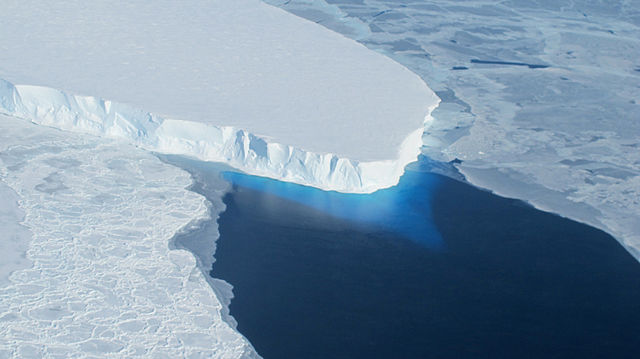
Thwaites Glacier [image credit: NASA]
Why the surprise? Natural climate cycles are well documented in Earth’s history. Their ‘many glaciers’ turn out to mostly mean the area around Thwaites Glacier (aka the Doomsday Glacier), known to be affected by subglacial volcanoes and other geothermal “hotspots”, which obviously have nothing to do with the current obsession over atmospheric trace gases.
– – –
The West Antarctic Ice Sheet is shrinking, with many glaciers across the region retreating and melting at an alarming rate, claims the British Antarctic Survey @ Phys.org.
However, this was not always the case according to new research published last month (April 28) in The Cryosphere. [Talkshop comment – self-evident].
A team of scientists from the International Thwaites Glacier Collaboration (ITGC), including two researchers from British Antarctic Survey (BAS), discovered that the ice sheet near Thwaites Glacier was thinner in the last few thousand years than it is today.
This unexpected find shows that glaciers in the region were able to regrow following earlier shrinkage.
Sea level rise is already putting millions of people in low lying coastal communities around the world at risk from flooding. The contribution from melting Antarctic ice is currently the greatest source of uncertainty in predictions of how much and how quickly sea level will rise in the coming decades and centuries.
Together with its immediate neighbor, Thwaites Glacier currently dominates the Antarctic contribution to sea level rise.
To understand how this important glacier will respond to the climate changes expected in the coming century, scientists need to know how it behaves under a wide range of climatic conditions and over long timescales. Since satellite observations only go back a few decades in time, we need to look at the geological record to find this information.
Jonathan Adams, co-author and Ph.D. student at BAS, says, “By studying the history of glaciers like Thwaites, we can gain valuable insight into how the Antarctic Ice Sheet may evolve in future. Records of ice sheet change from rocks that are presently exposed above the ice sheet surface end around 5000 years ago, so to find out what happened since then, we need to study rock presently buried beneath the ice sheet.”
Using drills specially designed to cut through both ice and the underlying rock, the team recovered rock samples from deep beneath the ice sheet next to Thwaites Glacier. They then measured, in those rock samples, specific atoms that are made when rocks are exposed at the surface of the Earth to radiation coming from outer space.
If ice covers those rocks, these particular atoms are no longer made. Their presence can therefore reveal periods in the past when the ice sheet was smaller than present.
Keir Nichols, a glacial geologist from Imperial College London and a lead author of the study, says, “This was a huge team effort: several of us spent weeks away from home doing fieldwork in an extremely remote part of Antarctica, while others endured literally thousands of hours in the lab analyzing the rocks we collected.”
“The atoms we measured exist only in tiny amounts in these rocks, so we were pushing right to the limit of what is currently possible and there was no guarantee it would work. We are excited that this is the first study to reveal the recent history of an ice sheet using bedrock collected from directly beneath it”.
The team discovered that the rocks they collected were not always covered by ice. Their measurements showed that, during the past 5,000 years, ice near Thwaites Glacier was at least 35 meters thinner than it is now.
Furthermore, their models demonstrated that its growth since then — making the ice sheet the size it is today — took at least 3,000 years.
This discovery reveals that ice sheet retreat in the Thwaites Glacier region can be reversed. The challenge for scientists now is to understand the conditions required to make that possible.
Full article here.
via Tallbloke’s Talkshop
May 31, 2023 at 04:12AM
If the primary justification for building enormously expensive offshore wind megaprojects is to reduce CO2 emissions then there may be no justification.
The post Offshore wind may not reduce CO2 emissions appeared first on CFACT.
via CFACT
May 31, 2023 at 03:58AM
 Iowa Climate Science Education