Month: May 2023

Australian Energy Minister’s Rejection of Nuclear Power Wins Prize For Dumbest Policy Move Ever

Apart from wrecking Australia’s reliable and affordable power supplies, there is no Plan A for energy. And there clearly isn’t a Plan B.

The Minister in charge of the current fiasco is Chris Bowen. A man who fails to exhibit any sign of intellect, let alone any indication of insight or wisdom. His maniacal mission to make the delivery of electricity so haphazard and costly starts with wind and solar generation target of 82%. No country in the world has ever got close; once wind and solar account for more than 30% of power delivered to a grid, grid reliability suffers and power prices skyrocket.

Opposition Leader, Peter Dutton recently rattled Bowen when he announced full-blown support for nuclear power. Bowen, exhibiting all the qualities for which he is renowned, called it “a dumb idea for Australia”, and proving, once and for all, that for as long as the Green/Labor Alliance are in charge of this Country, the chances of restoring reliable and affordable power are nil.

Michael de Percy explains how Australia’s energy future is being done-in by characters dimmer than a five-watt globe.

Where’s our energy Plan B, Chris Bowen?
Michael de Percy
Spectator Australia
15 May 2023

Minister for Climate Change and Energy, Chris Bowen, has released a video calling Opposition Leader Peter Dutton’s plan for nuclear energy ‘a dumb idea for Australia’. Mr Bowen’s statement is at odds with the people and also at odds with his Prime Minister’s promises – it’s hardly the stuff of ‘the government I lead will respect every one of you every day’ and ‘together we can end the climate wars’.

If nuclear is not on the table, and Australia is to achieve a target of 82 per cent renewables energy generation by 2030, then what ideas are not ‘dumb’?

At his speech at The Sydney Institute earlier this year, I asked Mr Bowen for his Plan B if his plan fails and the lights go out. He replied, ‘My Plan B is for that not to happen.’ His only plan is to rely on more transmission, batteries, pumped hydro, and green hydrogen. But he didn’t accept ‘the premise’ of the lights going out and stated that nuclear ‘won’t be happening here, not while we’re in office’.

When asked for an example of countries with high levels of renewables generation that did not have high electricity prices, Mr Bowen said he did not ‘accept the premise of the question’ and referred to the CSIRO’s report on the cost of nuclear.

Clearly, the premise is that Mr Bowen has no Plan B.

It is a scary prospect given the importance of electricity for every aspect of our existence. The demand for electricity is set to grow exponentially with the electrification of the transport and property sectors. And the ability of the infrastructure including the overbuilt grid necessary for solar and wind power to keep up with the demand for electricity is not something we should leave to ideologues.

Further, some have questioned the validity of the CSIRO’s data, and the most recent GenCost report uses figures from over four years ago to discount the efficacy of rapidly developing small modular reactor (SMR) technology. It seems it is fine to rely upon future technologies to reduce the cost of wind and solar, but somehow a proven technology won’t be able to reduce the cost.

According to the CSIRO’s Chief Energy Economist, nuclear energy is not viable in Australia amid a ‘lack of robust real-world data around small modular reactors (SMRs) due to low global use’.

It is also suggested that nuclear energy policy is likely to be ‘dominated by opinion and conflicting social values rather than a discussion on the underlying assumptions’ and that it cannot be deployed within the ‘timeframe required’.

If we look to other countries, many are rapidly returning to nuclear energy to achieve emissions targets and to reduce prices. Other OECD countries including Finland and Canada have longstanding nuclear energy generation, while KoreaSwedenFrance, and Japan (and soon, Italy) have reversed their policies to phase out nuclear energy given the rising cost of and intermittent generation of wind and solar energy.

Even Germany, after phasing out its nuclear power generators, has had to revert to coal and gas to fill the gap. Despite reaching some 46 per cent renewables energy generation, Germany is unlikely to reach its renewables generation target by 2030.

In the meantime, Germany’s electricity prices have been among the highest in the OECD.

Such ‘underlying assumptions’ leading to Germany’s renewables energy policy failure are not addressed in the CSIRO’s report.

One problem with underlying assumptions is the capital costs based on calculation of the effective lifespan of electricity generation assets.

Switzerland’s Beznau nuclear power plant began operating in 1969 and is still operational some 54 years later.

One Australian wind farm began operations in 2009. Late last year, the turbines sat idle for about six weeks, and in early January 2023 one of the blades caught on fire. The local Rural Fire Service could do nothing more than watch it burn and stop the fire spreading until it self-extinguished. The expected lifespan of wind farms is 20 years, but maintenance costs increase as equipment ages, especially if one of the blades catches fire in its fourteenth year of operation. [Note to Michael: the economic lifespan of wind turbines is 12-15 years, at best. In the US, thousands of turbines have been replaced after as little as 12 years in service.]

The expected lifespan of renewable energy plants versus nuclear plants was also called into question by Dr David Collins at an Australian Nuclear Association presentation last year.

Finally, a paper from the Energy Policy Institute of Australia provides an interesting critique of the CSIRO’s 2022 comparison of renewables (based on 2030 assumptions about renewables and older prices for SMRs).

The video tweeted by Mr Bowen has already attracted fact-checking context from Twitter.

And the Albanese government has been cautioned by respected scientist and former head of the Australian Nuclear Science and Technology Organisation, Dr Adi Paterson, that our current energy policy is being locked into a ‘flawed approach’.

Debate is an important part of any policy, and the contest of ideas is a cornerstone of liberal democratic practice. And being able to discuss the evidence for and against a particular approach requires much more than clever videos communicated via Twitter.

But we must also be cautious of dressing up policy-based evidence as evidence-based policy, for that would be a really dumb idea.
Spectator Australia

via STOP THESE THINGS

https://ift.tt/CXLeYUM

May 23, 2023 at 02:31AM

WHAT CAUSES CLIMATE CHANGE?

The CO2 Coalition is a very interesting website with a large number of informative posts. Here is one of them:

 Opinion: What Causes Climate Change? – CO2 Coalition

via climate science

https://ift.tt/q4hnmKO

May 23, 2023 at 01:36AM

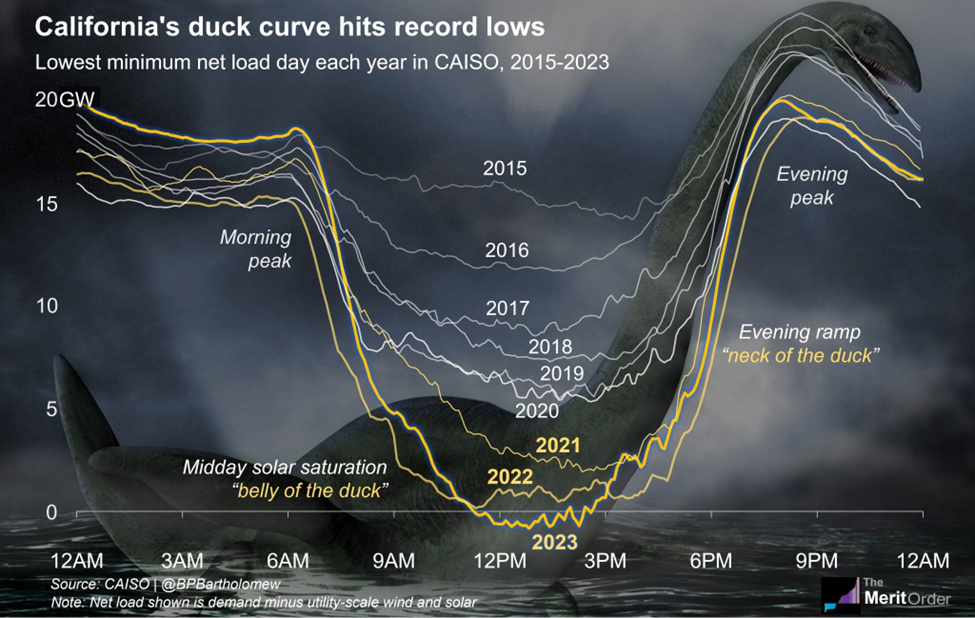
“California’s Duck Curve Hits Record Lows”

“The forced energy transformation crowd continues to be in denial about how badly the California grid has been compromised by wind and solar, how expensive the battery solution is, and the prospect of Big Brother in the home (setting temperatures and restricting power use at will). As Ludwig von Mises observed, the failure of government intervention leads to more and more intervention, posing a choice between free markets and Leviathan.”

Social media is where the industry experts and talented professionals are effectively challenging the “magical thinking” behind climate alarmism/forced energy transformation, given the blackout of the mainstream media. As yet another example, Mike Hassaballa, energy engineer and consultant, reported on LinkedIn: “California’s Duck Curve Hits Record Lows.” His comment and graphics follow.

———————

The famous “Duck Curve” that symbolizes the challenges of integrating renewable energy into the grid has reached an all-time low.

The Duck Curve, initially coined by the California Independent System Operator (CAISO), illustrates the daily electricity demand and supply patterns in California. Its distinctive shape resembles a duck with its head and neck representing the daily net load, i.e., the difference between electricity demand and generation.

But why is this curve so important? The Duck Curve showcases the impact of renewable energy sources, particularly solar power, on the grid. As solar panels proliferate across California, the curve’s belly – symbolizing midday surplus energy – has been steadily growing. This phenomenon poses a challenge as it can result in excess electricity during the day, followed by a rapid ramp-up in demand as the sun sets. Managing this imbalance is crucial for a stable and reliable energy system.

This highlights the pressing need for energy storage solutions, demand response programs, and further integration of renewable energy into the grid. By effectively managing the duck curve, we can accelerate our transition to a more sustainable and resilient energy future.

—————

More than 200 comments followed, most from the pro-renewables crowd arguing, in effect, “okay, this presents a challenge that the next phase of energy transformation, such as batteries and demand-reduction, must address.”

The critics of forced grid solar had comments ranging from “That is one ugly duckling,” which elicited the response: “It’s bound to be, it’s based on ‘quack’ climate science.” Then came the more serious. Dan Fowler commented in part:

The takeaway is that no new solar projects should be permitted (or are needed) without an equal amount of storage being made available.

And another:

No amount of batteries will address this problem at a fiscally sensible level. Pursuing further penetration of solar and wind, along with batteries will push California’s electricity rates ever higher to the point of impoverishing the population and driving any sensible business away.

Scott Tinker made the obvious point of more-of-the-same-is-worse:

… the logic of integrated more of the thing that is causing the duck into the system is somewhat lost on people who understand and have to manage these things. Perhaps additional dispatchable sources like natural gas and nuclear to create reliable electricity would be useful. And also have the benefit of bringing California’s highest in the nation [lower-48] electricity prices down for the consumer. Or, you could continue to follow Europe…

The obvious solution is to stop the wounding and treat the wound. No more wind and solar. And retire existing capacity to allow market signals to bring in combined power plants fueled by either natural gas or fuel oil. Coal-by-wire should also be encouraged. The electricity rate debacle can be solved and Big Brother kept out of the home.

Conclusion

The forced energy transformation crowd continues to be in denial about how badly the California grid has been compromised by wind and solar, how expensive the battery solution is, and the prospect of Big Brother in the home (setting temperatures and restricting power use at will). As Ludwig von Mises observed, the failure of government intervention leads to more and more intervention, posing a choice between free markets and Leviathan.

The post “California’s Duck Curve Hits Record Lows” appeared first on Master Resource.

via Master Resource

https://ift.tt/CZtHoUj

May 23, 2023 at 01:04AM

Europe can achieve Net Zero by demolishing historic buildings and starting again, Central Bank claims

From NOT A LOT OF PEOPLE KNOW THAT

By Paul Homewood

h/t Ian Magness

So that’s alright then!

A top central banker has warned of the economic damage that the rush to ‘Net-Zero’ could cause, and illustrates the point by stating that deleting Europe’s architectural history would be required to achieve severe green expectations.

Among the comments made by Paolo Angelini, deputy governor of the Bank of Italy, about European Net Zero ambitions that, in his opinion, risk inflicting more harm than good, the central banker outlined the level of change that Europeans would need to satisfy those demands.

While saying pushing Europe to net zero risks destabilising the continent’s economy and undermining Europe’s ability to lead on green issues globally, the top economist made his point by revealing he’d asked his team at the Bank of Italy what would be necessary just to make the single institution that he leads compliant.

Angelini revealed the shocking response, remarking in an interview with Politico: “They told me: ‘If you allow us to tear down all our historical buildings and build energy efficient ones, then we can do it’.”

The Bank of Italy wouldn’t be committing itself to net zero any time soon, said Angelini. This was not because he didn’t believe in the cause, but simply because with the technology presently available, he didn’t think it was physically possible.

He said: “For the time being I am refraining from raising my hand and saying at the Bank of Italy we’re going to net zero, because I don’t have the technology, the ability to be certain about the pledge.”

Reflecting on the central banker’s remarks — which may possibly have been tongue-in-cheek — Politico itself mused: “it’s a potent symbol of the trade-offs that the green transition demands: how much of Europe’s present — and past — is it willing to risk to secure its future?”.

The Bank of Italy itself is headquartered in the Palazzo Koch in Italy, an impressively grand 19th-century palace named for its architect which features a money museum and significant interiors and staterooms.

While survey after study demonstrates that the general public appreciates classic design, the issue is politicised to some extent. U.S. President Donald Trump issued an executive order requiring ancient architectural styles (Roman or Greek revival) for Federal structures, which President Biden reversed.

In the United Kingdom, a hard-left London mayor’s advisor stated traditional architecture is “offensive” because it “harkens back to oppression.”

https://britmaxnews.com/europe-can-achieve-net-zero-by-demolishing-historic-buildings-and-starting-again-central-bank-claims/

While it’s obviously tongue in cheek, Angelini does raise a serious issue about Europe’s old buildings. But at least it appears that Komrade Khan will be happy!

via Watts Up With That?

https://ift.tt/KpHhzlU

May 23, 2023 at 12:56AM