
Nebraska State Senator Machaela Cavanaugh shows off her skills at reaching out to the Democratic Party voting base.
via Real Climate Science
May 20, 2023 at 12:58PM
Nebraska State Senator Machaela Cavanaugh shows off her skills at reaching out to the Democratic Party voting base.
via Real Climate Science
May 20, 2023 at 12:58PM
Guest Post by Willis Eschenbach
By way of what in my life is a fairly common path, that of a series of misunderstandings and coincidences, I ended up on the web page of the Rutgers Snow Laboratory. Remember a while back when some typically alarmist climate scientist said our children wouldn’t know what snow is? Here’s the actual record of the Northern Hemisphere snow extent:
Figure 1. Northern Hemisphere snow extent, 1972 – April 2023. Graph from Climate4You.
But I digress. I started out to tell you about the curiosity I found at the Rutgers Snow Laboratory web page. Here’s the oddity I saw when I went there.
In that list of datasets, I saw an opportunity …
… dang, sez I, if I have snow extent data for North America both with and without Greenland, I can subtract one from the other to give me snow extent data just for Greenland.
And here is that result:
Figure 2. Monthly snow extent, Greenland. Flat areas at the time of the maximum extent show months when the entire island is snow-covered.
Hmmm … further discussion below. Next, here’s the average snow extent by month.
Figure 3. Greenland snow climatology, entire dataset. Note that the island is completely snow-covered for ~ six months out of the year.
Not a whole lot of summer in Greenland.
Finally, here’s a closer look at the changes in snow extent over time.
Figure 4. Expanded view, Greenland snow extent as in Fig. 2 above. Includes snow extent linear trend (yellow/black), snow extent CEEMD smooth (blue/black), and minimum extent (solid black w/circles).
Here we can see that since 1972, by all measures and despite the general slight post-1972 global warming, the snow extent in Greenland has been steadily increasing. Not decreasing. Increasing.
Please note that I’m not making any overarching claims about the meaning of this result. In particular, it says nothing about the state of the Greenland Ice Cap.
I’m simply pointing out that during a time when the earth has been slowly warming, Greenland is getting more snow.
Ah, the unbearable complexity of climate.
Anyhow, that’s where my monkey mind took me today … go figure …
Here on our northern California hillside, we’re about six miles (10 km) from the ocean. Our house is at the location shown by the red pin in the forest at the upper right. We can see a tiny bit of the ocean between the far hills.
When the sea fog rolls in, sometimes it traps and funnels the sounds of the coast this far inland. And on nights like tonight when that is happening, along with the boom of the far-distant surf I can hear the forlorn sound of the foghorn on the breakwater at the mouth of Bodega Bay, endlessly calling lost souls home to safe harbor …
My wish is for the very best of safe harbors for all of you,
w.
As Always: When you comment, I ask that you quote the exact words you are discussing. This avoids many of the misunderstandings that plague the intarwebs.
via Watts Up With That?
May 20, 2023 at 12:14PM
By Paul Homewood
h/t Paul Kolk
The Telegraph is becoming a bigger joke than ever!

Climate change is the greatest health threat of the 21st century. It is not only endangering the lives of millions by driving inhospitable weather conditions across the globe, but also heightening the risk of outbreaks of deadly diseases.
In altering the characteristics of the environment in which animals habitually live, both in terms of temperature and the availability of water and food sources, the danger of infections spilling over from animals into humans is high.
Worryingly, disease-carrying animals and insects are now moving into those parts of the world that are heating up and creating the environments that allow these creatures to thrive.
Because of this shift, the northern regions of the planet are particularly at risk of developing epidemic outbreaks.
In Europe, North America and some Arctic regions of Russia, a change in the distribution of tick species that carry pathogens such as Lyme disease – a flu-like infection that includes skin rashes followed, weeks or months later, by neurological, cardiac, or joint changes – has been observed.
It is still a relatively rare disease that can affect the blood and lead to hemolytic anemia, in which the body’s red blood cells break down, but its impact on health can be expected to increase significantly soon with climate change.
The Asian tiger mosquito, native to tropical and subtropical areas, has also gradually spread to America, Europe and China as well, causing the spread of some of the diseases it vectors, such as dengue.
This is a disease influenced by rising temperatures and humidity, which promotes both the reproduction of the mosquito, prolonging its life cycle, and the frequency of bites.
In addition, where drought forces water supply and its collection in special tanks or cisterns, the mosquito uses these places to lay eggs and multiply its reproductive capacity, coming more easily into contact with humans.
The likelihood of dengue infection is highest in metropolitan areas. Italy and France are currently the most affected European nations – a British tourist contracted the ‘tropical’ disease in Nice last September – but the risk of outbreaks in the near future appears high across the continent.
Increased rainfall, driven by climate change, can also contribute to changes in the behaviour of disease-carrying creatures in a given area and the pathogenic microorganisms associated with them, altering their likelihood of survival and thus the risk of spread.
For example, mosquitoes of the genus Aedes, responsible for diseases such as Rift Valley fever (RVF) in East Africa, proliferate particularly during periods of high rainfall associated with phases of El Niño activity.
There are currently no reports of RVF in Europe, but the spread of other mosquito-borne African viruses outside the continent raises concerns that this disease could soon follow suit.
Heavy rains associated with high temperatures and humidity are also believed to be responsible for the increase in malaria cases, the endemic spread of which had been virtually eliminated through massive hygiene and public health interventions in the 1970s.
The disease is again emerging in Europe due to the combined effect of increased travel and immigration from high-endemic countries and the climate-driven spread of the Anopheles mosquitoes, the vector of Plasmodium, which causes malaria.
The World Bank report indicates that, by 2050, climate change could put some previously malaria-unexposed areas such as China, South America and sub-Saharan Africa at risk, with a 50 per cent increase in the likelihood of disease transmission.
So who is this Francesco Branda who wrote the article? Some expert on tropical diseases maybe? Unsurprisingly, no:

A Ph.D. student in computer modelling! Have not the Telegraph learnt anything about modelling, following the COVID fiasco?
Instead of letting a student write an article, why did not they ask an expert like Paul Reiter to do it. His experience in the field is second to now – see here. In 2005, he gave a detailed presentation to the Select Committee on Economic Affairs, concerning the IPCC’s statements on malaria and other mosquito borne diseases.
He began by reminding members that the area occupied by Parliament used to be a notorious malarious swamp, and finished with these remarks:
The natural history of mosquito-borne diseases is complex, and the interplay of climate, ecology, mosquito biology, and many other factors defies simplistic analysis. The recent resurgence of many of these diseases is a major cause for concern, but it is facile to attribute this resurgence to climate change, or to use models based on temperature to "predict" future prevalence. In my opinion, the IPCC has done a disservice to society by relying on "experts" who have little or no knowledge of the subject, and allowing them to make authoritative pronouncements that are not based on sound science. In truth, the principal determinants of transmission of malaria and many other mosquito-borne diseases are politics, economics and human activities. A creative and organized application of resources is urgently required to control these diseases, regardless of future climate change.
The full speech can be read here.
Our World in Data neatly sums up what Reiter was saying:
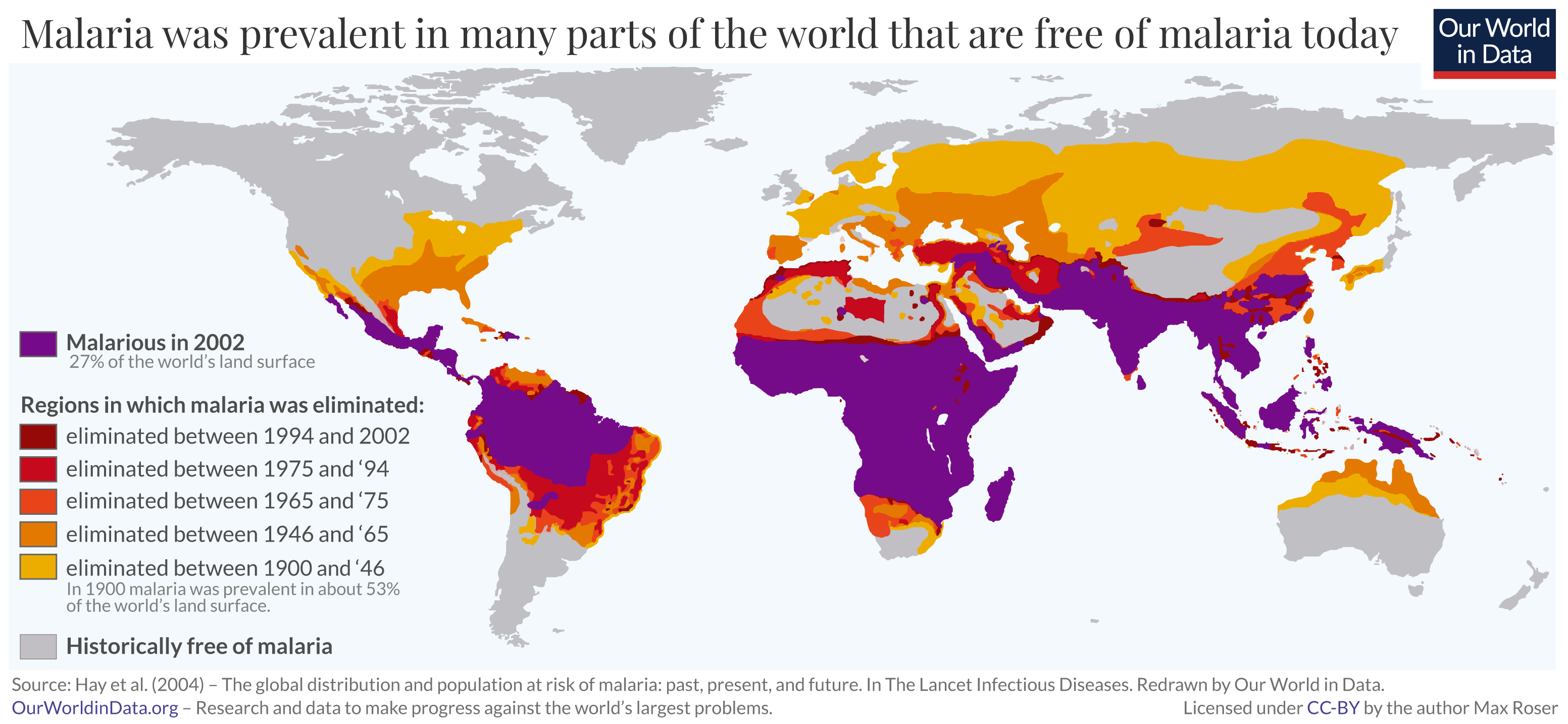
Just a few decades ago, malaria was prevalent in many places that are colder than its current coverage. And they add:
Malaria left its mark on our history, our bodies, drinks, and for thousands of years the deaths of people in all corners of the world.
But in the last few generations, humanity gained ground in this long-lasting battle against the disease. The map shows in which regions of the world malaria is prevalent today (in purple) and where it was prevalent in the past. Just a few generations ago malaria was common in many more places around the world than it is today. Over the course of the 20th century the disease was eliminated in many populous regions of the world, saving the lives of millions.
What the map makes clear is that malaria is not a tropical disease, but a disease that was eliminated everywhere except for the tropics. Historically malaria was prevalent in Europe and North America – poet Friedrich Schiller contracted the disease in Mannheim, Oliver Cromwell in Ireland, and Abraham Lincoln in Illinois.9
First, public health measures, especially the widespread use of insecticides to attack the mosquito. Second, the drainage of swampland for expanding agricultural land had the side effect of restricting the breeding grounds for mosquitoes. And third, social and economic development which not only made treatment available to those that were infected, but also led to improvements in housing conditions which lowered the chances of infection in the first place.
All three factors – insecticides, land use change, and economic development – were major reasons that Europe and the other regions shown in shades of yellow, orange, and red are free of malaria today.
Prof Duane Gubler is an expert on dengue, and he had this to say:
Dengue is the most important arboviral disease of humans with over half of the world’s population living in areas of risk. The frequency and magnitude of epidemic dengue have increased dramatically in the past 40 years as the viruses and the mosquito vectors have both expanded geographically in the tropical regions of the world. There are many factors that have contributed to this emergence of epidemic dengue, but only three have been the principal drivers: 1) urbanization, 2) globalization and 3) lack of effective mosquito control. The dengue viruses have fully adapted to a human-Aedes aegypti-human transmission cycle, in the large urban centers of the tropics, where crowded human populations live in intimate association with equally large mosquito populations. This setting provides the ideal home for maintenance of the viruses and the periodic generation of epidemic strains. These cities all have modern airports through which 10s of millions of passengers pass each year, providing the ideal mechanism for transportation of viruses to new cities, regions and continents where there is little or no effective mosquito control. The result is epidemic dengue.
https://www.ncbi.nlm.nih.gov/pmc/articles/PMC3317603/
And the WMO add:
The Aedes aegypti mosquito lives in urban habitats and breeds mostly in man-made containers. Unlike other mosquitoes Ae. aegypti is a day-time feeder; its peak biting periods are early in the morning and in the evening before dusk. Female Ae. aegypti bites multiple people during each feeding period.
Aedes albopictus, a secondary dengue vector in Asia, has spread to North America and more than 25 countries in the European Region, largely due to the international trade in used tyres (a breeding habitat) and other goods (e.g. lucky bamboo). Ae. albopictus is highly adaptive and, therefore, can survive in cooler temperate regions of Europe. Its spread is due to its tolerance to temperatures below freezing, hibernation, and ability to shelter in microhabitats.
https://notalotofpeopleknowthat.wordpress.com/2018/12/12/the-lancet-climate-change/
The Telegraph should apologise for misleading readers, and ask the experts to write an article giving the facts.
via NOT A LOT OF PEOPLE KNOW THAT
May 20, 2023 at 12:06PM
Oil and gas are already planned…
Since the Socialists and Greens took over power in Germany a year and half ago, the government has announced one ban after the other.

Wood heat may be the next heat source to be banned from homes in Germany as verbot-orgy expands. Image: P. Gosselin
It’s becoming clear that the climate movement is all about stripping citizens of choices, comfort and ability to move around.
One of the boldest initiatives, introduced under the guise of independence from Russian energy, particularly natural gas, was the controversial plan to phase out oil and gas heating systems beginning already next year. In their place, Germans would be ordered to invest in heat pumps – a costly and for many an unfeasible measure.
The latest crackdown on human comfort is the German Socialist/Green federal government’s calling into question the future of wood stoves and pellet heating systems. As gas prices skyrocketed, many German households opted for wood heat using firewood or pellets. But that option for heat has since become environmentally controversial. Today a delivery time for a wood stove is over one year in many cases. Firewood prices have skyrocketed as well.
According to Blackout News here, “From 2024, it will no longer be permitted to heat new buildings with wood. If an existing system has to be retrofitted or replaced, buffer storage, fine dust filters and an alternative heat source such as a solar thermal system or photovoltaics must also be installed. This is provided for in the federal government’s draft for the new version of the Building Energy Act. There will be only a few exceptions.”
And, as expected, criticism has been immediate, for example from the opposition parties and groups like the German Association of Forest Owners, AGDW. But government authorities are saying the step is necessary because they claim more than 20 per cent of all fine dust emissions are due to the burning of wood, which is roughly equivalent to road traffic emissions. Fine dust has suddenly been reactivated as a major health issue again.
The proposed idea of banning wood stove, has however, run up against opposition from even within the government itself. For example, “The SPD parliamentary group has already announced that it wants to prevent the ban on wood and pellet heating in new buildings,” reports Blackout News.
However, controversy is swirling whether heating with wood is even “climate-friendly” at all. The Federal Environment Ministry states that cheating with wood is not climate neutral. Trees are carbon sinks that store CO2. Mass forest clearing not only destroys biotope, but also leads to a premature release of CO2 into the atmosphere.
The German Greens, are against wood as a fuel, but supports using wood as a construction material.
Donate – choose an amount
via NoTricksZone
May 20, 2023 at 11:31AM
 Iowa Climate Science Education