If all of us should be doing “everything possible” to stop climate change, why is it still OK–15 years after polar bears were declared threatened with extinction because of predicted climate change effects–for researchers across the Arctic to use helicopters to study polar bears? Aircraft that consume massive amounts of aviation fuel and engine oils, otherwise known as ‘fossil fuels.’
Money quote: “…the lifeblood of most polar bear research is jet fuel needed by helicopters.” (Derocher 2012:107).
From Hudson Bay and the High Arctic in Canada, the Beaufort Sea off Alaska, to Svalbard in Norway (above, from 2015), polar bear research is impossible without helicopters powered by fossil fuels. This has been true since the 1980s (e.g. Ramsy and Stirling 1988). And this doesn’t even take into account the fossil fuel-powered fixed wing aircraft needed in some locations, commercial airline flights that transport personnel and equipment to distant locations, or the Tundra buggies used in Churchill (Western Hudson Bay) to get up close to bears and educateindoctrinate the tourists.
USFWS in the Beaufort Sea 2001, Amstrup photo.
If there is such an indisputable correlation between human-caused CO2 and sea ice decline that the total collapse of polar bear populations can be predicted with certainty (Molnár et al. 2020), why bother with these energy-intensive studies? If researchers are so sure what will befall polar bears under a “business as usual” approach to CO2, how can they possibly justify the ‘greenhouse gas’ emissions their own work adds to the problem?
Why not leave the polar bears to their inevitable fate and engage in some other form of research that doesn’t contribute so dramatically to the damage they insist is being done?
Or is it that they consider their work to be so much more important than anyone else’s job that their contribution to the climate change problem should be discounted?
Funny how journalists never ask these kinds of questions. Governments around the world are planning to ban gasoline powered cars, which millions of people depend upon to get to their jobs but no one, it seems, talks about the hypocrisy in Arctic research.
Derocher, A.E. 2012.Polar Bears: A Complete Guide to their Biology and Behavior. Photographs by Wayne Lynch, in association with Polar Bears International. Johns Hopkins University Press. [see my review here]
Molnár, P.K., Bitz, C.M., Holland, M.M., et al. 2020. Fasting season length sets temporal limits for global polar bear persistence. Nature Climate Change. https://doi.org/10.1038/s41558-020-0818-9
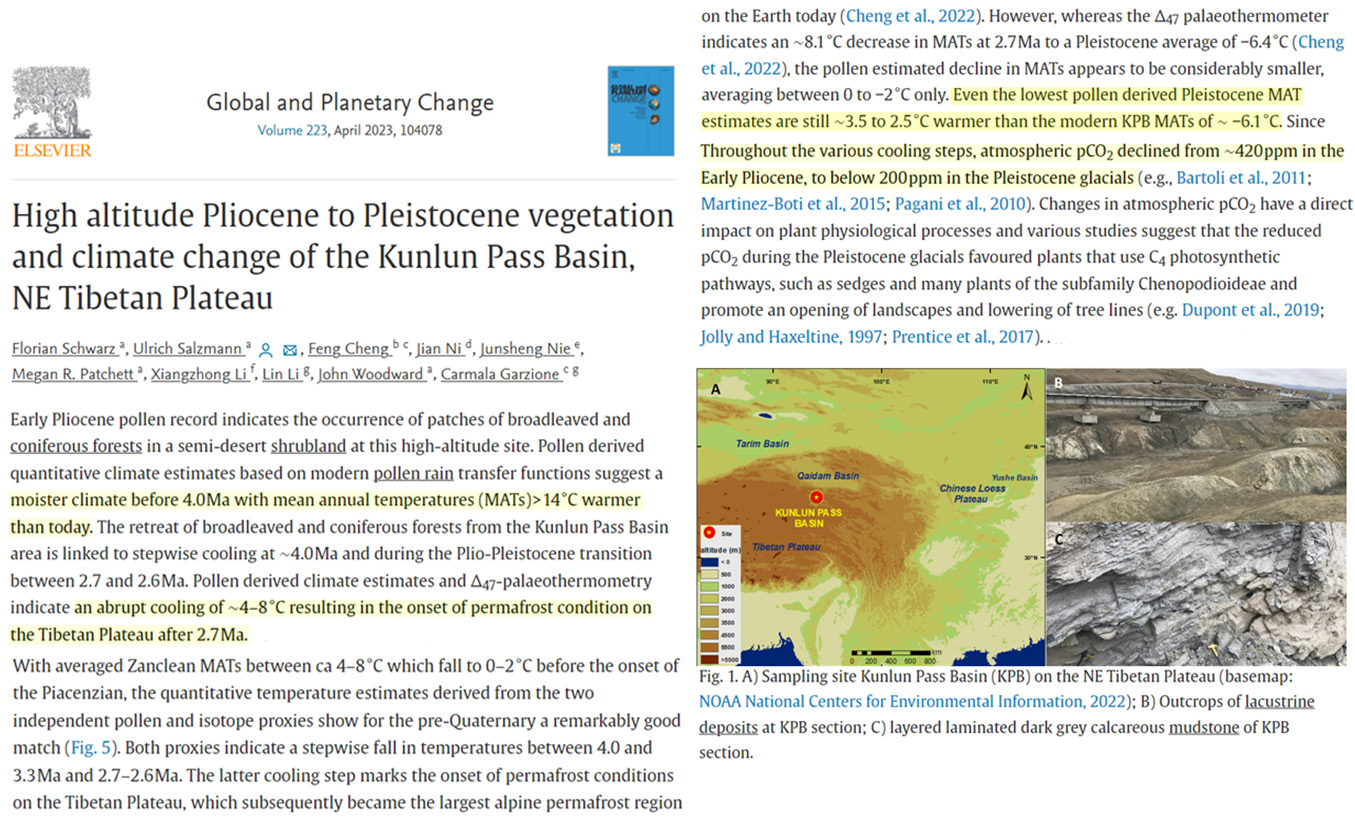
“Even the lowest pollen derived Pleistocene MAT [mean annual temperature] estimates are still ∼3.5 to 2.5 °C warmer than the modern KPB MATs [Kunlun Pass Basin] of ∼ −6.1 °C.” – Schwarz et al., 2023
The Kunlun Pass Basin (KPB) in the northeastern Tibetan Plateau is the largest alpine permafrost region on Earth.
About 4 million years ago, during the Pliocene epoch, this location was permafrost-free. The mean annual temperatures (MAT) were more than 14°C warmer than they are today (Schwarz et al., 2023).
While scientists have sometimes claimed the higher Pliocene CO2 concentrations (~420 ppm) were at least partly responsible for this warmth, it is well established that CO2 concentration changes follow temperature changes by centuries to millennia in paleoclimate reconstructions (Fischer et al., 1999;Monnin et al., 2001; Caillon et al., 2003; Stott et al., 2007; Kawamura et al., 2007). Since causes cannot lag effects, this largely precludes CO2 as a driving mechanism for ancient temperature fluctuations.
To further clarify CO2 concentrations are not a climate driver, pollen records in the KPB indicate that even the lowest glacial temperatures and lowest CO2 concentrations (“below 200 ppm”) of the Quaternary ice age (last ~2.5 million years) were still “~3.5 to 2.5−°C warmer” than they are with today’s CO2 (~420 ppm) concentrations (Schwarz et al., 2023).


 Iowa Climate Science Education