The level of crazy from climate alarmists appears boundless. 5:03 PM · May 10, 2023
via Real Climate Science
May 18, 2023 at 07:43AM
The level of crazy from climate alarmists appears boundless. 5:03 PM · May 10, 2023
via Real Climate Science
May 18, 2023 at 07:43AM
A tornado on May 18, 1902 destroyed Goliad, Texas and killed more than 100 people. 20 May 1902, Page 1 – The Semi-Weekly Times-Democrat at Newspapers.com
via Real Climate Science
May 18, 2023 at 07:43AM
Ambrose Evans-Pritchard, writing in the Telegraph, has been looking at what the future grid might do to stay afloat when the wind isn’t blowing. This is certainly an important question, and one that you might have hoped would no longer be the subject of speculation now that we are twenty years into the renewables ‘revolution’. Unfortunately, the Green lobby has conned the country into ploughing on before finding the answers, but I suppose we should be relieved that the issues are finally getting an airing.
AEP’s first suggestion is to use Allam-cycle gas turbines, and this is only a partially daft idea. Allam cycle looks a promising technology, and is said to be able to deliver power for about the same cost as unabated CCGTs, although presumably the storage bit is extra. You can believe the hype or not, as you prefer. Either way, it looks likely it is going to be lower cost than renewables, and without causing the same problems for the system as a whole. That being the case, it’s hard to see why you wouldn’t just dump all the windfarms and use Allam cycle on its own.
AEP’s other suggestion is, of course, hydrogen, and here he betrays the lack of economic understanding that is so prevalent in the media. Here’s what he says:
The second default option is to use free electricity from excess renewable power that would otherwise have to be curtailed – at night, at weekends, etc – to produce green hydrogen via electrolysis.
If I had a penny for every time some wild-eyed hack in Fleet Street punted the idea of “free” curtailed electricity I would long since have retired to the sun. Let me explain why this is so wrong.
Imagine a windfarm (let’s call her “Anna”), which each year produces 2 million megawatt hours of electricity per year at a cost of £100 each. That’s a total cost of £200 million, representing part of Anna’s build cost and all of her operating costs for the year. Note the word “cost”: it’s what has been paid out to produce the energy, as distinct from the “price”, which is what someone is willing to hand over to get their hands on it.
Then imagine that the following year another windfarm (“Betty”) comes on stream in the vicinity, and that at times throughout the year, there is not enough transmission capacity to get both windfarms’ output to market. Let’s say 10% of Anna’s output has to be curtailed. Her unit cost therefore goes up (to £200m/180m = £111/MWh).
In year 3, someone sees an opportunity and builds a hydrogen plant (“Horace”) next door to Anna. They will take the curtailed power off her hands for nothing (in reality, for a low price, but let’s not quibble). Anna’s output is therefore back up to 2 million MWh, and her unit costs back down to £100. But the 200,000 MWh of electricity that pass from Anna to Horace have still cost £100 each to make! The price may be low, but the cost is still high! Selling this power for nothing to Horace therefore creates a big loss in Anna’s books, which cancels out the “profit” that Horace has effectively made by getting hold of electricity worth £100 for free.
Another way to think about the transaction is to consider the picture if Anna’s owners had built their own hydrogen plant and administered it as part of the same operating company as the windfarm. Feeding power from the windfarm to the hydrogen plant would then just be a change of location. No profit, illusory or otherwise, would be seen. In AEP’s model of the world, creating the hydrogen plant as a separate entity magically creates “free” electricity. It’s daft!
So in system terms, the “free electricity” is an illusion. It’s only free to the hydrogen plant because a loss has been sustained elsewhere.
Fortunately for Anna, things are pretty comfortable whatever happens. Firstly, if she is curtailed, she gets a constraint payment from the grid for her trouble, and can then get that topped up to her CfD strike price. Both these sums are ultimate funded by consumers. And if she can unconstrain herself, by building a direct wire between her and Horace (in other words, if she doesn’t have to deliver power via the transmission grid), she can get the constraint payment, the strike price top up and whatever Horace is willing to pay her for the power. Quids in!
This is the antithesis of “free”.
via Net Zero Watch
May 18, 2023 at 05:43AM
By Paul Homewood
From the CO2 Coalition

On May 14, Cyclone Mocha made landfall near Myanmar and Bangladesh. It was not surprising to see many mainstream media blame climate change for it. The pattern has now become common.
Every time there is a major cyclonic event, the media fan fear of climate change and argue that human-induced emissions of carbon dioxide are causing more extreme weather. However, an examination of relevant data shows such reports to be misleading.
As I write this, Mocha has made landfall close to the Myanmar–Bangladesh border. Residents of coastal districts of Chattogram and Barishal are likely to experience the worst impact of the cyclone for weeks to come.
Among the most vulnerable are refugees who fled persecution in Myanmar and have been living for half a decade in Bangladesh camps without the protection of storm-resistant shelter. As sad as the situation is, cyclones are not unprecedented for the region.
Incidence of Cyclonic Storms are Decreasing
According to the Indian Government’s “Assessment of Climate Change over the Indian Region,” overall cyclone frequency in the Indian Ocean is showing no increase. In fact, there has been a decrease.
“Long-term observations (1951–2018) indicate a significant reduction in annual frequency of tropical cyclones” in both the North Indian Ocean basin and the Bay of Bengal, the report states.
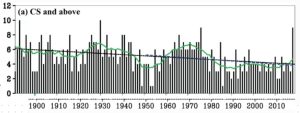
Image: Annual Frequency of Cyclonic Storm (CS) between 1891 and 2016. Linear trend lines are indicated by dashed lines—black (1891–2018), blue (1951–2018). 10-year running mean is shown by a solid-green line. Source: Extreme Storms, Indian Meteorological Department, Govt. of India. Published June 13, 2020.
The data clearly show a decrease in frequency of cyclones for more than 100 years in the North Indian Ocean, the birthplace of storms affecting more than 1.5 billion people. However, this information is obscured by cherry picking data for shorter times frames to suggest alarming weather trends.
Hurricane Data Reveal Similar Decrease in U.S.
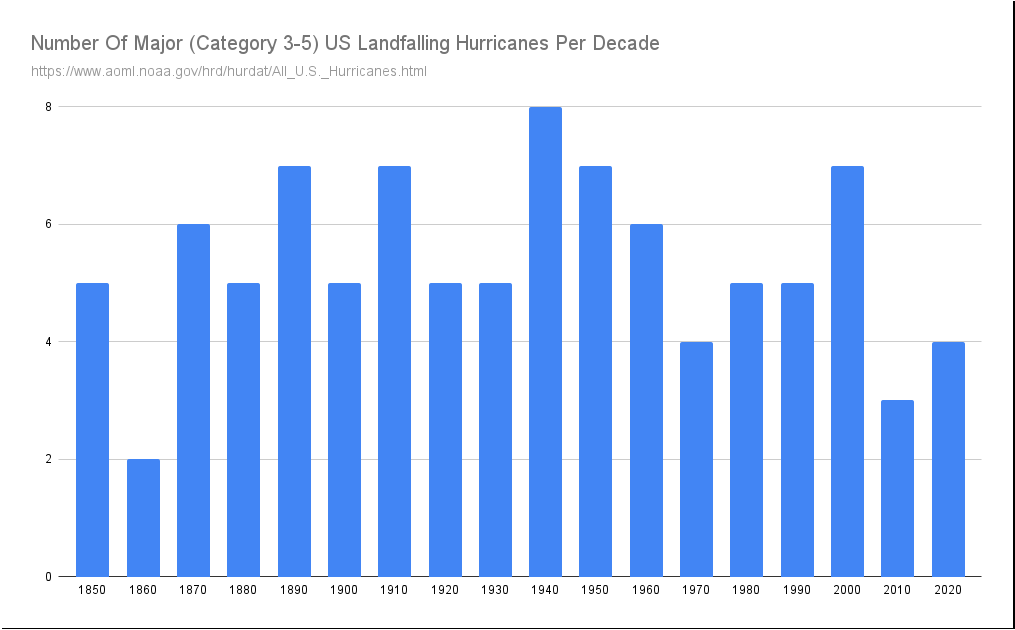
It is not just the Indian Ocean region. In the U.S., there has been a decrease in the number of landfalling hurricanes per decade since 1850. According to data from the Hurricane Research Division of the National Oceanic and Atmospheric Administration (NOAA), the number of major hurricanes have been declining since the 1950s.
“In summary, it is premature to conclude with high confidence that increasing atmospheric greenhouse gas concentrations from human activities have had a detectable impact on Atlantic basin hurricane activity,” NOAA’s Geophysical Fluid Dynamics Laboratory states.
The mainstream media is good at tricking people into believing a false emergency. In instances like Cyclone Mocha, they prey on people’s compassion for storm victims and use the calamity to drive fear into people’s minds.
Don’t fall for the climate bait. We will see more and more of it in the coming days, as the climate doomsday bandwagon loses steam in many parts of our world. And desperate times call for desperate deceptions embedded onto the public psyche through repetitive, aggressive media programming.
Vijay Jayaraj is a Research Associate at the CO2 Coalition, Arlington, Virginia. He holds a master’s degree in environmental sciences from the University of East Anglia, UK and resides in India.
https://co2coalition.org/2023/05/15/cyclone-mocha-dont-fall-for-the-climate-bait/
via NOT A LOT OF PEOPLE KNOW THAT
May 18, 2023 at 04:24AM
 Iowa Climate Science Education