
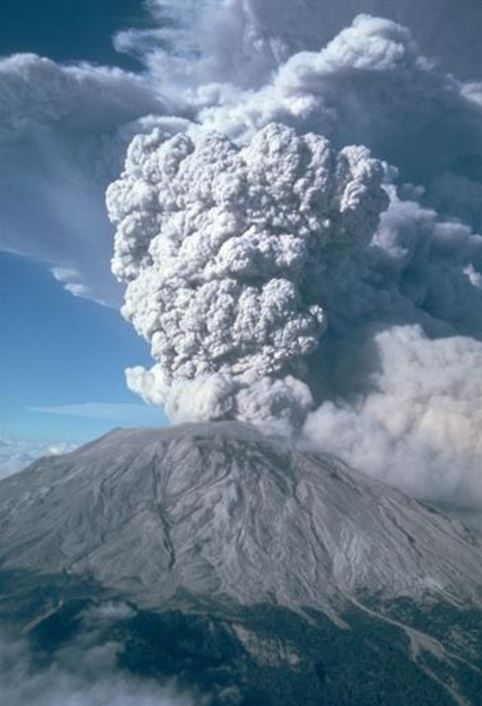
Volcanic eruption
The idea proposed here of climate model forecasts becoming ‘more robust’ by including smaller effects depends on them being robust to some degree in the first place, which is open to question given their output to date.
– – –
Researchers have found that the cooling effect that volcanic eruptions have on Earth’s surface temperature is likely underestimated by a factor of two, and potentially as much as a factor of four, in standard climate projections, says Phys.org.
While this effect is far from enough to offset the effects of global temperature rise caused by human activity [Talkshop comment – unsupported assertion], the researchers, led by the University of Cambridge, say that small-magnitude eruptions are responsible for as much as half of all the sulfur gases emitted into the upper atmosphere by volcanoes.
The results, reported in the journal Geophysical Research Letters, suggest that improving the representation of volcanic eruptions of all magnitudes will in turn make climate projections more robust.
Where and when a volcano erupts is not something that humans can control, but volcanoes do play an important role in the global climate system.
When volcanoes erupt, they can spew sulfur gases into the upper atmosphere, which forms tiny particles called aerosols that reflect sunlight back into space. For very large eruptions, such as Mount Pinatubo in 1991, the volume of volcanic aerosols is so large that it single-handedly causes global temperatures to drop.
However, these large eruptions only happen a handful of times per century—most small-magnitude eruptions happen every year or two.
“Compared with the greenhouse gases emitted by human activity, the effect that volcanoes have on the global climate is relatively minor, but it’s important that we include them in climate models, in order to accurately assess temperature changes in future,” said first author May Chim, a Ph.D. candidate in the Yusuf Hamied Department of Chemistry.
Standard climate projections, such as the Intergovernmental Panel on Climate Change (IPCC) Sixth Assessment Report, assume that explosive volcanic activity over 2015–2100 will be at the same level as the 1850–2014 period, and overlook the effects of small-magnitude eruptions.
“These projections mostly rely on ice cores to estimate how volcanoes might affect the climate, but smaller eruptions are too small to be detected in ice-core records,” said Chim. “We wanted to make a better use of satellite data to fill the gap and account for eruptions of all magnitudes.”
Full article here.
via Tallbloke’s Talkshop
June 24, 2023 at 06:03AM
 Iowa Climate Science Education