Neptune
As the senior author of the study noted: “These remarkable data give us the strongest evidence yet that Neptune’s cloud cover correlates with the sun’s cycle”. The planet receives only 1/900th of the sunlight we get on Earth.
– – –
For the first time in nearly three decades of observations, clouds seen on Neptune have all but vanished, says Phys.org.
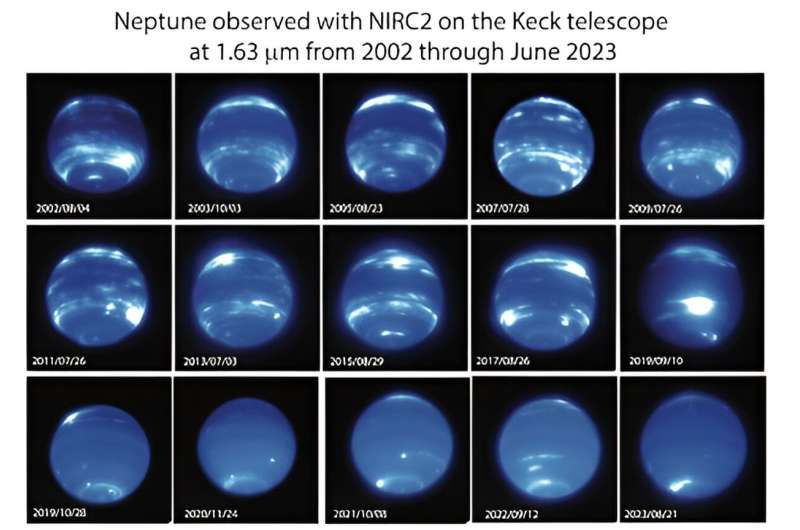
Images from 1994 to 2022 of the big blue planet captured from Maunakea on Hawaiʻi Island through the lens of W. M. Keck Observatory, along with views from space via NASA’s Hubble Space Telescope show clouds are nearly gone with the exception of the south pole.
The observations, which are published in the journal Icarus, further reveal a connection between Neptune’s disappearing clouds and the solar cycle—a surprising find given that Neptune is the farthest major planet from the sun and receives only 1/900th of the sunlight we get on Earth.
A University of California (UC) Berkeley-led team of astronomers discovered the abundance of clouds normally seen at the icy giant’s mid-latitudes started to fade in 2019.
“I was surprised by how quickly clouds disappeared on Neptune,” said Imke de Pater, emeritus professor of astronomy at UC Berkeley and senior author of the study. “We essentially saw cloud activity drop within a few months.”
“Even four years later, the images we took this past June showed the clouds haven’t returned to their former levels,” said Erandi Chavez, a graduate student at Harvard University’s Center for Astrophysics who led the study when she was an undergraduate astronomy student at UC Berkeley. “This is extremely exciting and unexpected, especially since Neptune’s previous period of low cloud activity was not nearly as dramatic and prolonged.”
To monitor the evolution of Neptune’s appearance, Chavez and her team analyzed images taken from 1994 to 2022 using Keck Observatory’s second generation Near-Infrared Camera (NIRC2) paired with its adaptive optics system (since 2002), as well as observations from Lick Observatory (2018-2019) and the Hubble Space Telescope (since 1994).
In recent years the Keck Observatory observations have been complemented by images taken as part of Keck Observatory’s Twilight Observing Program and by Hubble Space Telescope images taken as part of the Outer Planet Atmospheres Legacy (OPAL) program.
The data revealed an intriguing pattern between changes in Neptune’s cloud cover and the solar cycle—the period when the sun’s magnetic field flips every 11 years, causing levels of solar radiation to fluctuate.
When the sun emits more intense ultraviolet (UV) light, specifically the strong hydrogen Lyman-alpha emission, more clouds appear on Neptune about two years later. The team further found a positive correlation between the number of clouds and the ice giant’s brightness from the sunlight reflecting off it.
“These remarkable data give us the strongest evidence yet that Neptune’s cloud cover correlates with the sun’s cycle,” said de Pater. “Our findings support the theory that the sun’s UV rays, when strong enough, may be triggering a photochemical reaction that produces Neptune’s clouds.”
Full article here.
– – –
Study (pre-print version): Evolution of Neptune at Near-Infrared Wavelengths from 1994 through 2022
From section 5. CONCLUSIONS
We examined the time variation in the fractional cloud cover and the disk-averaged I/F of Neptune’s clouds as derived from near-infrared HST and Keck data between 1994 and 2022. We summarize our findings as follows:
• Periodic variation is apparent in Neptune’s cloud activity. While it is present in the fractional cloud coverage, it is most notable in the disk-averaged cloud brightness measurements. We documented two cycles of activity with maxima in ∼ 2002 and 2015, and minima in ∼ 1996, 2007, and 2020.
. . .
• The pattern in Neptune’s average cloud brightness (i.e., disk-averaged I/F after subtraction of a uniform background atmosphere) shows a correlation with Solar ultraviolet emissions. Our data provide the strongest evidence to date that the discrete cloud coverage appears correlated with the solar cycle, following the findings by Roman et al. (2022) and extending the observational record initially reported by Karkoschka (2011).
via Tallbloke’s Talkshop
August 18, 2023 at 04:21AM
 Iowa Climate Science Education