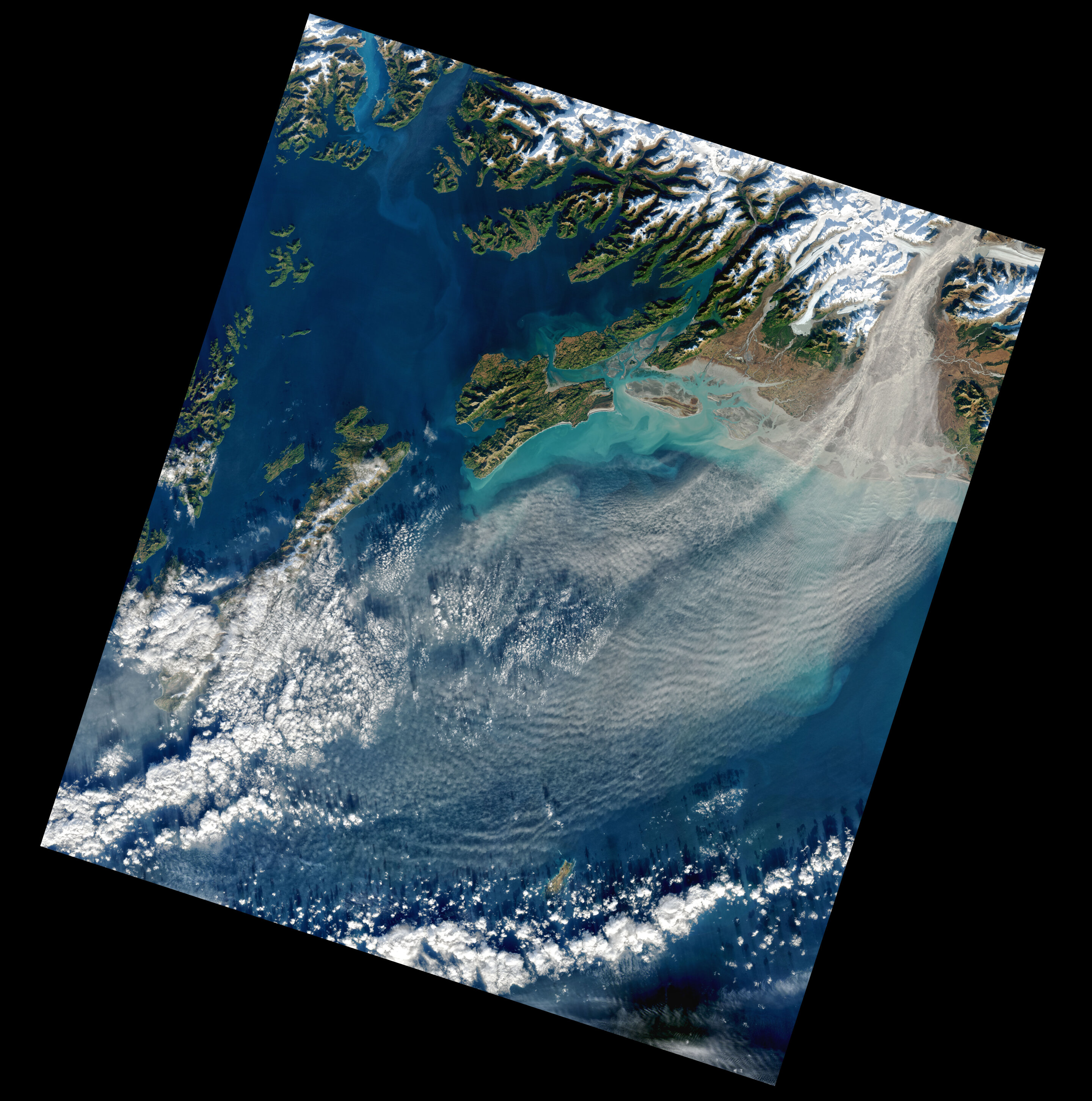
Alaskan dust storm [image credit: NASA]
Although this was already a known effect to some extent, the new research suggests the effect is ‘bigger than previously thought’. Anything linked to cloud formation is significant, including for climate modellers.
– – –
Giant dust storms in the Gulf of Alaska can last for many days and send tons of fine sediment or silt into the atmosphere, and it is having an impact on the global climate system, say scientists.
The storms are so extensive they can be seen by satellites orbiting the Earth, reports Phys.org. An image captured by the Landsat satellite in 2020 shows dust blowing out of the valley and over Alaska’s south coast.
Exactly how the dust may be influencing the global climate system is not yet clear, although new research from the University of Leeds and the National Center for Atmospheric Science suggests the effect is bigger than previously thought.
How ice forms in clouds
At a low enough temperature, the silt—microscopic fragments of rock, minerals and vegetation—act as ice nucleating particles, which encourage the formation of ice crystals in clouds.
Whether ice formation in clouds will add to global warming or help cool the planet depends on how much ice they contain, how many ice nucleating particles are present and the nature of those particles.
In a paper, titled “Southern Alaska as a source of atmospheric mineral dust and ice-nucleating particles,” published in the journal Science Advances, the research team argue that more research is needed to understand the role that dust plays in the complex global climate system.
. . .
Professor Benjamin Murray, an Atmospheric Scientist in the School of Earth and Environment at Leeds who supervised the study, said, “Only a small fraction of the dust particles in the atmosphere has the capacity to nucleate ice and we are only just starting to understand their sources and global distribution.
“Whether a cloud becomes more or less reflective of sunlight depends on how much ice is in them, so we need to be able to understand and quantify the various sources of ice-nucleating particles around the globe.
“At present, climate models tend not to represent these high-latitude sources of dust, but our work indicates that we need to.”
Full report here.
– – –
Research article: Southern Alaska as a source of atmospheric mineral dust and ice-nucleating particles (Aug. 2023)
via Tallbloke’s Talkshop
August 20, 2023 at 07:21AM
 Iowa Climate Science Education