
0 out of 10 based on 0 rating
via JoNova
September 30, 2023 at 09:14PM
Why climate models not yet worth their salt!
By Jim Steele
As all hurricane researchers lament, model predictions of when and where hurricanes will intensify, have not improved much in the past 20 years. As recently as the early 2010s, weather model forecasts failed to predict 88 percent of rapidly intensifying tropical storms. Nonetheless National Public Radio (NPR) has ranted that hurricanes are “intensifying more quickly, turning from less-serious storms to very strong ones in hours or days. Superheated ocean waters hold a lot of extra energy, and a growing storm can draw from that enormous pool.” But such “superheated water” is not widespread as rising CO2 narratives suggest, but found only in very limited regions and usually associated with “barrier layers”.
Hurricanes intensify as they draw “superheated” subsurface waters of 65.5°F or higher. However, when a hurricane’s suction pulls up cooler subsurface waters, the hurricane weakens. This negative feedback naturally limits the intensity of all hurricanes. In the upper panel of the attached graphic, Arnand (2023) illustrates where thin barrier layer exists, hurricane intensity hovers around Category 1. In contrast, where thick barrier layers form, cooler deep waters are prevented from reaching the surface, and instead allow superheated sub-surface waters to cause rapid intensification.
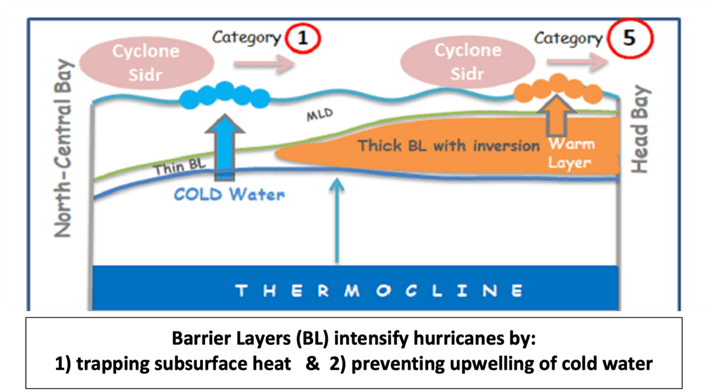
Denser fluids don’t naturally rise above less dense fluids! Barrier layer formation happens wherever freshwater overlays dense salty waters. Although solar heating would normally make subsurface waters less dense and rise to the surface, layers with higher saltiness makes the water more dense which inhibits warm convection. That traps and intensifies the subsurface heat, enabling hurricanes to intensify to Category 5.
As illustrated, solar ponds can produce useful heat and electrical generation by simply maintaining a dense salty layer at about a 10-foot depth and overlay it with a fresh upper surface layer. As illustrated in the left-hand graphic, despite ambient air temperatures of only 30°C, solar pond’s dense salty layer reaches 90°C. ( For more details regards solar ponds dynamics, watch Science of Solar Ponds Challenges the Climate Crisis )
Similar to solar pond dynamics, the right graphic of the middle panel documents a natural forming barrier layer in the Bay of Bengal, where subsurface temperatures that would normally be cooler than the surface were “superheated” to 4.5°C warmer than the surface layer. In the Bay of Bengal thick barrier layers often form and intensify cyclones due to freshwater flows from the Ganges and Brahmaputra Rivers overlaying dense salty water. Likewise, thick barrier layers are common in the south China Sea due to freshwater outflow from the Yangtze River (Chángjiāng). Barrier layers form in the Caribbean due to outflows from the Amazon and Orinoco Rivers, while outflows from the Mississippi River cause barrier layers in the Gulf of Mexico.
Intensification does not require higher ocean heat content. Climate models fail to accurately predict hurricane intensification because the models rely on sea surface temperatures and ocean heat content, but lack good subsurface saltiness data to determine barrier layer dynamics. Miles (2023) studying the intensification of Hurricane Ida in 2021 concluded that even with marginal ocean heat content, barrier layers are conducive to storm intensification. By not including barrier layer dynamics, climate model predictions have suffered high failure rates yet still incorrectly attribute hurricane intensification to rising CO2.
Hurricane Katrina was one of the worst natural disasters in US history causing over 1800 deaths and billions of dollars of damage. New Orleans was susceptible to heavy hurricane-induced flooding because humans dried out the land causing the city to sink, while the government failed to maintain the required levees. Although Katrina was only a Category 3 when it struck New Orleans it is often described as a Category 5. Thus, the tragedy of Katrina prompted a flurry of research on extreme weather attribution and proclamations of a climate crisis. But the bottom panel of the attached graphic shows Katrina only intensified to a Category 5 for a brief time in a limited area, consistent with barrier layer formation.
The Gulf of Mexico’s summer surface temperature hovers between 28 to 29°C as the Loop Current delivers warm and salty tropical water. As that current pushes closer to the Gulf Coast and gets covered by fresh Mississippi water, barrier layers form. As Katrina’s storm track reveals, it was a weak Category 1 off the coast of southern Florida suggesting a lack of any “superheated” water that alarmist suggest rising CO2 is causing. Then over a 24-hour period Katrina intensified from a Category 3 to a Category 5, then weakened back to a Category 3, again consistent with barrier layer dynamics.
The fact that extreme Category 5 hurricanes are clustered over a few years, and then disappear for another 5 to 8 years, suggests the variability in dense salty currents and freshwater outflows, will cause variable formation of thick barrier layers. But the media rarely ever educates the public about barrier layers. Likely because barrier layers provide an alternative scientific warming dynamic that conflicts with the CO2 crisis narratives.
You can always recognize biased alarmist scientists and media. They will report the intensification of a hurricane in a very small region for a very short time where barrier layers form, and only blame it on CO2global warming.
via Watts Up With That?
September 30, 2023 at 08:06PM
Essay by Eric Worrall
Microsoft appears to have quietly accepted the reality that renewables cannot deliver the reliable and affordable energy their data centers need.
Principal Program Manager Nuclear Technology
Multiple Locations, United States
Date posted Sep 25, 2023
Job number 1627555
Work site Up to 100% work from home
Travel 0-25 %
Role type Individual Contributor
Profession Program Management
Discipline Technical Program Management
Employment type Full-Time
Overview
“The next major wave of computing is being born, as the Microsoft Cloud turns the world’s most advanced AI models into a new computing platform,” said Satya Nadella, chairman and chief executive officer of Microsoft. “We are committed to helping our customers use our platforms and tools to do more with less today and innovate for the future in the new era of AI.”
We’re looking for a Principal Program Manager, Nuclear Technology, who will be responsible for maturing and implementing a global Small Modular Reactor (SMR) and microreactor energy strategy.
This senior position is tasked with leading the technical assessment for the integration of SMR and microreactors to power the datacenters that the Microsoft Cloud and AI reside on. They will maintain a clear and adaptable roadmap for the technology’sintegration, diligently select and manage technology partners and solutions, and constantly evaluate the business implications of progress and implementation.
…
Before you rush to brush up your CV, the job mentions they are no longer accepting applications.
Microsoft also inked a deal in June with Constellation Energy to supply nuclear power to one of their data centres.
Microsoft tried the renewable route, but it obviously isn’t working out.
Back in 2015 Bill Gates announced a $1 billion investment in clean energy. But by 2018 he had cooled somewhat on renewables over concerns battery technology wasn’t up to the job of firming intermittent energy sources, though he still seems to be slinging lots of cash at exotic energy projects, such as organic solar cell development.
As far as I’m aware Bill Gates and Microsoft have not made an official comment on why they need a nuclear programme. Which seems rather a shame, because a strong statement from someone as well known as Bill Gates could potentially help save the world from squandering trillions of dollars on useless renewables.
via Watts Up With That?
September 30, 2023 at 04:01PM
By Paul Homewood
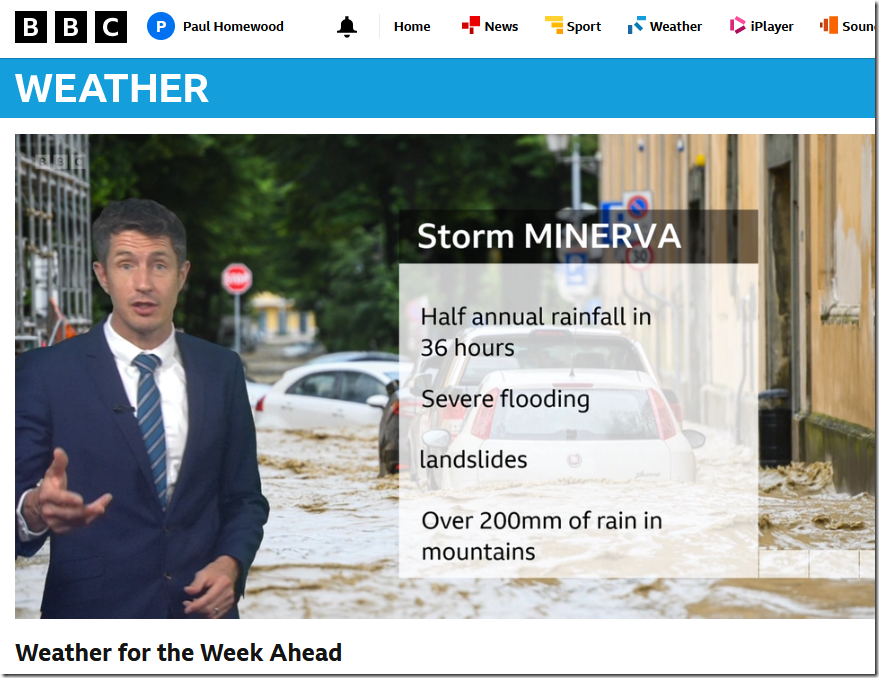
https://www.bbc.co.uk/weather/av/65640935
Another BBC complaint is wending its way the their Executive Complaints Unit!
You will probably remember their claim after the Bologna floods in May of “half annual rainfall in 36 hours”. The claim was made by weatherman Chris Fawkes, as a lead in to the weather forecast.
He mentioned “over 200mm of rain”, but average annual rainfall in the region is about 1000mm, so the claim was clearly fake.
I therefore complained at the time, and asked them to substantiate their claim. They still have failed to do so.
Their first response was the usual waste of time. The second response states:
I have gone back to Chris Fawkes who is adamant that the information provided in his video was correct and was based on official data. His voiceover said: Storm Minerva brought with it half a years’ worth of rainfall in places falling in just 36 hours.”
He says: “The BBC weather supplier Meteogroup stated “Observations show that Ferrara has seen 207mm in the 36 hours to 06z this morning. Bologna has seen 127mm of rain in the same 36 hour period – this is more than double the May average of 58mm.
“What I can see is that Ferrara is a lowland site in Emilia-Romagna. During this rainfall event the prevailing winds were northeasterly – these winds would have pushed the weather system into the Apennines and would very certainly have brought much larger rainfall totals over high ground. In short the Meteogroup observation would corroborate the statement from Civil Protection Minister Nello Musumeci that 20cm of rain fell in 36hrs. I don’t have observations for the 500mm of rain he also reported, national meteorology centres often have some observations that aren’t widely available publicly, but I also have no specific reason to doubt his statement either.”
In other words, he actually backs up my complaint, saying that the 36 hour rainfall was “more than double the May average”, not half a year’s worth, and admitting there is no evidence of 500mm falling anywhere.
Of course, 500mm may have fallen somewhere, but they are unable to find any data to that effect. “Maybes” are not facts. And viewers are entitled to the facts, not least when they come from a weatherman, who is supposed to deal in hard facts and not climate propaganda.
I have therefore escalated the complaint to the ECU, with this reply:
Your second response dated 27th September goes into great detail, but actually confirms my original complaint, ie that there is no evidence that “half of annual rainfall fell in 36 hours”.
As Chris Fawkes notes, the highest rainfall amount recorded appears to be at Ferrara, which had 207mm in 36 hours. Your response states that the average annual rainfall in the region is 1000mm, so 207mm would be the equivalent of about two and a half months.
It may be that higher amounts fell elsewhere, but there is no evidence of this.
Therefore a correction should be published to the effect that the original claims have not been officially confirmed or substantiated. The correction should also include the actual rainfall figures and annual averages mentioned above.
Their first response, by the way, quoted the comment at the time by Italy’s Civil Protection Minister Nello Musumeci that 500mm had fallen in some areas. I replied that I wanted evidence of his claim, and pointed out that it is of course the BBC’s duty to challenge the claims of politicians, instead of merely accepting them as gospel truth.
Their latest response laughingly states that “I am unsure why you feel what the minister said was wrong or untrustworthy”!
Can you imagine the BBC ever accepting to words of a Tory UK minister as gospel?
via NOT A LOT OF PEOPLE KNOW THAT
September 30, 2023 at 12:18PM
 Iowa Climate Science Education