How a new method of inferring ancient population size revealed a severe bottleneck in the human population which almost wiped out the chance for humanity as we know it today.
An unexplained gap in the African/Eurasian fossil record may now be explained thanks to a team of researchers from China, Italy and the United States.
[…]
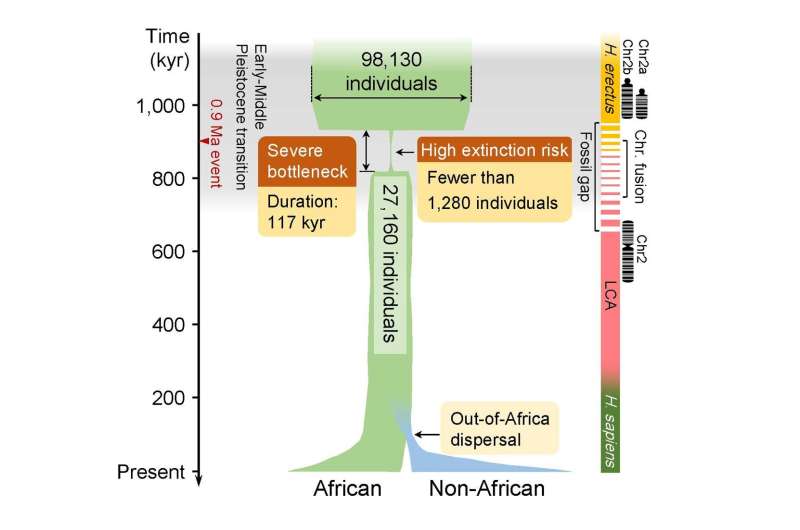
These findings indicate that early human ancestors went through a prolonged, severe bottleneck in which approximately 1,280 breeding individuals were able to sustain a population for about 117,000 years. While this research has illuminated some aspects of early to middle Pleistocene ancestors, there are many more questions to be answered since uncovering this information.
[…]
Reasons suggested for this downturn in human ancestral population are mostly climatic: glaciation events around this time lead to changes in temperatures, severe droughts, and loss of other species, potentially used as food sources for ancestral humans.
The African hominin fossil gap and the estimated time period of chromosome fusion is shown on the right. Credit: Science (2023). DOI: 10.1126/science.abq7487
An estimated 65.85% of current genetic diversity may have been lost due to this bottleneck in the early to middle Pleistocene era, and the prolonged period of minimal numbers of breeding individuals threatened humanity as we know it today.
What was going on from 1,000-800 ka that may have nearly wiped out our ancestors? Temperatures plunged, glaciers and ice sheets started expanding, sea levels fell & began oscillating with glacial cycles and atmospheric CO2 dropped to its lowest level in 400 million years.
Reference
Kenneth G. Miller et al. ,Cenozoic sea-level and cryospheric evolution from deep-sea geochemical and continental margin records.Sci. Adv.6,eaaz1346(2020).DOI:10.1126/sciadv.aaz1346

 Iowa Climate Science Education