Month: September 2023

Pyrenean caves reveal a warmer past – Net Zero Watch

Pyrenees view

The finding that ‘the temperature increase [since 1950] is most notable in the past 2500 years’ fits with the recent research of Prof. Harald Yndestad (as we featured here). Natural climate variation never went away.
– – –
The world’s high mountain regions are particularly sensitive to climate change, says Dr David Whitehouse @ Net Zero Watch.

Straddling the border between France and Spain the Pyrenees occupy a crucial position in southern Europe, influenced by both Mediterranean and Atlantic climates.

New research published in the journal ‘Climate of the Past,’ investigating climate proxy data based on stalagmites is revealing that past climates were warmer than our own.

This is the first climate reconstruction in the region based on speleothems over the past 2500 years. Previous reconstructions have been based on lake sediments, tree-rings and glaciers.

Global surface temperatures in the first two decades of the 21st century (2001–2020) were 0.84 to 1.10°C warmer than 1850–1900 AD (IPCC, 2021). According to the IPCC anthropogenic global warming is unprecedented in terms of absolute temperatures and spatial consistency over the past 2000 years.

However, pre-industrial temperatures were less spatially coherent, and further work is needed to explain regional and natural climate change. Thus, according to the authors of the new study, “obtaining new and high-quality records in terms of resolution, dating and regional representativeness is thus critical for characterising natural climate variability on decadal to centennial scales.”

It is clear that the Pyrenees has followed the global trend. Their temperature has increased by more than 1.5 °C since 1882, as shown by the longest time series recorded at the Pic du Midi observatory. Recent studies confirm this warming trend, showing an increase of 0.1 °C per decade during the last century in the Central Pyrenees, or even 0.28°C per decade if only the 1959-2015 period is considered.

In addition, long-term snow depth observations (starting in 1955) show a statistically significant decline, especially at elevations above 2000 m. The glaciated area has decreased by 21.9% in the last decade from 2060 ha during the Little Ice Age (LIA) to 242 ha in 2016.
. . .
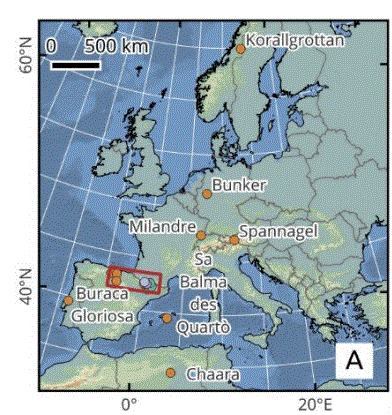
The new work has been carried out by researchers from seven nations and led by the Department of Geoenvironmental Processes and Global Change, Pyrenean Institute of Ecology in Zaragoza (Spain). It presents a composite record of oxygen isotope variations during last 2500 years based on eight stalagmites from four caves in the central Pyrenees dominated by temperature variations, with precipitation playing a minor role.
. . .
In summary: Over the past 2500 years it was the Roman Period that was the warmest. A cold period started around 300 AD with two particularly cold events in 500-650 and 750-850. The warm and dry Medieval Climatic Anomaly was well observed as well as the Little Ice Age.

Cooling was observed during the Maunder Minimum and possibly the Dalton Minimum, both periods of low solar activity. Low temperatures started to increase around 1950 and the temperature increase since then is most notable in the past 2500 years.

Full article here.

via Tallbloke’s Talkshop

https://ift.tt/Ex1thL2

September 12, 2023 at 02:43PM

2,500 years of wild climate change in southern Europe: It was warmer in Roman Times than now

Pyrenes, Cave, Medieval, Little Ice Age, Roman Times. Temperature.By Jo Nova

Nothing at all about the modern era stands out as unusual at all

Thanks to David Whitehouse at NetZeroWatch who has found a remarkable paper: Pyrenean caves reveal a warmer past

The new study on stalagmites in caves of the Pyrenees shows that modern climate change is nothing compared to normal fluctuations in the last 2,500 years, when it was at times  much hotter, colder, and more volatile. Rapid shifts between temperatures were common.

The researchers looked at 8 stalagmites in 4 caves and local lake levels, but they also compared their results with other European temperature proxies and reconstructions and the pattern is consistent across the region. The Roman Warm Period was much hotter than today even though coal plants were rare.  There was a reason people wore togas.

The Dark Ages were very cold, especially around 520 – 550AD — which may be related to what the researchers call a “cataclysmic” volcanic eruption that took place in Iceland in 536AD. It was followed by two other massive volcanoes in 540 and  547AD. This effect is apparently visible in European tree rings which showed “an unprecedented, long-lasting and spatially synchronized cooling”.

Indeed, the researchers declare that volcanoes and solar variability appear to be the main drivers of the climate in SouthWestern Europe.

So finally we see one long continuous proxy record from ancient Greek times right through until 2010. The big question is why these sorts of studies are not done everywhere and all the time. It’s not like we don’t have plenty of caves with stalagmites to analyze. If the climate really was “the biggest threat to life on Earth” why are these extraordinary datasets not the top item on the wish-list of every institution that claims they cares about the climate?

There will be more to say on this remarkable paper:


Some passages from the paper discuss how these results match other studies from Europe

The cold event at ca. 540 AD (the coldest of the speleothem record) may be related to a cataclysmic volcanic eruption that took place in Iceland in 536 AD and spewed ash across the Northern Hemisphere, together with the effect of two other massive eruptions in 540 and 547 AD (Sigl et al., 2015). An unprecedented, long-lasting and spatially synchronized cooling was observed in European tree-ring records associated with these large volcanic eruptions, corresponding to the LALIA period (Büntgen et al., 2016).

Some passages from the paper discuss how these results compare with many other studies from Europe and with stark moments in history.

5.2.2. Temperature variability in W Europe and the W Mediterranean during last 2500 years
There are very few high-resolution speleothem records in Europe covering the CE (Comas-Bru et al., 2020). We compare the Central Pyrenean speleothem composite with nine selected speleothems records in Europe  and northern Africa which cover with robust chronology and decadal resolution the last 2500 years (Fig.  5). One of these records is interpreted as NAO variability (Baker et al., 2015), three are paleo-precipitation reconstructions (Ait Brahim et al., 2019; Cisneros et al., 2021; Thatcher et al., 2022) and the other five are  reflecting paleo-temperature variations (Affolter et al., 2019; Fohlmeister et al., 2012; Mangini et al., 2005;  Martín-Chivelet et al., 2011; Sundqvist et al., 2010). Considering these differences in the interpretation and the fact these records are from different regions with different climates (from Sweden to Morocco), dissimilar profiles of paleoclimate variability can be expected. Still, some features are comparable and can be discussed to obtain a super-regional picture.

A. The Roman period in Europe-W Mediterranean. In Europe, and particularly in the Mediterranean region, the RP is well-known as a warm period (e.g., McCormick et al., 2012). The average sea-surface temperature in the western Mediterranean Sea was 2°C higher than the average temperature of the late centuries (Margaritelli et al., 2020). Our composite, with high values of normalized  18O values during the whole RP, and particularly from 0-200 AD, agrees with the scenario of warm temperatures (Fig. 5i). Speleothem data from the Balearic Islands (Cisneros et al., 2021) indicate a transition from humid to dry conditions along the Iberian-RP (Fig. 5c). The dry period at the end of the RP in the Balearic record, appears in agreement with a new speleothem record from northern Italy (Hu et al., 2022), suggesting that the observed drying trend was a possible contribution to the collapse of the Roman Empire in 476 AD. Record from Morocco (Ait Brahim et al., 2019), contrarily, marks a humid trend at the end of the RP (Fig. 5d). Similarly, an increase in humidity was observed in southern Iberia during the Iberian-Roman Period (Jiménez-Moreno et al., 2013; Martín-Puertas et al., 2009) thus reflecting a large spatial heterogeneity in precipitation during the RP when comparing records from the north and south of the Mediterranean basin.

REFERENCES

Bartolomé, M., Moreno, A., Sancho, C., Cacho, I., Stoll, H., Haghipour, N., Belmonte, Á., Spötl, C., Hellstrom, J., Edwards, R. L., and Cheng, H.: Reconstructing land temperature changes of the past 2,500 years using speleothems from Pyrenean caves (NE Spain), Clim. Past Discuss. [preprint], https://ift.tt/Quc0wI9, in review, 2023.


0 out of 10 based on 0 rating

via JoNova

https://ift.tt/cK2Peab

September 12, 2023 at 02:37PM

Sydney Airport EV Fire Destroys 5 Vehicles

Essay by Eric Worrall

Should Electric Vehicles be banned from airports and ferries?

Five cars destroyed at Sydney Airport after battery from luxury electric vehicle ignites

By Olivia Ireland
September 12, 2023 — 4.48pm

Five cars have been destroyed at Sydney Airport after a battery from a luxury electric car burst into flames.

About 8.30pm on Monday, firefighters were called to a parking lot on Airport Drive in Mascot after flames engulfed a luxury electric car before spreading to another four vehicles.

Research officers from Fire and Rescue’s Safety of Alternative and Renewable Energy Technologies team have also been at the scene.

Fire and Rescue NSW Superintendent Adam Dewberry said … “There had been some problem with the car and the battery had been removed, we believe that the car has suffered some mechanical damage which can contribute to a battery breaking down and catching fire without notice.

“We don’t have a concern about this broadly, it’s not often that electric cars catch fire.”

Read more: https://www.smh.com.au/national/nsw/five-cars-destroyed-at-sydney-airport-after-battery-from-luxury-electric-vehicle-ignites-20230912-p5e43h.html

The fire chief Adam Dewberry claims they don’t have a concern about this broadly, but in that case, why do they need a special fire department renewable energy technologies team?

Even if an EV needs minor accident damage to turn it into a ticking time bomb, airports are notorious for minor bumps and scrapes, lots of people arrive late and have to rush to catch their flight. If a minor bump can turn an EV into a ticking time bomb, at the very least EVs should be isolated in their own fire hazard area, especially if they show any signs of damage.

As for passenger ferries, I mean we’ve all seen what an EV can do to a vehicle transport ship – ferocious white hot flames which can’t be quenched, even by experienced maritime fire control officers.

Even if the risk is small, it’s still only a matter of time until a group of EV’s parked next to each other on board a passenger ferry catch fire and torch the entire ship, leading to massive loss of life, and lifelong injuries to survivors who inhaled toxic lithium smoke.

via Watts Up With That?

https://ift.tt/0vadpoO

September 12, 2023 at 12:11PM

No One Talks About It: Solar System “Climate Change”… Happening Beyond Planet Earth

Mysteriously, warming is happening across the solar system. The one common factor is at the center of it all: the sun. 
Artist's Concept of Solar Storm Hitting MarsThe solar system’s powerful sun. Artist’s image of a solar storm hitting Mars, stripping ions from the planet’s upper atmosphere. Image: NASA, public domain. 

Because man is burning fossil fuels, our planet is allegedly becoming increasingly covered by a blanket of “heat-trapping” greenhouse gases, scientists like to make people believe. The recent global warming simply couldn’t have anything to do with the sun, they insist.

They’re likely way off the mark.

Today German prof. Stefan Homburg tweeted a summary of warming that’s happening at other places within our solar system, suggesting the sun is behind it.

“Global warming isn’t only happening on earth,” he tweets.

Triton has warmed 3°K

For example, warming is happening on Triton, Neptune’s moon. According to Germany’s wissenschaft.de: “Neptune’s giant moon Triton is the first body in the solar system where global warming could be detected.”

According to measurements, the atmospheric pressure doubled and the temperature rose 3 degrees Kelvin. “The cause is probably higher solar irradiation of the nitrogen ice cap at Triton’s south pole.”

Mars warmed 0.65°K since 1970s

German online news weekly Stern also reported in 2007: “The average temperature on Mars has risen by about 0.65 degrees Celsius since the 1970s,” citing American astronomers. Blamed here, though, are Martian dust storms. Why would dust storms on Mars be getting stronger? It’s likely linked to increased solar activity.

The Moon 3°C warmer, due to man!

Newly analyzed temperature data show the surface temperature of the moon raised by about three degrees Celsius, reported Germany’s Business Insider here in 2018. But NASA blames the astronauts!  “By walking around and poking at the lunar surface.”

“Climate change” on Pluto

According to www.wissenschaft.de here, Pluto’s atmosphere has warmed to being 40°K warmer than the temperature at the surface (-220°C). The reason for this temperature gradient is the “absorption of sunlight [by methane] reflected from Pluto’s surface into the atmosphere.”

Methane makes up only half a percent of Pluto’s  atmosphere. This small fraction heats the atmosphere in sunlight.

But not only Triton, Pluto and Mars are warming in our solar system, as Prof. Homburg suggests, other planets are warming as well. And there’s only one common denominator: The Sun. Global warming scientists do all they can to ignore this rampaging elephant in the room.

Jupiter’s “planetary heat wave”

Scientists last year found “an unexpected ‘heat wave’ of 700 degrees Celsius, extending 130,000 kilometers in Jupiter’s atmosphere.”

What’s behind it? Jupiter experiences variable intensity auroras around its poles as an effect of the solar wind.

Saturn heating

The surface of Saturn has been “slowly heating up” as well, reports Popular Science here. But NASA blames Saturn’s rings for the recent phenomenon.

According to the paper, the most feasible explanation is that icy ring particles raining down onto Saturn’s atmosphere cause this heating. writes Popular Science. “A few things could be driving this shower of particles, including the impact of micrometeorites, bombardments with particles from solar wind, solar ultraviolet radiation, or electromagnetic forces picking up electrically charged dust. Additionally, Saturn’s gravitational field is pulling particles into the planet while this is all occurring.

Note how it’s never the sun’s solar activity and variability. It’s always some mysterious explanation.

Yet, there’s a reason why it’s called the “solar” system. It’s because the sun is at its center, and so its solar storms and variability impact all the bodies in it.

Donate – choose an amount


via NoTricksZone

https://ift.tt/EBe0i5P

September 12, 2023 at 11:29AM