Month: September 2023

‘Biggest clean energy disaster in years’ — UK government sells rights to the wind and no one wants them

Wind farm offshoreBy Jo Nova

The free market has spoken

Wind energy is so cheap and profitable that last week, investors abandoned the annual UK auction to build industrial wind plants in the oceans around the UK. Exactly no one offered to spend money building turbines even though electricity prices are burning hot. Apparently prices for building the machinery to collect and transmit low density erratic energy are not “free” like the wind. Even after decades of advances, sacred green electrons still cost a lot more than war-afflicted-fossil-fuel electrons do.

At The Guardian, – it was, of course, all the Governments fault, and the dreaded Hand Of Inflation. It’s so unfair:

Lack of interest was widely expected after government failed to heed warnings about soaring costs

Jillian Ambrose

None of the companies hoping to build big offshore windfarms in UK waters took part in the government’s annual auction, which awards contracts to generate renewable electricity for 15 years at a set price.

The companies had warned ministers repeatedly that the auction price was set too low for offshore windfarms to take part after costs in the sector soared by about 40% because of inflation across their supply chains.

Matt Ridley explained what really happened:

Electricity from wind isn’t cheap and it never will be

The latest auction of rights to build offshore wind farms failed to attract any bids, despite offering higher subsidised prices. That alone indicates that wind is not cheap or getting cheaper.

But the real reason for the lack of interest in the auction is that, for the first time, bidders are not free to walk away from their bids when it suits them. In the past, they could put in low offers, boast about them being cheap, then take the higher market price later. The Government has at last called their bluff, so they are having to admit that electricity prices need to be higher to make wind farms pay.

The cost of subsidising wind is vast. Then add the cost of getting the power from remote wind farms to where people live. And the cost of balancing the grid and backing wind up with gas plants for the times when the wind drops. And the cost of paying wind farms to reduce output on windy days when the grid can’t take it.

And yet the wind industry is complaining that today’s high electricity prices are not high enough, and without more subsidies they will stop building

The true cost of adding wind power to the electricity grid was always hidden with complex schemes. Apparently somehow wind energy is still cheap

It’s a catastrophe

At The Guardian, this auction was described as “catastrophic”, so we know it’s good news:

Sam Richards, the founder and campaign director of Britain Remade, which campaigns for economic growth in Britain, said the “catastrophic outcome” of the auction was “the direct result of the government’s complacency and incompetence”.

The government didn’t listen to the industry:

Industry insiders said the three offshore wind developers behind these plans – SSE, ScottishPower and the Swedish company Vattenfall – were forced to sit out the bidding after ministers refused to heed their warnings.

Now if the Government had listened to Exxon that would have been evidence of the planet-wrecking influence of Big Oil, but if the government didn’t listen to Big Renewables, it was incompetent.

Things are so bad, the wind industry is abandoning current half built projects:

The industry warnings intensified after Vattenfall said in July that it would cease working on the multibillion-pound Norfolk Boreas windfarm because rising costs meant it was no longer profitable.

Apparently the British government should have taken more money from citizens or forced the prices of electricity up for customers in order to “deliver low cost energy”, whatever that is:

Keith Anderson, the chief executive of ScottishPower, said: “This is a multibillion-pound lost opportunity to deliver low-cost energy for consumers and a wake-up call for government.

This “Low Cost Energy” seemingly refers to some mythical electrical kilowatthours that only show up on academic reports. It never appears on consumer electricity bills.

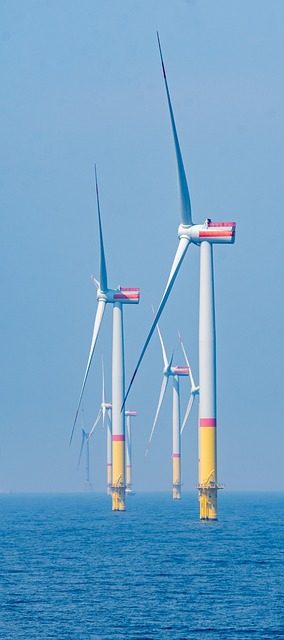
Image by Thomas from Pixabay


0 out of 10 based on 0 rating

via JoNova

https://ift.tt/3DFua8r

September 11, 2023 at 03:19PM

G20: Coal Should be Phased Down “in line with national circumstances”

Essay by Eric Worrall

In response to UN calls for the urgent elimination of coal, the G20 has responded with a commitment to keep coal as long as needed, and to pursue nuclear energy with the same urgency as renewables.

Implementing Clean, Sustainable, Just, Affordable & Inclusive Energy Transitions

38. We commit to accelerating clean, sustainable, just, affordable and inclusive energy transitions following various pathways, as a means of enabling strong, sustainable, balanced and inclusive growth and achieve our climate objectives. We recognise the needs, vulnerabilities, priorities and different national circumstances of developing countries. We support strong international and national enabling environments to foster innovation, voluntary and mutually agreed technology transfer, and access to low-cost financing. To this end, we:

  1. Emphasise the importance of maintaining uninterrupted flows of energy from various sources, suppliers and routes, exploring paths of enhanced energy security and market stability, including through inclusive investments to meet the growing energy demand, in line with our sustainable development and climate goals, while promoting open, competitive, non-discriminatory and free international energy markets.
  2. Recognizing that developing countries need to be supported in their transitions to low carbon/emissions, we will work towards facilitating low-cost financing for them.
  3. Support the acceleration of production, utilization, as well as the development of transparent and resilient global markets for hydrogen produced from zero and low-emission technologies and its derivatives such as ammonia, by developing voluntary and mutually agreed harmonising standards as well as mutually recognised and inter-operable certification schemes. To realise this, we affirm the ‘G20 High Level Voluntary Principles on Hydrogen’, to build a sustainable and equitable global hydrogen ecosystem that benefits all nations. We take note of the Presidency’s initiative to establish the Green Hydrogen Innovation Centre steered by the International Solar Alliance (ISA).
  4. Will work towards facilitating access to low-cost financing for developing countries, for existing as well as new and emerging clean and sustainable energy technologies and for supporting the energy transitions. We note the report on “Low-cost Financing for the Energy Transitions” prepared under the Indian Presidency and its estimation that the world needs an annual investment of over USD 4 trillion, with a high share of renewable energy in the primary energy mix.
  5. Will pursue and encourage efforts to triple renewable energy capacity globally through existing targets and policies, as well as demonstrate similar ambition with respect to other zero and low-emission technologies, including abatement and removal technologies, in line with national circumstances by 2030. We also note the ‘Voluntary Action Plan for Promoting Renewable Energy to Accelerate Universal Energy Access’.
  6. Pledge to advance cooperation initiatives to develop, demonstrate and deploy clean and sustainable energy technologies and solutions and other efforts for innovation.
  7. Take note of the ‘Voluntary Action Plan on Doubling the Rate of Energy Efficiency Improvement by 2030’.
  8. Recognize the importance of sustainable biofuels in our zero and low- emission development strategies, and note the setting up of a Global Biofuels Alliance.
  9. Support reliable, diversified, sustainable and responsible supply chains for energy transitions, including for critical minerals and materials beneficiated at source, semiconductors and technologies. We take note of the Presidency’s “Voluntary High- Level Principles for Collaboration on Critical Minerals for Energy Transitions”.
  10. xi. Recognize the role of grid interconnections, resilient energy infrastructure and regional/cross-border power systems integration, where applicable in enhancing energy security, fostering economic growth and facilitating universal energy access for all.
  11. x. For countries that opt to use civil nuclear energy, will collaborate on voluntary and
  12. mutually agreed terms, in research, innovation, development & deployment of civil nuclear technologies including advanced and Small Modular Reactors (SMRs), in accordance with national legislations. These countries will promote responsible nuclear decommissioning, radioactive waste and spent fuel management and mobilizing investments, and share knowledge and best practices, through strengthening international cooperation to promote nuclear safety globally.
  13. Will increase our efforts to implement the commitment made in 2009 in Pittsburgh to phase-out and rationalise, over the medium term, inefficient fossil fuel subsidies that encourage wasteful consumption and commit to achieve this objective, while providing targeted support for the poorest and the most vulnerable.
  14. Recognise the importance to accelerate the development, deployment and dissemination of technologies, and the adoption of policies, to transition towards low-emission energy systems, including by rapidly scaling up the deployment of clean power generation, including renewable energy, as well as energy efficiency measures, including accelerating efforts towards phasedown of unabated coal power, in line with national circumstances and recognizing the need for support towards just transitions.

Read more: https://www.g20.org/content/dam/gtwenty/gtwenty_new/document/G20-New-Delhi-Leaders-Declaration.pdf

Good news for nuclear – modular reactors, explicitly mentioned in the text, are clearly one of the “other zero and low-emission technologies” to be pursued, with similar ambition to renewables.

Coal to be phased out “in line with national circumstances” – so as an when alternatives become available.

Not a good day for the renewables industry – in addition to promoting the role of small modular nuclear reactors, the statement emphasises the need for “resilient energy infrastructure”, in my opinion likely a veiled rebuke at Western pressure for developing nations to embrace intermittent, unreliable and unaffordable renewable energy technologies, which clearly are not ready or fit for purpose.

The document also makes mention of climate change and climate finance elsewhere, in sections I didn’t quote.

My overall impression is the document is a commitment to business as usual, with a little woke window dressing. The document is yet another strong indication that developing countries prize economic growth above the Western obsession with CO2 emissions, and are increasingly unafraid to say so.


Click here for more information on the economic obstacles to achieving Net Zero.

via Watts Up With That?

https://ift.tt/xN0gqvt

September 11, 2023 at 12:01PM

Proof You Can’t Fix Stupid!

By Paul Homewood


h/t Mike Rennoldson


This one really takes the biscuit!


 image

via NOT A LOT OF PEOPLE KNOW THAT

https://ift.tt/6AIDm05

September 11, 2023 at 11:54AM

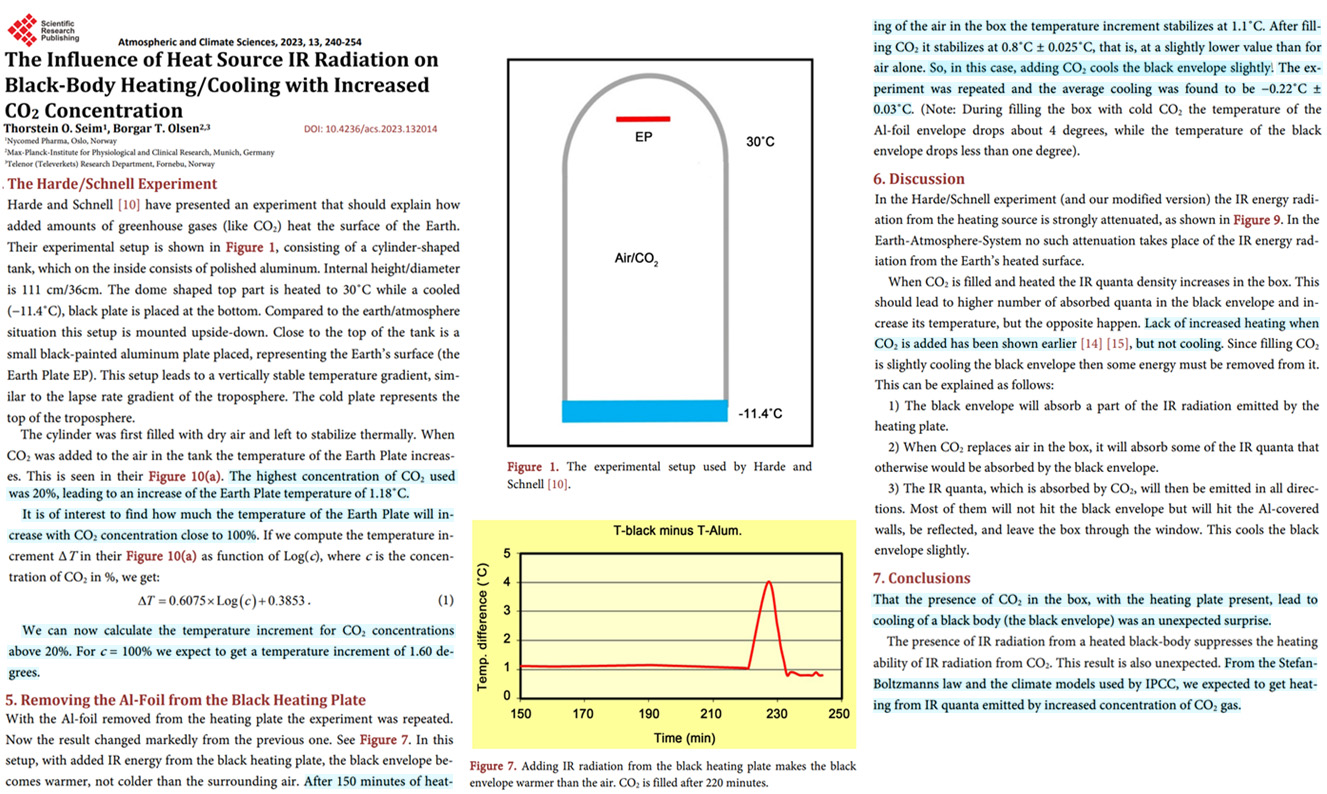
Lab Experiment Shows A 2500-Fold CO2 Increase Delivers Surface Cooling, Not Warming

In a modified experiment, where IR emission from the heating source is present, no heating but a slight cooling of a black object is found when air is replaced by CO2. The modified experimental situation is also more like the earth/atmosphere situation.”  – Seim and Olsen, 2023

Scientists Hermann Harde and Michael Schnell published a paper in 2021 entitled “Verification of the Greenhouse Effect in the Laboratory.” The study purported to experimentally determine that the atmospheric CO2 greenhouse effect not only exists, but functions in concert with physical laws.

“To our knowledge we present the first demonstration of the atmospheric greenhouse effect in a laboratory experiment, which also allows quantitative measurements under conditions as in the lower troposphere. We use an experimental set-up consisting of two plates in a closed housing, one plate in the upper position heated to 30°C, the other at the bottom and cooled to -11.4°C.”

Thorstein Seim and Borgar Olsen (2023) have analyzed their experimental setup in further detail. They discover that in the Harde and Schnell (2021) greenhouse effect experiment, when the CO2 is increased 500-fold, or from 0.04% (400 ppm) to 20% (200,000 ppm), the plate temperature increases by just 1.18°C. Further, raising CO2 from 20% to 100% (1,000,000 ppm) adds just 0.4°C additional warming (1.6°C).

Since it is assumed that the 100 ppm (0.01%) atmospheric CO2 increase since 1950, from ~310 to 410 ppm, has been the primary cause of 1950-to-present global warming, an experiment that shows increasing CO2 2500-fold (0.04% to 100%) only produces a warming of 1.6°C would hardly appear to support the “verification” of the CO2 greenhouse effect.

Image Source: Seim and Olsen, 2023

But it may be worse than that. Seim and Olsen modify the Harde and Schnell experiment to better simulate “the earth/atmosphere situation.” Instead of modestly increasing the plate temperature by a degree and a half, the modified experiment shows that increasing CO2 from 0.04% to 100% actually cools the blackbody (plate) by about -0.2 to -0.3°C.

The temperature stabilizes at 1.1°C after 150 minutes of heating when only air (78% N2, 21% O2, 0.04% CO2) is used in the container. But when the air is replaced by CO2 (100%), the temperature stabilizes at 0.8°C − a few tenths of a degree cooler. The average cooling when 0.04% CO2 is replaced with 100% CO2 is determined to be -0.22°C.

An observation that shows increasing CO2 by a factor of 2500 elicits cooling in a laboratory is characterized as an “unexpected surprise” by the authors.

Either way, experimental results that show only modest temperature changes occur when CO2 is dramatically increased do not lend support to the “verification” of the CO2 greenhouse effect. And it especially does not validate the popular viewpoint that CO2 is a driving factor in modern global warming.

via NoTricksZone

https://ift.tt/gVN2uB5

September 11, 2023 at 11:38AM