Month: September 2023

Households face £2,300 bills under net zero plans

By Paul Homewood

h/t Philip Bratby


Just one more cost burden from Net Zero:


 image

Households face an estimated bill of £2,300 each to shut down Britain’s gas grid as part of the Government’s drive towards net zero, a leaked draft of an official report suggests.

The cost of decommissioning the grid could reach a total of £65bn, according to a draft National Infrastructure Commission (NIC) report.

It is the first time a public body has examined the future of the 176,000-mile network of buried pipes, which serves eight in ten homes but risks becoming obsolete under plans to reach net zero carbon emissions. Unused pipes must be removed or they risk decay and experts fear the potential collapse of roads.

Households could be left to foot the bill through higher energy bills or taxes since there is no provision for decommissioning in current government budgets, and energy companies are not obliged to cover the costs.

The NIC did not dispute the figures when contacted, although an insider insisted the report was a draft and could change before final publication next month.

The NIC believes the grid could theoretically be converted to carry hydrogen, which is cleaner, but that would also come at cost of “tens of billions of pounds” and there are doubts over the suitability of hydrogen as a mass heating solution.

Senior Conservatives said the figures raised serious questions about the Government’s plan to reach net zero by 2050.

Craig Mackinlay, a Tory MP who chairs the Net Zero Scrutiny Group in Parliament, said: “Bit by bit, the true astronomical cost of net zero is being revealed, and it’s far from clear the products we are being forced to switch to are any better than their forebears.

“The forced conversion from gas boilers to heat pumps appears to be a case in point; it will also leave the country with a vast network of redundant infrastructure that will take tens of billions of pounds to decommission.

“I’m worried the command and control approach to net zero that the Government is taking will leave us with a cost of living crisis that stretches far into the future.”

The prospect of hydrogen heating looked “dead in the water”, Mr Mackinlay added, after Grant Shapps, the former energy secretary, appeared to rule it out in July.

Sir Jacob Rees-Mogg, the former business and energy secretary, said the Government’s net zero plans were “stuck in cloud cuckoo land”.

He said: “The Government cannot decommission the gas grid, because it can’t afford to.

“They have got to look very seriously at whether the legal obligation to reach net zero is realistic.”

However, Kwasi Kwarteng, another former business and energy secretary, said the costs of decommissioning was “hypothetical”.

He said: “Given the infrastructure we’ve got, it doesn’t make sense to decommission the whole grid at vast expense. I cannot see a government doing that.

“It’s unrealistic to expect that all household heating in this country will be electrified.”

Under current proposals for households and businesses to “stop unabated burning of natural gas”, ministers are backing electric heat pumps as the main replacement for gas-fired boilers.

But if most households ditch their boilers, the existing gas grid cannot just be switched off and left in the ground due to safety concerns.

One industry source said: “We’ve got large-diameter pipes criss-crossing major cities. If we were to just turn them off and not maintain them, they would decay – and roads could start falling in.”

Shutting down the gas grid would be a complex but gradual process as people switch to alternative technologies, requiring engineers to safely close off certain areas while allowing gas to keep flowing in others.

The ultimate fate of the network, which was privatised by Margaret Thatcher’s government in 1986, will depend on how much is repurposed to carry hydrogen.

At least some of the grid is likely to be used to supply hydrogen to heavy industry, which cannot easily decarbonise, in future. But ministers are waiting until 2026 to decide whether hydrogen will also be used for home heating.

Many experts have also poured cold water on that idea, pointing out that hydrogen is energy-intensive to produce and must be burned in much higher quantities than natural gas to produce the same amount of heat.

In the meantime, the monopoly owners of the gas networks continue to invest billions of pounds in upgrades, replacing metal pipes with plastic ones, in a programme that stretches into the 2030s.

These investments will be paid for by consumers through their bills – in addition to any future cost of decommissioning.

Dr Richard Lowes, an expert in heating at Exeter University, said the Government should review whether the upgrade programme was still good value for money or would make energy bills unnecessarily higher.

He also warned that as more households abandon gas, those still using the network could be forced to shoulder an ever-larger share of decommissioning costs – raising the risk that those who cannot afford a heat pump become financially “trapped”.

Dr Lowes said: “It’s a huge issue and no one [in the Government] has got their head around this properly.

“Fundamentally, there’s two options: You pay for it through bills, or via the tax system.”

One way to ensure the burden is spread fairly would be for the Government to nationalise the network, which is valued today at about £20bn, he said.

A government spokesman said: “This claim is simply untrue. Our gas network will always be part of our energy system and therefore any such estimations are wrong.

“We have and will always put affordability at the heart of our approach to improving it. We will continue to work with the industry to explore if using hydrogen offers value for money for consumers and meets the required safety standards.”

https://www.telegraph.co.uk/business/2023/09/09/household-energy-bills-britain-gas-grid-shut-down-net-zero/


The govt response is the usual head in the sand one.

“Our gas network will always be part of our energy system “

Seriously? What will it be carrying then – certainly not gas! And not much in the way of hydrogen either by all reports.

For all of the promises of a golden Net Zero future in thirty years time, the harsh and undeniable reality is that there are enormous costs to be paid for, both now and in the next decade or two. It is no consolation to be told we might be a bit better off long after we are dead!

This story also highlights a very serious dilemma.

As more and more households stop using gas, per govt plans, the increasingly small number still using gas will have to pay a much bigger share of the overheads associated with the gas network, and not just these decommissioning costs. As this very good article outlines, the alternative will be for government to assume responsibility for the gas grid and its costs.

A further problem, also outlined, is how we will be able to gradually decommission the gas grid, district by district. If, say, there are a few homes in a street still using gas, will their gas supply simply be cut off regardless?

via NOT A LOT OF PEOPLE KNOW THAT

https://ift.tt/5pHJybu

September 10, 2023 at 03:36AM

‘Green’ Hydrogen Hoax Implodes: The Economics Simply Don’t Stack Up

The wind and solar scammers raking in massive subsidies have been joined by the ‘hydrogen huckster’, just as eager to exploit an opportunity when he sees one; an opportunity to gouge untold $billions from taxpayers. The shakedown is said to be justified on the bogus pretext that they’re out to save the planet.

Scratch the surface, and you’ll find it’s no such thing.

Which brings us to Andrew ‘Twiggy’ Forrest. An iron ore mining magnate from Western Australia, Forrest has been promoting ludicrous large-scale solar projects, but don’t stack up and any measure. But his pet obsession is producing so-called ‘green’ hydrogen using intermittent and unreliable wind and solar, already heavily subsidised.

While the iron ore price was sitting at US$200 per tonne, Forrest’s obsession didn’t appear to trouble his management team or shareholders, all that much.

With China’s economy fast imploding, and the iron ore price diving with it (currently sitting at a soft US$100 per tonne), the wheels have fallen off Forrest’s grand ‘green hydrogen’ dream.

His hand-picked team of crack executives have rushed for the exits, unconvinced by Forrest’s utopian vision and no doubt troubled by his increasingly unhinged rantings. In July, his wife of 31 years announced that they were parting company.

Forrest’s declining grip on reality resembles America’s Howard Hughes, who died as a crazed recluse after leading the life of a Hollywood raconteur and aviation entrepreneur.

The Australian’s Nick Cater outlines how an obsession with ‘green’ hydrogen adds the sudden fall to Twiggy Forrest’s rapid rise.

Andrew Forrest’s green hydrogen dream doesn’t hold water
The Australian
Nick Cater
4 September 2023

The oceans are warming, Antarctica is collapsing and if the airconditioning fails, you’re toast. “Lethal humidity is already here,” Andrew Forrest said in a speech last week. “Millions of people will die. If you can’t get rid of that heat because of humidity, you cook yourself.”

The mainstream media drew a discreet veil over the Fortescue Metals chairman’s wild speech to the Boao Forum in Perth last week. Yet if it is a glimpse of the conversation with staff behind closed doors, the only surprising thing about the departure of two senior executives and a board member last week was that it didn’t happen earlier. Forrest is sounding like the people who glue themselves to train tracks instead of the chair of Australia’s third-largest mining corporation.

“Business is causing global warming,” he told the forum. “Business will kill your children. Business is responsible for lethal humidity.” Fortescue exported a record 192 million tonnes of iron ore last year. Forrest told the forum his ambition was to lead the world in ensuring metals and energy are delivered “in a form that won’t kill your children”. It is an indication of how cosily woke the world of corporate investment has become that few have been prepared to call out the recklessness of betting the company’s future on green hydrogen, which has yet to be manufactured at scale anywhere in the world and for which there is not yet a genuine market.

Forrest described hydrogen as the “miracle molecule … the Swiss Army knife of energy and green products” in a speech to the National Press Club two years ago. “To make green hydrogen, you simply split water. Any old water. It can be wastewater, desalinated water, seawater.” Yet hydrogen is not an energy source, it is an energy carrier. It requires a grid-shattering amount of power to produce, roughly 50 TWh (terawatt-hours) per megatonne at an efficiency rate of 67pc.

The heavy consumption of power alone condemns Fortescue’s goal of manufacturing 15Mt by 2030 to the realm of fantasy. It is so far off the dial it makes the government’s target of 82 per cent green electricity by 2030 look puny. In the highly unlikely event Australia is producing 180 TWh of electricity from renewables by 2030, Forrest could gobble the lot and still fall 570 TWh short of what he needs. Fortescue Future Industries NSW manager Joshua Moran set out the scale of the challenge at a conference in May last year. Fortescue will need to deliver 20GW of electrolysers a year by 2029, almost 20 times more than the current global output. It must install 20 wind turbine blades daily, each 80m long, and install 31 million solar modules a year.

It is a measure of the strength of the prevailing vision among the corporate elite and journalists that so few have criticised Forrest’s monomaniacal obsession with green hydrogen. The uncritical woke press has succumbed to groupthink, hailing as a good thing the $2bn government subsidy of the research and development of green hydrogen announced in this year’s budget. Forrest, whose company stands to pocket a substantial chunk of that subsidy, somewhat ungratefully described it as “kicking the can down the road”, suggesting he’d be putting his hand out for more.

He can expect a sympathetic reception since Chris Bowen’s ambition of turning Australia into a green energy export hub rests on the delusion that Australia’s supply of renewables is inexhaustible.

It is not. The supply of wind, solar and hydro power is constrained by the scarcity of land, as Forrest’s Squadron Energy is finding. Squadron is a company in the Tattarang portfolio, which is privately owned by Andrew and Nicola Forrest.

Squadron claims it will build 14GW of renewable energy by 2030 – a large chunk of the renewable energy required to meet Bowen’s 2030 target. It has just 2.1GW in operation. The 5.5GW proposed or under construction is hitting roadblocks that put the timetable in doubt.

The most serious setback was in the Upper Burdekin, a project run by Wind Lab, a global renewable energy development company owned by Squadron Energy and Federation Asset Management. It was to be financed through a Power Purchase Agreement with Apple.

After adverse publicity about the destruction of 749ha of koala habitat and threats to other vulnerable species, the tech giant decided to pull out.

The construction of Squadron’s Clarke Creek wind farm came to an abrupt halt in May for reasons that still need to be fully explained. The lead times for construction mean the company’s renewables target is as fanciful as its plans for green hydrogen. Yet this is Forrest’s vision, which senior executives are required not to question.

Irving L Janis, in his classic 1975 study of groupthink, identifies a lack of vigilance and excessive risk-taking as forms of temporary group derangement to which responsible executives are not immune. The chief executive manipulates his advisers to rubberstamp his own ill-conceived proposals and places subtle constraints to prevent a member from fully exercising his critical powers.

Good businesses do not rely on the vision of one person but use the combined resources of a team each operating within their field of professional competence. A chairman’s role is to temper the excessive zeal of executives. At Fortescue, it’s the other way around.
The Australian

via STOP THESE THINGS

https://ift.tt/QCwWA4N

September 10, 2023 at 02:36AM

It’s a 1775 moment says Vivak Ramaswamy — but the deep state “is a machine we are up against”

By Jo Nova

Vivek Ramaswamy has a plan. It’s quite something to listen to. He has an extraordinary combination of skills.

This is a man who is only 38, and has studied molecular biology*, made millions in biotech, understands Big Pharma, but he’s also done a law degree at Yale. He is that rarest of combinations — the CEO who understand biology and science, and the lawyer who reads the constitution, and the investor who has played and won on Wall Street. He is all of these things.

I’ve never heard a Presidential candidate speak like this — with an eight year plan grounded in the legal foundations of the nation. He knows employment laws make individuals unsackable, but whole departments can be razed. Nothing can stop the President from dismantling the FBI if he wants to. Ramaswamy is already assembling a team, picking the players. He can list what he will get done by 2033 when he leaves office and his youngest starts high school.

We talked about a small extract of this interview with Shawn Ryan —  “Big Pharma is the worlds biggest lobbying organisation” . But the whole interview is worth hearing. I’ve listened to several interviews before about his his books, about Woke Inc, about Strive (his Capital Fund that runs counter to BlackRock and ESG) but this interview is about Ramaswamy himself, his plan for the US, and how he came to be in such a remarkable position at such a young age. As the child of Indian immigrants he can explain what makes America Great better than many Americans can.

His role in this campaign will surely change it — his competitors must be listening to interviews like this, taking notes.

“It’s a machine that we are up against”

Ramaswamy describes the Deep State as a machine which needs puppets to represent them  — the people we elect to run the government are not the ones who run the government. It’s no accident we have a gerontocracy, he says. It’s designed to be that way. The real laws of this country are not made in Congress, they’re made in the halls of bureaucracy.

The machine in the Monster that we have created. There are many good individuals doing what they think is a good job inside the machine. The waterfall of power flows from the President to the administrative state, to executives in social media, to managers in third party firms to AI. The decisions are not even being made by humans. The AI has learnt to spot US Flags in social media as a risk factor.

We the People cannot be Trusted to run the country

In the old world, people got together in smoky rooms in the back of Palace Halls to decide how to run the countries. Now it’s the enlightened elite making these decisions. We the People cannot be Trusted to run the country and decide about issues like climate change or racial injustice. The real divide is between the managerial class and the citizen. We fought a revolution to say Hell No to that theory and that We The People in this constitutional republic must be the ones who decide.

Now that old monster is rearing its head again, except this time they say the power is at the back of a three-letter-government building in Washington DC, but there’s no smoking hall there. Maybe the power lies at the corner office of BlackRock, but it’s not quite there either.

The power is woven into a machine of the managerial class. It’s very hard to identify. It’s very pervasive…

It’s a two hour interview. You can convert it to Mp3 and listen as you jog, drive or cook. It was compelling starting from 3 mins in.

*Molecular biology is my favourite science — it’s not possible to understand the human condition, life, viruses, medicine and biotechnology without it.


0 out of 10 based on 0 rating

via JoNova

https://ift.tt/5Q6RJoj

September 10, 2023 at 02:14AM

400 Generations Of A Stable Climate

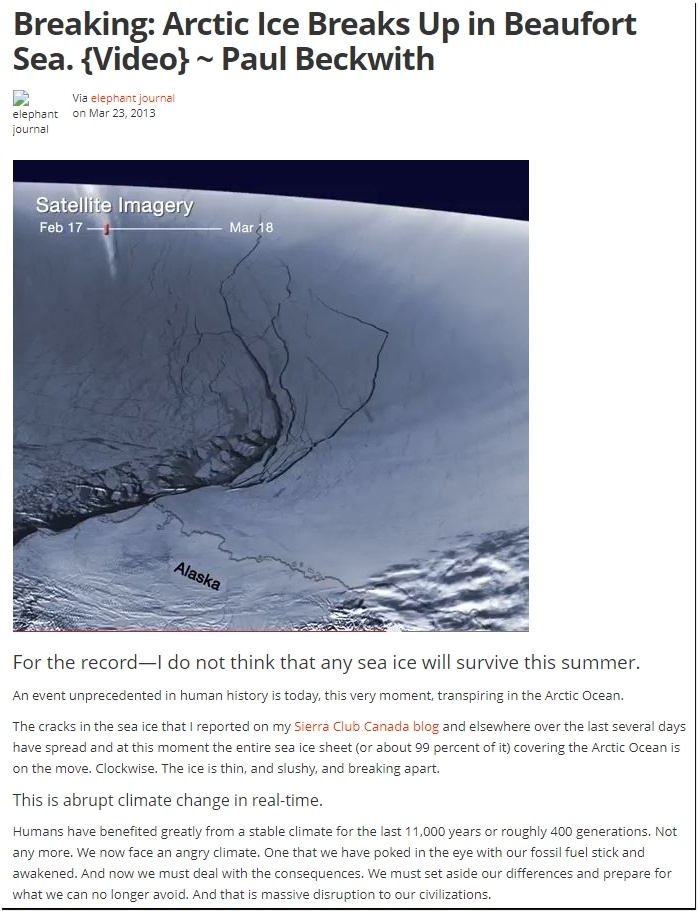
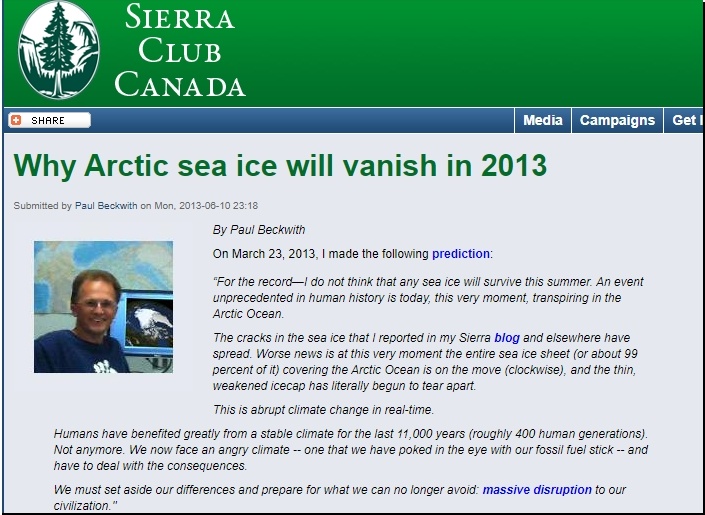
The Sierra Club said Arctic sea ice would disappear in 2013, after 11,000 years of a stable climate

“Humans have benefited greatly from a stable climate for the last 11,000 years or roughly 400 generations. Not any more. We now face an angry climate. One that we have poked in the eye with our fossil fuel stick and awakened. And now we must deal with the consequences. We must set aside our differences and prepare for what we can no longer avoid. And that is massive disruption to our civilizations.”

Breaking: Arctic Ice Breaks Up in Beaufort Sea. ~ Paul Beckwith | elephant journal

Why Arctic sea ice will vanish in 2013 | Sierra Club Canada

via Real Climate Science

https://ift.tt/jS9syqc

September 10, 2023 at 01:59AM