London, 28 September – A new paper from the Net Zero Watch demonstrates conclusively renewables increase electricity bills — indeed, it is almost impossible that adding a new windfarm to the grid would ever reduce consumer prices.
The author of the paper, Net Zero Watch director Andrew Montford, outlines a series of effects that a new windfarm will have on bills, showing that in each case households will take a financial hit. As Mr Montford explains:
"In order to reduce bills, a new generator generally has to force an old one to leave the electricity market — otherwise there are two sets of costs to cover. But with wind power, you can’t let anything leave the market, because one day there might be no wind." But as well as adding excess capacity to the grid, renewables also have a series of other effects, each of which will push bills up further. Mr Montford says: "Renewables need subsidies, they cause inefficiency, they require new grid balancing services that need to be paid for; the list of all the different effects is surprisingly long. There is only one way a windfarm will push your power bills, and that’s upwards."
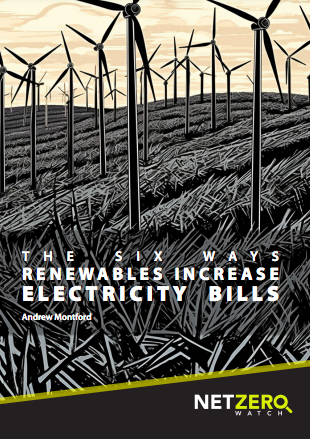
The paper is entitled The Six Ways Renewables Increase Electricity Bills. It is available in plain text below, or can be downloaded as a PDF by clicking on the cover image.
Storm Agnes is yet another one that failed to live up to the hyperbole beforehand, with the media publishing all sorts of bloodcurdling nonsense, fanned by the Met Office warnings. The Express, for instance:
The media, of course, loves all of this, because it attracts readers’ attention, but you cannot blame them when the Met Office has been equally guilty of fanning the flames:
“Personally , I’ve now reached a point where I believe breaking the law for the climate is the ethically responsible thing to do.” (- Chris Packham, UK Wildlife TV presenter & conservationist)
Andrew Griffiths and Verel Rodrigues, UK climate activists, refuse to question climate alarm and forced energy transformation. They are frustrated despite major (anti-commoner) government intervention for not doing enough. And this in a country that produces about one percent of global GHG emissions.
Instead of checking their premises, Griffiths and Rodrigues (and others) want to double down. So what is the floor on despair–when you “hit bottom” in the vernacular of addiction? Is it open-ended violence?!
Watching this eco documentary just after watching Rishi Sunak’s roll back on climate policies genuinely restored hope that there is a significant shift coming. I am grateful for Chris Packham showing leadership and pledging full support to those who break the law for climate.
Documentary presenters don’t usually make a virtue out of bewilderment, but these are confounding, confusing times. Chris Packham: Is It Time to Break the Law? – an extraordinary, anguished think piece – opens with an audio montage of Packham’s desperate thoughts about the climate crisis, arranged so they chaotically overlap. This chattering inner monologue is accompanied by the unforgettable sight of the presenter’s face slowly being smothered in thick, black crude oil.
OK, the “oil” is probably treacle, but Packham’s film does involve the idea of putting his own safety and future on the line. It is beyond merely thought provoking: it follows him as he deals with a profound dilemma about how to live his life, and what that life is for, and it tells us that this is a decision we at home must also now make. The climate apocalypse is here and, despite fires and floods around the world, there is still – maddeningly – little sign of the change needed to avert the deeper catastrophe that is coming. Voting hasn’t worked. Peaceful protest hasn’t worked. Rational debate hasn’t worked. What now?
Bring on the violence, the article and its subject continues:
Packham, however, is deeply sympathetic towards the ordinary people who have become some of Britain’s most hardline climate activists, via actions organized by the guerrilla pressure group Just Stop Oil. … Packham opines that society ought to feel shame at putting principled people behind high walls and razor wire.
But the risks these pioneers are willing to brave are not confined to retaliation by the state. Viral clips of the actions of Just Stop Oil increasingly feature members of the public taking grim pleasure in reacting with violence, from shoving activists out of the road to driving heavy goods vehicles at them. Packham states that those people have been riled up by “the rightwing media”, referring to a Mail Online article in which Just Stop Oil activists are called “zealots” who have formed a “mob”.
Knowing what is at stake, Packham is still inclined towards extreme measures – not just approving of them, but participating in them himself…. Self-confessedly lost and uncertain, he seeks further counsel. He meets the Swedish ecology professor Andreas Malm, whose book How to Blow Up a Pipeline is worth the publishing deal just for the title. Malm stresses that he doesn’t mean literally blowing things up. Well, not necessarily. But he does advocate sabotaging pipelines or other fossil-fuel infrastructure….
In the end, Packham does not make TV history by publicly announcing his intention to commit an imprisonable offence, though he does reiterate his support for climate activists who cross that line. There is one obvious reason to hope he doesn’t get himself sent to jail: it would stop him making programmes as honest, as challenging and as urgently relevant as this.
Reaction on LinkedIn
Verel’s post seconding Packham got a cool reaction. Stated the self-described “Social Entrepreneur, UN Award Recipient, Inventor, Vegan” Theo Cosmora:
Instead of spending hours sitting in the middle of the road stopping others’ important travel, which may well include someone reaching hospital in time for an urgent operation or giving birth, spend the time and resources raising money for and deploying one of these in permitted river locations around the country to deliver clean very low cost 24/7 energy to local communities nationwide.
It’s important to understand that the solutions to all are problems are already here, but they are being delayed by lack of awareness, lack of funding, and delay tactics by the fossil fuel industry. The most important thing is social change. How do we change ourselves if we are not aware of how pressing the issues we face are? Most of the population is just trying to survive, they don’t have the mental capacity to think about how climate change is going to affect them 10 years down the line.
Assuming that technology is going to fix all of our problems without fixing ourselves, is only going to create more problems. It’s a deadly cycle. Worth reflecting on this for a few days
They don’t have the mental capacity. Well, that pretty much says in all about you, does it not? We know, you are special, you are mentally capable. We bow down to your genius.
Given that you are already committed to that reality, you are not open to reason, logic, or fact based-dialog. In other words, your mind is closed and you have moved on to justifying violence in the name of the “greater good.” That makes you no better to the millions who have come before you. They all thought they were right as well.
Verel: For goodness sakes, check your premises. Don’t assume, study. Human betterment is just the opposite of what you are proposing as the God in the Machine. “The road to hell is paved with good intentions.”
Yes – there are times when governments pass laws that go against basic morality and those with morals should disobey. However regarding the use of energy to live that some say will bring disaster sometime in the future is hardly a moral imperative. Especially in light of the ongoing debate by good and honest skeptics. It is in fact immoral to silence those who may in fact be right.
But Verel might be beyond saving. He has a religion, the Church of Climate. As he commented to one critic:
I don’t see sitting in the road to raise awareness about how climate change is going to kill so many people across the world as violent. Allowing and being complicit with climate change to killing millions of people is not moral, and I support those who are doing their best to raise awareness about this crisis in whatever way they can, as long as they are not violent.
A new paper from the Net Zero Watch demonstrates conclusively renewables increase electricity bills — indeed, it is almost impossible that adding a new windfarm to the grid would ever reduce consumer prices.
The author of the paper, Net Zero Watch director Andrew Montford, outlines a series of effects that a new windfarm will have on bills, showing that in each case households will take a financial hit. As Mr Montford explains:
In order to reduce bills, a new generator generally has to force an old one to leave the electricity market — otherwise there are two sets of costs to cover. But with wind power, you can’t let anything leave the market, because one day there might be no wind.
But as well as adding excess capacity to the grid, renewables also have a series of other effects, each of which will push bills up further. Mr Montford says:
Renewables need subsidies, they cause inefficiency, they require new grid balancing services that need to be paid for; the list of all the different effects is surprisingly long. There is only one way a windfarm will push your power bills, and that’s upwards.
The paper is entitled The Six Ways Renewables Increase Electricity Bills. It is available in plain text below, or can be downloaded as a PDF by clicking on the cover image.
Full text
Introduction
There are many misconceptions about how electricity bills are affected by new generation capacity, and in particular by new windfarm capacity. Here I break down the main effects. To illustrate them, I will first look at a simple example of a ‘dash for gas’ in a fossil-fuel powered grid. Then I move on to look at the more complex case of a ‘dash for wind’ in a grid powered by gas and renewables. In both cases, the grid I describe is much simpler than the real one, so I close by considering whether what I describe is correct in practice.
Costs and markets
The electricity market tends to favour generators with lower fuel* costs: the ones with the lowest fuel costs always run, ones with intermediate costs run some of the time, and ones with high costs only get to run occasionally (this is called the ‘merit order’). However, it is important to understand that, no matter what its fuel cost, a generator still needs to cover all its costs (i.e. including capital and maintenance).
Some can earn enough in the marketplace to do this, but others can’t. How it works is all bound up in the way the market works, and the fact that electricity is a commodity; in other words, everybody in the marketplace is selling the same thing.
A concrete example should make it all clear. Let us look at a grid running wholly on gas- and coal-fired power stations, and assume that gas has lower fuel costs and thus runs preferentially.† When demand is sufficient to require both gas and some coal-fired units to run, the gas-fired units do not sell at a lower price, despite their lower fuel cost. Instead, they sell at the higher price demanded by coal-fired units – they are all selling megawatt hours, after all.
As a result, the wholesale market price for electricity tends to settle at around the fuel cost of the coal-fired units (we say the market price is ‘set’ by coal).
The market price varies though. At times of high demand, older coal-fired units will have to be fired up. Because these are inefficient, and also because they get to run comparatively rarely, they have high fuel costs and high total costs. But when they are called upon, they are indispensable, and they can demand very high payments. Since everyone in the market can see this coming, they all bid at the same prices they expect the old coal-fired station to get, and the market clears at a commensurately higher price. Consumers carry the cost.
Being able to charge those higher prices enables the gas-fired units to earn enough money to pay for their capital and maintenance costs as well as their fuel. However, this is not an option for the coal-fired units (or perhaps just the least efficient ones), which will therefore require a subsidy to keep them in the market.
A dash for gas
Now consider what happens when you add to the generation mix a new, lower-cost source of generation, such as a state-of-the-art gas-fired power station. How will market prices change?
It’s important to note that there is no direct effect, because market prices are set by coal. However, there are many indirect effects.
Firstly, the coal-fired power stations all get to run less often. This will increase their fuel costs somewhat, since they will use coal less efficiently if they are switching on and off more often. So, counterintuitively, one effect of adding new, lower cost generation (in this case a new gas-fired unit) to the generation mix may be to increase market prices,‡ and thus the amount that consumers have to pay to every generator on the grid. In addition, since some of their costs are fixed (in other words they are unaltered by output changes – the obvious example being depreciation), their total costs per megawatt hour, and thus the price they need to achieve in the marketplace, increase even further. One way or another, consumers have to pay this too. We’ll call this the inefficiency effect.
It is possible that the least efficient coal-fired power station will decide that a reduction in operating hours is intolerable, and it will decide to shut up shop. If that happens, market prices going forward may well be set by a somewhat more efficient coal-fired power plant, thus tending to push market prices down again. We’ll call this the displacement effect.
However, grid managers may decide that these units are indispensible for dealing with periods of very high demand. They will therefore offer them a financial bung to make them stay around. We’ll come back to this subsidy, which we’ll refer to as the capacity market effect (after the mechanism currently used to deliver it).
If more and more gas-fired power stations are added, these effects will continue in tandem. However, eventually, there will be some periods of low demand when no coal-fired units are required at all. When that happens, the wholesale market price will no longer be set by coal, but by gas. This will cause a sharp drop in prices, which will then feed through to consumers. As more and more gas-fired units come on stream, average market prices steadily decline.
Thus dashing from coal to gas will eventually make consumers better off.
A dash for wind
When the new generation capacity is wind rather than gas, things are rather different. Imagine a grid that is a mixture of gas-fired power stations and windfarms – much like the one in the UK today – to which a new, state-of-the-art windfarm is added.
As in the previous example, the fuel costs of the new generator are lower (for wind they are zero!); in other words, wind will run in preference to gas. However, because of their very high capital costs and low output, wind’s total costs are – except in exceptional circumstances – so high that there is no possibility of them being earned back through selling electricity.§ As a result, subsidies will be necessary to get the windfarm built. These subsidies – the Renewables Obligation and Contracts for Difference (CfDs) – are levied on electricity suppliers and thus directly exert upward pressure on consumer bills (that is, outside the wholesale market). We’ll call this the levy effect.
Once it is operational, the windfarm produces effects that are similar to those seen in the dash for gas. For example, the inefficiency effect is still in play: each new windfarm will reduce the efficiency of the gas-fired power stations, thus pushing market prices upwards.
Similarly, the displacement effect will still be in operation too, with older, less efficient power stations eventually nudged out of the marketplace, and the market price thus tending to be pushed down again. However, this time there is a crucial difference. Because the wind turbines are intermittent, they are not a direct replacement for gas-fired power stations. If, say, we replace a 1-GW gas-fired unit with three 1-GW windfarms, delivering on average 33% of their nameplate capacity, the annual output is theoretically the same. But 33% is the average; at times, the windfarms will deliver nothing at all.¶ As a result, we still need that 1-GW gas-fired unit; if it has left the marketplace, we may sometimes be left with a catastrophic shortfall in supply. Thus, when renewables are involved, it becomes much more important not to let old, inefficient generators leave the marketplace; the capacity market effect will be seen to a much greater degree, and there will be little or no relief from the displacement effect. Consumers carry the cost of ensuring this back-up generation remains in place.
If we go on adding windfarms to the grid, there will eventually be periods of low demand and/or high wind generation in which the gas-fired power stations are no longer required to run. At these times, the market price will be set by the fuel cost of a wind farm. Since this is zero, the market price will drop to approximately zero too. (Such very low prices are already seen occasionally on the UK grid). In fact, windfarms in the Renewables Obligation can bid negative prices into the market because they will still receive generous subsidies on top of whatever they are paid for power. However, windfarms in the CfD regime have different concerns. CfDs essentially give generators an agreed fixed price, typically above market prices. However, the rules state that this top-up is only paid when the market price is not negative. Thus CfD windfarms will bid into the market just above zero, and this is the likely to be the price at which the market clears. They then receive a large top-up to take them back to where they expected to be. In other words, there is no gain to consumers – the low price inside the wholesale market is completely cancelled out by the high subsidy levied outside it. On the other hand, the Renewables Obligation units will take a (possibly large) reduction in income. This means a gain to consumers, at least in the short term. However, assuming the level of the Renewables Obligation is no higher than required to make these windfarms competitive, they will have to counterbalance periods of below-average prices with periods of above-average prices in order to make the necessary returns. Thus there may be no gain to consumers at all.
There are other effects arising from windfarms’ intermittency too. The Balancing Mechanism is the grid’s process for ensuring that the electricity system remains stable. The costs of fixing any imbalances between supply and demand are passed on to electricity system users. The best known of these costs are constraints payments, which are incurred when windfarms in far-flung locations cannot get their power to market due to limitations in grid capacity. In these circumstances, they are paid to switch off, and another generator (typically a gas-fired power station) located closer to the consumer is paid to switch on to ensure the windfarm’s customer gets their required power.
The grid has also had to introduce a new service in response to the growth of wind power. Gas-fired power stations naturally stabilise the grid (providing so-called ‘inertia’); a fault in one place tends to propagate slowly across the network, giving managers time to respond. However, windfarms have no inertia, and faults can therefore propagate almost instantaneously, threatening major blackouts. In order to mitigate this risk, the grid pays for artificial inertia, typically in the form of flywheels and batteries. In other words, a service once provided for free by gas-fired power stations is now a further burden on consumer bills.
Finally, because windfarms tend to be built far from centres of demand (in the ocean, and in remote highland areas), they bring with them the necessity for major upgrades to the transmission grid. The costs of what we can call the transmission effect are charged to users of the grid, ultimately raising consumer bills still further.
Summary
In summary, adding a windfarm to the grid increases costs to consumers in no fewer than six ways:
The inefficiency effect
The capacity market effect
The levy effect
Constraints payments
Artificial inertia
The transmission effect
Only the displacement effect could theoretically reduce costs to consumers, but in practice this is likely to be zero, because of the urgent need to keep gas-fired power stations on the grid.
In summary, it seems implausible that windfarms will ever reduce costs.
Table 1 gives indicative costs for each effect, suggesting a total of £24.5 billion, or around £850 per household per year. Approximately half of this will be experienced as increases in household bills, and the rest as increases in the general cost of living.
Table 1: Annual effect of renewables on consumer bills
Annual cost
Total
Per household
£billion
£
Inefficiency
10.0
370
Capacity market
1.0
37
Levies
8.4
311
Constraints
1.0
37
Artificial inertia and other balancing
1.5
56
Transmission
1.0
37
22.9
848
Caveat
When I began, I observed that my examples described grids that were simpler than the real one. In particular, I looked at grids with centralised dispatch based on the different bids from generators. The reality of the UK market is rather different, with only a fraction of total electricity traded on the open market; most is delivered under the terms of private ‘power purchase agreements’, and generators tend to ‘self-dispatch’. However, this may make little difference to my conclusions. Most of the effects outlined above are a function of physical and engineering constraints rather than of market structures. Differences are therefore likely to be of degree.
* Strictly, it is lower marginal costs, which includes some other cost elements, but it’s mostly fuel.
† In the real world, carbon prices change the equation considerably, but we’ll leave that complication out here.
‡ If it pushes a high-cost generator off the grid completely, it may decrease the cost. See discussion of the displacement effect below.
§ This has always been the case, although the opposite was true for a short period at the start of the Ukraine war.
¶ On Friday 8 October 2023 at 2pm, the UK’s 14000 MW of offshore windfarms were delivering 36 MW of power to the grid.




 Iowa Climate Science Education