
The giant, empty caverns known as the Strategic Petroleum Reserve are empty.
The post The cavernous hole in American energy policy appeared first on CFACT.
via CFACT
September 4, 2023 at 11:09AM
The giant, empty caverns known as the Strategic Petroleum Reserve are empty.
The post The cavernous hole in American energy policy appeared first on CFACT.
via CFACT
September 4, 2023 at 11:09AM
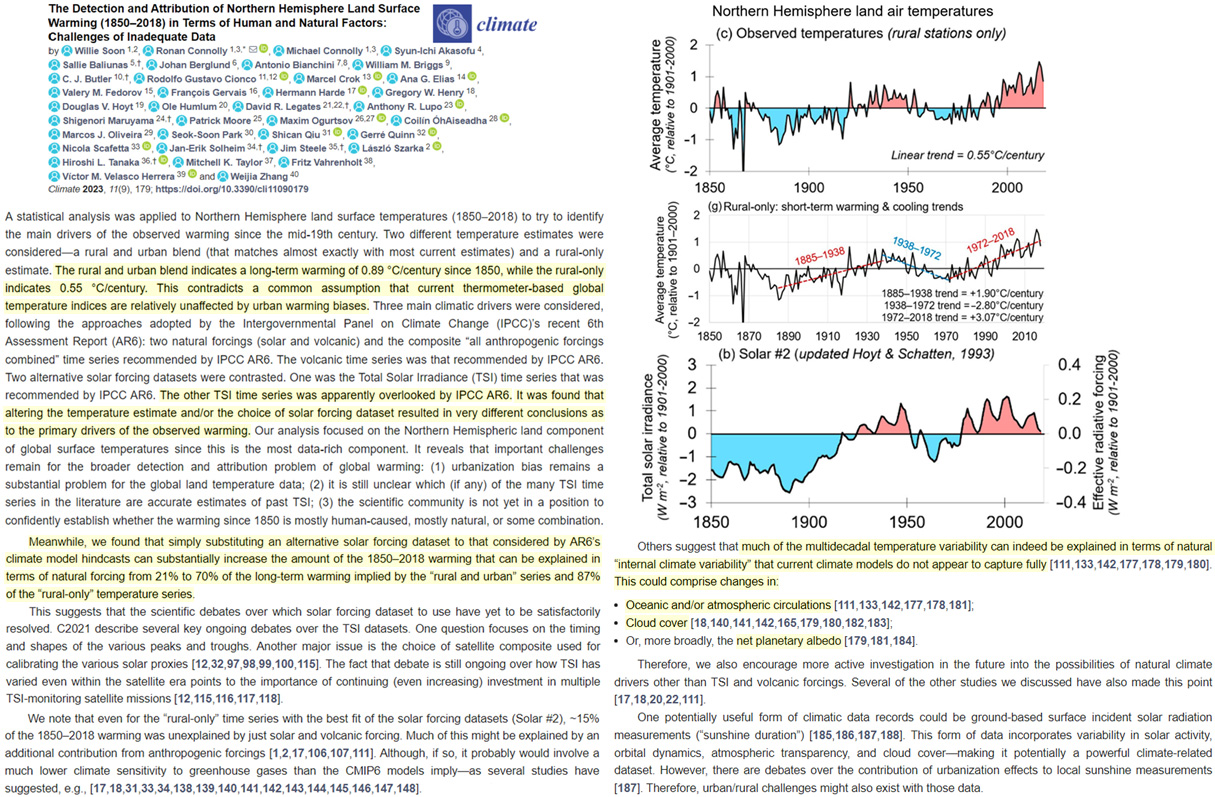
A new study authored by 37 scientists in the journal Climate finds using rural-only Northern Hemisphere temperature data (i.e., removing artificial, non-climatic urban heat effects) reduces the post-1850 warming trend from 0.89°C per century to 0.55°C per century.
Further, using a total solar irradiance (TSI) dataset neglected by the IPCC (Hoyt and Schatten, 1993, updated to present) allows TSI to explain up to 87% of modern warming.
Variations in cloud cover, albedo, and natural ocean circulations may also be factors arising from internal climate variability that could explain modern climate changes.
In summary, then, much of modern global warming’s alleged link to human activity may have been formulated by selecting data that align with the hypothesis, and neglecting or dismissing data which do not.
via NoTricksZone
September 4, 2023 at 09:53AM
By Paul Homewood

London, 4 September
Onshore wind policy is “lose, lose, lose” for Rishi Sunak
Net Zero Watch says that the Government is incapable of a coherent climate policy. Ministers have announced on the one hand that Rishi Sunak will stand up to climate advisers over airport expansion, and on the other hand that he will cave in to their demands and relax the rules over new onshore windfarms.
Speaking to Julia Hartley-Brewer on TalkTV, Net Zero Watch Head of Policy, Harry Wilkinson, said:
"You have quite a large number of Tory MPs who have been asking [for more onshore wind] for some time, because they don’t understand the fundamental energy issues at play. There is just a difference of opinion in the Conservative Party on this topic which Rishi Sunak has been trying to balance…What we need is leadership from the Prime Minister."
And the campaigning group warned that the Conservatives would pay a heavy electoral price if the onshore windfleet expands in the way climate campaigners want, with many rural voters strongly opposed to turbines and the pylons required to bring their power to market, and the public at large facing increased energy bills at a time when they are already hard pressed.
Net Zero Watch director Andrew Montford said:
"Every time a new windfarm comes on stream, we have to fork out subsidies, wholesale prices are pushed up, our bill for switching off windfarms increases, and we need to buy more grid balancing services. It’s a lose, lose, lose, lose situation for the consumer, so it’s hardly going to be a win for the Government."
via NOT A LOT OF PEOPLE KNOW THAT
September 4, 2023 at 08:27AM
In the vast landscape of climate discourse, few articles stand out as starkly as Susannah Crockford’s piece titled “That Which They Will Not See: Climate Denial as a Vector of Epistemological Crisis in the Contemporary United States”. At first glance, the article promises an in-depth exploration of the cultural epistemology of climate denial in the US, particularly in the southern states. However, a closer examination reveals a piece riddled with constructed narratives that seem more intent on smearing a broad group of people than offering a genuine understanding of their perspectives.
“Climate denial continues as a cultural epistemology for anthropogenic climate change in the United States, despite worsening impacts.”
From the outset, the framing of climate skepticism as “denial” is problematic. This term inherently dismisses any counter-arguments and paints a vast group with a broad brush, without delving into the complexities of their beliefs. The use of the term “denial” is a classic rhetorical move, designed to equate skepticism about certain aspects of climate science with the denial of undeniable historical events, such as the Holocaust. This is not just misleading but intellectually dishonest.
“Engaging with the literature on agnotology, the social construction of ignorance, the argument is made that this literature as it pertains to climate denial does not go far enough in accounting for the persistence of the rejection of climate science.”
Here, Crockford insinuates that those skeptical of mainstream climate narratives are merely ignorant. But what if they’re informed by a different set of data, experiences, or perspectives that the mainstream has overlooked or intentionally suppressed? By leaning on the concept of agnotology, the article conveniently sidesteps the possibility that there might be legitimate reasons for skepticism, painting it instead as a mere product of ignorance.
“Theoretically drawing from anthropological work on the incommensurability of paradigms, the argument is based on a tripartite construction of denial as produced through an interaction of a cultural norm of radical empiricism, a political-media ecosystem funded by fossil fuel companies, and a cosmological schema derived from conservative white evangelicalism.”
This tripartite construction is a glaring example of the article’s flawed approach. By attributing skepticism solely to these three factors, Crockford ignores a myriad of other potential reasons for differing viewpoints and perpetuates a false narrative. It’s a reductionist approach that doesn’t account for the vast complexities of human belief and understanding.
“Francis Beer and Robert Hariman (\nCitation2020\n: 20) argue that the Covid-19 pandemic exposed an epistemological crisis of stark knowledge disparities between vernacular and scientific explanations of causality and solutions.”
Drawing parallels between the Covid-19 pandemic and climate change might seem like a stretch, but there’s a strong element of truth her. It’s just the opposite of what Crockford concludes. In both cases, ideologically captured institutions, academia, and media have marched in lockstep to force approved narratives and suppress and censor unapproved ones. The “epistemological crisis” isn’t just about knowledge disparities but about the suppression of dissenting voices and the dangers of echo chambers.
“I situate this reframing in conversation with anthropological work on white evangelical Protestants, a group associated in particular with climate denial, either through opposition to secular culture or end-times chronotope.”
This is perhaps the most egregious part of the article. By singling out white evangelical Protestants, Crockford engages in a baseless smear campaign, suggesting that this group is the primary driver of climate skepticism without any substantial evidence. It’s a classic case of scapegoating, diverting attention from the real issues at hand.
In sum, Crockford’s article is a glaring example of the very epistemological bubble it purports to critique. By constructing false narratives and failing to genuinely engage with the complexities of climate skepticism, it continues the path of polarization and othering.
Articles such as this are simply expressions of frustration that those ignorant savages just won’t listen to reason. It’s a frustration borne of moral narcissism and unwavering obeisance to expertocracy. The epistemological crisis occurring is one of a failing expertocracy forcing its viewpoints and worldviews through an onslaught of propaganda and censorship on a populace that can see the contradictions and flaws in those viewpoints.
Source: https://www.tandfonline.com/doi/full/10.1080/00141844.2023.2242599
via Watts Up With That?
September 4, 2023 at 08:04AM
 Iowa Climate Science Education